Try it on your room

Nothing dates a room faster than a row of flat, builder-grade white hollow doors. They blend into the trim, the walls, and each other until the whole hallway reads as one beige blur. Painting those interior doors black is the cheapest high-impact upgrade in the house: a quart of paint and a weekend turns a forgettable door into the thing every visitor comments on. This is a painting interior doors black before and after gallery, not a tutorial. The goal here is to show you what the swap actually does to different rooms, which black to reach for, and how to see the result on your own door before you commit.
If you want the step-by-step (sanding, deglossing, spray versus brush, drying times), our how to paint interior doors, trim and baseboards guide covers the mechanics. This page is about the decision: is black right for your room, and what will it look like?
Upload a picture of your door and preview it in black in about 30 seconds, before you buy a single can.
What black doors actually do to a room (the before and after)
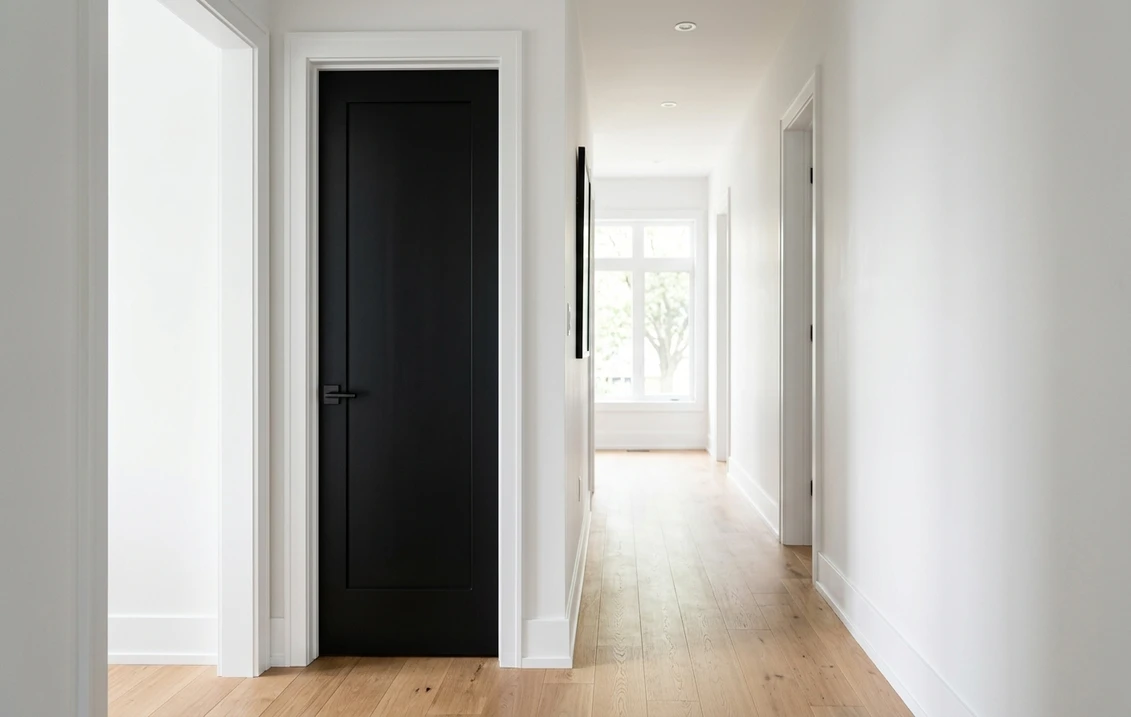
The transformation is mostly about contrast and framing. A white door on a white wall has nowhere to land for the eye. Switch it to black and you suddenly have a deliberate frame: the door reads as architecture, the trim around it pops, and the wall color looks more intentional. Designers borrow the trick from steel-frame "Crittall" windows, where the dark line does the visual work. Here is what tends to happen in each room, based on the before-and-after pattern we see most:
| Before | After (black door) | Net effect |
|---|---|---|
| White hollow door, white trim, greige wall | Matte black door, white trim kept | High-contrast modern frame; the cheapest "expensive" look |
| Honey-oak 1990s door, oak trim | Soft black door, trim painted white | Instantly de-dates the room; reads transitional, not dated |
| Flat closet doors blending into the wall | Black doors as a graphic accent | Turns dead wall space into a design feature |
| Dark hallway, white everything | Black doors, walls a step warmer | Adds depth and intention; the hall feels designed, not leftover |
Try it on your house
No photo? Try a sample
The biggest "wow" before-and-after is almost always the old honey-oak six-panel door. The grooves and panels catch the black beautifully, the shadow lines deepen, and a $40 makeover does what a $400 slab replacement would. The least dramatic? A flush flat door in a tiny, windowless room, where black can close the space in instead of framing it.
Which black to pick (they are not all the same)
"Black" is a range, not a single color, and the wrong one is the difference between "soft and architectural" and "harsh hole in the wall." The four most popular interior door blacks in the US:
- Benjamin Moore Black (2132-10): a true, deep, neutral black. The safest pick when you want unmistakable black with no color games. Reads crisp and modern.
- Sherwin-Williams Tricorn Black (SW 6258): the most popular soft black in the country. A hair warmer and softer than a pure black, it forgives uneven light and never looks like a void.
- Benjamin Moore Onyx (2133-10): a soft black with the faintest blue-gray lean, gorgeous in cool, north-facing light where a warm black can go muddy.
- Benjamin Moore Soot (2129-20): technically a very dark charcoal. Choose it if true black feels too stark; it gives the same effect with a touch more give in dim rooms.
Finish matters as much as the color. A satin or eggshell sheen is the modern default: it shows the panel detail, hides minor brush marks, and wipes clean of fingerprints. High-gloss black is striking but unforgiving, every dust mote and roller mark shows, so save it for a single statement entry door, not a whole hallway. Still deciding between warm and cool blacks? Our interior paint color families guide explains how undertones behave once they hit a wall.
Preview a warm soft black and a true black side by side on your actual door, free.
Black doors by room: where the after really lands
Hallways and entries
This is black doors' home turf. A long hall with three or four matching black doors becomes a rhythm of dark frames against light walls, reading like a boutique hotel corridor. The before is forgettable; the after is the photo people stop on. Keep the trim white or cream for maximum contrast, or paint the trim black too for a bolder, fully framed look.
Bedrooms and offices
A single black door anchors a room without committing the whole space to dark color. Pair it with warm white walls and natural wood furniture and it reads calm and grounded rather than heavy. In a home office, a black door behind the desk makes a clean backdrop for video calls.
Closets and laundry
Bifold and flat closet doors are the best low-risk place to start. They are small, easy to remove and lay flat, and the graphic before-and-after of black panels on a light wall is immediate. Many people test black here first, like the result, then do the rest of the floor.
Open-plan and modern spaces
Black doors tie into the matte-black hardware, light fixtures, and window frames that define current interiors. If you are already running black faucets and pulls, black doors complete the thread. To plan how the doors sit inside the wider palette, our interior color schemes guide shows how to pair a dark architectural element with wall and trim colors that support it.
When black doors go wrong (the bad after)
The before-and-after only flatters when a few things line up. The failures are predictable:
- Tiny, windowless rooms. Black absorbs light. In a small powder room with no daylight, a black door can make the space feel like a closet. Use it where there is at least some natural or layered light.
- No contrast around it. A black door on a dark gray wall with dark floors disappears into a murky blob. The magic is contrast; give the door a lighter wall or trim to frame against.
- One lonely door. A single black door in a sea of white doors can look like a mistake rather than a choice. Either commit to all the doors on that floor, or pick one clearly intentional statement door (front of a study, pantry).
- Skipping prep. Black shows every flaw. Glossy old doors that were not sanded or deglossed will peel, and dust under satin black is obvious. The flawless after depends on the boring prep step.
If you love the dark-frame look but the door alone feels timid, an accent wall behind it can carry the drama instead. Our accent wall color strategy covers how to place a single bold surface so it reads as design, not accident, and the same logic applies to choosing which doors go black.
Preview your before and after first
The honest catch with any before-and-after gallery is that it is someone else's house, someone else's light, someone else's wall color. Black behaves differently against your specific trim and the daylight in your hallway. The fastest way to know whether the upgrade lands in your space is to make the before-and-after yourself:
- Take the "before" photo straight on, in normal daytime light, with the door fully in frame.
- Generate the "after" by previewing the door in a soft black and a true black so you can see which one suits your light.
- Check it against the trim and wall you actually have, not a staged showroom, so the contrast call is real.
That is exactly what our interior paint visualizer does: upload your door, see it rendered in black on your own photo, and decide before you sand anything. It will not replace a real paint sample for the final shade, but it rules out the directions you would have regretted in seconds. For the broader menu of door, trim, and surface methods, see our specialty surface painting guide.
One HD preview plus three variations free. See black on your door before you buy paint.
Frequently asked questions
Do black interior doors make a room look smaller?
Not when there is contrast and light. Black absorbs light, so in a tiny windowless room a black door can feel closing-in. But in a normal room with light walls and some daylight, the door reads as a crisp frame and actually makes the space feel more intentional and larger, because the eye registers the architecture. The trap is a black door on dark walls with no contrast.
What is the best black paint for interior doors?
Benjamin Moore Black (2132-10) is the safe true black, and Sherwin-Williams Tricorn Black (SW 6258) is the most popular soft black, slightly warmer and more forgiving. For cool north light, Benjamin Moore Onyx leans faintly blue-gray, and Soot is a near-black charcoal if true black feels too stark. Use a satin or eggshell finish for door panels; it shows detail and hides fingerprints.
Should I paint just one door black or all of them?
Either works, but be deliberate. A single black door only looks intentional if it is a clear statement (a study, pantry, or front-facing door). One random black door among white ones can read like a mistake. The strongest before-and-after is usually all the doors on a floor or hallway painted black together, which creates a designed rhythm.
Can I preview black doors before I paint?
Yes. Upload a photo of your door to the FacadeColorizer interior paint visualizer and see it rendered in black on your own image, so you can judge the contrast against your real wall and trim. You get one HD preview plus three variations free. It is an AI preview to narrow the decision, not a substitute for a final physical paint sample.
See the after before you commit to the prep work.
Disclaimer: Benjamin Moore, Black 2132-10, Onyx 2133-10, and Soot 2129-20 are trademarks of Benjamin Moore & Co. Sherwin-Williams and Tricorn Black SW 6258 are trademarks of The Sherwin-Williams Company. FacadeColorizer is an independent paint visualization service, not affiliated with or endorsed by Benjamin Moore or Sherwin-Williams. On-screen color approximates the manufacturer's chip and varies with your display, lighting, and surface; always confirm with a physical paint sample before committing. Sources: Benjamin Moore 2132-10, 2133-10, and 2129-20 technical data 2026; Sherwin-Williams SW 6258 technical data 2026.
Trademarks mentioned (Sherwin-Williams, Benjamin Moore, Behr, Caparol, Brillux, Sto, Alpina, Valspar, PPG, Glidden, Dulux, Crown Trade, Sandtex, Farrow & Ball, Johnstone's, Leyland) are property of their respective owners. FacadeColorizer is independent and not affiliated with any of them. Nominative fair use under Lanham Act §1125.