Try it on your room

Quick answer: A painted brick fireplace works when you pick a color with a job to do (a warm white to lift a dark room, a soft black to anchor it, a mid-gray to blend it into the wall) and when you treat the brick like the masonry it is: clean off the soot, prime with a stain-blocking masonry primer, then two coats of 100 percent acrylic latex in eggshell or satin. The surround stays well under 200 degrees Fahrenheit, so ordinary interior paint is fine there; the inside of the firebox is not, and needs a high-heat paint rated to at least 1,200 degrees. Painting is permanent in practice, so if you might want the brick back, whitewash or limewash first. Preview any color on a photo of your own fireplace with the free interior paint visualizer before you open a can.
A brick fireplace is usually the largest fixed surface in a living room and the one thing you cannot move. When the brick is orange, dark or simply dated, paint is the fastest way to change how the whole room reads. It is also the least reversible finish you can put on brick, which is why this guide starts with the choice between paint, whitewash and limewash, then gives ten colors that reliably work on a fireplace, and finishes with the prep and product sequence that keeps the paint on masonry for years.
Paint, whitewash or limewash: decide this first
| Finish | Look | Reversible | Pick it when |
|---|---|---|---|
| Solid paint | Opaque, uniform color; texture stays, brick color disappears | No (stripping is slow and costly) | You want one exact color, dark or light, that matches the rest of the room. |
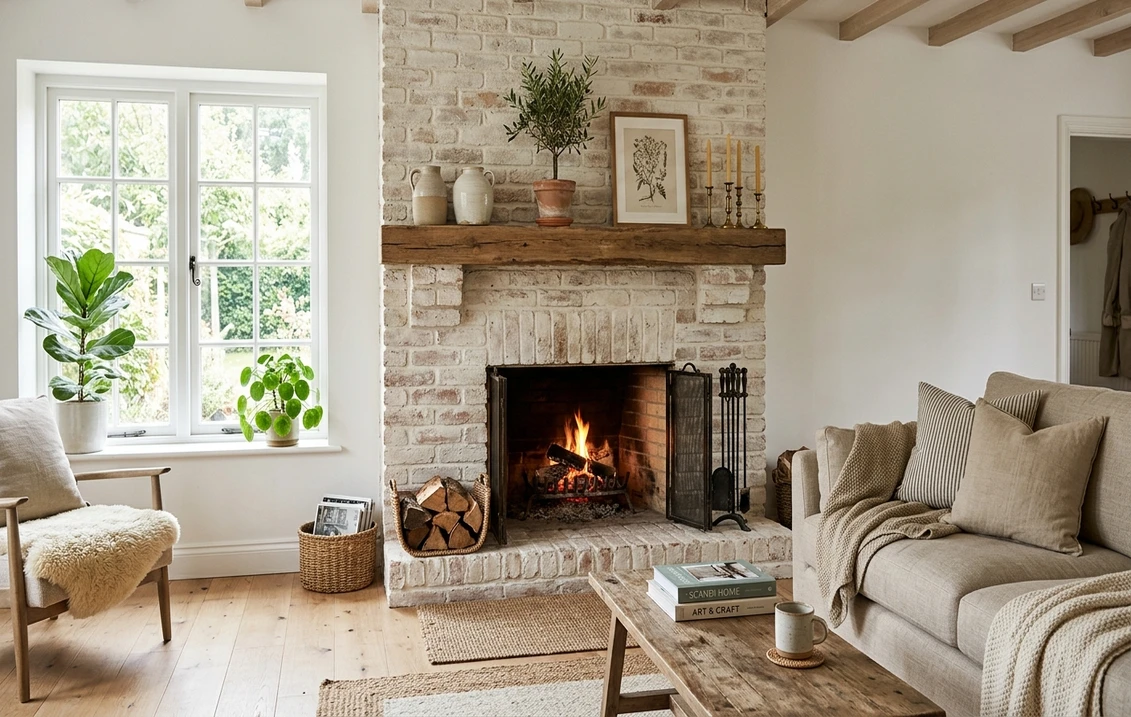
| Whitewash (thinned paint) | Translucent white, brick shows through unevenly | Partly, if wiped early | You like the brick but want it two shades lighter. See the whitewash brick guide. |
| Limewash | Chalky, mottled, mineral; ages with the brick | Yes, for the first days (pressure washes off) | You want a soft, aged European look and a breathable finish. See the limewash brick technique. |
Try it on your room
No photo? Try a sample
The rest of this guide is about solid paint. If you are torn, render both on a photo of the actual fireplace: a solid warm white and a whitewash read very differently on the same brick.
10 painted brick fireplace colors that work
Brick texture changes how a color reads: the mortar lines catch shadow, so every color looks slightly darker and more textured on brick than on a flat wall. Light Reflectance Values below are the manufacturer figures; on a fireplace, expect the result to read a point or two darker.
| Color | Code, LRV | What it does on a fireplace |
|---|---|---|
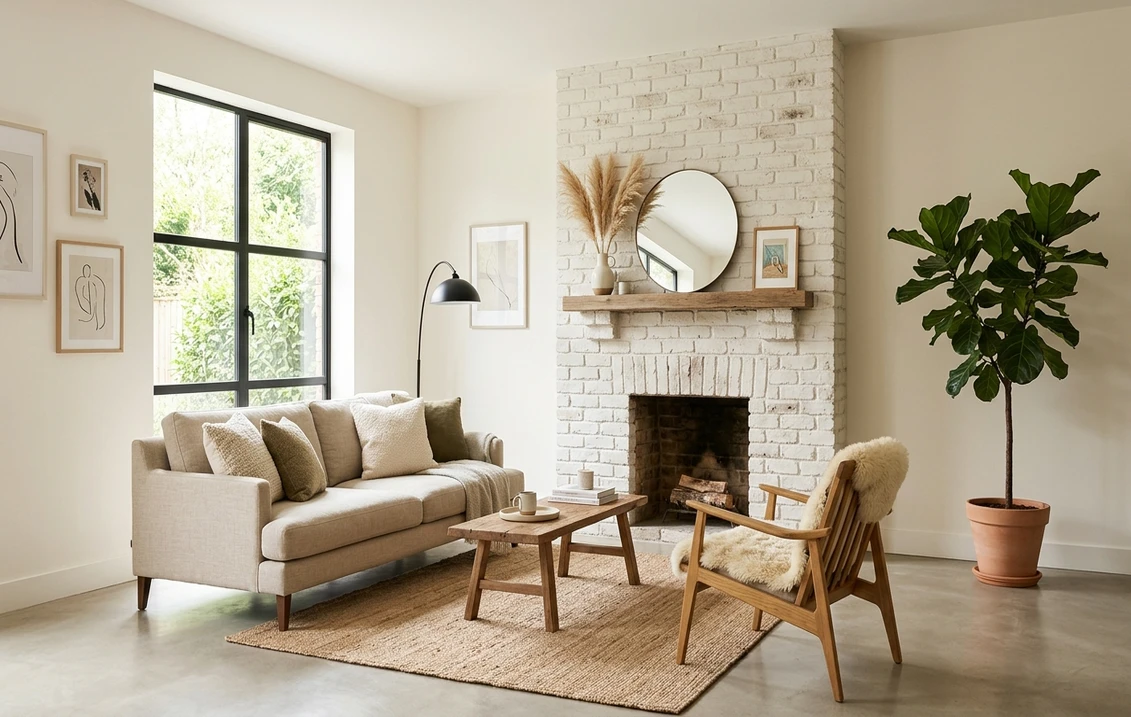
| Alabaster | SW 7008, LRV 82 | The default warm white. Lifts a dark room without the clinical look of a pure white; the mortar shadows keep it from looking flat. |
| White Dove | BM OC-17, LRV 85 | Softer and a touch grayer than Alabaster; the safer pick next to cool gray walls. |
| Greek Villa | SW 7551, LRV 84 | Warm and slightly brighter than Alabaster; good on brick that sits in a dim corner. |
| Pure White | SW 7005, LRV 84 | Neutral white for modern rooms with white trim; can look stark on very rough brick. |
| Snowbound | SW 7004, LRV 83 | Cool-neutral white; pairs with stainless, slate hearths and gray floors. |
| Agreeable Gray | SW 7029, LRV 60 | Greige that blends the fireplace into a greige or white room instead of making it the focal point. |
| Mindful Gray | SW 7016, LRV 48 | Mid-gray that hides soot marks and reads calm; works with a wood mantel. |
| Urbane Bronze | SW 7048, LRV 9 | Warm charcoal-bronze; the darkest color that still feels warm next to wood and brass. |
| Iron Ore | SW 7069, LRV 6 | Soft black that turns the fireplace into a deliberate dark mass; hides every soot mark. |
| Tricorn Black | SW 6258, LRV 3 | True black, sharper than Iron Ore; for modern rooms with white walls and a strong mantel. |
1 free HD render. No sign-up. No card.
Which direction: lighter, darker or blended in
- Lighter than the walls (whites, LRV 80 and up): the classic fix for an orange or dark brown fireplace. The fireplace stays the focal point but stops absorbing the room's light. Pair with a mid-tone wall so the white reads as white, not cream.
- Same value as the walls (Agreeable Gray, Mindful Gray on greige or gray walls): the fireplace disappears into the wall plane and the mantel, art or TV become the focal point. This is the right move when the brick is badly proportioned or the room is small. The fireplace and TV accent wall ideas guide covers the layouts where this works.
- Darker than the walls (Urbane Bronze, Iron Ore, Tricorn Black): the fireplace becomes an anchor. Best in rooms with plenty of daylight and a light wall color; in a dim room a black fireplace can feel like a hole in the wall.
How to paint a brick fireplace so it lasts
Brick is porous, dusty and, on a working fireplace, coated with soot that bleeds through ordinary paint within weeks. The sequence below is the one masonry painters and the Painting Contractors Association standards describe; skipping the primer is the single most common reason a painted fireplace yellows or peels.
- Clean. Vacuum the brick, then scrub with a degreasing cleaner (TSP or a TSP substitute) and a stiff brush. Rinse and let the brick dry fully, at least 24 hours: paint over damp brick blisters.
- Repair. Fill crumbling mortar joints with a mortar repair compound and let it cure. Paint will not bridge a missing joint.
- Mask. Tape the mantel, hearth edge and firebox opening. Brick pulls paint into the joints, so the tape line matters more than on drywall.
- Prime. Use a stain-blocking primer made for masonry. On a fireplace that has burned wood, a shellac-based or oil-based stain blocker stops soot and creosote from bleeding through the finish; on clean, never-used brick, a bonding acrylic masonry primer is enough. Work it into the joints with a brush before rolling the faces.
- Paint. Two coats of 100 percent acrylic latex, interior or masonry grade, in eggshell or satin. Flat shows soot and handprints; semi-gloss exaggerates every irregularity in the brick. A thick-nap roller for the faces, a brush for the joints.
- Let it cure. Latex dries in hours but hardens over days. Avoid a fire for a week so the film reaches full strength before it sees heat.
Heat: what ordinary paint can take and what it cannot
The surround, mantel wall and hearth of a wood-burning or gas fireplace stay far below the limit of interior latex paint, which is generally rated to around 180 to 200 degrees Fahrenheit. The inside of the firebox is a different environment. The steel parts around it (grate, screen, doors, damper frame, the metal surround of an insert) take a high-heat paint rated to 1,200 degrees Fahrenheit, sold as stove or grill paint in matte black and a few dark colors; Rust-Oleum's High Heat Ultra is the common example, and its own label lists fireplace screens and wood stoves as intended uses. The same manufacturer excludes surfaces directly exposed to flame, which is exactly what the firebrick lining is. Leave the firebrick unpainted: no latex, no primer, no enamel and no high-heat paint on the brick that the fire touches. Gas insert fronts and glass frames follow the appliance manufacturer's instructions, not the paint can.
Not sure between a white and a black fireplace?
Upload one photo of the room, set the brick to Alabaster, then to Iron Ore, and compare the two renders on your actual mantel, floor and wall color before you commit to a finish you cannot easily remove.
Preview my fireplace in both colorsMistakes that ruin a painted fireplace
- No stain-blocking primer on a used fireplace: yellow-brown soot bleed through a white finish within a month.
- Painting a sealed or glazed brick without scuffing: the paint sheets off. Test with a drop of water; if it beads, sand lightly and use a bonding primer.
- One heavy coat instead of two thin ones: runs in the joints and a plastic look on the faces.
- Semi-gloss on rough brick: every chip and bump lit up. Eggshell or satin.
- Painting the firebox with the same paint: it burns off and smells. High-heat paint only.
- Choosing the color from a chip: brick darkens a color; test a full brick or render the fireplace first.
What the Brick Industry Association says about coating brick
The reference document for this whole subject is the Brick Industry Association's Technical Note 6, Changing the Appearance of Brick Masonry. It covers every treatment in this article and a few more: acrylic latex paint, masonry stain, mineral paint, limewash, mortar wash, pigmented water repellents and semi-opaque paint, each with its preparation, application, removal, advantages and drawbacks. Three of its points apply directly to a fireplace.
- The masonry must be sound first. Cracked brick, crumbling joints and efflorescence (the white salt bloom on damp brick) are repaired before any coating, because a coating hides the symptom and traps the cause.
- A film-forming paint changes how the wall handles water. Outdoors, the BIA expects painted masonry to need repainting every three to five years. An interior fireplace sees no rain, so a coating lasts far longer, with one exception: the chimney. Water entering through a bad cap or flashing travels down the masonry and pushes paint off from behind. If the brick around the firebox shows tide marks or white deposits, fix the chimney before you paint the fireplace.
- Not every treatment is reversible. Paint and stain are considered permanent on brick; limewash and mortar wash can be softened or partly removed early on. If there is any chance a future owner will want the brick back, that difference should drive the choice.
Limewash, mineral paint and stain: the options that keep brick breathing
If the comparison table above pushed you away from a solid paint, three treatments change the color of a fireplace without sealing the brick.
- Limewash. A slaked-lime paint that carbonates into the surface of the brick instead of forming a plastic film. The best-known US product, Romabio Classico Limewash, is 97 percent mineral, fully breathable, and goes directly onto absorbent, unpainted brick without a primer, according to its technical data sheet. It can be brushed back with water while fresh to expose more brick, which is how the soft, mottled "limewashed fireplace" look is made. It does not work over brick that has already been painted or sealed, because the lime needs a porous surface to bond to.
- Mineral (silicate) paint. Bonds chemically with the masonry rather than sitting on top of it, stays matte and vapor-open, and gives a more uniform color than limewash. It is the option for a solid, even color on bare brick without a latex film.
- Masonry stain. A penetrating colorant that tints the brick and mortar without a film: no peeling, no sheen change, and the texture stays exactly as it was. It is the most permanent option and the least forgiving to test, so sample it on the least visible brick first.
The rule for choosing: bare, absorbent, never-painted brick is the only surface that takes limewash, mineral paint or stain. Brick that has been painted, sealed or glazed only takes another film-forming paint, after the primer described above.
Before the first coat: the inspection and the lead test
Two checks belong before the drop cloths come out. The first is the chimney. The Chimney Safety Institute of America follows NFPA 211, the US standard for chimneys, fireplaces and vents, which calls for an inspection at least once a year for soundness, freedom from deposits and correct clearances (CSIA homeowner resources). Do that inspection before painting rather than after: soot patterns, staining and efflorescence on the face of the fireplace are evidence a sweep reads, and a fresh coat of paint erases it. A Level 1 inspection covers a fireplace in normal use; a Level 2, with a camera in the flue, is the one to ask for after a chimney fire, when buying the house, or when changing the fuel.
The second is lead. A brick fireplace that was painted decades ago in a pre-1978 house may carry lead paint, and scuff-sanding it releases the dust. The EPA's Renovation, Repair and Painting rule requires paid contractors who disturb more than six square feet of painted interior surface in such a house to be certified and to use lead-safe practices; a fireplace face is usually well over that area. Homeowners are not covered by the certification requirement, but the EPA's lead-safe guide for do-it-yourselfers asks for the same discipline: test with an approved kit, contain the area, wet-sand, and clean with a HEPA vacuum. If the test is positive, the safest route on a fireplace is to skip sanding entirely, clean, and use a bonding primer over the intact old paint.
Painting the outside of a brick house follows different rules (breathability, weather, masonry paint classes) and is covered separately in the painted brick exterior guide; the wider family of masonry, stucco and other tricky surfaces is in the specialty surface painting guide.
Sources and references
- Brick Industry Association, Technical Notes on Brick Construction, Technical Note 6: Changing the Appearance of Brick Masonry (2025 edition, PDF).
- Romabio, Classico Limewash technical data sheet (mineral content, breathability, application on unpainted brick).
- Rust-Oleum, High Heat Ultra product page (1,200 degrees Fahrenheit rating, intended uses, exclusion of surfaces exposed to direct flame).
- Chimney Safety Institute of America, homeowner resources (NFPA 211 annual inspection, inspection levels).
- US Environmental Protection Agency, Lead Renovation, Repair and Painting Program rules and Lead-Safe Renovations for DIYers.
- Painting Contractors Association, PCA Industry Standards (surface preparation levels for repainting).
- Sherwin-Williams color pages, for example Alabaster SW 7008, and Benjamin Moore color pages, for the LRV values in the table.
Interior latex heat tolerance (around 180 to 200 degrees Fahrenheit) is taken from manufacturer data sheets. Color names and codes are trademarks of their owners.
Frequently asked questions
What is the best color to paint a brick fireplace?
Do I need special heat-resistant paint for a brick fireplace surround?
What primer should I use on a brick fireplace?
Is painting a brick fireplace reversible?
Trademarks mentioned (Sherwin-Williams, Benjamin Moore, Behr, Caparol, Brillux, Sto, Alpina, Valspar, PPG, Glidden, Dulux, Crown Trade, Sandtex, Farrow & Ball, Johnstone's, Leyland) are property of their respective owners. FacadeColorizer is independent and not affiliated with any of them. Nominative fair use under Lanham Act §1125.