Try it on your room

Benjamin Moore Bone White (OC-15) is one of those quiet warm whites that almost nobody picks first and almost everybody is happy with afterward. It is not the bright, gallery-clean white people grab when they want walls to disappear, and it is not the heavy cream that turns a room buttery. It sits in between: a soft, organic off-white with the faint warmth of actual bone or unbleached linen. The search that brings most people here is simple worry: will it look yellow? The truthful answer is that Bone White carries real warmth, but whether that warmth reads as cozy and inviting or as dingy yellow comes down to your light, your trim, and the whites sitting next to it. Here is exactly how OC-15 behaves on interior walls.
Quick orientation before the deep dive. Bone White OC-15 has a published LRV of about 74 and a hex approximation of #E7DFCE (RGB 231, 223, 206). That places it solidly in soft off-white territory: bright enough to keep a room open and light-filled, but a clear step down from a stark white, with enough body that it reads as a color rather than as bare drywall. The undertone is a gentle yellow-cream with a whisper of green-gray that keeps it from going golden. This profile is one stop in our wider Benjamin Moore interior paint colors guide, and it sits alongside the cooler classics covered in our Benjamin Moore White Dove OC-17 review. If you are still deciding between warm whites in general, our warm white paint colors guide maps the whole family.
Upload a photo of your actual room and preview BM Bone White under your own light in about 30 seconds. Free: 1 HD render plus 3 variations.
Bone White at a glance: the numbers that matter
Before opinions, here are the verifiable specs from the Benjamin Moore color library. These are the values you can take to a paint counter:
| Spec | Bone White OC-15 |
|---|---|
| Color number | OC-15 (Off-White collection) |
| LRV (Light Reflectance Value) | Approximately 74: soft off-white, stays light without going stark |
| Hex / RGB (approx.) | #E7DFCE / 231, 223, 206 |
| Color family | Warm off-white |
| Primary undertone | Soft yellow-cream, with a faint green-gray that tempers the gold |
| Best base / finish | White or light tint base; eggshell or matte on walls, satin to semi-gloss on trim |
Try it on your house
No photo? Try a sample
The takeaway from those numbers: Bone White is a true warm off-white, not a stark white and not a deep cream. At LRV 74 it bounces plenty of light, so it keeps a room feeling open, yet it lands roughly ten points below a near-pure white like Chantilly Lace, which is why it never has that clinical, blue-white glare. The yellow-cream undertone is the whole identity. The green-gray riding underneath is the secret ingredient: it stops the color from tipping into buttery or golden the way a pure cream would, and it is why Bone White can pass as a soft neutral in the right setting. That balance, warm but not loud, is the entire case for the color.
Is Bone White too yellow? The undertone, decoded
Bone White is a warm white, full stop. Anyone selling it as a crisp neutral is overselling. But warm is not the same as yellow, and the difference is exactly what separates a room that reads cozy and quietly elegant from one that looks like aging builder paint. Here is what is happening underneath the surface.
The dominant undertone is a soft yellow-cream, and it is loudest in warm, direct light. Underneath it runs a quiet green-gray that mutes the gold and keeps the color from going custard. In a bright, south- or west-facing room the warmth reads as inviting and full, like sunlight resting on the wall even after dark. In cool, indirect, or north light the yellow drains down and the green-gray surfaces, so Bone White reads more like a soft, slightly grayed off-white than a cream. That is its trick: it shifts gently with the day instead of locking into one note. The danger zone is heavy, warm incandescent lamps in an already-warm room, which can push the yellow forward until the wall looks faintly sallow. Cooler 2700K LEDs (not 2200K vintage bulbs) keep it honest.
Watch out for one quirk. Bone White looks more yellow on a 2-inch fan-deck chip and in styled photos than it does as a finished, rolled wall under your own lamps. The chip exaggerates the cream because there is nothing around it to set a reference; on a full wall, next to white trim and daylight, the color reads noticeably softer and more neutral than the chip suggested. So if Pinterest has you worried it is too gold, assume the real wall will land a half-step calmer.
| Indoor light | How Bone White reads |
|---|---|
| South-facing (bright, warm) | Full, glowing warm off-white; its richest, coziest read |
| West-facing (warm afternoon) | Warmest in late-day sun; the cream comes forward, almost golden at sunset |
| East-facing (cool after noon) | Soft and balanced in the morning, quieter and grayer by afternoon |
| North-facing (cool, indirect) | The green-gray surfaces; reads as a calm, slightly grayed off-white rather than cream |
| Artificial light at night | Warm 2700K bulbs keep it soft and creamy; cool 4000K bulbs flatten it toward neutral; very warm 2200K bulbs can push it sallow |
Sources: Benjamin Moore OC-15 color data 2026; off-white undertone coverage from The Spruce and designer field reports compiled by FacadeColorizer.
Free AI visualizer. Test Bone White on your real walls before buying a single sample pot.
Best rooms for Bone White
Warm, soft, and forgiving, Bone White is happiest in rooms where you want comfort and a sense of age-old calm rather than crisp modern brightness. It is the off-white you reach for when stark white feels too cold and cream feels too heavy. Here is where it consistently earns its keep:
Living rooms and open-plan spaces
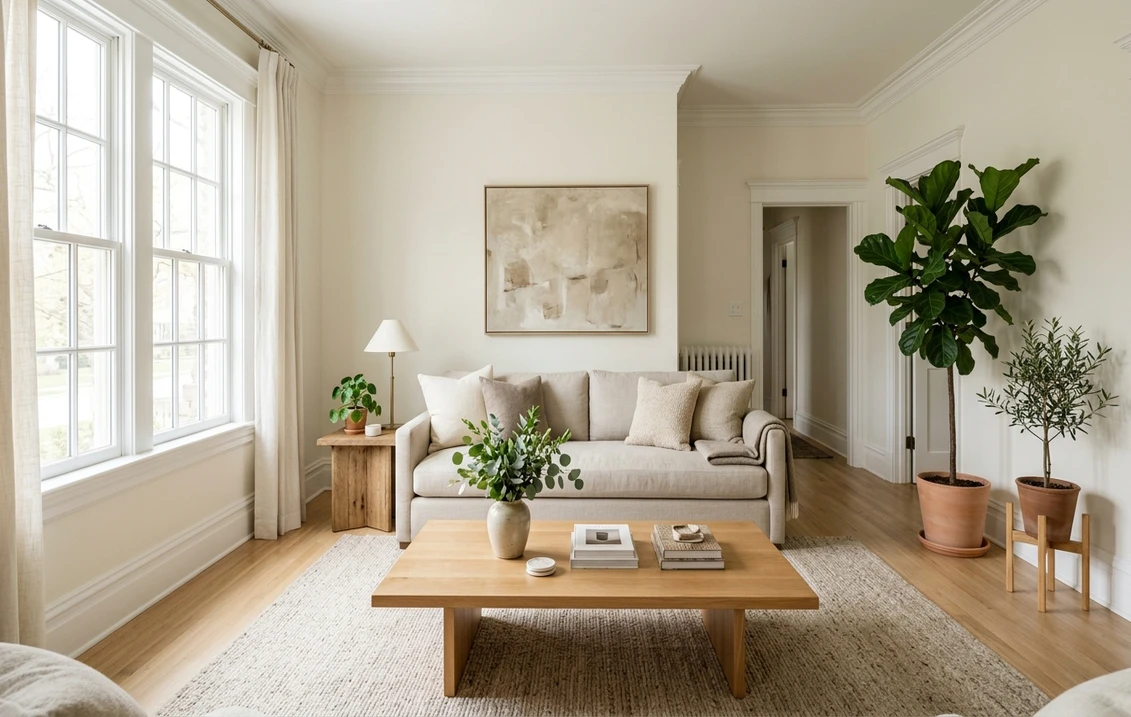
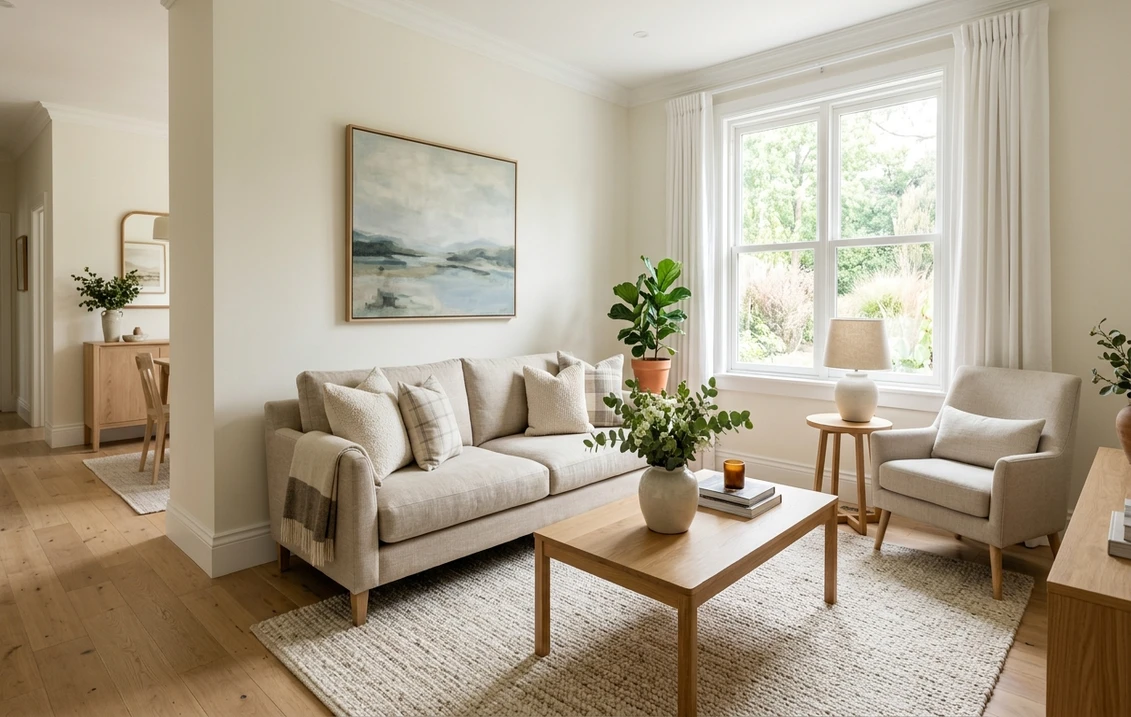
This is Bone White's home turf. In a main living space with decent natural light, the warm off-white wraps the room in a soft glow, flatters skin tones and warm woods, and gives art and furniture a quiet backdrop without the chill of a gray-white. Because LRV 74 keeps it bright, it works beautifully across a whole open floor plan where you want one color to flow from living room to kitchen without feeling flat. It pairs especially well with oak, rattan, leather, and creamy textiles.
Bedrooms and cozy retreats
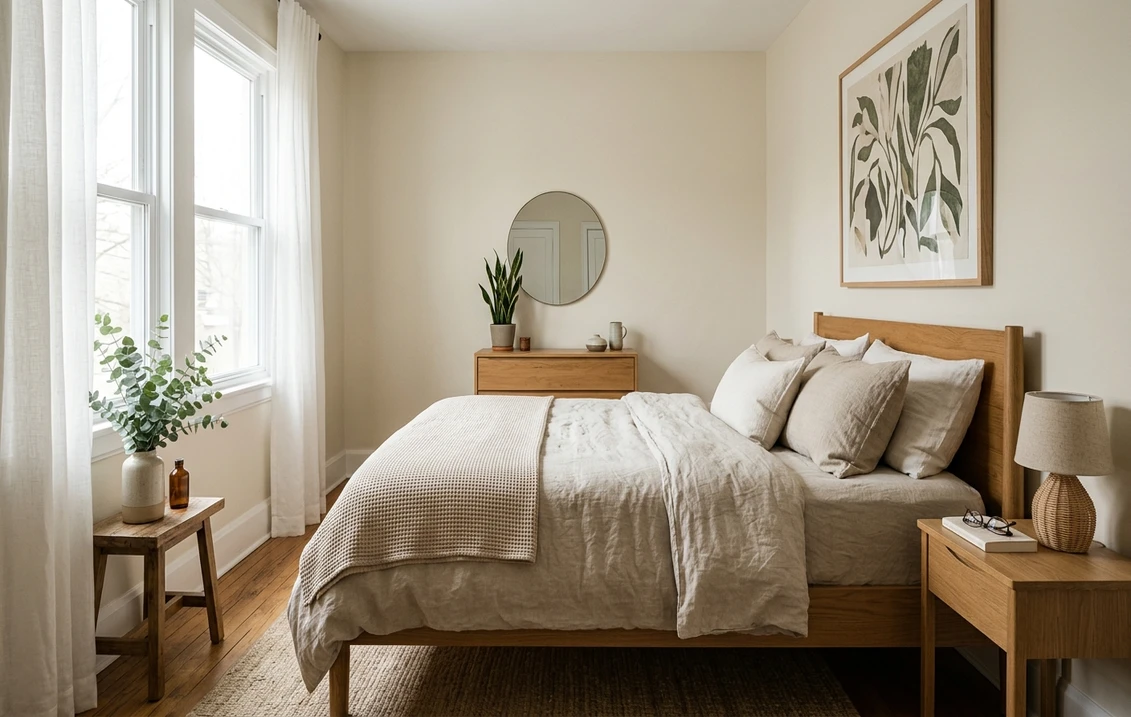
In a bedroom the gentle warmth reads as enveloping and restful, the opposite of a cool gray-white's slight edge. It makes a small or low-light bedroom feel inviting rather than dim, and it sits gorgeously behind linen bedding, walnut nightstands, and brass lamps. For a softer, more cocooning palette than a bright white delivers, Bone White is a natural anchor.
Traditional kitchens and trim-heavy rooms
Bone White is a classic cabinet and millwork color in traditional and transitional kitchens, where its soft cream warmth keeps painted wood from looking cold or builder-grade. On wainscoting, beadboard, and crown molding it adds quiet richness. If you want context on where it lands among other soft, warm choices, our off-white paint colors guide is a useful map.
Where to think twice
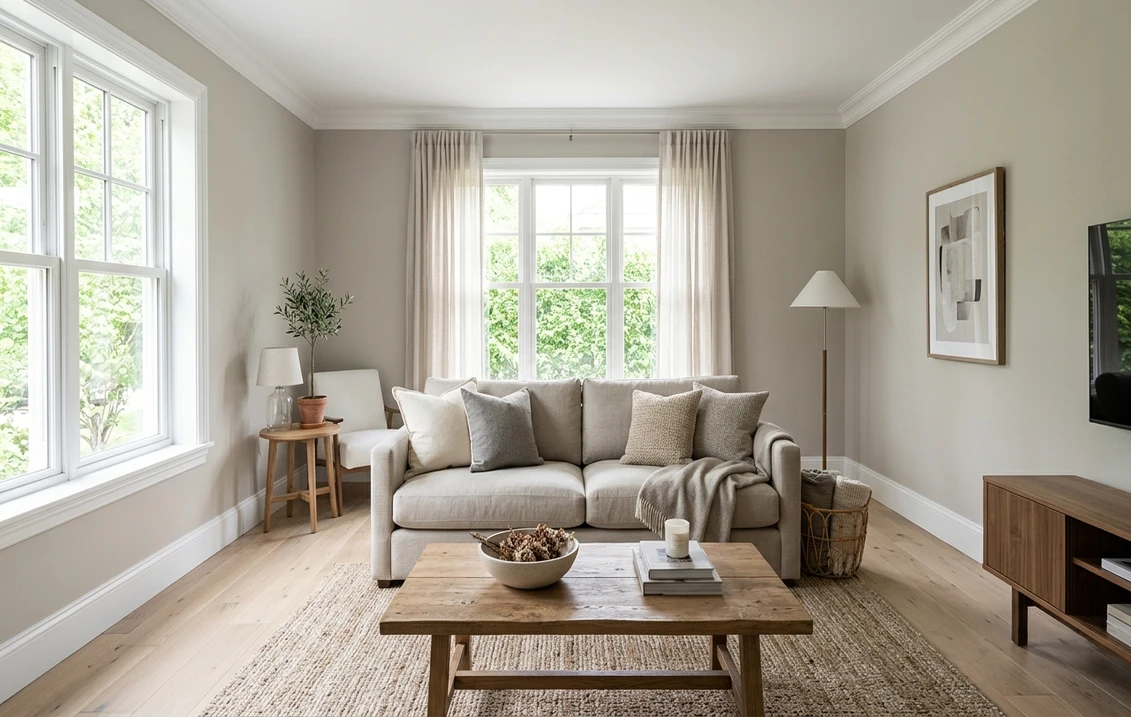
A bright, modern room with cool gray flooring, black-framed windows, and chrome hardware can make Bone White look slightly out of step, too warm against an otherwise cool scheme. In that setting a cooler white reads cleaner. And in a room with very warm 2200K vintage bulbs and yellow-toned wood, Bone White can compound into a sallow note. Match it to warm, traditional, or natural-material schemes, not cool minimalist ones.
Trim, ceiling, and decor pairings
A warm off-white lives or dies on contrast. Too little and the room reads monotone; too much and the wall suddenly looks dirty next to a brighter white. Bone White is best handled with a tone-on-tone strategy.
- Tonal warm trim (most balanced): BM White Dove (OC-17, LRV 85) is the designer default. It is brighter and a touch grayer than Bone White, so it reads as crisp trim without exposing Bone as yellow. The warmth families match, which keeps the whole room cohesive. This is the safe pick for most homes.
- Self-trim (soft, enveloping): using Bone White itself on trim in a flatter sheen than the walls creates a serene, gallery-like wrap, ideal for a bedroom or a quiet study.
- Crisp white trim (use with care): a very bright white like BM Chantilly Lace (OC-65) gives strong contrast, but it can pull the yellow forward in Bone White and make the walls look creamier than you want. Best only in bright rooms where you actively want that warm-cool contrast.
- Avoid: a cool gray-white trim with a blue undertone next to Bone White. The temperature clash makes the walls look yellow and the trim look dingy at the same time, the worst of both.
- Ceilings: the trim white carried up, or a soft warm white, keeps the room cohesive. A stark blue-white ceiling can look harsh over a warm wall.
- Floors and decor: warm oak, walnut, rattan, jute, brass, aged bronze, and cream or camel textiles all flatter Bone White. Cool gray flooring and black-and-white modern schemes fight it.
For contrast and grounding, a deep warm green, soft black, or warm taupe on a door, built-in, or accent wall reads handsome against the soft cream walls. If you are weighing Bone White against richer creams and antique whites, our cream and antique white paint colors guide shows the next step deeper into warmth. There is a step past that one, and it is worth naming: if every sample board keeps leaving you wishing the wall read more decisively golden, what you want is a color rather than a white. Benjamin Moore's historic gold, Hawthorne Yellow HC-4, sits at LRV 63 against Bone White's 74 and takes the same White Dove trim you would have used here, so the room's framing does not have to be rethought.
See walls, trim, and floor together in one preview, free.
Bone White vs its near-twins: Sea Pearl and White Sand
Almost every Bone White search ends in a side-by-side with another soft Off-White collection neighbor. These are the two that matter most, plus the two benchmarks at the bright end, and getting them straight is the whole game with warm whites:
- vs BM Sea Pearl (OC-19): the closest call. Sea Pearl (LRV near 76) is a hair lighter and reads cooler and grayer, with a faint green-gray that keeps it from ever looking yellow. Bone White is warmer and creamier, with a clearer yellow note. Choose Sea Pearl when you want a soft white that stays neutral-to-cool and never risks gold; choose Bone White when you want genuine, cozy warmth on the wall. Side by side, Bone reads like aged linen and Sea Pearl like cool oyster.
- vs BM White Sand (OC-10): White Sand (LRV near 76) is also lighter, but its warmth leans more toward a soft beige-tan than Bone White's yellow-cream. White Sand can drift slightly pink-beige in some light, while Bone White stays in the yellow-green warm lane. Pick White Sand for a sandy, almost greige softness; pick Bone White for a cleaner cream warmth without the beige drift.
- vs BM White Dove (OC-17): the cooler benchmark. White Dove (LRV 85) is brighter and grayer, a soft warm-neutral that reads far closer to a true white. Bone White is noticeably warmer and a step deeper. Use White Dove when you want walls that read as white; use Bone White when you want walls that read as a warm soft color.
- vs BM Cloud White (OC-130): the warm benchmark, and the one this list was missing. Cloud White OC-130 stays in the same cream-yellow lane as Bone White but sits much higher on the light scale (LRV around 85 against 74), so it keeps the warmth without giving the wall visible body. Where White Dove buys brightness by going grayer, Cloud White buys it while staying frankly warm. Choose it for a dim room that cannot spare the reflectance; keep Bone White when you want the wall to read as a soft color rather than a white.
The short version: among the warm off-whites, Bone White is the one with the clearest, coziest yellow-cream warmth, while Sea Pearl stays cooler and White Sand leans sandier. If warmth is the goal, Bone White wins; if you fear yellow at all, Sea Pearl is the safer hedge.
Spelling note: bone white benjamin moore, BM Bone White, and Bone White OC-15 all point to this same color.
How to test Bone White before you commit
A 2-inch fan-deck chip is the number-one reason people reject a warm white that would have looked beautiful: it overstates the yellow and cannot show how the green-gray calms the color across a real day on a real wall. Two better methods:
- Paint a large swatch: roll a 12-by-12-inch sample (or a peel-and-stick sample) on two different walls and check it mid-morning, mid-afternoon, and at night under your normal bulbs. Watch specifically for how yellow it goes in your warmest, sunniest corner; that corner tells you the truth about whether the cream is too much.
- Preview it digitally first: upload a real photo of your room and apply Bone White (plus a cooler hedge like Sea Pearl and a brighter option like White Dove) before you buy any samples, narrowing three contenders to the one worth painting. For budget context on the full repaint, our interior house painting cost guide for 2026 breaks down price per square foot.
Preview Bone White against Sea Pearl and White Dove, side by side, free.
Frequently asked questions
Is Benjamin Moore Bone White warm or cool?
Bone White (OC-15) is a warm off-white with a soft yellow-cream undertone and a faint green-gray that keeps the gold in check. In bright south or west light the warmth comes forward and reads cozy, even glowing; in cool north light the green-gray surfaces and it reads as a calm, slightly grayed off-white. It is firmly a warm white, not a crisp neutral, but the underlying green-gray stops it from ever going golden the way a true cream would.
What is the LRV of Bone White OC-15?
Bone White has a Light Reflectance Value of about 74 on the Benjamin Moore color data, with a hex approximation of #E7DFCE (RGB 231, 223, 206). That makes it a bright soft off-white: it reflects plenty of light to keep a room open, but sits roughly ten points below a near-pure white, so it never has the stark, clinical glare of a blue-white. It reads as a warm soft color rather than a true white.
What are the best rooms for Bone White?
Living rooms, open-plan spaces, bedrooms, and traditional kitchens or trim-heavy rooms are where Bone White shines, because its warm cream undertone makes a space feel cozy and inviting and flatters wood, brass, and natural materials. It is least reliable in cool, modern rooms with gray flooring, black windows, and chrome, where it can look out of step, and in rooms lit by very warm 2200K bulbs, where it can tip slightly sallow.
What trim color goes with Bone White?
BM White Dove (OC-17) is the most balanced trim because it is brighter and slightly grayer than Bone White but stays in the same warm family, giving crisp contrast without exposing the wall as yellow. Self-trimming in Bone White at a different sheen gives a soft, enveloping look. A very bright white like Chantilly Lace works only in bright rooms; avoid a cool blue-gray-white trim, which makes the walls look yellow and the trim look dingy.
What is the difference between Bone White and Sea Pearl?
Sea Pearl (OC-19, LRV near 76) is a hair lighter and reads cooler and grayer, with a green-gray undertone that keeps it from ever looking yellow. Bone White (OC-15, LRV near 74) is warmer and creamier, with a clearer yellow note. Choose Sea Pearl when you want a soft white that stays neutral-to-cool and never risks gold; choose Bone White when you want genuine, cozy warmth on the wall. Side by side, Bone reads like aged linen and Sea Pearl like cool oyster.
Preview BM Bone White on your actual walls under your own light before buying a single sample.
Disclaimer: Benjamin Moore, Bone White (OC-15), Sea Pearl (OC-19), White Sand (OC-10), White Dove (OC-17), and Chantilly Lace (OC-65) are trademarks of Benjamin Moore & Co. FacadeColorizer is an independent paint visualization service and is not affiliated with, endorsed by, or sponsored by Benjamin Moore. Color reproduction on screens approximates the manufacturer's chip; always confirm with a manufacturer sample under your own light before purchase. Sources: Benjamin Moore OC-15 Bone White color data 2026, Benjamin Moore OC-19 Sea Pearl, OC-10 White Sand, OC-17 White Dove and OC-65 Chantilly Lace color data 2026, off-white undertone coverage from The Spruce, and designer field reports compiled by FacadeColorizer.
Trademarks mentioned (Sherwin-Williams, Benjamin Moore, Behr, Caparol, Brillux, Sto, Alpina, Valspar, PPG, Glidden, Dulux, Crown Trade, Sandtex, Farrow & Ball, Johnstone's, Leyland) are property of their respective owners. FacadeColorizer is independent and not affiliated with any of them. Nominative fair use under Lanham Act §1125.