Try it on your room

The first time a client picks Benjamin Moore Cheating Heart (2034-20) off a fan deck, they almost always ask the same thing: is this black, or is it navy? It is the right question, because Cheating Heart lives exactly on that fault line. In a bright room with the can open it looks like a deep, inky blue. Roll it on a north wall at dusk and it reads close to black. That shape-shifting, almost-but-not-quite-black quality is the entire reason this color has quietly become a favorite for moody bedrooms, dramatic accent walls, and tailored cabinetry. It is a navy that behaves like a black, and that is harder to pull off than it sounds. Here is exactly how it acts indoors, what it pairs with, and how it differs from the two BM blues it gets confused with.
Quick orientation before the deep dive. Cheating Heart 2034-20 has a published LRV of about 6 and a hex approximation of #36424B (RGB 54, 66, 75). That puts it firmly in the very-dark, near-black drama zone: it absorbs far more light than it reflects, which is what gives a room that enveloping, cocooning depth. The undertone is a genuine blue core wrapped in a soft green-gray shadow, so it never reads as a hard, flat black and never tips purple. This profile is one chapter in our wider Benjamin Moore interior paint colors guide, and it sits at the deep end of the BM blue family. If you want the lighter, grayer cousin, that is covered in our Hale Navy HC-154 review: this page stays on Cheating Heart, its near-black behavior, and the rooms where it earns its keep.
Upload a photo of your actual room and preview BM Cheating Heart under your own light in about 30 seconds. Free: 1 HD render plus 3 variations.
Cheating Heart at a glance: the numbers that matter
Before opinions, here are the verifiable specs straight from the Benjamin Moore color library. These are the values you can take to a paint counter and the ones that explain why this color behaves the way it does:
| Spec | Cheating Heart 2034-20 |
|---|---|
| Color number | 2034-20 (Color Preview collection) |
| LRV (Light Reflectance Value) | Approximately 6: very dark, near-black, absorbs most light |
| Hex / RGB (approx.) | #36424B / 54, 66, 75 |
| Color family | Deep blue, reads as near-black navy |
| Primary undertone | True blue core with a soft green-gray shadow |
| Best base / finish | Deep tint base; matte or eggshell on walls, satin or semi-gloss on cabinets and doors |
Try it on your house
No photo? Try a sample
The takeaway from those numbers: with an LRV near 6, Cheating Heart is one of the darkest colors a homeowner will ever realistically commit to on four full walls. That low number is not a warning, it is the feature. Light disappears into the wall, edges soften, and the room feels deep and intimate. The trade is real though: a color this dark shows every dent, roller lap, and patch, and it needs a primer tinted gray under it to cover in two coats. A deep base also means the pigment load is high, so it can stay slightly soft to the touch longer than a pale color. Plan for that and the color rewards you.
Is Cheating Heart navy or black? The undertone, decoded
Cheating Heart is a navy that masquerades as a black, and that is precisely why the name fits. It is unfaithful to a single identity. Understanding which way it leans in your room is the whole game, so here is what is actually happening underneath the surface.
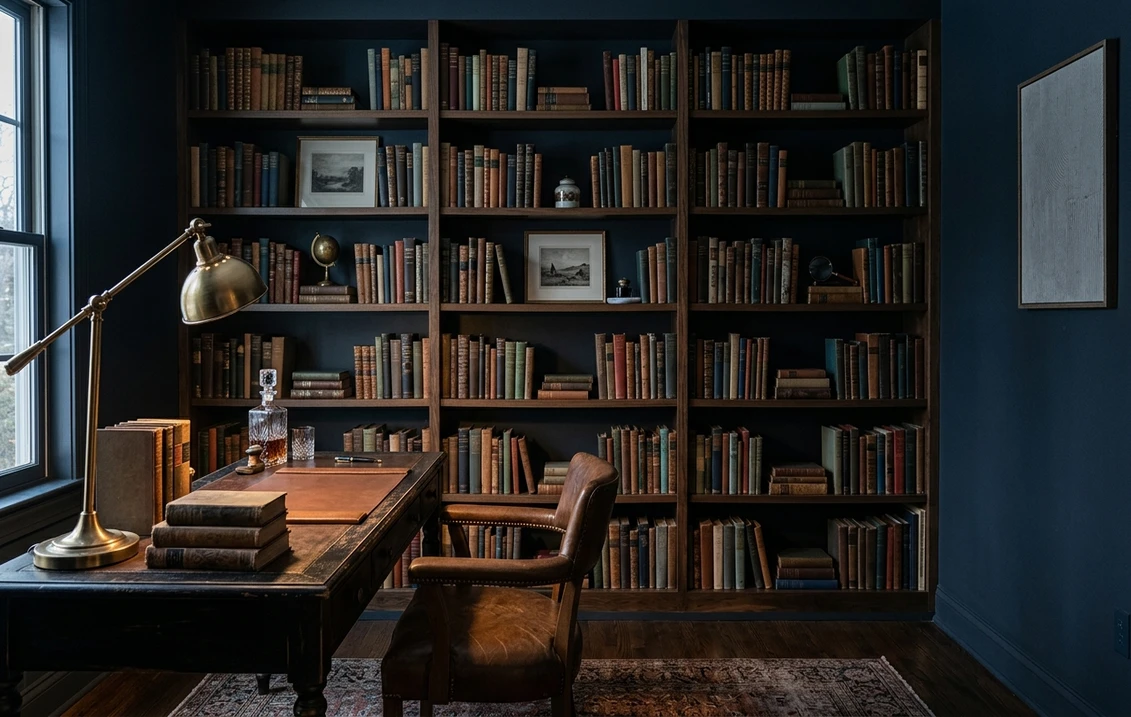
The dominant undertone is a true, slightly muted blue, deeper and more grayed than a classic primary navy. Riding under that blue is a faint green-gray shadow that keeps the color grounded and stops it from ever flashing purple, which is the single most common failure mode of cheaper near-black blues. That green-gray is also why Cheating Heart can read almost charcoal in low light: when the blue wavelengths drain out of a dim room, the gray steps forward and the wall settles toward black. In strong, clean daylight the opposite happens, the blue lifts to the surface and the wall is unmistakably navy. Most people who choose this color do so for exactly that duality.
Watch out for one thing that catches first-timers. On a tiny fan-deck chip, Cheating Heart looks far more obviously blue than it will on a full wall. Pigment density compounds as you scale up, and four coats of wall absorb so much light that the blue calms and the black takes over. So if you fall for the bright navy on the chip, expect the finished room to land noticeably darker and more neutral than you pictured. That is not a defect, it is just how very low LRV colors scale.
| Indoor light | How Cheating Heart reads |
|---|---|
| South-facing (bright, warm) | Its bluest and richest: clearly navy with depth, the most flattering read |
| West-facing (warm afternoon) | Warm late sun adds an inky glow; blue stays present but softens toward dusk |
| East-facing (cool after noon) | Crisp navy in the morning, slides toward near-black by afternoon |
| North-facing (cool, indirect) | Darkest and most black-leaning; the green-gray shadow dominates. Lean into the moody read |
| Artificial light at night | Warm 2700K bulbs pull it toward inky charcoal-navy; cool 4000K bulbs revive the blue and keep it crisper |
Sources: Benjamin Moore 2034-20 color data 2026; deep-color undertone coverage from The Spruce and designer field reports compiled by FacadeColorizer.
Free AI visualizer. Test how dark Cheating Heart really goes on your walls before buying a single sample pot.
Best rooms for Cheating Heart
A color this deep is not a whole-house neutral, it is a statement. The trick is to use that low LRV where drama and enclosure are the goal, not where you need brightness. Here is where Cheating Heart consistently delivers:
Moody bedrooms and primary suites
This is Cheating Heart's natural habitat. On all four walls of a bedroom, the near-black navy collapses the boundaries of the room and creates a cocoon that feels luxurious and quiet, ideal for sleep. White or oatmeal bedding glows against it, and brass lamps read like jewelry. It is one of the standout deep picks in our roundup of dark and moody bedroom paint ideas precisely because it stays warm and enveloping instead of cold.
Cabinetry, islands, and built-ins
In a kitchen island, a bank of lower cabinets, or a library wall of built-ins, Cheating Heart reads as a sophisticated, almost-black navy that pairs with brass and unlacquered hardware better than a true black does. The faint blue keeps it from looking harsh. If you are weighing it against a pure black for cabinetry, our guide to the best black kitchen cabinet paint colors shows how near-blacks like this one differ from a flat true black on doors.
Home offices, dens, and studies
Deep blue is a focus color, and Cheating Heart turns a small office or study into a serious, library-quiet space that photographs beautifully on video calls. Bookshelves in the same color disappear into the wall and let the books pop. For how it sits next to other concentration-friendly shades, see our guide to home office paint colors for productivity.
Accent walls, doors, and powder rooms
If a full room of near-black feels like too much, Cheating Heart is a superb single-wall or front-door color, and a windowless powder room painted in it (ceiling included) becomes a jewel box. For where deep blues land among the year's other navies, our best navy interior paint colors guide maps it against the field.
Where to think twice
Do not reach for Cheating Heart when you need a room to feel bigger or brighter. A small, dim, north-facing room with little natural light and only one window will feel like a cave, not a cocoon, and the green-gray shadow can make it feel heavy. If brightness is the goal, this is the wrong color: choose a mid-tone blue or a lighter gray instead. Cheating Heart wants either generous light or a deliberate, embraced darkness, never a half-measure.
Trim, ceiling, and decor pairings
A near-black navy lives or dies on contrast. The white you set against it decides whether the room reads tailored and gallery-crisp or muddy and dated.
- Crisp bright trim (most dramatic): BM Chantilly Lace (OC-65, LRV 90) is the go-to. Its clean, blue-leaning white maximizes contrast and makes Cheating Heart look modern and architectural. Best for high-contrast, gallery-style rooms.
- Soft warm trim (more relaxed): BM White Dove (OC-17, LRV 85) softens the contrast with a gentle cream bias, so the room feels cozier and less stark. Best for traditional bedrooms and studies where you want warmth.
- Tone-on-tone (most immersive): paint trim and walls both in Cheating Heart for a true cocoon effect, letting only the hardware and art provide contrast. Stunning in a powder room or library.
- Avoid: a builder antique white or a yellowed off-white next to it. The warm-cool clash makes the trim look dingy and the navy look flat.
- Ceilings: for drama, carry the color onto the ceiling; for a lift, a crisp white ceiling keeps the room from feeling closed. A creamy builder white can look dull over a near-black, so favor a clean white if you stop at the walls.
- Floors and decor: warm white oak, walnut, brass, aged gold, rattan, and natural linen all flatter the deep blue and add the warmth a dark wall needs. Chrome and cool nickel keep it sharp and modern.
For accent and accessory colors, terracotta, mustard, rust, and warm whites all sing against this navy, while sage and olive echo its green-gray shadow. For a full pairing playbook, our guide to colors that go with navy blue covers the combinations that work with a deep blue like Cheating Heart.
See walls, trim, and floor together in one preview. Free.
Cheating Heart vs the deep blues people confuse it with
Almost every Cheating Heart search ends in a side-by-side with another BM deep blue. Two comparisons matter most, and they are genuinely different colors, not the same paint under two names:
Cheating Heart 2034-20 vs Hale Navy HC-154
This is the comparison that trips up the most people, and the difference is real. Hale Navy (HC-154) has an LRV of about 7 and reads as a classic, slightly grayed navy: it is visibly, reliably blue in most light and forgiving enough to use almost anywhere. Cheating Heart (LRV about 6) is a notch darker and tips closer to black, with a cooler green-gray shadow instead of Hale Navy's warmer gray. In short: Hale Navy is the safe, recognizable navy that still reads blue at dusk; Cheating Heart is the near-black drama navy that disappears toward charcoal in low light. Choose Hale Navy if you want people to clearly see blue; choose Cheating Heart if you want a sophisticated almost-black that only reveals its blue in good light. The full breakdown of the lighter option is in our Hale Navy HC-154 review.
Cheating Heart 2034-20 vs Gentleman's Gray 2062-20
Gentleman's Gray (2062-20) sits at a similar low LRV (around 6 to 7) and is also a near-black blue, but its undertone is more clearly, vividly blue with a teal edge, where Cheating Heart is grayer and more muted with that green-gray shadow holding it back. Side by side, Gentleman's Gray looks like a rich, saturated peacock-leaning navy, while Cheating Heart looks like a quieter, more neutral near-black. Choose Gentleman's Gray when you want the blue to read bold and almost jewel-toned; choose Cheating Heart when you want the same depth but with a calmer, more black-leaning, more versatile feel that works with brass and warm woods without competing.
For the broader picture of how deep blues like these stack up across the BM line, our navy interior paint colors guide places all three on the same scale.
One color outside the blue family belongs in the same decision. If the green-gray shadow is the part you keep noticing, Essex Green sits at the same LRV of roughly 6 but is a true forest green rather than a navy, and at that depth it behaves the same way: black in shade, green only where light reaches it, and greener in semi-gloss than in flat. Our Benjamin Moore Essex Green review sets out how much light it takes before that green surfaces, which is the whole question with a color this dark.
Spelling note: cheating heart benjamin moore, BM Cheating Heart 2034-20, and Benjamin Moore cheating heart navy all point to this same 2034-20.
How to test Cheating Heart before you commit
With a color this dark, the gap between the chip and the finished wall is the widest of any paint you can buy, which is exactly why people regret near-blacks chosen from a fan deck. Two better methods:
- Paint a large swatch: roll a 2-by-2-foot sample (two coats over gray-tinted primer) on at least two walls and check it mid-morning, mid-afternoon, and at night under your normal bulbs. Watch your darkest corner closely: that corner shows you how near-black it really goes and whether the room can carry it.
- Preview it digitally first: upload a real photo of your room and apply Cheating Heart alongside a lighter alternative like Hale Navy and a true black, so you can judge the depth before you commit to gray primer and two coats. Pricing context for the full repaint is in our navy pairing guide and the broader BM pillar.
Preview Cheating Heart against Hale Navy and a true black, side by side. Free: 1 HD render plus 3 variations.
Frequently asked questions
Is Cheating Heart navy or black?
Cheating Heart (2034-20) is technically a very dark blue, but with an LRV around 6 it reads as a near-black navy. In bright south light the blue lifts to the surface and it looks clearly navy; in dim, north, or evening light the green-gray shadow takes over and it settles close to black. It is a navy that behaves like a black, which is exactly why people choose it for drama.
What is the LRV of Cheating Heart?
Cheating Heart has a Light Reflectance Value of about 6 on the Benjamin Moore color data, with a hex approximation of #36424B (RGB 54, 66, 75). That makes it one of the darkest colors most homeowners will commit to on full walls: it absorbs the large majority of light, which creates that enveloping, cocooning depth but also means it needs gray-tinted primer and two coats to cover well.
What is the difference between Cheating Heart and Hale Navy?
Hale Navy (HC-154, LRV about 7) is a classic grayed navy that reads reliably blue in most light and is more forgiving. Cheating Heart (2034-20, LRV about 6) is a notch darker, tips closer to black, and has a cooler green-gray shadow. Pick Hale Navy if you want people to clearly see blue; pick Cheating Heart if you want a sophisticated near-black that only reveals its blue in good light.
What trim color goes with Cheating Heart?
BM Chantilly Lace (OC-65) is the most dramatic trim because its clean, bright white maximizes contrast and makes Cheating Heart look modern and architectural. BM White Dove (OC-17) is the warmer, cozier option for traditional rooms. For a true cocoon, paint the trim in Cheating Heart too. Avoid a yellowed builder antique white, which makes both the trim and the navy look dull.
What are the best rooms for Cheating Heart?
Moody primary bedrooms, cabinetry and islands, home offices and studies, accent walls, and windowless powder rooms are where Cheating Heart shines, because its near-black depth creates a luxurious, enveloping cocoon. It is the wrong choice for small, dim, north-facing rooms where you need brightness, since the low LRV and green-gray shadow can make a poorly lit space feel like a cave rather than a retreat.
Preview BM Cheating Heart on your actual walls under your own light before buying a single sample.
Disclaimer: Benjamin Moore, Cheating Heart (2034-20), Hale Navy (HC-154), Gentleman's Gray (2062-20), Chantilly Lace (OC-65), and White Dove (OC-17) are trademarks of Benjamin Moore & Co. FacadeColorizer is an independent paint visualization service and is not affiliated with, endorsed by, or sponsored by Benjamin Moore. Color reproduction on screens approximates the manufacturer's chip; always confirm with a manufacturer sample under your own light before purchase. Sources: Benjamin Moore 2034-20 Cheating Heart color data 2026, Benjamin Moore HC-154 Hale Navy and 2062-20 Gentleman's Gray color data 2026, deep-color undertone coverage from The Spruce, and designer field reports compiled by FacadeColorizer.
Trademarks mentioned (Sherwin-Williams, Benjamin Moore, Behr, Caparol, Brillux, Sto, Alpina, Valspar, PPG, Glidden, Dulux, Crown Trade, Sandtex, Farrow & Ball, Johnstone's, Leyland) are property of their respective owners. FacadeColorizer is independent and not affiliated with any of them. Nominative fair use under Lanham Act §1125.