Try it on your room

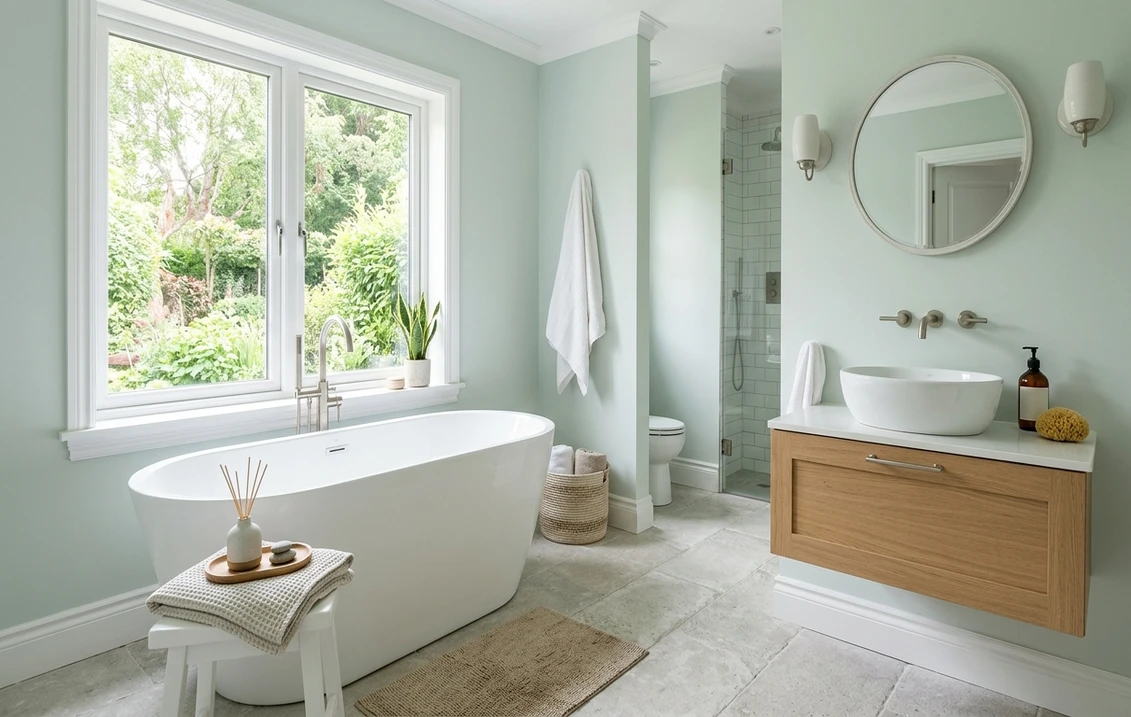
The first time a client asked me to roll Benjamin Moore Healing Aloe (1562) in a primary bathroom, she described it as the color of sea glass that had been left in the sun too long. That is honestly the best description I have heard. Healing Aloe is one of those whisper-soft colors that refuses to commit to a single name: half the people who walk into a Healing Aloe room call it green, a third call it blue, and the rest swear it is just a soft gray. They are all a little right. It is a barely-there spa green with a gentle gray-blue lean, the kind of color that sits a hair away from white but carries enough tint to feel calm, watery, and quietly restorative. The question every search starts with is the same: is it green, blue, or gray, and will it actually show up on my walls? Here is how it really behaves indoors.
Quick orientation before the deep dive. Healing Aloe 1562 has a published LRV of about 72 and a hex approximation of #DDE2DA (RGB 221, 226, 218). That puts it firmly in the light, airy end of the color wheel: bright enough to read almost as a tinted white in strong sun, but with just enough pigment to turn soft sage-aqua in cooler light. The undertone is a delicate green softened by a gray-blue cast, which is exactly what gives it that pale spa quality. This profile is one stop in our wider Benjamin Moore interior paint colors guide, and it sits right next to the other quiet greens in our interior green paint shades guide. This page stays on Healing Aloe itself: its undertones, its light behavior, the rooms it loves, and the colors people confuse it with.
Upload a photo of your actual room and preview BM Healing Aloe under your own light in about 30 seconds. Free: 1 HD render plus 3 variations.
Healing Aloe at a glance: the numbers that matter
Before any opinions, here are the verifiable specs straight from the Benjamin Moore color library. These are the values you can take to the paint counter:
| Spec | Healing Aloe 1562 |
|---|---|
| Color number | 1562 (Color Preview collection) |
| LRV (Light Reflectance Value) | Approximately 72: light and airy, keeps a room bright |
| Hex / RGB (approx.) | #DDE2DA / 221, 226, 218 |
| Color family | Pale spa green with a gray-blue cast |
| Primary undertone | Soft green, cooled and quieted by gray-blue |
| Best base / finish | Light base; eggshell or matte on walls, satin or semi-gloss on trim |
Try it on your house
No photo? Try a sample
The takeaway from those numbers: Healing Aloe is a true tinted soft color, not a colored white and not a saturated sage. At LRV 72 it reflects a lot of light, so it brightens a room rather than darkening it, and it almost never reads heavy. But unlike a flat off-white, that green-and-gray-blue tint means it changes character through the day. Embrace the shift and the color feels alive and spa-like; expect a single fixed shade and it can surprise you. That is the entire decision in one sentence.
Is Healing Aloe green, blue, or gray? The undertone, decoded
Healing Aloe is, at its core, a pale green. But it is a green that has been deliberately muted and cooled, so it never shouts the way a clear sage or a clean mint would. Two pigments fight gently underneath, and understanding them is the difference between a room that feels like a calm spa and one that looks like an off-white that went slightly off.
The green is the lead. It is what gives the color that aloe, sea-glass, just-washed quality. But riding alongside it is a soft gray-blue that pulls the green back from anything fresh or grassy and tips it toward water and stone. In warm, bright light the green steps forward and the wall reads as the softest sage, almost pistachio when the sun is strong. In cool, indirect light the gray-blue takes over, the green recedes, and the same wall reads more like a pale aqua-gray, which is the read that makes people call it blue or even gray. It rarely goes muddy, and it never turns yellow-green, which is exactly why it is such a trusted spa color.
Watch out for one quirk. Because the LRV is so high, Healing Aloe can disappear into white in a flood of midday sun, especially next to bright white trim or tile, and look like nothing more than a clean off-white. Then at dusk, or in a north room, the tint suddenly reappears and the wall is clearly green-blue. So if you are choosing from a chip alone, assume the finished wall will swing between "is that even painted?" in full sun and "oh, there it is" in softer light. That swing is the feature, not the flaw.
| Indoor light | How Healing Aloe reads |
|---|---|
| South-facing (bright, warm) | Softest sage, near pistachio in strong sun; can flirt with off-white at noon |
| West-facing (warm afternoon) | Green steps forward, warm and gentle; the most flattering read of the day |
| East-facing (cool after noon) | Fresh and balanced in the morning, drifts toward aqua-gray by afternoon |
| North-facing (cool, indirect) | At its bluest and grayest; reads as a pale watery spa color, never dingy |
| Artificial light at night | Warm 2700K bulbs pull out the green and warmth; cool 4000K bulbs push it toward crisp aqua-gray |
Sources: Benjamin Moore 1562 color data 2026; The Spruce green-paint undertone coverage; designer field reports compiled by FacadeColorizer.
Free AI visualizer. Test Healing Aloe on your real walls before buying a single sample pot.
Best rooms for Healing Aloe
Pale, watery, and quietly restorative, Healing Aloe is at its happiest in rooms where calm is the assignment. The name is not an accident: this is the color people reach for when they want a space to feel like a deep breath. Here is where it consistently earns its keep:
Bathrooms and powder rooms
This is Healing Aloe's natural home. The spa-green-blue undertone reads clean and watery against white subway tile, marble, polished nickel, and chrome, and at LRV 72 it keeps even a windowless bath feeling open and bright rather than closed in. It is the rare soft color that says spa without going either icy-cool or sweetly minty. It is one of the most popular calming greens in our roundup of the best bathroom paint colors for 2026 for exactly this reason.
Bedrooms built for rest
In a bedroom the muted green and gray-blue read serene and grounding, the kind of color you can live with for years without tiring of it. It pairs beautifully with white bedding, natural linen, rattan, and pale wood, and it leans restful without going cold the way a true blue can. If a calm bedroom is your project, our guide to calming master bedroom paint colors shows how it sits next to other quiet picks.
Bright living rooms, hallways, and whole-floor flow
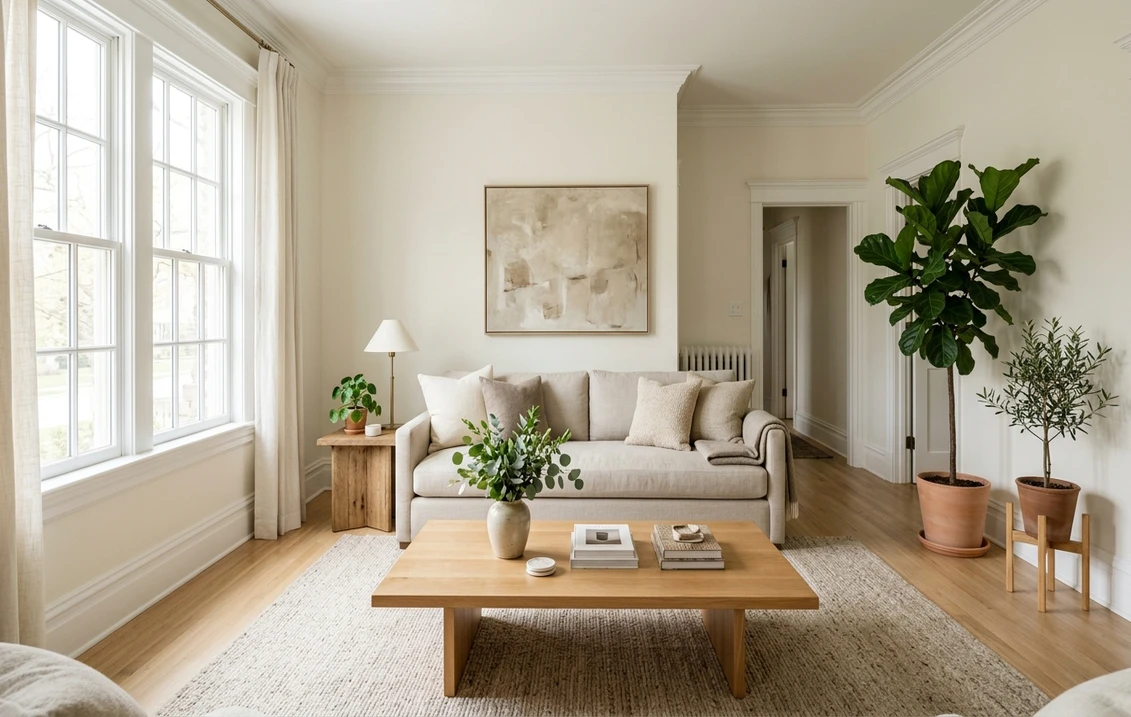
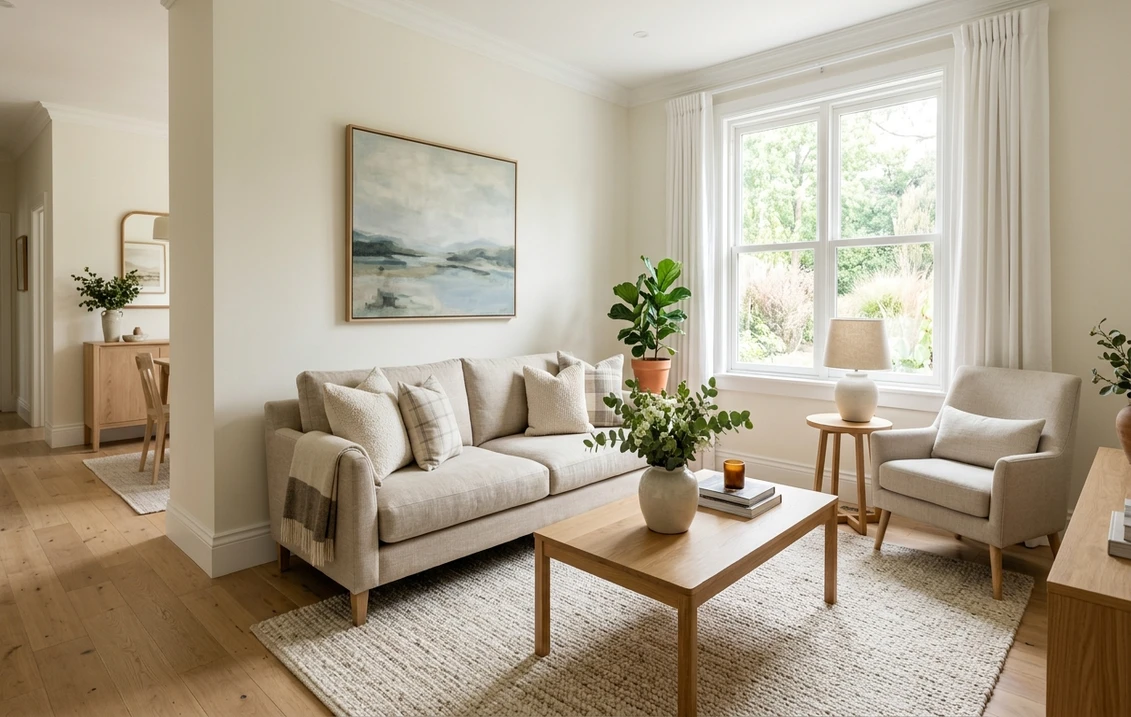
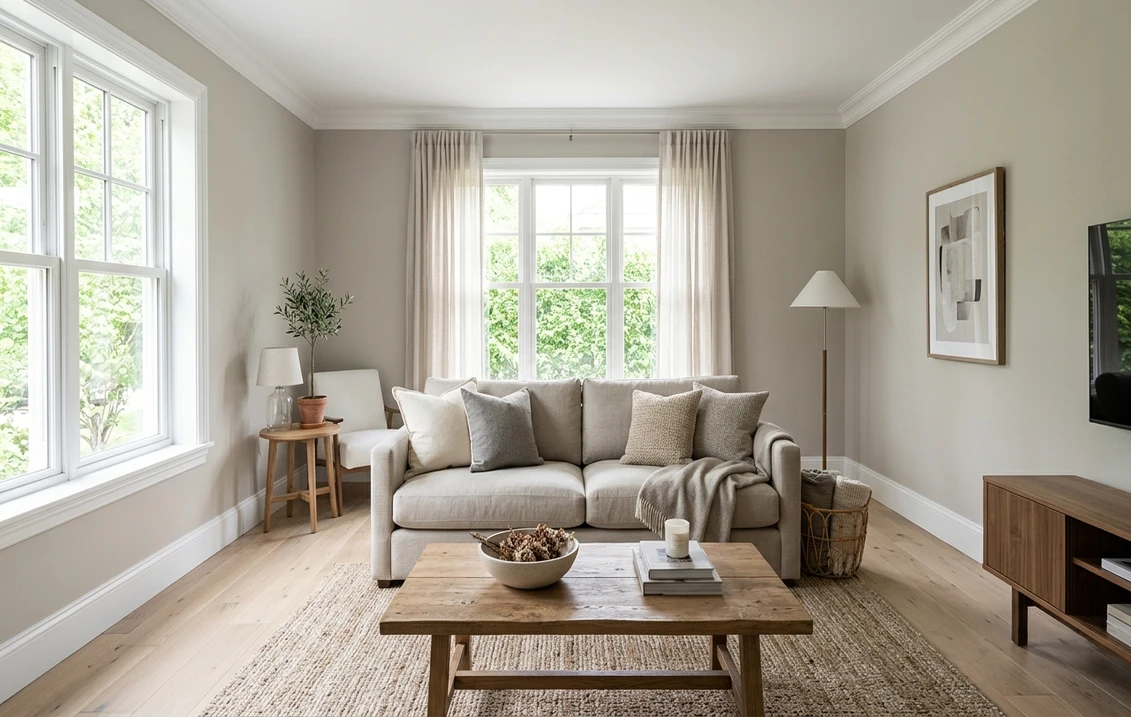
Because the tint is so light, Healing Aloe works as a near-neutral that carries a faint personality, which makes it a great whole-floor color for an open plan where you want continuity with a hint of color. In a south- or west-facing living room it reads as a soft, sophisticated backdrop for art and warm wood. For where it lands among the year's other soft greens, our sage green interior paint shades and pairings guide is a useful map.
Where to think twice
Healing Aloe needs light to show its character. In a dim, fully interior room with only cool LED light, the gray-blue can take over and the color can read as a flat, slightly cold off-white that loses all its charm. If you want it to read green and spa-like in a darker space, lean into 2700K warm bulbs and let in what natural light you have. Bury it in a windowless cave under daylight LEDs and you will wonder why you bothered tinting the wall at all.
Trim, ceiling, and decor pairings
A pale spa color lives or dies on its trim. Get the white right and Healing Aloe looks intentional and watery; get it wrong and the color can either vanish entirely or look slightly grubby by comparison.
- Soft warm trim (most balanced): BM White Dove (OC-17, LRV 85) is the designer default. Its gentle cream bias gives Healing Aloe a warm frame that lets the green read clearly without making the wall look cold. This is the safe, cohesive pick for most homes.
- Crisp trim (cleaner, cooler): BM Chantilly Lace (OC-65) gives a bright, modern, slightly cooler edge that leans into the spa-aqua side of Healing Aloe. Best for bathrooms, modern baths, and black-window homes where you want crisp contrast.
- Avoid: a heavy yellow-cream antique white next to Healing Aloe. The warm-yellow clash can pull the wall toward a dull, slightly dirty green and rob it of its watery freshness.
- Ceilings: a clean white (often the trim color) keeps the room bright and airy. Healing Aloe itself, slightly thinned or at full strength, can also work as a spa-tone ceiling in a bathroom for an enveloping effect.
- Floors and decor: pale oak, white oak, marble, brushed nickel, woven natural fibers, and soft linen all flatter the gray-green and reinforce the spa read. Cool whites and warm woods both work, which is part of why this color is so easy to live with.
For a touch of contrast and depth, a soft black or a deep warm wood on a vanity, door, or window frame reads tailored against the pale walls without breaking the calm. If you want to push the green a half-step deeper somewhere in the home, a true sage like October Mist makes a natural companion, which we cover in our Benjamin Moore October Mist 1495 review.
See walls, trim, and floor together in one preview. Free.
Healing Aloe vs the colors people confuse it with
Almost every Healing Aloe search ends in a side-by-side, because three pale-to-mid spa colors live close together and it is genuinely easy to mix them up. Here is how they truly differ indoors:
- vs BM Palladian Blue (HC-144): the most common dilemma. Palladian Blue (LRV around 61) is noticeably deeper and more saturated, and it leans clearly blue-green rather than green-with-a-whisper-of-blue. Where Healing Aloe at LRV 72 can fade toward off-white in strong sun, Palladian Blue always reads as a defined color and reads more aqua. Choose Healing Aloe when you want a soft, near-neutral spa tint that brightens; choose Palladian Blue when you want the spa color to actually be seen as a color on every wall.
- vs BM Soft Fern (2144-40): Soft Fern is a true mid-tone sage that is clearly, confidently green, with far less of the gray-blue cooling that defines Healing Aloe. Soft Fern is darker and earthier and reads as a real green from across the room; Healing Aloe is pale, watery, and ambiguous. Pick Soft Fern when you want a room to read green; pick Healing Aloe when you want barely-there calm that flexes between green and aqua-gray.
- vs BM Quiet Moments (1563): its immediate color-strip neighbor and the closest twin. Quiet Moments is a half-step deeper and leans slightly more blue, so it commits more firmly to a soft blue-green. Healing Aloe is the lighter, more elusive of the two and the better choice when you want the tint to nearly disappear in bright light.
- vs BM Silver Mist (1619): the same soft-green idea with the blue removed. Silver Mist sits at LRV 64, eight points deeper, and its undertone is a straight green-gray rather than green cooled by gray-blue, so over white tile and chrome it stays gray-green instead of drifting toward aqua. Pick Silver Mist when the spa-blue read is precisely the part you do not want; pick Healing Aloe when that watery lean is the appeal.
- vs a real mid-tone sage: if what you actually want is a green that reads as green from the doorway, none of the pale spa tints will get you there. Jump to the other end of the range with Louisburg Green HC-113, a saturated historic sage, and keep Healing Aloe for the rooms that should stay airy.
Spelling and naming note: healing aloe benjamin moore, BM Healing Aloe 1562, and Healing Aloe paint color all point to this same 1562. There is no separate "healing aloe HC" code; it lives in the Color Preview fan deck.
How to test Healing Aloe before you commit
A 2-inch fan-deck chip is the number-one reason people pick a pale spa color that disappoints: at LRV 72 the chip looks like a tinted white, so you cannot tell how much green will actually appear, or how much it will swing across a real day on a real wall. Two better methods:
- Paint a large swatch: roll a 12-by-12-inch sample (or a peel-and-stick sample) on two different walls and check it mid-morning, mid-afternoon, and at night under your normal bulbs. Watch specifically for two moments: how off-white it goes in your brightest sun, and how blue-gray it goes in your dimmest corner. Those two extremes tell you the truth.
- Preview it digitally first: upload a real photo of your room and apply Healing Aloe (plus a deeper alternative such as Palladian Blue and a greener one such as Soft Fern) before you buy any samples, narrowing three contenders to the one worth painting. For other quiet sage and green options to test against it, our interior green paint shades guide lays out the field.
Preview Healing Aloe against a deeper and a greener spa color, side by side. Free.
Frequently asked questions
Is Healing Aloe green, blue, or gray?
Healing Aloe (1562) is fundamentally a pale green, but it is muted and cooled by a soft gray-blue cast, which is why people see it so differently. In warm or south light the green steps forward and it reads as the softest sage; in cool, indirect, or north light the gray-blue takes over and it reads more like a pale aqua-gray. It never goes yellow-green or muddy, which is what makes it such a trusted spa color.
What is the LRV of Healing Aloe?
Healing Aloe has a Light Reflectance Value of about 72 on the Benjamin Moore color data, with a hex approximation of #DDE2DA (RGB 221, 226, 218). That makes it a light, airy color that reflects a lot of light and brightens a room. Because the LRV is so high, it can fade toward a tinted off-white in strong midday sun and then show its green-blue tint clearly again in softer or cooler light.
What are the best rooms for Healing Aloe?
Bathrooms, powder rooms, restful bedrooms, and bright open-plan living spaces are where Healing Aloe shines, because its pale spa green-blue reads clean and watery against white tile, marble, and chrome while keeping a room bright. It is least reliable in dim, windowless rooms lit only by cool LED light, where the gray-blue can flatten it into a slightly cold off-white; warm 2700K bulbs and natural light bring the green back.
What trim color goes with Healing Aloe?
BM White Dove (OC-17) is the most balanced trim because its gentle cream bias frames Healing Aloe warmly and lets the green read clearly without making the wall look cold. BM Chantilly Lace (OC-65) is the crisper, cooler option for bathrooms and modern spaces. Avoid a heavy yellow-cream antique white, which can pull the wall toward a dull, dirty green and rob it of its watery freshness.
What is the difference between Healing Aloe and Palladian Blue?
Palladian Blue (HC-144, LRV around 61) is deeper, more saturated, and leans clearly blue-green, so it always reads as a defined spa color on the wall. Healing Aloe (1562, LRV near 72) is much lighter and leans green with only a whisper of blue, so it can fade toward off-white in strong sun. Choose Palladian Blue when you want the spa color to be obvious, and Healing Aloe when you want a soft, near-neutral tint that brightens the room.
Preview BM Healing Aloe on your actual walls under your own light before buying a single sample. Free: 1 HD render plus 3 variations.
Disclaimer: Benjamin Moore, Healing Aloe (1562), Palladian Blue (HC-144), Soft Fern (2144-40), Quiet Moments (1563), October Mist (1495), White Dove (OC-17), and Chantilly Lace (OC-65) are trademarks of Benjamin Moore & Co. FacadeColorizer is an independent paint visualization service and is not affiliated with, endorsed by, or sponsored by Benjamin Moore. Color reproduction on screens approximates the manufacturer's chip; always confirm with a manufacturer sample under your own light before purchase. Sources: Benjamin Moore 1562 Healing Aloe color data 2026, Benjamin Moore HC-144 Palladian Blue and 2144-40 Soft Fern color data 2026, The Spruce green-paint undertone coverage, designer field reports compiled by FacadeColorizer.
Trademarks mentioned (Sherwin-Williams, Benjamin Moore, Behr, Caparol, Brillux, Sto, Alpina, Valspar, PPG, Glidden, Dulux, Crown Trade, Sandtex, Farrow & Ball, Johnstone's, Leyland) are property of their respective owners. FacadeColorizer is independent and not affiliated with any of them. Nominative fair use under Lanham Act §1125.