Try it on your room

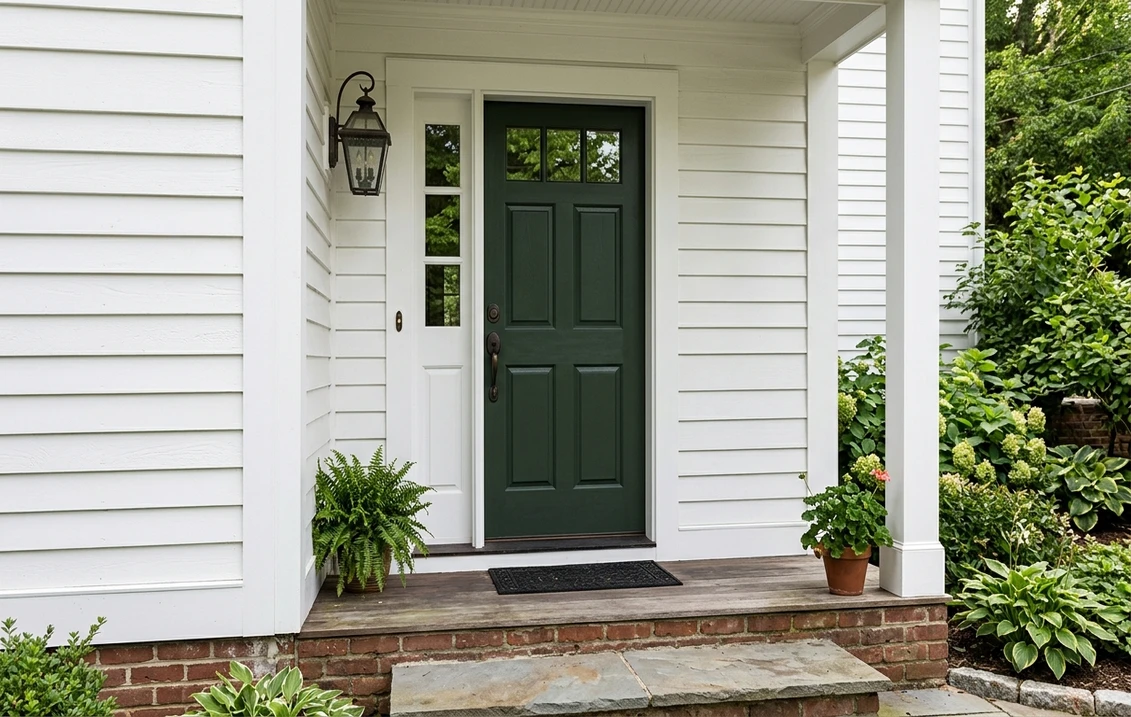
Benjamin Moore Essex Green is one of those colors people fall for in a photograph and then second-guess in the store, because on the chip it looks almost black. That is exactly its appeal. Essex Green is a deep, classic forest green with a cool, slightly blue lean, the kind of green that has dressed New England shutters, front doors, and library walls for a century. It reads black at dusk and under cloud, then opens up into a rich evergreen the moment direct sun touches it. The question that fills every search bar is whether it is actually green or just a dark you could get from a charcoal, and how it stacks up against the two greens people constantly confuse it with. Here is how Essex Green really behaves, indoors and out.
Quick orientation before the deep dive. Essex Green belongs to Benjamin Moore's Historical Color collection (it carries the name rather than a 2000-series number on the deck), with a published LRV of about 6 and a hex approximation of #303D33 (RGB 48, 61, 51). That LRV puts it firmly in near-black territory: it absorbs almost all the light that hits it, which is why it can pass for black on a shutter until you stand close. The undertone is a cool, deep blue-green, with just enough warmth in the green to keep it from going cold and slate-like. This profile sits inside our wider Benjamin Moore color guide, and it is a cousin to the historic darks covered in our Charleston Green almost-black guide: that one is a black-green-with-a-whisper-of-blue, while Essex is more openly forest green when the light is right.
Upload a photo of your real house or room and preview BM Essex Green on shutters, a door, or siding in about 30 seconds, free.
Essex Green at a glance: the numbers that matter
Before opinions, here are the verifiable specs you can take to a paint counter. With a color this dark, the base matters as much as the color number: ask for it in a deep or accent base so the pigment load is honest.
| Spec | Essex Green |
|---|---|
| Collection | Historical Color (named, not a 2000-series number) |
| LRV (Light Reflectance Value) | Approximately 6: near-black, absorbs almost all light |
| Hex / RGB (approx.) | #303D33 / 48, 61, 51 |
| Color family | Deep forest green (near-black) |
| Primary undertone | Cool blue-green, with a faint warm green core in sun |
| Best base / finish | Deep / accent base; semi-gloss on shutters and doors, satin on siding, eggshell on interior walls |
Try it on your house
No photo? Try a sample
The takeaway from those numbers: Essex Green is a near-black that earns its keep by revealing green only when it is allowed to. At LRV 6 it behaves the way charcoals and true blacks do (high contrast against white trim, dramatic, formal), but the cool blue-green undertone gives it a depth and a heritage feel that flat black never delivers. The whole identity is that controlled reveal. Put it where sun can reach it for at least part of the day and it sings as a forest green; bury it in permanent shade and you have, effectively, bought a soft black. That single fact decides whether you will love it or feel cheated.
Is Essex Green really green? The undertone, decoded
Yes, but conditionally. Essex Green is a true green at heart, not a green-tinted black, yet its low LRV means most of that green stays hidden until light coaxes it out. Understanding the mechanism is what separates a homeowner who is thrilled with their shutters from one who calls it bait-and-switch.
The undertone is a cool, deep blue-green. In flat or indirect light the blue side dominates and the wall or shutter reads as a sophisticated near-black with a slate edge. The instant direct sun strikes it, the warmer green core wakes up and the surface glows evergreen, like pine needles in late-afternoon light. There is no muddy brown or olive ghost the way some darker greens carry; Essex stays clean, which is precisely why it has survived as a heritage standard. On an exterior this is a feature: shutters look black and formal from the street and reveal their green as you walk up the path. Indoors it means a powder room or library wall will shift through the day, reading inkier in the morning and greener by mid-afternoon.
Watch out for one quirk shared by all very low-LRV colors. Sheen reads as color. In a flat finish Essex Green looks more uniformly black; in semi-gloss the highlights catch sky and sun and the green pops far more. So if you want the green to show, go glossier; if you want a quieter, more charcoal effect, drop the sheen. Photographs also lie in the bright direction: a sunny listing photo can make Essex look almost emerald, while the real shutter at noon under cloud will look black. Judge it across a full day, not from one image.
| Light situation | How Essex Green reads |
|---|---|
| South-facing (bright, direct) | Richest evergreen; the green core is fully awake and unmistakable |
| West-facing (warm afternoon) | Warm, glowing forest green in late-day sun, its most flattering hour |
| East-facing (cool after noon) | Bright green at dawn, then settles into a cooler near-black by afternoon |
| North-facing / heavy shade | Reads as a soft, slate-leaning black; the green barely surfaces |
| Indoor 2700K (warm) bulbs | Cozy, deep green-black; warmth nudges the green core forward |
| Indoor 4000K (cool) bulbs | Crisper and inkier; the blue side of the undertone leads |
Sources: Benjamin Moore Essex Green Historical Color data 2026; The Spruce dark-green paint coverage; designer field reports compiled by FacadeColorizer.
Free AI visualizer. Test Essex Green on your real facade before buying a single quart.
Best uses for Essex Green
Dark, dramatic, and quietly green, Essex Green is an accent and statement color first. It is rarely a whole-house body color in the US (that much near-black absorbs heat and reads heavy on a large field), but as a deliberate dark it is hard to beat. Here is where it consistently earns its keep:
Shutters and front doors
This is Essex Green's home turf and the reason it exists. Against a white, cream, or pale-gray house it gives that crisp, heritage contrast people associate with colonial New England, but with a richness a flat black can never carry. A semi-gloss front door in Essex Green reads classic and welcoming rather than severe. If you are weighing dark greens for the exterior, it sits among the top picks in our roundup of the best exterior green paint colors for 2026.
Accent siding, garage doors, and porch ceilings
On the body of a smaller cottage or a board-and-batten gable, Essex Green can carry a whole facade if the trim is generous and bright, grounding the house the way charcoal does but with more warmth. It is also a strong, unexpected garage-door color that ties back to green shutters. For how dark greens read across full exteriors, our guide to green exterior paint colors for siding and trim is a useful map.
Libraries, studies, powder rooms, and cabinetry
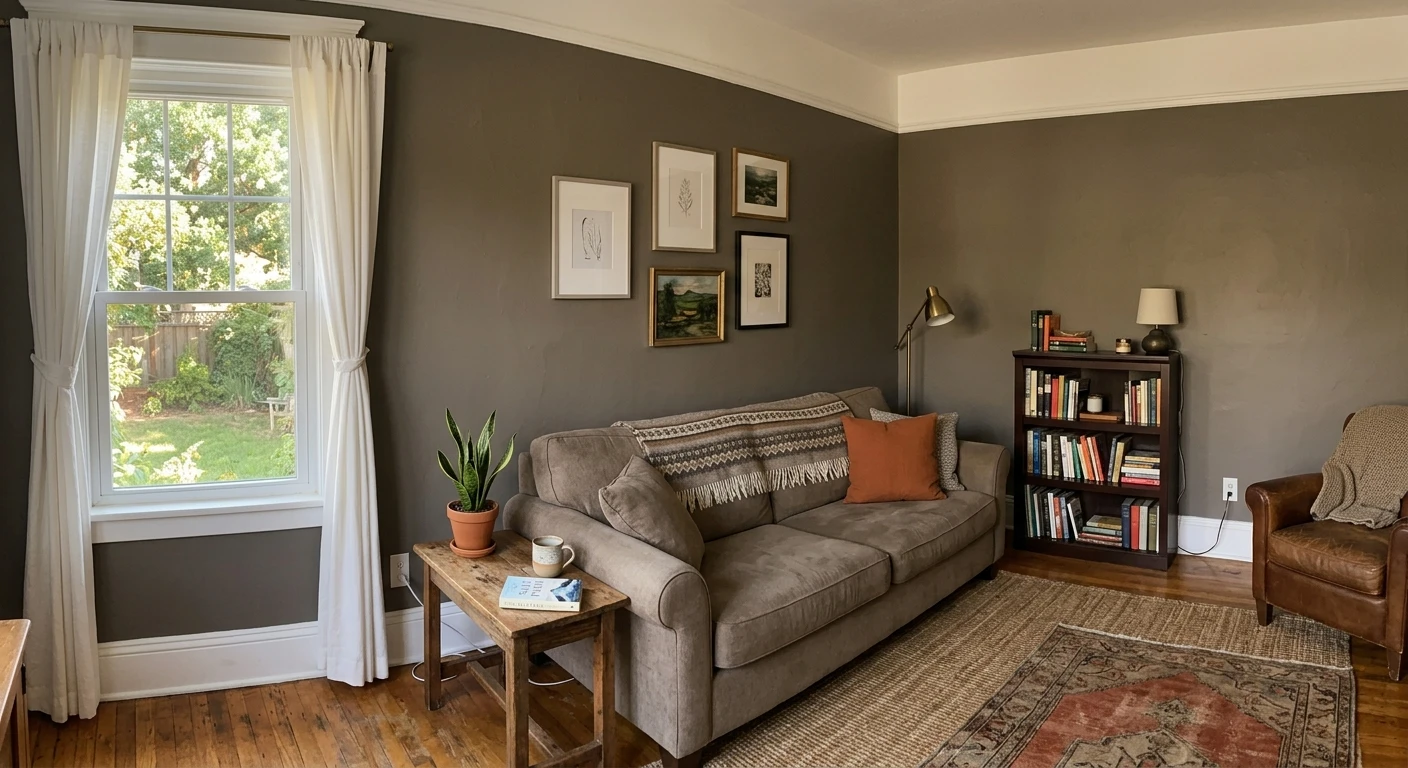
Indoors, Essex Green is a moody-room specialist. A small study or powder room drenched in it (walls, trim, and ceiling all the same near-black green) feels like a jewel box, the green core glowing under lamplight. It is also a superb kitchen-island or built-in color against warm brass and white-oak. For palettes that flatter a deep green like this, see our pairings guide on colors that go with dark green.
Where to think twice
A large, fully shaded north wall is where Essex Green disappoints, because the green never surfaces and you have paid for a green that behaves like black. In hot, sun-blasted climates the LRV-6 surface also absorbs serious heat, which can stress siding and lift adhesion over time, so confirm the product is rated for dark exterior use and consider it for shutters and doors rather than broad walls. If you want green that stays clearly green even in shade, a mid-tone like a sage reads far more reliably; see our Benjamin Moore Saybrook Sage HC-114 guide for that gentler route.
Trim, ceiling, and coordinating pairings
A near-black green lives or dies on what sits next to it. Get the trim right and Essex Green looks intentional and historic; get it wrong and it can read either cold or strangely flat. These Benjamin Moore reels work hard with it:
- Soft warm white (most balanced): BM White Dove (OC-17, LRV 85) is the designer default. Its gentle cream bias gives Essex Green the heritage, slightly-aged contrast that pure white cannot, keeping the pairing classic rather than stark. This is the safe pick for shutters and doors on most houses.
- Crisp bright white (cleaner, cooler): BM Chantilly Lace (OC-65) maximizes contrast and leans modern. Best on a black-window home or where you want the green to read as crisp and graphic against the body.
- Warm greige body (for accent siding): a warm gray-beige body lets Essex Green shutters feel grounded and natural; pair with BM Manchester Tan or a soft greige siding for an earthy, traditional facade.
- Ceilings (interior drench): for a powder room or study, carry Essex Green right up onto the ceiling for the jewel-box effect, or break it with the trim white if you want a touch more air.
- Metals and decor: unlacquered brass, aged bronze, and white-oak flatter the warm green core; polished chrome and cool nickel lean into the blue side for a sharper, cooler look. Natural stone and terracotta both sit beautifully against it.
For an exterior, a black or dark-bronze light fixture and a natural-wood or warm-cream door surround complete the heritage look. If you are choosing between several dark accents for a whole-house scheme, our Benjamin Moore exterior paint colors guide shows where Essex Green fits among the year's most-used darks.
See shutters, door, and trim together on your own house, free.
Essex Green vs the dark greens people confuse it with
Almost every Essex Green search ends in a three-way comparison with the other Benjamin Moore near-black greens. They photograph nearly identically and behave very differently in person. Here is how to tell them apart:
- vs BM Hunter Green (2041-10): the most common mix-up. Hunter Green is a purer, slightly brighter classic green that sits a touch higher on the green axis, so it reads more openly green even in shade where Essex stays near-black. Hunter has a cleaner, more saturated emerald quality; Essex is darker, cooler, and more blue-leaning, with that controlled black-to-green reveal. Choose Hunter when you want the green obvious from the curb; choose Essex when you want it to whisper black and reward a closer look.
- vs BM Black Forest Green (2047-10): the deepest of the three. Black Forest Green is darker and more charcoal, reading black almost everywhere with only the faintest green warmth surfacing in strong sun. Essex Green is the more genuinely green of the pair: at the same distance and light, Essex shows its evergreen sooner. Pick Black Forest Green when you basically want a soft, green-tinged black; pick Essex when you still want the color to register as forest green when the sun is out.
- vs Charleston Green: the historic Southern almost-black. Charleston Green carries a blue-black, nearly-black-with-a-secret quality, famously ambiguous between black, green, and navy. Essex Green is more committed to green and a touch lighter in feel. Use Charleston when you want maximum mystery; use Essex when you want a recognizable, traditional forest green that still reads dark.
Spelling note: essex green benjamin moore, BM Essex Green, and Benjamin Moore Essex Green shutters all point to this same Historical Color. Because all three darks live within a few LRV points of one another, a small sample under your own light is the only reliable way to separate them.
How to test Essex Green before you commit
A 2-inch fan-deck chip is the worst possible way to judge a near-black green: at that size it just reads black, and you cannot see how the green emerges across a real day on a real surface. Two better methods:
- Paint a large sample in the right sheen: brush a 12-by-12-inch swatch (or a peel-and-stick sample) onto the actual shutter, door, or wall, in the finish you plan to use, and check it at dawn, noon, late afternoon, and after dark. Sheen and sun are the whole story with this color, so a flat indoor sample will never show you what a semi-gloss shutter in sun will do.
- Preview it digitally first: upload a real photo of your house or room and apply Essex Green next to Hunter Green and Black Forest Green before you buy any quarts, so you narrow three near-identical darks to the one that actually behaves the way you want in your light.
Preview Essex Green against Hunter Green and Black Forest Green, side by side, free.
Frequently asked questions
Is Benjamin Moore Essex Green actually green or just black?
It is a true forest green, but with an LRV of about 6 it absorbs almost all light, so it reads near-black in flat or shaded light and reveals its cool blue-green core only when direct sun hits it. Sheen matters too: a semi-gloss finish shows the green far more than a flat one. So it is genuinely green, conditionally, which is why it looks black on the chip and evergreen on a sunny shutter.
What is the LRV and hex of Essex Green?
Essex Green has a Light Reflectance Value of about 6, with a hex approximation of #303D33 (RGB 48, 61, 51). That makes it a near-black deep forest green that absorbs almost all the light striking it. Because it is so dark, ask for it in a deep or accent base so the pigment load is correct, and confirm the product is rated for dark exterior use if you are painting siding in a hot, sunny climate.
What are the best uses for Essex Green?
It shines as an exterior accent: shutters, front doors, garage doors, and the body of smaller cottages against bright white trim, where it gives heritage New England contrast with more warmth than flat black. Indoors it is a moody-room specialist for libraries, studies, powder rooms, and cabinetry or kitchen islands paired with brass and white-oak. Avoid it on large, fully shaded walls where the green never gets a chance to surface.
What trim color goes with Essex Green?
BM White Dove (OC-17) is the most balanced choice because its soft cream bias gives Essex Green a heritage, slightly-aged contrast that pure white cannot. For a crisper, more modern look, BM Chantilly Lace (OC-65) maximizes contrast and suits black-window homes. On accent siding, a warm greige body grounds Essex Green shutters for an earthy, traditional facade, and brass or aged-bronze hardware brings out the warm green core.
What is the difference between Essex Green and Hunter Green 2041-10?
Hunter Green (2041-10) is a purer, slightly brighter classic green that reads more openly green even in shade, with a cleaner emerald quality. Essex Green is darker, cooler, and more blue-leaning, staying near-black until sun reveals its forest-green core. Choose Hunter when you want the green obvious from the curb, and Essex when you want it to read black at a distance and reward a closer look. Black Forest Green (2047-10) is darker still, the most charcoal of the three.
Preview BM Essex Green on your actual shutters, door, or walls under your own light before buying a single quart.
Disclaimer: Benjamin Moore, Essex Green, Hunter Green (2041-10), Black Forest Green (2047-10), White Dove (OC-17), Chantilly Lace (OC-65), Manchester Tan, and Saybrook Sage (HC-114) are trademarks of Benjamin Moore & Co. FacadeColorizer is an independent paint visualization service and is not affiliated with, endorsed by, or sponsored by Benjamin Moore. Color reproduction on screens approximates the manufacturer's chip; always confirm with a manufacturer sample under your own light before purchase. Sources: Benjamin Moore Essex Green Historical Color data 2026, Benjamin Moore Hunter Green 2041-10 and Black Forest Green 2047-10 color data 2026, The Spruce dark-green paint coverage, designer field reports compiled by FacadeColorizer.
Trademarks mentioned (Sherwin-Williams, Benjamin Moore, Behr, Caparol, Brillux, Sto, Alpina, Valspar, PPG, Glidden, Dulux, Crown Trade, Sandtex, Farrow & Ball, Johnstone's, Leyland) are property of their respective owners. FacadeColorizer is independent and not affiliated with any of them. Nominative fair use under Lanham Act §1125.