Try it on your room

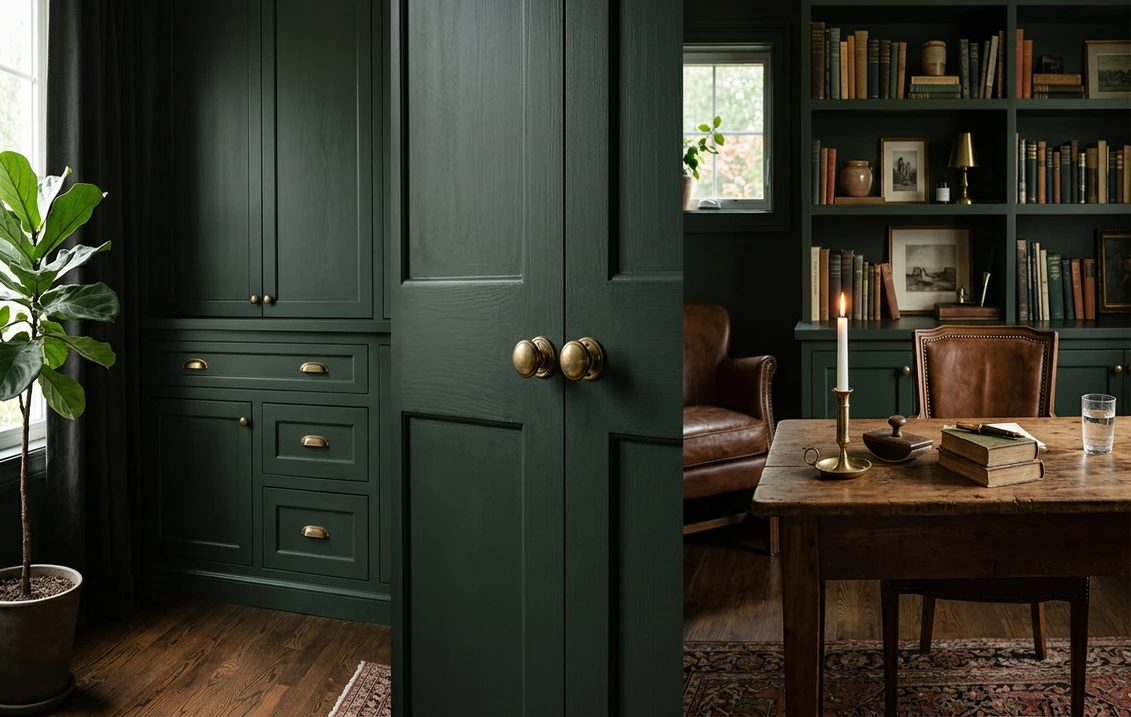
The first time a client asked me to roll Benjamin Moore Black Forest Green (2047-10) on a dining room, she warned me she wanted "a green that looks black, but only when it wants to." That is the single best description of this color I have ever heard. Black Forest Green is one of those deep, almost-black greens that behaves like a chameleon: in a dim corner or under low evening light it reads as a rich, sophisticated near-black, then a shaft of daylight hits it and the forest green wakes up, glowing and saturated. It is the color people reach for when plain black feels too cold and a true green feels too loud. The whole question, the one that fills every search bar, is whether it reads more black or more green in a real room. The honest answer depends entirely on your light, and here is exactly how it plays out.
Quick orientation before the deep dive. Black Forest Green 2047-10 has an LRV of about 6 and a hex approximation of #2B3A2F (RGB 43, 58, 47). That LRV puts it firmly in the near-black drenching zone: it absorbs almost all the light that hits it, which is exactly why it can pass for black in low light and why it demands a real light source to show its green. The undertone is a clean, slightly cool forest green with the faintest gray softening it, no yellow-olive cast and no blue-teal tip. This profile is one stop in our wider Benjamin Moore interior paint colors guide, and it sits in the same deep, moody family as Hale Navy HC-154: this page stays squarely on Black Forest Green's interior undertone, rooms, and pairings.
Upload a photo of your actual room and preview BM Black Forest Green under your own light in about 30 seconds. Free: 1 HD render plus 3 variations.
Black Forest Green at a glance: the numbers that matter
Before opinions, here are the verifiable specs straight from the Benjamin Moore color library. These are the values you can take to a paint counter and the ones that explain its behavior:
| Spec | Black Forest Green 2047-10 |
|---|---|
| Color number | 2047-10 (Color Preview collection) |
| LRV (Light Reflectance Value) | Approximately 6: near-black, absorbs almost all light |
| Hex / RGB (approx.) | #2B3A2F / 43, 58, 47 |
| Color family | Deep, near-black forest green |
| Primary undertone | Clean cool green with a faint gray, no yellow-olive cast |
| Best base / finish | Deep tint base; matte or eggshell on walls, satin or semi-gloss for cabinets and millwork |
Try it on your house
No photo? Try a sample
The takeaway from those numbers: at LRV 6, Black Forest Green is a true drenching color, in the same league of darkness as black and charcoal. That low number is not a flaw, it is the whole point: it is what lets the color disappear into shadow and read as near-black, then reveal its green only where light lands. Use it the way you would use a black, with respect for how much light a room actually gets. One practical note before you buy: because it is a deep base, you will almost always need two full coats, and a tinted gray primer underneath will save you a third. The clean green undertone, with no muddy yellow-olive in it, is its signature, and it is what separates Black Forest Green from the warmer near-black greens.
Is Black Forest Green black or green? The undertone, decoded
Black Forest Green is a green, not a black, but it spends a good part of every day pretending to be black. Understanding when it shows which face is the entire skill of using it well. Here is what is happening underneath.
The green pigment is genuine and clean, leaning very slightly cool, the color of deep pine needles in shade rather than the warm khaki of olive. There is a whisper of gray that keeps it from ever looking neon or kelly, which is what makes it feel grown-up and architectural instead of sporty. But the dominant variable is not the pigment, it is the light. At LRV 6 the color has so little reflectance that in low or indirect light there simply is not enough returning light for your eye to read the hue, so it collapses toward black. Add direct light, daylight from a south window or a warm bulb aimed at the wall, and suddenly the green floods back in and the wall glows like a forest canopy.
Watch out for one quirk. Black Forest Green reads far greener on a small chip held near a window than it ever will across a finished, drenched wall in an average room. The chip is small and brightly lit; a real wall is large and shares the room's ambient shadow. So if you fell in love with the green on the fan deck, expect the finished room to skew noticeably more black, especially on the wall opposite the window and in every corner.
| Indoor light | How Black Forest Green reads |
|---|---|
| South-facing (bright, warm) | At its greenest and richest; the forest hue glows and the wall feels alive |
| West-facing (warm afternoon) | Warm late sun deepens it to a glowing bottle green, very flattering by candlelight hours |
| East-facing (cool after noon) | Crisp green in the morning, then settles toward near-black for the rest of the day |
| North-facing (cool, indirect) | Reads mostly as a cool near-black; the green only peeks through near the window |
| Artificial light at night | Warm 2700K bulbs revive the green and make it cozy; cool 4000K bulbs flatten it toward gray-black |
Sources: Benjamin Moore 2047-10 color data 2026; deep-color drenching coverage and LRV behavior; designer field reports compiled by FacadeColorizer.
Free AI visualizer. See whether Black Forest Green reads green or black on your real walls before buying a single sample pot.
Best rooms for Black Forest Green
Deep, enveloping, and dramatic, Black Forest Green is a color you drench a room in, not a safe whole-home neutral. It is happiest where you want intimacy, drama, or a jewel-box effect, and it rewards rooms you mostly use in the evening. Here is where it consistently earns its keep:
Dining rooms drenched for drama
This is Black Forest Green's home turf. A dining room is used mostly after dark, under warm bulbs and candlelight, which is exactly when this green glows its richest. Drench all four walls, the trim, and even the ceiling, add brass sconces and white china, and you get a moody, restaurant-grade backdrop. It is one of the most striking picks in our roundup of elegant dining room paint colors for 2026, where color drenching is the headline trend.
Studies, libraries, and home offices
The near-black depth gives a small study the cocooning, library feel that makes you want to close the door and read. Against warm wood shelving, leather, and brass it reads scholarly and expensive. It is a smarter, less expected alternative to charcoal for a focus room, with the same grounding effect; if you are weighing deep focus colors, our guide to the year's best home office paint shades is a useful map.
Cabinetry, islands, and built-ins
Where Black Forest Green truly excels is on millwork. A kitchen island, a run of lower cabinets, a fireplace built-in, or a powder-room vanity in this green looks bespoke and high-end, especially in satin or semi-gloss where the sheen lets the green catch light and show its true hue. It pairs naturally with unlacquered brass, marble with green veining, and warm oak.
Moody bedrooms and powder rooms
For a deeply restful, enveloping bedroom, drenching the walls in Black Forest Green creates a cocoon that feels like sleeping in a forest. A windowless powder room is the lowest-risk way to test a near-black color, because you expect drama in a small jewel-box space. See how it sits next to other deep picks in our guide to dark and moody bedroom paint ideas.
Where to think twice
A small, dim, north-facing room you use mostly in daytime is where Black Forest Green can disappoint, because the green never gets enough light to show and you are left with a flat, slightly gloomy near-black. It is also a poor choice for a bright, breezy, airy aesthetic; at LRV 6 it will shrink and darken the space, not open it. If you want green but want light, choose a sage or mid-green instead, not this one.
Trim, ceiling, and decor pairings
A near-black green lives or dies on contrast. Get the pairings right and Black Forest Green looks tailored and expensive; get them wrong and it can read either harsh or muddy.
- Soft warm white trim (most balanced): BM White Dove (OC-17, LRV 85) is the designer default against deep greens. Its gentle cream bias keeps the contrast crisp without the icy harshness a stark white can bring, so the green looks intentional and warm rather than stark.
- Tone-on-tone drench (most dramatic): paint the trim, doors, and even the ceiling the same Black Forest Green. This is the modern color-drench look and it makes a small dining room or study feel like a velvet box. Vary the sheen (matte walls, satin trim) so edges still read.
- Crisp clean white (cleaner, cooler): BM Chantilly Lace (OC-65) gives a sharp, modern, gallery-like edge and maximum contrast. Best where you want the green to look architectural and graphic rather than cozy.
- Avoid: a heavy yellow-olive cream trim. It fights Black Forest Green's clean cool green and can make both colors look slightly dirty.
- Metals and decor: unlacquered or antique brass is the perfect partner, warm against the cool green. Marble, warm oak, leather, and aged bronze all sing. Polished chrome and cool nickel can read a little cold next to it.
For a full palette around the color, our guide to colors that go with dark green covers the warm whites, blush, terracotta, and brass that flatter it, and our interior green paint shades guide shows where this near-black green sits among lighter options if you want to step down a level.
See walls, trim, and brass together in one preview. Free.
Black Forest Green vs the deep greens people confuse it with
Almost every Black Forest Green search ends in a side-by-side with another dark Benjamin Moore green. These are the two that matter most, and they are genuinely different colors, not just spelling variants:
- vs BM Hunter Green (2041-10): the most important comparison. Hunter Green is a touch brighter and more saturated, with slightly higher reflectance, so it stays visibly, recognizably green even in dimmer light. Black Forest Green is the darker, more restrained one: it leans further toward black and only shows its green where light lands. Choose Hunter Green when you want the color to read as green most of the time; choose Black Forest Green when you want a near-black that happens to be green, a more sophisticated and chameleon-like effect. In a low-light room Hunter Green will still feel green while Black Forest Green will feel black.
- vs BM Narragansett Green (HC-157): Narragansett is a grayer, slightly bluer deep green from the Historical collection. It reads softer, mossier, and more muted, with a foggy, weathered quality. Black Forest Green is cleaner, truer green, and darker. Pick Narragansett for a hazy, coastal, lived-in deep green; pick Black Forest Green for a crisper, more dramatic near-black green with no blue-gray fog.
If you want the deepest of the three by a clear margin, Black Forest Green is it. Hunter Green is the most overtly green, and Narragansett is the most muted and gray. They are not interchangeable, and the difference is obvious the moment you put them on the same wall.
Spelling note: black forest green BM, Benjamin Moore black forest green 2047-10, and black forest green Benjamin Moore all point to this same 2047-10. For an even darker historic near-black green look (more black than green), our Charleston Green guide covers the classic almost-black green.
How to test Black Forest Green before you commit
A 2-inch fan-deck chip is the single biggest reason people get a near-black green wrong: it is small and brightly lit, so it always looks far greener than the finished room will. Two better methods:
- Paint a large swatch: roll a 2-foot square (or a big peel-and-stick sample) on two different walls, including the darkest wall in the room, and look at it mid-morning, mid-afternoon, and at night under your normal bulbs. Pay attention to the corner farthest from the window; that corner tells you how black it will really read most of the day.
- Preview it digitally first: upload a real photo of your room and apply Black Forest Green (plus Hunter Green and a step-lighter green) before you buy any samples, so you can narrow three contenders to the one worth painting two coats of.
Preview Black Forest Green against Hunter Green, side by side, on your real walls. Free: 1 HD render plus 3 variations.
Frequently asked questions
Is Black Forest Green black or green?
Black Forest Green 2047-10 is a true green that reads near-black in low light. With an LRV of about 6 it absorbs almost all the light that hits it, so in dim or indirect light there is not enough returning light for your eye to see the hue and it looks black. Add direct daylight or warm lamplight and the clean forest green floods back. It is greenest in south and west light, and most black-looking in north light and in corners.
What is the LRV of Black Forest Green 2047-10?
Black Forest Green has a Light Reflectance Value of about 6 on the Benjamin Moore color data, with a hex approximation of #2B3A2F (RGB 43, 58, 47). That LRV puts it in the near-black drenching zone, in the same darkness league as black and charcoal. It is a deep tint base, so plan on two full coats and ideally a tinted gray primer underneath for clean, even coverage.
What are the best rooms for Black Forest Green?
Dining rooms, studies, libraries, home offices, moody bedrooms, powder rooms, and cabinetry or islands are where Black Forest Green shines, because its near-black depth creates an intimate, jewel-box drama that looks richest under warm evening light. It is least reliable in small, dim, north-facing rooms used mostly in daytime, where the green never gets enough light to show and the wall reads flat near-black.
What trim color goes with Black Forest Green?
BM White Dove (OC-17) is the most balanced trim because its soft warm-white bias keeps the contrast crisp without the icy harshness of a stark white. For a dramatic modern look, drench the trim and ceiling in the same Black Forest Green and vary the sheen. BM Chantilly Lace (OC-65) gives the cleanest, most gallery-like contrast. Avoid a heavy yellow-olive cream, which fights the clean green. Unlacquered brass is the ideal metal partner.
What is the difference between Black Forest Green and Hunter Green?
Hunter Green (2041-10) is a touch brighter and more saturated, so it stays visibly green even in dimmer light. Black Forest Green (2047-10) is darker and more restrained, leaning further toward black and showing its green only where light lands. Choose Hunter Green when you want the color to read as green most of the time, and Black Forest Green when you want a sophisticated near-black that happens to be green.
Preview BM Black Forest Green on your actual walls under your own light before buying a single sample pot.
Disclaimer: Benjamin Moore, Black Forest Green (2047-10), Hunter Green (2041-10), Narragansett Green (HC-157), White Dove (OC-17), and Chantilly Lace (OC-65) are trademarks of Benjamin Moore & Co. FacadeColorizer is an independent paint visualization service and is not affiliated with, endorsed by, or sponsored by Benjamin Moore. Color reproduction on screens approximates the manufacturer's chip; always confirm with a manufacturer sample under your own light before purchase. Sources: Benjamin Moore 2047-10 Black Forest Green color data 2026, Benjamin Moore 2041-10 Hunter Green and HC-157 Narragansett Green color data 2026, deep-color drenching and LRV behavior coverage, designer field reports compiled by FacadeColorizer.
Trademarks mentioned (Sherwin-Williams, Benjamin Moore, Behr, Caparol, Brillux, Sto, Alpina, Valspar, PPG, Glidden, Dulux, Crown Trade, Sandtex, Farrow & Ball, Johnstone's, Leyland) are property of their respective owners. FacadeColorizer is independent and not affiliated with any of them. Nominative fair use under Lanham Act §1125.