Try it on your room

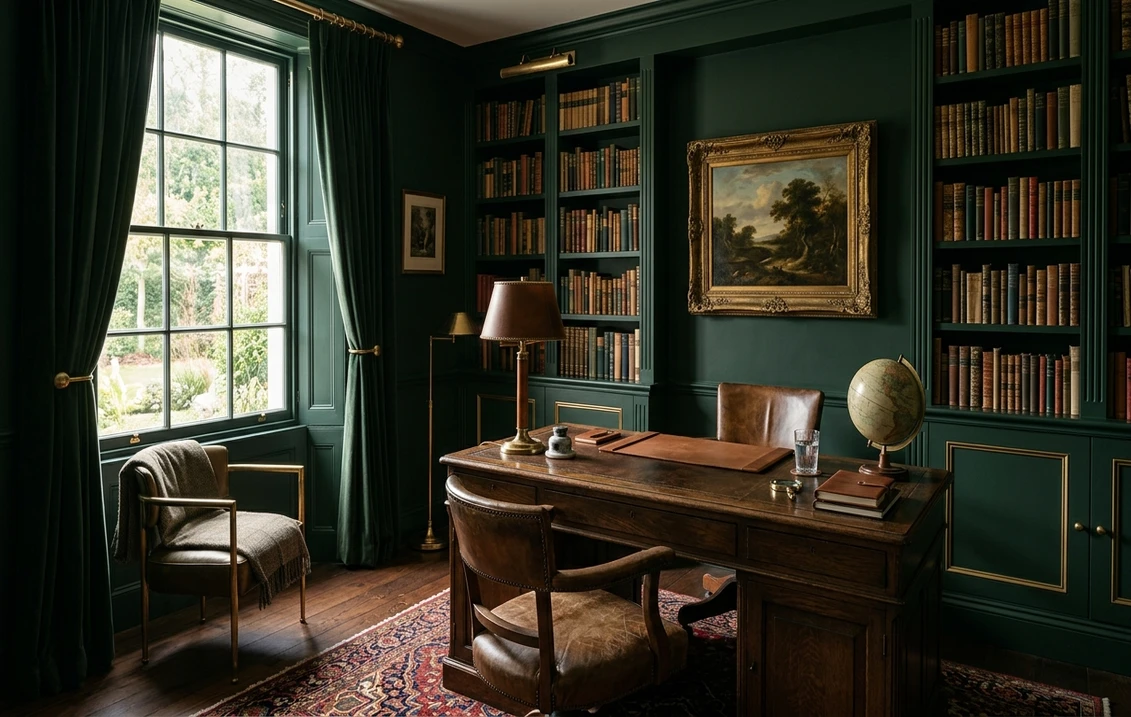
Most deep greens that land in a paint deck are quietly afraid of being green. They hedge toward black, drift toward gray, or hide a teal undertone so the color reads safe in a magazine. Benjamin Moore Hunter Green (2041-10) does none of that. It is an unapologetically vivid, true, saturated green: the color of a billiard table, an old British racing car, a hand-painted front door on a Georgian townhouse. When clients ask me for a green that actually looks green and not like a dirty bottle, this is the one I pull. The trade-off is that vividness is loud, and a loud green needs the right room, the right light, and the right neighbor colors or it tips from striking to garish. Here is exactly how Hunter Green 2041-10 behaves on real interior walls.
Quick orientation before the deep dive. Hunter Green 2041-10 has a published LRV of about 6 and a hex approximation of #23372B (RGB 35, 55, 43). That is genuinely deep: an LRV of 6 reflects very little light, so this is firmly in dark, dramatic, mood-making territory rather than the soft sage range. The undertone is a clean, slightly warm green that leans neither blue nor yellow hard enough to call it teal or olive. This profile is one stop in our wider Benjamin Moore interior paint colors guide, and it sits alongside the other saturated greens in our overview of the best interior green paint shades. This page stays on Hunter Green specifically: its numbers, its light behavior, and the deep greens it gets confused with.
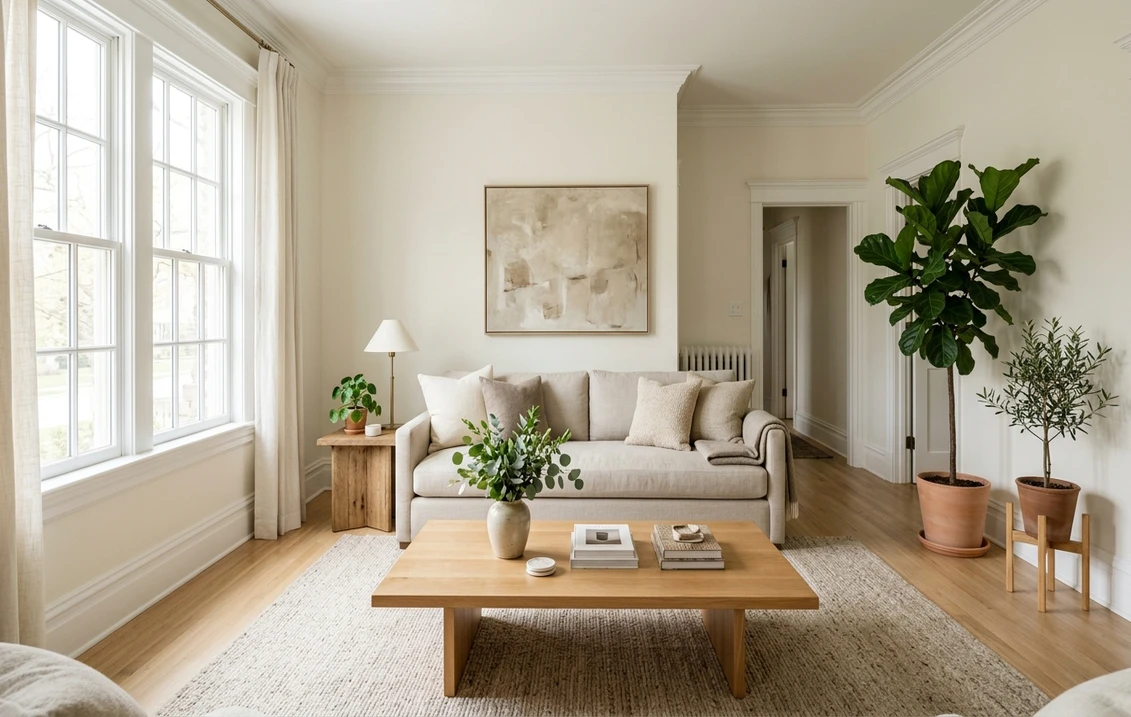
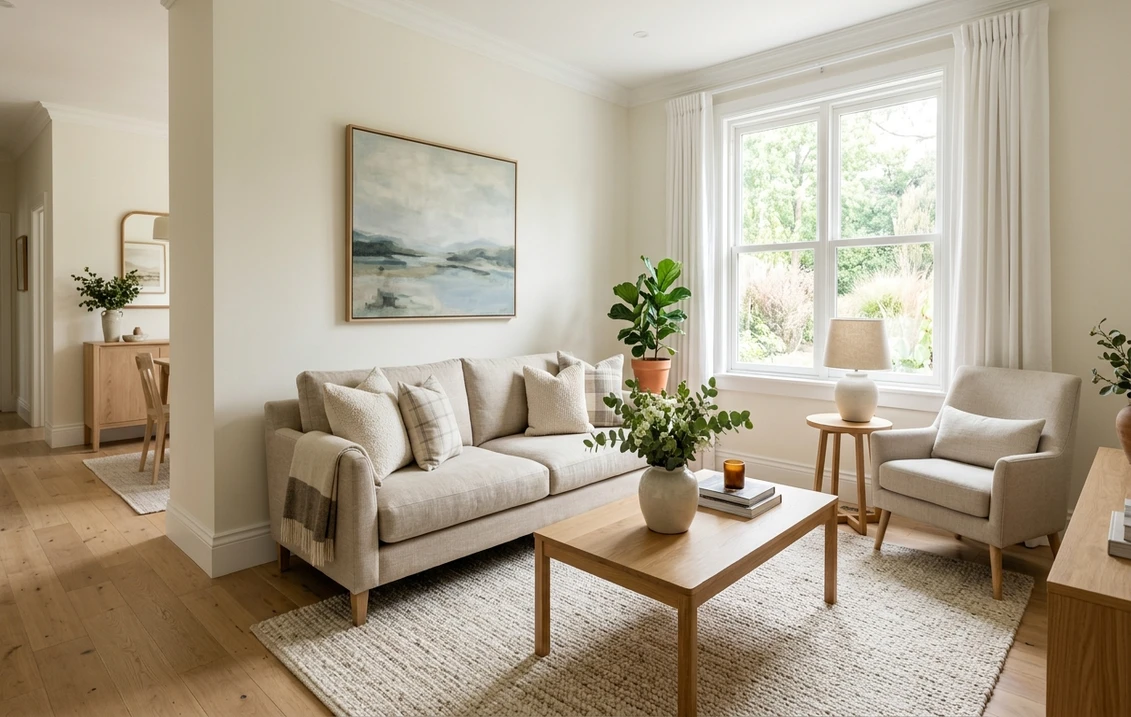
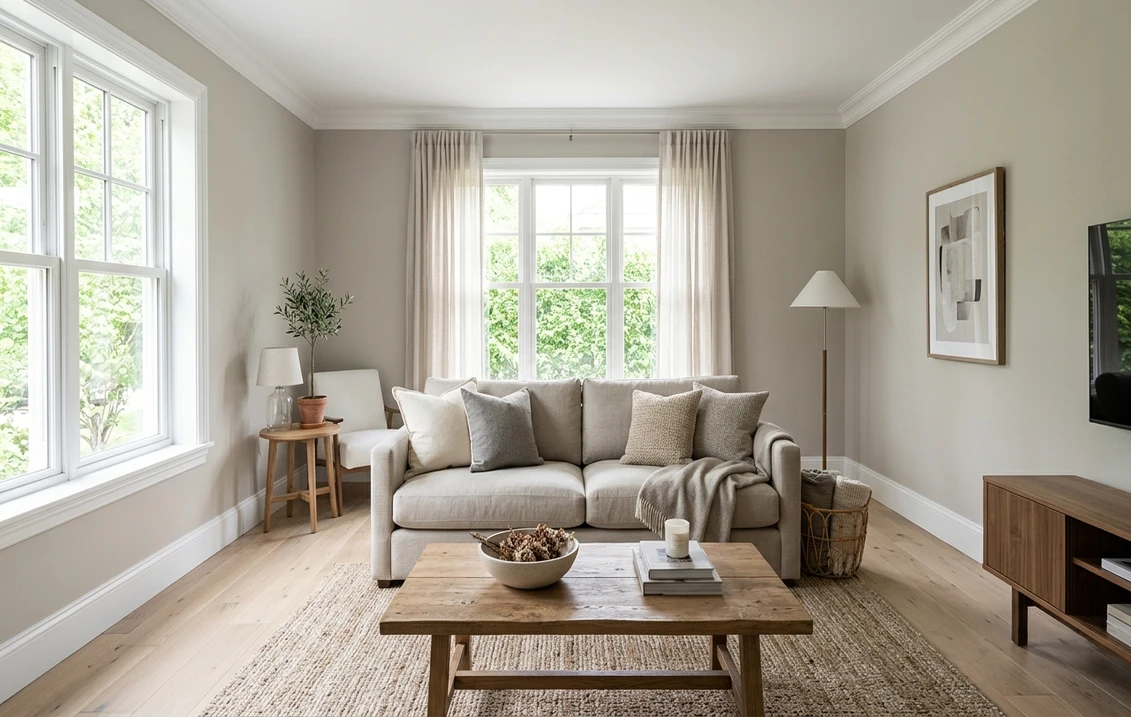
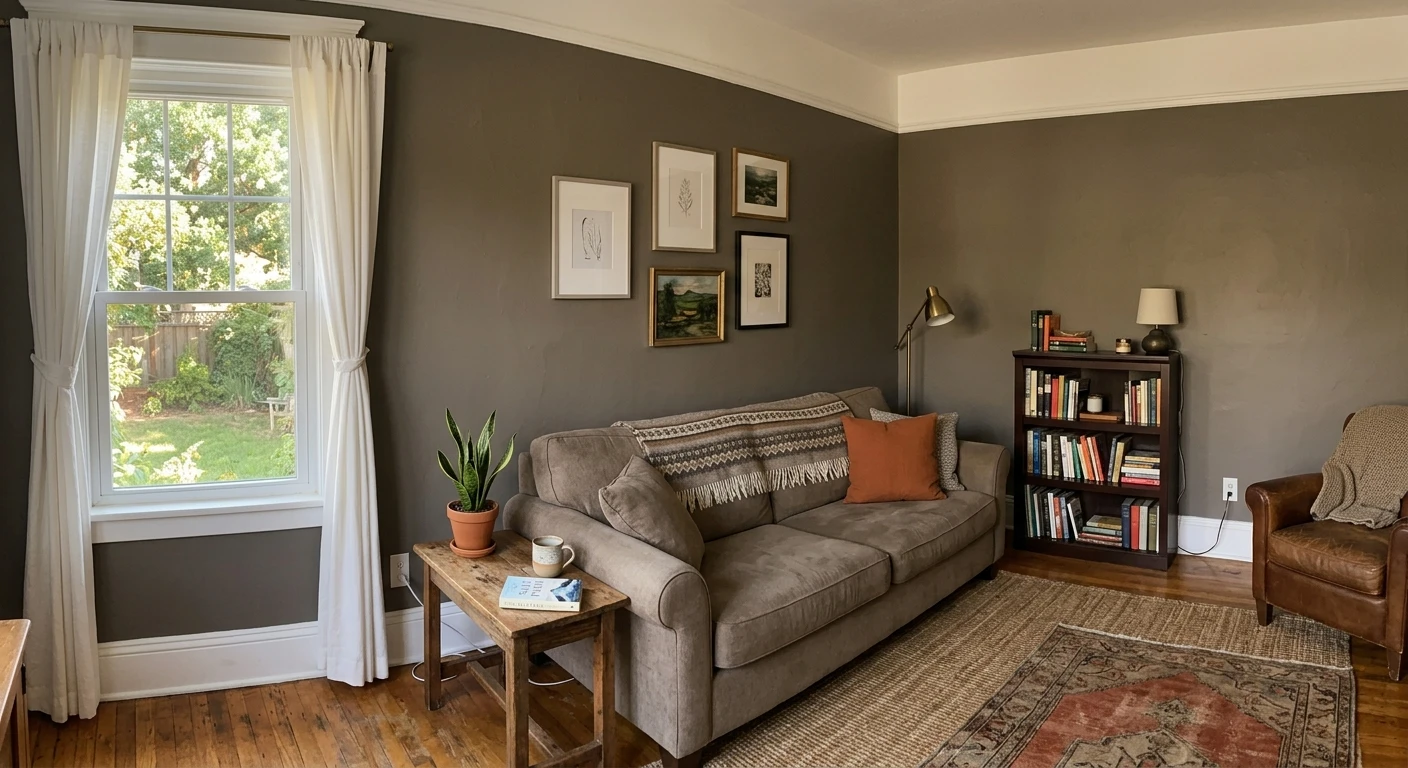
Upload a photo of your actual room and preview BM Hunter Green 2041-10 under your own light in about 30 seconds. Free, with one HD render and three variations.
Hunter Green at a glance: the numbers that matter
Before opinions, here are the verifiable specs straight from the Benjamin Moore color library. These are the values you can take to a paint counter:
| Spec | Hunter Green 2041-10 |
|---|---|
| Color number | 2041-10 (Color Preview collection) |
| LRV (Light Reflectance Value) | Approximately 6: very deep, absorbs most light, true drama |
| Hex / RGB (approx.) | #23372B / 35, 55, 43 |
| Color family | Deep, vivid true green |
| Primary undertone | Clean green with a faint warm (yellow-leaning) base, no strong teal |
| Best base / finish | Deep tint base; matte or eggshell on walls, satin to semi-gloss on cabinetry and doors |
Try it on your house
No photo? Try a sample
The takeaway from those numbers: Hunter Green is a true saturated green, not a near-black that happens to be green and not a gray-green hedge. At LRV 6 it behaves like a dark color first and a green second, meaning it will eat light, show every brushstroke and roller lap if your prep is sloppy, and demand a high-quality matte or eggshell to look even. But unlike the blacker deep greens, that vividness survives. Even in a dim corner Hunter Green stays recognizably, confidently green where its rivals go to charcoal. That single fact is the whole reason to choose it.
Is Hunter Green too vivid? The undertone, decoded
Hunter Green is a vivid color, full stop. Anyone selling it as a quiet, safe, blend-into-the-background green is misreading it. But vivid is not the same as loud-in-every-room, and understanding the undertone is what keeps a saturated green looking rich and tailored instead of crayon-bright. Here is what is happening underneath.
The dominant note is a clean, balanced green that sits almost exactly between blue-green and yellow-green, with the needle nudged a hair toward warm. That faint warmth is what stops it from reading cold or teal the way Newburg Green can. There is no strong gray pigment dulling it down, which is precisely why it stays so saturated and so green: there is nothing muddying the chroma. In bright, warm light the warm base lifts and Hunter Green looks lush and almost emerald-rich. In cool, indirect light the warmth drains and the color deepens toward a darker, more forest tone, but critically it does not turn teal or blue the way a more blue-based green would. It just gets darker and a touch more serious.
Watch out for one quirk specific to very dark, saturated colors. Because LRV 6 absorbs so much light, Hunter Green looks far brighter and more vivid on a small chip held to the window than it ever will as a finished wall in a real room. Rolled out at scale, with shadow falling across furniture and trim, it deepens and calms noticeably. So the fear that it will be too loud is usually overstated by the chip. The opposite surprise is more common: people worry it will be neon and instead find it reads rich and grounded once the whole wall is up.
| Indoor light | How Hunter Green reads |
|---|---|
| South-facing (bright, warm) | Lush and rich, the warm base lifts toward an emerald glow; its most vivid read |
| West-facing (warm afternoon) | Deep and saturated late in the day, almost jewel-like under low sun |
| East-facing (cool after noon) | Bright green in the morning, settles into a deeper forest tone by afternoon |
| North-facing (cool, indirect) | Darkest and most serious; stays green rather than turning teal, but loses its sparkle |
| Artificial light at night | Warm 2700K bulbs make it glow rich and cozy; cool 4000K bulbs flatten it toward a colder, blacker green |
Sources: Benjamin Moore 2041-10 color data 2026; deep-color LRV behavior coverage; designer field reports compiled by FacadeColorizer.
Free AI visualizer. See how Hunter Green deepens on your real walls before buying a single sample pot.
Best rooms for Hunter Green 2041-10
Deep, vivid, and confident, Hunter Green is a feature color, not a whole-home neutral. It is the color you reach for when you want a room to feel intentional, layered, and a little dramatic. Here is where it consistently earns its keep:
Dining rooms and studies
This is Hunter Green's home turf. A dining room or library wrapped in 2041-10 (walls, trim, and ceiling all the same color, the classic color-drenched look) feels rich, enveloping, and grown-up, the kind of room that flatters candlelight and brass. Because the green stays vivid even at LRV 6, the room reads as a deliberate jewel box rather than a dark cave. It is one of the most striking deep greens for moody, formal spaces.
Kitchen islands and cabinetry
Hunter Green on a kitchen island or a run of lower cabinets is a modern classic. Paired with brass or unlacquered-bronze hardware, white oak, and a warm white upper cabinet, it reads timeless rather than trendy. Its saturation gives cabinetry more life than the safer muddy greens. If cabinets are your project, our deeper look at the best green kitchen cabinet paint colors shows where it sits among the other contenders.
Accent walls and bedrooms aiming for cocoon
A single Hunter Green accent wall behind a bed or a built-in adds depth without committing a whole room to darkness, and a fully color-drenched bedroom in 2041-10 feels like a cocoon: restful, enveloping, and quietly luxurious. For more on building a calm-but-deep green bedroom, see our guide to green bedroom paint ideas.
Where to think twice
A small, north-facing room with only cool LED light is where Hunter Green can lose its magic. There the warmth drains, the green goes flat and heavy, and an LRV of 6 leaves the space genuinely dim. If that room must feel bright and open, this is the wrong choice; reach for a lighter sage instead, or commit fully and lean into the darkness with warm 2700K lighting and rich textiles. Hunter Green rewards warm light, so do not pair it with cold bulbs.
Trim, ceiling, and decor pairings
A vivid deep green lives or dies on what sits next to it. Get the neighbors right and Hunter Green looks like a designer did it; get them wrong and it can read either harsh or weirdly dated.
- Warm white trim (most balanced): BM White Dove (OC-17, LRV 85) is the designer default. Its gentle cream bias is warm enough to flatter Hunter Green's faint warm base, giving high contrast without the harsh, clinical edge a stark blue-white would create. This is the safe, cohesive pick for most rooms.
- Soft creamy contrast: BM Swiss Coffee (OC-45) or a soft cream pushes the room warmer and more traditional, perfect for a Georgian or cottage feel where you want Hunter Green to read heritage rather than modern.
- Lower-contrast off-white: White Dove and Swiss Coffee both sit high on the reflectance scale, so against an LRV 6 wall the trim snaps out hard. If you want that step gentler, a creamier off-white nearer LRV 73, such as Benjamin Moore Maritime White OC-5, keeps the woodwork clearly lighter without the graphic edge. It suits period rooms where crisp modern contrast feels wrong.
- Color-drenched (no contrast): for the most dramatic, modern look, paint trim and ceiling the same Hunter Green in a slightly higher sheen than the walls. The sheen shift does the work the contrast usually does, and the room feels seamless and enveloping.
- Avoid: a stark, cool, blue-white trim like a builder's bright white. The cool-warm clash can make Hunter Green look slightly acidic and the trim look chalky next to it.
- Metals and decor: brass, antique gold, and unlacquered bronze are the natural partners; they pull out the warmth in the green and read luxe. White oak, walnut, cane, and cream linen all flatter it. Cool chrome and stark black-and-white schemes fight the warm green and feel harsher.
For a deeper map of what pairs with a saturated dark green like this, our guide to colors that go with dark green walls through accent and decor combinations in detail.
See walls, trim, and cabinetry together in one preview. Free.
Hunter Green vs the deep greens people confuse it with
Almost every Hunter Green search ends in a side-by-side with another dark Benjamin Moore green. These three are the ones that genuinely look close on a chip and behave very differently on a wall. This is the section to read before you buy a sample.
- vs Essex Green: Essex Green is the classic shutter-and-door deep green, and it runs noticeably darker, blacker, and more muted than Hunter Green. Essex reads almost like a green-black with the chroma turned down, the safe heritage choice that disappears into a shadow at dusk. Hunter Green is brighter, cleaner, and stays visibly green. Choose Essex when you want a near-neutral deep green that whispers; choose Hunter Green 2041-10 when you want the green to actually announce itself.
- vs Black Forest Green (2047-10): these two are the closest twins by number, both deep Color Preview greens, but Black Forest is meaningfully blacker and quieter. In low light Black Forest reads almost charcoal while Hunter Green still reads as a true green. Black Forest is the pick when you want drama that flirts with black; Hunter Green is the pick when you want drama that stays green. If you love deep green but worry yours will look gray in a dim corner, Hunter is the safer of the two.
- vs Newburg Green (HC-158): Newburg is a Historical Color that leans dustier, cooler, and more teal, with a touch of gray softening it down. It reads quieter and more antique, almost a deep teal-green. Hunter Green is cleaner, warmer, and more purely green with no blue drift. Choose Newburg for a muted, blue-leaning heritage green; choose Hunter for a vivid, true, warmer green. We cover the teal sibling in full in our Benjamin Moore Newburg Green HC-158 review.
Spelling note: BM Hunter Green, Hunter Green 2041-10, and Benjamin Moore hunter green 2041 10 all point to this same Color Preview green.
One question the fan deck never settles: does Hunter Green belong on a front door? It can be tinted into an exterior formula, and the billiard-green door is a real look. But it is not one of the Benjamin Moore greens homeowners actually land on at the entry. Only three greens make the ranked door list: Saybrook Sage HC-114 (far lighter, LRV 49), Black Forest Green 2047-10, and Tarrytown Green HC-134. If the door is the project, start from our ranked guide to Benjamin Moore front door paint colors rather than from an interior favorite; if the room is the project, Hunter Green is exactly where the saturation pays off.
How to test Hunter Green before you commit
A 2-inch fan-deck chip is the number-one reason people misjudge a deep, vivid green: it exaggerates the brightness, hides how dark LRV 6 really plays at scale, and cannot show how the green deepens as shadow falls across a finished wall. Two better methods:
- Paint a large swatch: roll a generous 2-by-2-foot sample (or a peel-and-stick sample) on two different walls and check it mid-morning, mid-afternoon, and at night under your normal bulbs. With a color this dark, prime first or use two coats so you judge the true tone, not a thin patchy version. Watch how it reads in your dimmest corner; that corner tells you whether the room will feel rich or just dark.
- Preview it digitally first: upload a real photo of your room and apply Hunter Green (plus one blacker option like Black Forest and one lighter sage) before you buy any samples, narrowing three contenders to the one worth painting two coats of.
Preview Hunter Green against a blacker green and a lighter sage, side by side. Free.
Frequently asked questions
What is the LRV of Benjamin Moore Hunter Green 2041-10?
Hunter Green 2041-10 has a Light Reflectance Value of about 6 on the Benjamin Moore color data, with a hex approximation of #23372B (RGB 35, 55, 43). That makes it a genuinely deep, dramatic color that absorbs most light, so it behaves like a dark color first and a green second. Use a quality matte or eggshell and two coats over a tinted primer so the saturated tone reads evenly.
Is Hunter Green warm or cool?
Hunter Green is a clean, true green with a faint warm (yellow-leaning) base, so it reads slightly warm rather than cool. It sits almost exactly between blue-green and yellow-green, which is why it never drifts teal the way Newburg Green can. In warm or south light it glows rich and almost emerald; in cool north light it deepens and gets more serious but stays green rather than turning blue.
What is the difference between Hunter Green and Essex Green?
Essex Green is darker, blacker, and more muted, the classic heritage shutter-and-door green that nearly disappears into shadow at dusk. Hunter Green 2041-10 is brighter, cleaner, and stays visibly, confidently green even in low light. Choose Essex when you want a near-neutral deep green that whispers, and Hunter Green when you want the green to actually announce itself.
What rooms work best for Hunter Green?
Dining rooms, studies and libraries, kitchen islands and cabinetry, accent walls, and cocoon-style bedrooms are where Hunter Green shines, because its saturation keeps deep walls feeling like a jewel box rather than a cave. It is least reliable in small, north-facing rooms lit only by cool LED bulbs, where the warmth drains and an LRV of 6 leaves the space dim; warm 2700K lighting or a lighter sage are better there.
What trim color goes with Hunter Green?
BM White Dove (OC-17) is the most balanced trim because its gentle cream bias is warm enough to flatter Hunter Green's faint warm base, giving crisp contrast without a clinical edge. For maximum drama, color-drench the trim and ceiling in the same Hunter Green at a higher sheen. Avoid a stark cool blue-white, which can make the green look slightly acidic and the trim look chalky beside it.
Preview BM Hunter Green 2041-10 on your actual walls under your own light before buying a single sample. One HD render and three variations included.
Disclaimer: Benjamin Moore, Hunter Green (2041-10), Black Forest Green (2047-10), Newburg Green (HC-158), Essex Green, White Dove (OC-17), and Swiss Coffee (OC-45) are trademarks of Benjamin Moore & Co. FacadeColorizer is an independent paint visualization service and is not affiliated with, endorsed by, or sponsored by Benjamin Moore. Color reproduction on screens approximates the manufacturer's chip; always confirm with a manufacturer sample under your own light before purchase. Sources: Benjamin Moore 2041-10 Hunter Green color data 2026, Benjamin Moore 2047-10 Black Forest Green and HC-158 Newburg Green color data 2026, deep-color LRV behavior coverage, designer field reports compiled by FacadeColorizer.
Trademarks mentioned (Sherwin-Williams, Benjamin Moore, Behr, Caparol, Brillux, Sto, Alpina, Valspar, PPG, Glidden, Dulux, Crown Trade, Sandtex, Farrow & Ball, Johnstone's, Leyland) are property of their respective owners. FacadeColorizer is independent and not affiliated with any of them. Nominative fair use under Lanham Act §1125.