Try it on your room

The first thing people get wrong about Benjamin Moore Newburg Green (HC-158) is filing it next to the near-blacks. It is not a quiet stand-in for charcoal, and it is not the almost-black hunter you reach for when you want a wall to disappear into shadow. Newburg Green is a deep, saturated teal green with a genuine blue heart, the kind of color that holds its hue even after the sun drops. I have brushed it onto a dining room, a library wall, and a run of kitchen cabinets, and in every case the homeowner expected something blacker and got something far more alive. That gap between expectation and reality is the whole story of this color, so let me close it before you buy a gallon.
Quick orientation. Newburg Green HC-158 has a published LRV of about 8 and a hex approximation of #354B45 (RGB 53, 75, 69). That puts it firmly in deep, dramatic territory: dark enough to drench a room, but with enough green-blue pigment that it never collapses into a flat black. The undertone is teal, a balance of green and blue that leans cooler than a true forest green and warmer than a navy. This profile is one stop in our wider Benjamin Moore interior paint colors guide, and the key thing to keep in mind throughout is that Newburg Green is a color that wants to read as color, not as a moody neutral.
Upload a photo of your actual room and preview BM Newburg Green under your own light in about 30 seconds. Free: 1 HD render plus 3 variations.
Newburg Green at a glance: the numbers that matter
Before opinions, here are the verifiable specs from the Benjamin Moore color library. These are the values to take to a paint counter:
| Spec | Newburg Green HC-158 |
|---|---|
| Color number | HC-158 (Historical Color collection) |
| LRV (Light Reflectance Value) | Approximately 8: deep and dramatic, absorbs most light |
| Hex / RGB (approx.) | #354B45 / 53, 75, 69 |
| Color family | Deep teal green (blue-green) |
| Primary undertone | Teal: a clear blue lean inside the green, with a faint gray to keep it from going jewel-bright |
| Best base / finish | Deep base; matte or eggshell on walls, satin or semi-gloss on cabinets and trim |
Try it on your house
No photo? Try a sample
The takeaway from those numbers: at LRV 8, Newburg Green sits among the darkest paints Benjamin Moore offers, in the same depth bracket as Hale Navy and the near-blacks. But unlike a charcoal or a black-green, the RGB shows real separation between the green channel (75) and the red (53), with blue close behind (69). That separation is why the color reads as teal rather than black. Drench a room in it and the surfaces still announce a hue. That is both the appeal and the risk: Newburg Green is committed, never neutral.
Is Newburg Green teal, green, or blue? The undertone, decoded
Newburg Green is a teal, full stop, and the argument is only ever about which way it tips on a given wall. The base note is green; the blue undertone is the second voice, loud enough that in cool light the color can read almost peacock. There is also a soft gray that mutes the whole thing a notch, which is why it feels heritage and tailored rather than tropical. Here is how those three forces play out underneath.
In warm light the green steps forward and the wall reads richer and a touch more forest. The blue retreats, the gray relaxes, and the color feels like a deep classic library green. In cool or indirect light the opposite happens: the blue marches up, the green cools, and the surface tips toward a deep teal or even a muted peacock. This is the single biggest surprise for buyers who expected a green that stays green. Newburg Green does not stay put the way a true earthy hunter does; it pivots between green and teal depending entirely on the light hitting it.
Watch out for one quirk specific to very dark colors. On a fan-deck chip Newburg Green looks almost black, because the eye has nothing to compare it against and a tiny chip swallows its own hue. Rolled across a full wall under real light, the teal blooms and the color is unmistakably alive. So the chip undersells this paint badly: assume the finished wall will read far more green-blue and far less black than the swatch in your hand.
| Indoor light | How Newburg Green reads |
|---|---|
| South-facing (bright, warm) | Richest and greenest, a deep classic library green with the teal calmed down |
| West-facing (warm afternoon) | Warm and saturated late in the day, the green dominant and glowing |
| East-facing (cool after noon) | Balanced teal in the morning, tips clearly bluer and cooler by afternoon |
| North-facing (cool, indirect) | At its most teal and peacock; the blue leads and the color reads coolest here |
| Artificial light at night | Warm 2700K bulbs deepen the green and make it cozy; cool 4000K bulbs sharpen the teal and can push it toward peacock |
Sources: Benjamin Moore HC-158 color data 2026; The Spruce dark-paint undertone coverage; designer field reports compiled by FacadeColorizer.
Free AI visualizer. Test Newburg Green on your real walls before buying a single sample pot.
Best rooms for Newburg Green
A deep teal green at LRV 8 is a drench-and-commit color. It is happiest in rooms where you want envelopment and drama, not brightness, and where its teal personality can play against brass, wood, and warm light. Here is where it consistently earns its keep:
Dining rooms (its strongest room)
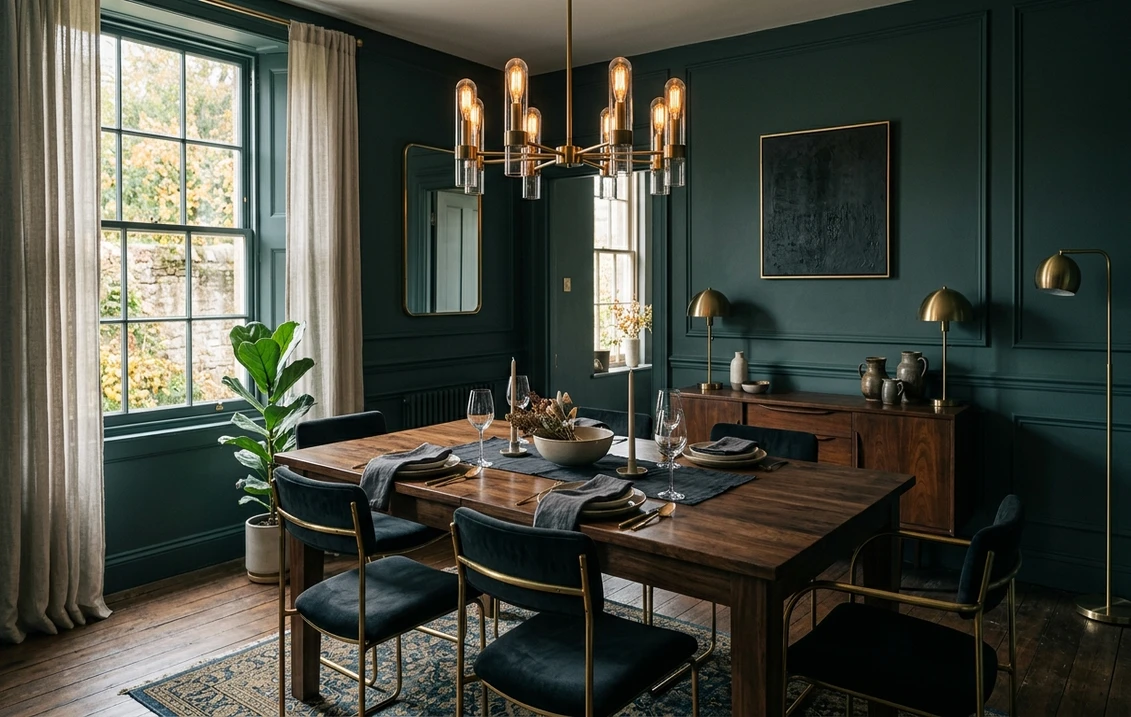
Newburg Green is a born dining room color. Painted floor to ceiling on walls, trim, and ceiling alike, the teal envelops the table and turns dinner candlelit and intimate, while brass sconces and warm wood furniture glow against it. Because dining rooms are used mostly at night under warm bulbs, you get the cozy, greener read most of the time. It belongs squarely in our roundup of elegant dining room paint colors for 2026, where drenched deep colors carry the whole list.
Libraries, studies, and home offices
Deep green is the historic library color for a reason, and Newburg's teal twist makes it feel less stuffy than a brown-leaning forest. Bookshelves and a desk painted the same color disappear into the walls and let the books and brass take center stage. The depth also reads as focus and quiet, which is exactly what a workspace wants.
Kitchen and bathroom cabinets
On lower cabinets or a kitchen island, Newburg Green pairs beautifully with brass hardware, warm wood counters, and a white or cream upper run. It is a more interesting choice than a safe navy and reads custom rather than trendy. In a powder room it can coat every surface for a jewel-box effect, the kind of bold small-room move featured in our guide to dramatic powder room paint colors.
Accent walls and moody bedrooms
As a single accent wall behind a bed, or drenched across a whole bedroom for a cocoon effect, Newburg Green delivers the moody, enveloping mood without the heaviness of a true black. If a deep, restful bedroom is the goal, see how it sits next to other dramatic picks in our guide to dark and moody bedroom paint ideas.
Where to think twice
A small, dark, north-facing room with only cool LED light is where Newburg Green can tip from rich teal toward a flat, cold peacock that swallows the space. At LRV 8 it absorbs nearly all available light, so a windowless room will feel even smaller and you must lean hard on warm 2700K lamps to bring the green back. It is also the wrong color if you wanted a true neutral that recedes; this paint always announces a hue, so do not expect it to behave like a charcoal.
Trim, ceiling, and decor pairings
A deep teal green lives or dies on its contrast. Get the trim right and Newburg Green looks tailored and intentional; get it wrong and it can read either harsh or muddy.
- Soft warm trim (most balanced): BM White Dove (OC-17, LRV 85) is the designer default. Its gentle cream bias gives high contrast without the icy edge of a pure white, so the teal reads crisp but not clinical. The pairing logic is the same as in our White Dove OC-17 review.
- Crisp trim (cleaner, cooler): BM Chantilly Lace (OC-65) is the brightest, coolest white and gives a sharp, modern edge that leans into Newburg's blue side. Best for contemporary kitchens and black-window homes. See our Chantilly Lace OC-65 review for how cool it actually runs.
- Drenched trim (most dramatic): paint the trim Newburg Green too. Matching trim, walls, and ceiling lets the architecture melt away and the teal become the whole room. This is the move for dining rooms and powder rooms.
- Metals and decor: brass and unlacquered brass are the perfect partner; their warmth lights up the teal. Warm wood (walnut, oak), cane, and cream upholstery all flatter it. Avoid heavy chrome or cool nickel, which can make the blue go cold.
- Ceilings: a soft white ceiling keeps a normal room from feeling like a cave, but a drenched dark ceiling is what turns a dining room into a jewel box. Choose based on how bold you want to go.
See walls, trim, and cabinets together in one preview. Free.
Newburg Green vs the deep greens people confuse it with
This is where most Newburg Green searches end, because at first glance several deep BM greens look identical on a chip. The difference is everything once it is on the wall. The three that matter most:
- vs BM Narragansett Green (HC-157): the confusion that drives this entire decision. Narragansett Green is Newburg's HC neighbor and is genuinely near-black: darker, grayer, and far less hue-forward, the color you choose when you want something that reads almost charcoal with a whisper of green. Newburg Green (HC-158) is lighter in feel, more saturated, and unmistakably teal. If you want a moody color that still looks like color, choose Newburg. If you want a near-black that only hints at green, choose Narragansett. They are not interchangeable.
- vs Essex Green: Essex Green is the classic deep blackened forest green, famous on shutters and front doors. It is browner and earthier, a true hunter that leans toward black rather than blue. Newburg Green is cooler, cleaner, and bluer; it reads teal where Essex reads forest. Pick Essex for a traditional, almost-black evergreen, pick Newburg when you want the blue spark of teal in the mix.
- vs BM Hunter Green (2041-10): Hunter Green is a pure, vivid, grass-and-pine green with no meaningful blue and no gray to mute it, so it stays bright and unambiguously green in every light. Newburg Green is darker, more muted, and tips blue. Choose Hunter Green for a lively, saturated classic green; choose Newburg for a deeper, more sophisticated teal that shifts with the room. For how the wider green family relates, our interior green paint shades guide maps them side by side, and our roundup of the best interior teal paint colors shows where Newburg lands among true teals.
Spelling note: newburg green, BM Newburg Green, and Newburg Green Benjamin Moore all point to this same HC-158. It is occasionally misspelled Newberg or Newburgh; the Benjamin Moore name is Newburg.
How to test Newburg Green before you commit
A 2-inch fan-deck chip is the number-one reason people are surprised by a dark teal: it looks black on the card and hides the hue that blooms on a real wall. Two better methods:
- Paint a large swatch: roll a 12-by-12-inch sample (or a peel-and-stick sample) on two different walls and check it mid-morning, mid-afternoon, and at night under your normal bulbs. Watch specifically for how teal it goes in your coolest corner and how green it reads under warm lamps; those two moments bracket what you will actually live with.
- Preview it digitally first: upload a real photo of your room and apply Newburg Green, plus a near-black like Narragansett and a truer green, before you buy any samples. That narrows three look-alikes to the one worth painting. Pricing context for the full repaint is in our interior house painting cost guide for 2026.
Preview Newburg Green against Narragansett Green and a true green, side by side. Free: 1 HD render plus 3 variations.
Frequently asked questions
Is Newburg Green a teal or a black-green?
Newburg Green (HC-158) is a deep teal green, not a near-black. Its RGB approximation (53, 75, 69) shows clear green and blue, so it reads as a saturated blue-green rather than a charcoal. On a fan-deck chip it can look almost black because a small swatch hides the hue, but on a full wall the teal blooms and the color is unmistakably alive. The near-black option in the same family is its neighbor Narragansett Green, not Newburg.
What is the LRV of Newburg Green?
Newburg Green has a Light Reflectance Value of about 8 on the Benjamin Moore color data, with a hex approximation of #354B45 (RGB 53, 75, 69). That makes it one of the darkest paints in the line: it absorbs nearly all available light, so it drenches a room in deep teal and works best where you want drama and envelopment rather than brightness. In a small or windowless room you will need warm lamps to keep it from feeling like a cave.
What is the difference between Newburg Green and Narragansett Green?
Narragansett Green (HC-157) is a near-black: darker, grayer, and far less hue-forward, the color you pick when you want something that reads almost charcoal with only a whisper of green. Newburg Green (HC-158) is more saturated and unmistakably teal, with a clear blue spark inside the green. Choose Narragansett for a moody near-black and Newburg when you want a dark color that still looks like a real teal.
What rooms work best for Newburg Green?
Dining rooms are its strongest room, where the drenched teal turns dinner intimate under warm light and brass. Libraries, studies, home offices, kitchen and bathroom cabinets, powder rooms, and moody bedrooms all suit it too. It is least reliable in small, windowless, north-facing rooms with only cool LED light, where its LRV of about 8 can make the space feel dark and the teal tip cold; lean on 2700K bulbs there.
What trim color goes with Newburg Green?
BM White Dove (OC-17) is the most balanced trim because its soft cream bias gives high contrast without an icy edge, keeping the teal crisp but not clinical. BM Chantilly Lace (OC-65) is the cooler, brighter option that leans into Newburg's blue side for modern spaces. For maximum drama, drench the trim in Newburg Green too. Brass hardware and warm wood are the ideal metal and material partners.
Preview BM Newburg Green on your actual walls under your own light before buying a single sample.
Disclaimer: Benjamin Moore, Newburg Green (HC-158), Narragansett Green (HC-157), Essex Green, Hunter Green (2041-10), White Dove (OC-17), and Chantilly Lace (OC-65) are trademarks of Benjamin Moore & Co. FacadeColorizer is an independent paint visualization service and is not affiliated with, endorsed by, or sponsored by Benjamin Moore. Color reproduction on screens approximates the manufacturer's chip; always confirm with a manufacturer sample under your own light before purchase. Sources: Benjamin Moore HC-158 Newburg Green color data 2026, Benjamin Moore HC-157 Narragansett Green and OC-17 White Dove color data 2026, The Spruce dark-paint undertone coverage, designer field reports compiled by FacadeColorizer.
Trademarks mentioned (Sherwin-Williams, Benjamin Moore, Behr, Caparol, Brillux, Sto, Alpina, Valspar, PPG, Glidden, Dulux, Crown Trade, Sandtex, Farrow & Ball, Johnstone's, Leyland) are property of their respective owners. FacadeColorizer is independent and not affiliated with any of them. Nominative fair use under Lanham Act §1125.