Try it on your room

I painted my first teal wall a decade ago in a north-facing home office, picked the chip in the store under cool fluorescents, and ended up with a color that read almost gray-blue on the wall, nothing like the jewel tone on the fan deck. That is the whole story of teal paint colors in one sentence: teal is a blue-green moving target, and the exact balance of blue versus green decides whether your room feels coastal-calm, library-moody, or just murky. This guide walks the full family, from soft sea-glass tones up to inky dark teal paint, with the LRV numbers and the rooms each one actually flatters.
Quick orientation first. Teal sits between blue and green on the color wheel, which is exactly why it never feels as flat as a plain blue or as expected as a sage green. The lighter members read like coastal glass and behave like a soft neutral. The darker members, the territory of peacock teal, swing toward a saturated jewel that can carry a whole accent wall or a cabinet run. This page is the teal stop inside our broader interior paint color families guide. If you decide you actually want a straight blue instead, our interior blue paint colors guide covers that lane, and the interior green paint colors guide covers the green side. Teal is the bridge between the two.
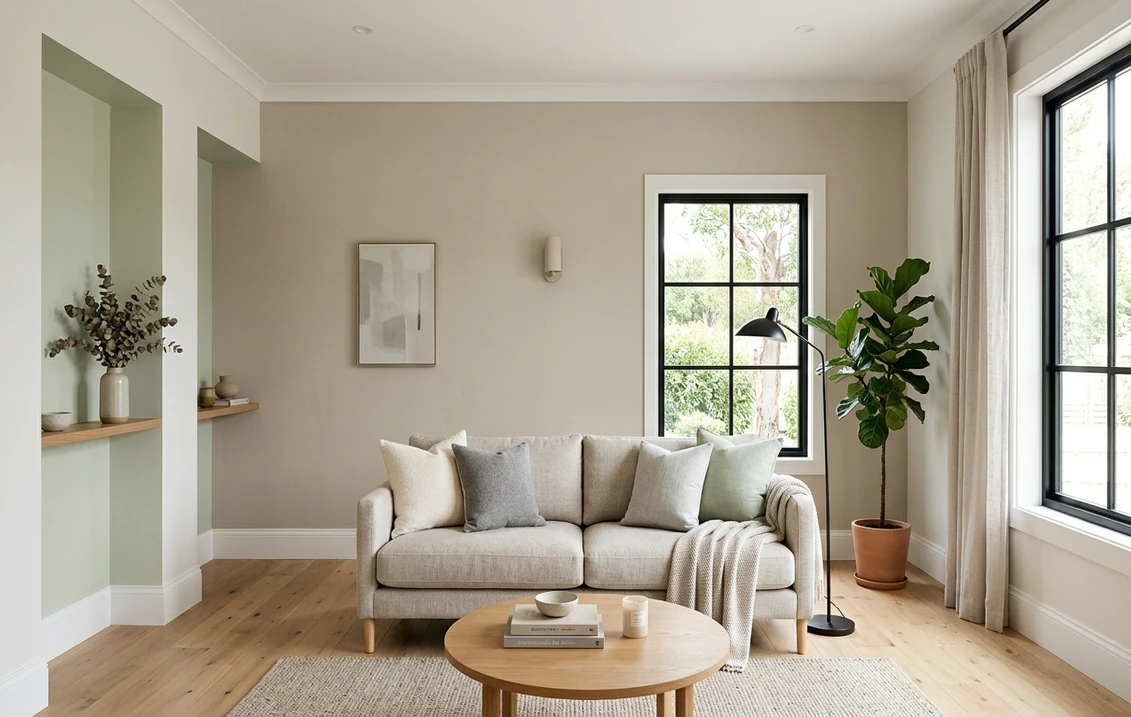
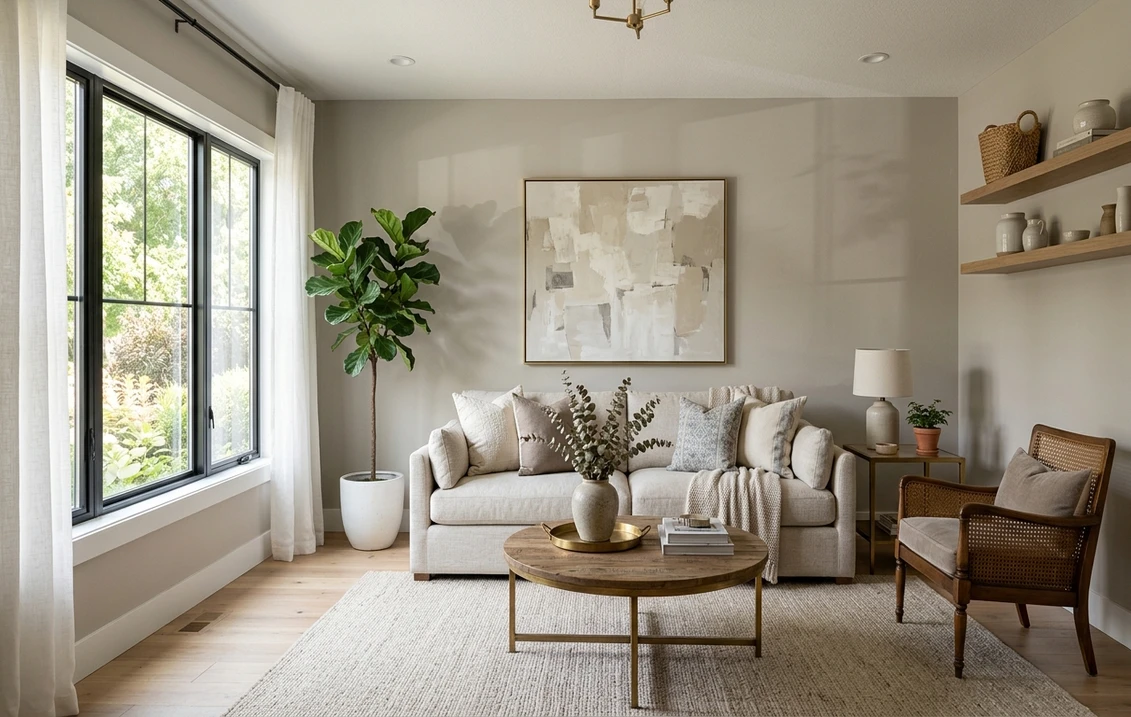
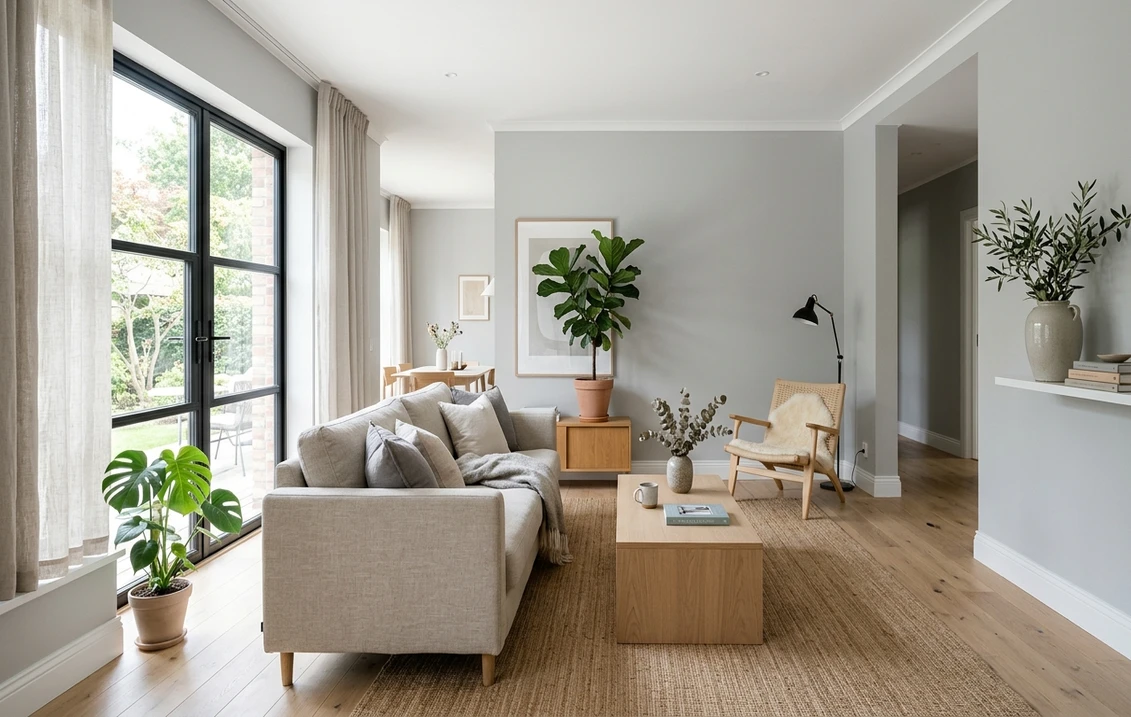
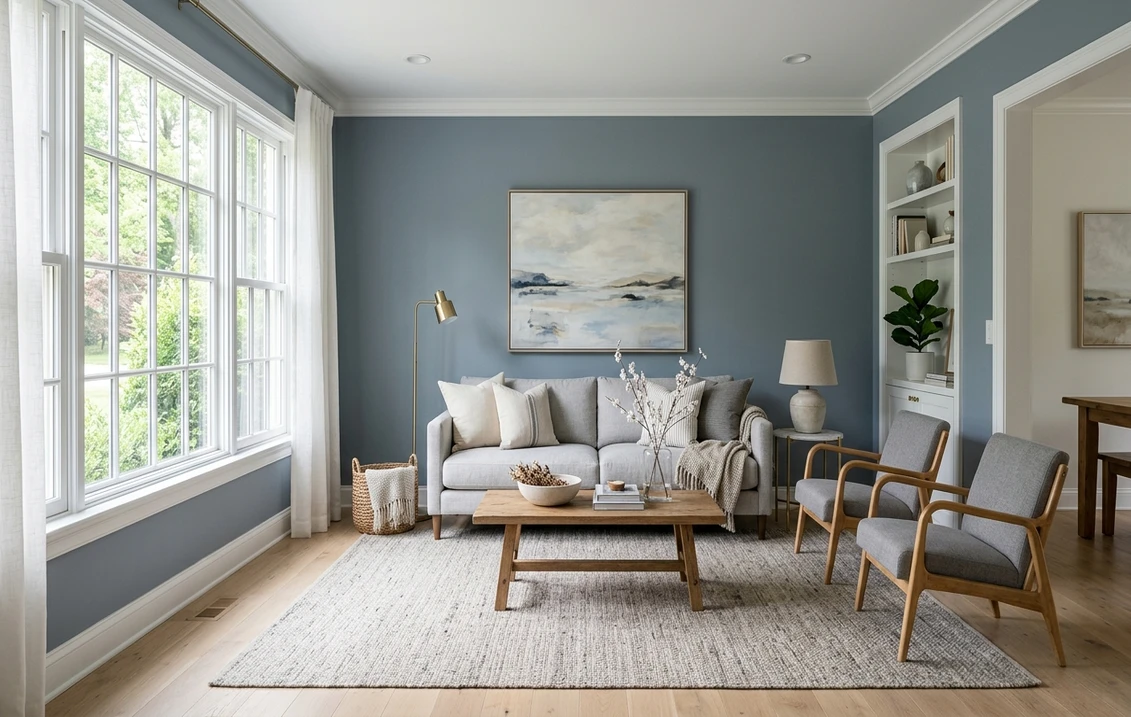
Upload a photo of your real room and preview any teal shade under your own light in about 30 seconds, free.
What makes a color read as teal
Teal is a blue-green built from roughly equal parts blue and green pigment, darkened with a little black. Shift the recipe and you walk the family: add green and it slides toward emerald and the muted teal-greens, add blue and it deepens toward peacock and then navy, add gray and it mutes into the calm grayed-teals that act like neutrals. None of these are wrong, but they behave very differently on a wall, so the first job is deciding where on that line your room should land.
LRV (Light Reflectance Value) is the number that predicts how dark the finished wall feels, on a 0 (black) to 100 (white) scale. Most usable interior teals run from the high 30s for soft sea-glass tones down to single digits for the inkiest dark teals. Anything under about LRV 15 will eat light, so it belongs on an accent wall, in a moody powder room, or on cabinetry, not wrapped around a small dim bedroom. Keep that in mind as you read the table below.
12 best teal paint colors for interiors, by depth
Here are twelve teals I keep coming back to, grouped from lightest to darkest, with approximate LRV and the read each one gives. LRV values are from the manufacturers' published color data and round to the nearest whole number:
| Teal shade | Brand / code | Approx. LRV | How it reads |
|---|---|---|---|
| Watery | SW 6478 | 52 | Light coastal sea-glass; reads calm, never loud |
| Beach Glass | BM 1564 | 50 | Gray-green-blue; the chameleon of the group |
| Wythe Blue | BM HC-143 | 49 | Pale green-leaning teal, almost a soft neutral |
| Drizzle | SW 6479 | 39 | A step deeper than Watery on the same strip, still airy and soft |
| Aegean Teal | BM 2136-40 | 25 | Soft mid-teal with a clay warmth; the easy whole-room pick |
| Mediterranean | Behr M460-5 | 22 | Clear mid-teal, true blue-green balance |
| Riverway | SW 6222 | 12 | Deep grayed teal-green for a moody dining room |
| Oceanside | SW 6496 | 12 | The famous peacock teal, equal jewel blue and green |
| Galapagos Turquoise | BM 2057-20 | 9 | Vivid deep teal with real punch |
| Aegean Storm | Behr S470-6 | 9 | Stormy blue-leaning teal, library-dark |
| Dark Teal | Behr T18-19 | 8 | Saturated peacock; accent walls and cabinets |
| Dark Night | SW 6237 | 5 | Near-black teal-navy; the deepest, most dramatic option |
Try it on your house
No photo? Try a sample
Sources: Sherwin-Williams, Benjamin Moore, and Behr published color data 2026; designer field reports compiled by FacadeColorizer. LRV values are approximate and rounded.
A blunt opinion: skip the chip ladder if you can. Teal is the family most likely to fool you on a 3-inch fan deck, because the small sample hides how much the blue versus green balance shifts once it covers a full wall and catches your room's light.
Free AI visualizer. Test a soft, a mid, and a dark teal on your real walls before buying a single sample pot.
Soft teal vs dark teal vs peacock teal
Three words get thrown around for this family, and they are not interchangeable. Here is how I separate them when a client says "I want teal."
Soft teal (LRV 35 and up)
This is the coastal-glass end: Watery, Drizzle, Wythe Blue, Beach Glass. These behave almost like soft neutrals, so you can wrap a whole bedroom or bath in them without the room feeling closed in. They lean green in warm light and blue-gray in cool light, which is the charm and the catch. If you want quiet rather than statement, start here.
Dark teal (LRV under 15)
Riverway, Dark Night, and the Behr Dark Teal sit here. Dark teal paint is dramatic, enveloping, and best used with intent: an accent wall behind a bed, a dining room you want to feel like dusk, a fireplace surround, or kitchen cabinetry. In a tight, low-light room it can read closer to charcoal than teal, so be honest about how much daylight you get before you commit it to four walls.
Peacock teal (the jewel)
Oceanside SW 6496 and Galapagos Turquoise are the textbook peacock teal shades: deep, saturated, and balanced perfectly between jewel blue and jewel green. This is the showstopper version. Peacock teal is fantastic as a single bold teal wall paint moment or on a built-in, but it does not play the quiet-background role, so do not expect it to disappear behind your furniture. It wants to be seen. For a powder room or a statement entry, that is exactly right.
Best rooms for teal paint
Teal is more flexible than its reputation suggests, but it is not a true go-anywhere neutral. Here is where each depth earns its keep:
Living rooms and dens
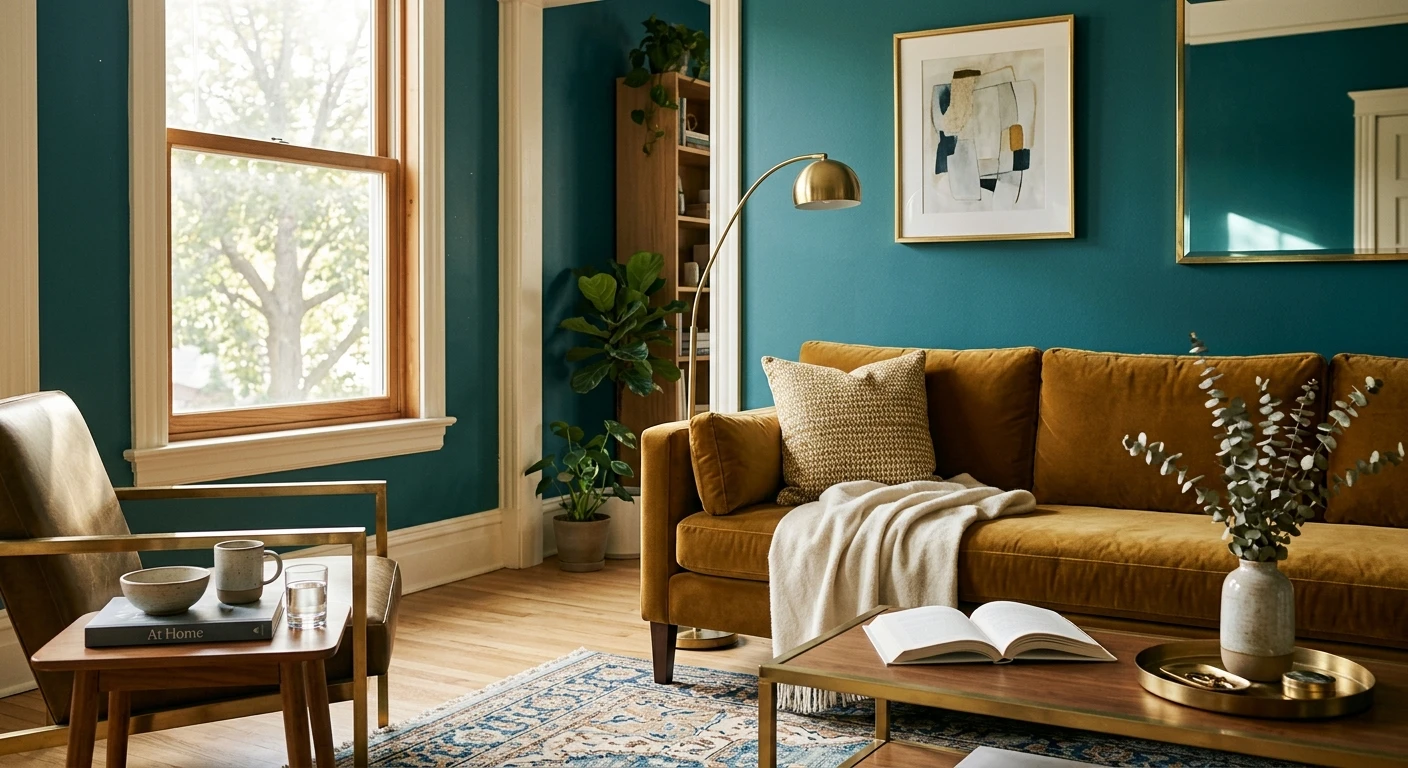
A soft teal like Aegean Teal makes a warm, collected living room, especially with brass lighting and natural wood. A dark teal works beautifully on a single accent wall or in a den you want to feel cocooning at night. For the full set of room schemes, our top living room paint colors for 2026 shows how teal sits next to other anchors.
Bedrooms
The grayed soft teals are genuinely restful, blue enough to calm and green enough to stay grounded. A deep teal accent wall behind the headboard is one of the most reliable bedroom upgrades I install. Our guide to calming master bedroom paint colors covers how it pairs with restful neutrals.
Bathrooms and powder rooms
Teal and water go together for a reason. Soft teals make a spa-like full bath, while a peacock teal turns a windowless powder room into a jewel box, which is one of the few places a near-black tone genuinely improves a small space. See our best bathroom paint colors for 2026 for the supporting palette.
Dining rooms and kitchen cabinets
A deep teal dining room reads intimate and a little dramatic by candlelight, which is exactly what you want for dinners. On lower cabinets, teal has become one of the most popular non-neutral choices; our blue kitchen cabinet paint colors guide overlaps heavily with the deep-teal end and is the place to start for a cabinet project.
Where to think twice
Teal does not work well as a whole-room color in a tight, north-facing space with only cool light: the soft versions go flat and gray, and the dark versions go murky. It also fights aggressively with strong yellow-undertone oak floors if the teal leans too green. In both cases, either pull warmth in elsewhere (wood, brass, warm-white trim) or step to a different family entirely.
Free AI visualizer. See whether teal stays a jewel or goes flat under your own light.
Trim, ceiling, and pairing colors for teal
A teal wall lives or dies on what frames it. The wrong white next to teal makes the whole wall read cold and slightly clinical, so this is not the place to grab a leftover builder white.
- Warm white trim (most harmonious): a soft creamy white keeps teal from tipping cold and lets the blue-green stay rich. This is the safe pick in almost every room.
- Brass and warm metals: teal's natural partner. Brass hardware, lighting, and frames pull the warm note that stops teal from feeling icy. Cool chrome does the opposite, so I avoid it against deeper teals.
- Warm wood: walnut and white oak reflect warmth back and make teal read intentional rather than cold. Gray-washed floors leave a teal room feeling flat.
- Terracotta and rust accents: the complement to teal on the color wheel. A little rust, clay, or blush keeps a teal room from going one-note.
- Ceilings: a clean warm white keeps a soft-teal room bright. On a dramatic dark-teal room, carrying the color up onto the ceiling makes the space feel enveloping rather than half-finished.
For the deeper cousins, a true navy reads moody and rich beside teal: our Benjamin Moore Hale Navy HC-154 review covers where dark teal blurs into navy. For a softer, grayed neighbor when full teal feels too loud, our Evergreen Fog SW 9130 guide is the muted teal-green to compare. And for the full set of partner tones, our teal color pairings guide goes deeper on accents and whole schemes.
How to test teal before you commit
Teal punishes the fan-deck shortcut more than any neutral, because the blue-versus-green balance only shows up at full-wall scale and shifts hard between morning and night. Two reliable methods:
- Paint a large swatch and watch it all day: roll a 12-by-12-inch sample (or a peel-and-stick sample) on two walls and check it mid-morning, mid-afternoon, and at night under your normal bulbs. Watch the green-to-blue swing, and remember most teals want a proper second coat to reach their true depth.
- Preview it digitally first: upload a real photo of your room and apply a soft, a mid, and a dark teal before you buy any samples, narrowing three contenders to one worth painting. Budget context for the full repaint is in our interior house painting cost guide for 2026.
Preview a soft, a mid, and a dark teal on your actual walls, side by side, free.
Frequently asked questions
What is the best teal paint color for interior walls?
For a whole room, a soft mid-teal like Benjamin Moore Aegean Teal (2136-40, LRV about 25) is the safest, most flexible pick because it carries a clay warmth that keeps it from reading cold. For a bold accent wall or cabinetry, a peacock teal such as Sherwin-Williams Oceanside (6496) gives the jewel-tone drama. The right answer depends on your light: brighter rooms can take a deeper teal, dim rooms do better with a soft one.
What is the difference between teal, dark teal, and peacock teal?
Teal is a balanced blue-green. Dark teal is the same family at a low LRV (under about 15), so it is deep and enveloping and best on accent walls, cabinets, or moody rooms. Peacock teal is a deep, highly saturated teal balanced perfectly between jewel blue and jewel green, like Oceanside or Galapagos Turquoise; it is the showstopper version that wants to be seen rather than fade into the background.
What rooms work best with teal paint?
Soft teals suit bedrooms, full bathrooms, and living rooms because they behave almost like calm neutrals. Dark and peacock teals shine on a single accent wall, in a dining room you want to feel intimate, in a windowless powder room turned jewel box, or on lower kitchen cabinets. Teal is least reliable as a whole-room color in a small, north-facing space with only cool light, where it can go flat or murky.
What trim and accent colors go with teal?
A warm creamy white is the most harmonious trim, because a stark blue-white makes teal read cold. Brass hardware and warm metals are teal's natural partners, warm wood like walnut and white oak keeps it grounded, and a touch of terracotta or rust (teal's complement) stops the room going one-note. Avoid cool chrome against deeper teals, which only sharpens the chill.
Does teal paint make a room look smaller?
A soft teal at LRV 35 or higher keeps a room feeling open and can even read as a light neutral. A dark or peacock teal absorbs light and will visually shrink a space, which is a feature in a cozy den, dining room, or powder room and a problem in a small low-light bedroom. If you love deep teal but the room is tight, use it on one accent wall or carry it up onto the ceiling for a deliberate cocooning effect instead.
Preview any teal shade on your actual walls under your own light before buying a single sample.
Disclaimer: Sherwin-Williams, Watery (SW 6478), Drizzle (SW 6479), Riverway (SW 6222), Oceanside (SW 6496), Dark Night (SW 6237), and Evergreen Fog (SW 9130) are trademarks of The Sherwin-Williams Company. Benjamin Moore, Aegean Teal (2136-40), Wythe Blue (HC-143), Beach Glass (1564), Galapagos Turquoise (2057-20), and Hale Navy (HC-154) are trademarks of Benjamin Moore & Co. Behr and its color names are trademarks of Behr Process Corporation. FacadeColorizer is an independent paint visualization service and is not affiliated with, endorsed by, or sponsored by any of these manufacturers. Color reproduction on screens approximates the manufacturer's chip; always confirm with a manufacturer sample under your own light before purchase. LRV values are approximate and rounded. Sources: Sherwin-Williams, Benjamin Moore, and Behr published color data 2026; designer field reports compiled by FacadeColorizer.
Trademarks mentioned (Sherwin-Williams, Benjamin Moore, Behr, Caparol, Brillux, Sto, Alpina, Valspar, PPG, Glidden, Dulux, Crown Trade, Sandtex, Farrow & Ball, Johnstone's, Leyland) are property of their respective owners. FacadeColorizer is independent and not affiliated with any of them. Nominative fair use under Lanham Act §1125.