Try it on your room

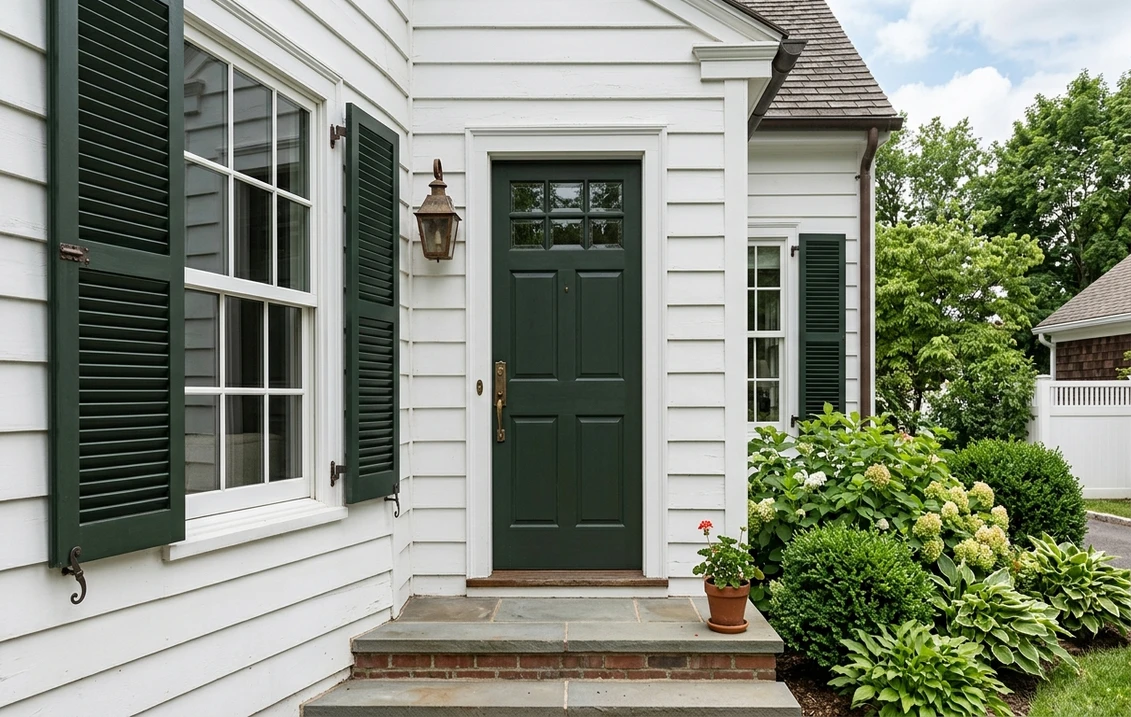
The first time a client asked me to paint shutters in Benjamin Moore Narragansett Green (HC-157), she handed me the chip and said, "I want black, but not boring black." That sentence is the whole color in nine words. Narragansett Green is a very dark, almost-black green that reads as a confident black from the curb and reveals a deep, cool, slightly inky green only when you stand close or catch it in direct sun. It is the kind of near-black that traditional New England houses wear on their shutters, front doors and window sashes, and increasingly the moody color homeowners reach for on interior cabinetry, libraries and accent walls. The big question every search has is simple: does it actually look green, or does it just look black? The honest answer depends almost entirely on your light, and here is exactly how it behaves.
Quick orientation before the deep dive. Narragansett Green HC-157 has a published LRV of about 6 and a hex approximation of #3A453E (RGB 58, 69, 62). That puts it deep in near-black territory: it reflects almost no light, which is why it reads as black at a distance, but the green pigment underneath keeps it from going flat or chalky like a true black would. The undertone is a cool, blue-leaning green, the chromatic green that separates it from a warm forest green and from the bluer teal-greens in the same family. This profile is one stop in our wider Benjamin Moore interior paint colors guide, and it sits naturally beside our look at Charleston Green, the almost-black historic green: that page covers the famous Southern near-black-green tradition, while this one stays on Narragansett Green specifically, its undertone, its numbers and how it differs from its near-twins.
Upload a photo of your actual home or room and preview BM Narragansett Green under your own light in about 30 seconds. Free: 1 HD render plus 3 variations.
Narragansett Green at a glance: the numbers that matter
Before opinions, here are the verifiable specs straight from the Benjamin Moore color library. These are the values you can take to a paint counter:
| Spec | Narragansett Green HC-157 |
|---|---|
| Color number | HC-157 (Historical Color collection) |
| LRV (Light Reflectance Value) | Approximately 6: near-black, absorbs almost all light |
| Hex / RGB (approx.) | #3A453E / 58, 69, 62 |
| Color family | Very dark, almost-black green |
| Primary undertone | Cool, blue-leaning green; never warm or olive |
| Best base / finish | Deep tint base; satin or semi-gloss on shutters, doors, cabinets and trim |
Try it on your house
No photo? Try a sample
The takeaway from those numbers: Narragansett Green is functionally a "black with a secret." At LRV 6 it is in the same depth bracket as Benjamin Moore's true blacks and charcoals, so it carries all the architectural weight of a black on shutters or cabinetry. But the green pigment gives it a softness and a richness that pure black lacks, the same way a near-black navy reads warmer and more livable than a flat black. The cool blue-green undertone is the entire identity. It is what keeps the color from looking like asphalt and what distinguishes it from the warmer, browner forest greens it is constantly compared to.
Does Narragansett Green look black or green? The undertone, decoded
This is the question that decides whether you will love it or feel cheated, so let me be precise. Narragansett Green is a green, but at LRV 6 it spends most of the day reading as a sophisticated near-black. The green only declares itself under three conditions: direct sunlight, a bright reflective surround (white siding, snow, pale gravel), and close viewing distance. Step back twenty feet on an overcast day and it is, for all practical purposes, black. That is not a flaw; it is exactly why people choose it. They want the gravitas of black with a hint of life inside it.
The undertone is cool and blue-leaning, and that matters enormously. In strong sun the color opens up into a deep, slightly inky pine-green with a cool, almost forest-at-dusk quality. There is no yellow, no olive, no brown in it. That coolness is what lets it sit comfortably against gray and blue-gray houses, crisp white trim, and slate roofs, where a warmer forest green would clash. In shade or under heavy cloud the blue side of the undertone steps forward and the color can read as a very dark blue-black for a few hours, which is part of its moody charm.
Watch out for one quirk that trips up every shopper. A 2-inch chip of Narragansett Green looks much more obviously green than the finished, applied surface does, because the chip is small and you are holding it close. Painted onto a full shutter or a cabinet run and viewed from a normal distance, it collapses toward black. So if you fell in love with the chip expecting a clearly green house, calibrate your expectations: you are buying a near-black that whispers green, not a green that happens to be dark.
| Light condition | How Narragansett Green reads |
|---|---|
| South-facing (bright, direct sun) | Its greenest moment: a deep cool pine-green clearly shows in the highlights |
| West-facing (warm afternoon) | Warm low sun lifts the green and adds a soft glow; reads richest at golden hour |
| East-facing (cool after noon) | Green in the bright morning, drifts toward blue-black by afternoon shade |
| North-facing / overcast (cool, indirect) | Reads as a near-pure black or blue-black; the green nearly disappears |
| Indoor 2700K warm bulbs | Softens toward a warm black-green; cabinets feel cozy and inky |
| Indoor 4000K cool bulbs | Pushes the blue-green forward; reads crisper, cooler, more clearly green |
Sources: Benjamin Moore HC-157 color data 2026; near-black paint undertone field tests compiled by FacadeColorizer; designer reports on dark-green exteriors.
Free AI visualizer. Test Narragansett Green on your real facade before buying a single quart.
Best uses for Narragansett Green
Because it carries the weight of black with a green soul, Narragansett Green is happiest as an accent and an architectural anchor rather than a whole-room wall color. At LRV 6 it absorbs light, so it shrinks and darkens a space; that is exactly the effect you want on the right surfaces and exactly the trap on the wrong ones. Here is where it consistently earns its keep:
Exterior shutters, doors and window sashes
This is its native habitat. On a white, cream, gray or weathered-shingle house, Narragansett Green shutters and a matching front door deliver the crisp, historic New England look that reads as black from the street but rewards close inspection with depth. It is cooler and bluer than the classic Essex Green, which makes it the better pick on a gray or blue-gray body. It pairs beautifully with the picks in our roundup of the best exterior green paint colors for 2026, and it is a perennial favorite among the deep, statement-making options in our guide to Benjamin Moore front door colors.
Kitchen and bathroom cabinetry
Indoors, Narragansett Green has quietly become a designer favorite for lower cabinets, islands and vanities. Against brass or unlacquered-brass hardware, white oak floors, marble counters and warm 2700K lighting, the near-black green reads luxe and moody without the harshness of true black. It grounds a kitchen the way a charcoal or navy would, but with a softer, more organic character. A satin or semi-gloss finish is essential on cabinets so the depth does not flatten into a void.
Libraries, studies and accent walls
In a room with good light and a clear purpose, a single Narragansett Green accent wall or a fully enveloped small study turns dramatic and cocooning. It makes brass, gold-framed art, leather and warm wood pop. For ideas on what to put next to it, our guide to colors that go with dark green covers the moody pairings that flatter a near-black green like this one.
Where to think twice
Do not use Narragansett Green on all four walls of a small, dim, north-facing room expecting a cozy green. At LRV 6 it will simply read black and feel like a closet. It also fights warm, orange-toned brick and terracotta-roofed homes, where its cool blue-green can look like a mismatched black. On those houses a warmer near-black or a true forest green sits better. And on a large exterior body color it can look severe; it is at its best in disciplined accent doses.
Trim, body and decor pairings
A near-black green lives or dies on its contrast partner. The whole reason to use Narragansett Green instead of plain black is the interplay between its cool depth and a crisp, light surround.
- Crisp white trim and body (most classic): BM Chantilly Lace (OC-65) or Simply White (OC-117) on the house body makes Narragansett shutters snap with that clean New England contrast. The cooler the white, the more the green reads green.
- Soft warm white (gentler, historic): BM White Dove (OC-17, LRV 85) or a creamy off-white warms the pairing and leans the look toward a heritage colonial rather than a modern high-contrast scheme.
- Gray and blue-gray bodies (where it shines): its cool blue-green undertone is tailor-made to sit against a light-to-mid gray or a blue-gray. This is the combination where Narragansett out-performs the warmer Essex Green.
- Brass and gold hardware (interiors): on cabinetry, unlacquered or satin-brass pulls are the definitive partner; they warm the cool green and read instantly upscale.
- Avoid: warm beige or yellow-cream bodies and orange-toned brick. The warm-cool clash makes the green look like a muddy, mismatched black.
- Roofs and stone: slate, charcoal and gray roofing reinforce the cool scheme; warm brown or red roofs fight it.
If you want a near-black with a different undertone for comparison, the navy route is worth a look: our Benjamin Moore Hale Navy HC-154 review covers the deep blue that competes with Narragansett Green for the same shutter-and-cabinet jobs, just with a blue rather than a green soul.
See shutters, body color and roof together in one preview.
Narragansett Green vs the near-black greens people confuse it with
Almost every Narragansett Green search ends in a side-by-side, because the dark-green family is full of look-alikes that behave very differently once they are on the wall. The three that matter most:
- vs BM Newburg Green (HC-158): the classic dilemma, since they are HC neighbors. Newburg Green is deeper, bluer and more clearly a teal-leaning blue-green. Narragansett (HC-157) is a touch lighter and reads as a truer, more balanced green rather than tipping toward teal. Choose Newburg when you want the color to lean unmistakably blue-green; choose Narragansett when you want a near-black that reads as a clean, classic green in the sun. On most houses Narragansett is the safer, more flexible of the two.
- vs BM Hollingsworth Green (HC-141): Hollingsworth is the warmer, lighter, more sage-forward cousin with a noticeably greener, gentler presence and a higher LRV. It never reads black. If you actually want a room or shutters to look green, Hollingsworth delivers that; Narragansett is for when you want near-black with a green secret. They are not interchangeable: one is a green, the other is a black-green.
- vs Essex Green (the traditional shutter green): Essex Green is the warmer, more forest-and-pine, slightly browner classic that has dressed New England shutters for generations. Narragansett is cooler, bluer and more contemporary. On a warm cream or yellow house, Essex sits better; on a white, gray or blue-gray house, Narragansett's cool undertone is the cleaner match. If you keep waffling between "warm forest" and "cool inky," that is the Essex-versus-Narragansett decision in a nutshell.
Spelling note: narragansett green, BM Narragansett Green, Narragansett Green Benjamin Moore, and the occasional misspelling narraganset green all point to this same HC-157.
How to test Narragansett Green before you commit
A near-black green is the single most deceptive kind of color to choose from a chip, because the chip exaggerates the green and cannot show you when the color will collapse to black across a real day on a real surface. Two better methods:
- Paint a large swatch in your finish: brush a 12-by-12-inch sample in satin or semi-gloss directly onto a shutter, door or cabinet door, and check it at mid-morning, golden hour and after dark under your normal bulbs. Watch specifically for how black it goes in shade; that shaded read is the truth most of the day.
- Preview it digitally first: upload a real photo of your house or kitchen and apply Narragansett Green (plus a warmer comparison like Essex Green and a navy like Hale Navy) before you buy any samples, narrowing three near-blacks to the one worth painting. For the broader green-color landscape it lives in, our best exterior green paint colors guide is a useful map.
Preview Narragansett Green against Essex Green and a navy, side by side. Free: 1 HD render plus 3 variations.
Frequently asked questions
Does Narragansett Green look black or green?
Narragansett Green (HC-157) reads as a sophisticated near-black most of the time and reveals its cool, blue-leaning green only in direct sunlight, against bright surrounds like white trim or snow, and at close range. At LRV 6 it absorbs almost all light, so from across the street it looks black; up close and in the sun the deep pine-green shows. People choose it precisely because they want the weight of black with a hint of green inside.
What is the LRV of Narragansett Green?
Narragansett Green has a Light Reflectance Value of about 6 on the Benjamin Moore color data, with a hex approximation of #3A453E (RGB 58, 69, 62). That puts it firmly in near-black territory, in the same depth bracket as true blacks and deep charcoals, which is why it carries so much architectural weight on shutters, doors and cabinetry while still hiding a cool green underneath.
What are the best uses for Narragansett Green?
It excels as an architectural accent: exterior shutters, front doors and window sashes on white, cream, gray or blue-gray houses; kitchen and bathroom cabinetry paired with brass hardware; and library or study accent walls. It is least reliable on all four walls of a small, dim, north-facing room, where it simply reads black and feels closed in, and against warm orange-toned brick, where its cool undertone clashes.
What is the difference between Narragansett Green and Newburg Green?
Newburg Green (HC-158) is deeper, bluer and more clearly a teal-leaning blue-green, while Narragansett Green (HC-157) is slightly lighter and reads as a truer, more balanced near-black green rather than tipping toward teal. Choose Newburg when you want the color to lean unmistakably blue-green, and Narragansett when you want a near-black that opens up into a clean, classic green in the sun. Narragansett is the more flexible of the two on most homes.
Is Narragansett Green the same as Essex Green?
No. Essex Green is the warmer, more forest-and-pine, slightly browner traditional shutter green, while Narragansett Green is cooler, bluer and more contemporary. On a warm cream or yellow house Essex sits better; on a white, gray or blue-gray house Narragansett's cool blue-green undertone is the cleaner match. Both read as near-black from a distance, but the undertone difference shows clearly in sunlight and against the body color.
Preview BM Narragansett Green on your actual shutters, door or cabinets under your own light before buying a single sample.
Disclaimer: Benjamin Moore, Narragansett Green (HC-157), Newburg Green (HC-158), Hollingsworth Green (HC-141), Essex Green, Hale Navy (HC-154), Chantilly Lace (OC-65), Simply White (OC-117), and White Dove (OC-17) are trademarks of Benjamin Moore & Co. FacadeColorizer is an independent paint visualization service and is not affiliated with, endorsed by, or sponsored by Benjamin Moore. Color reproduction on screens approximates the manufacturer's chip; always confirm with a manufacturer sample under your own light before purchase. Sources: Benjamin Moore HC-157 Narragansett Green color data 2026, Benjamin Moore HC-158 Newburg Green and HC-141 Hollingsworth Green color data 2026, near-black paint undertone field tests and designer reports compiled by FacadeColorizer.
Trademarks mentioned (Sherwin-Williams, Benjamin Moore, Behr, Caparol, Brillux, Sto, Alpina, Valspar, PPG, Glidden, Dulux, Crown Trade, Sandtex, Farrow & Ball, Johnstone's, Leyland) are property of their respective owners. FacadeColorizer is independent and not affiliated with any of them. Nominative fair use under Lanham Act §1125.