Try it on your room

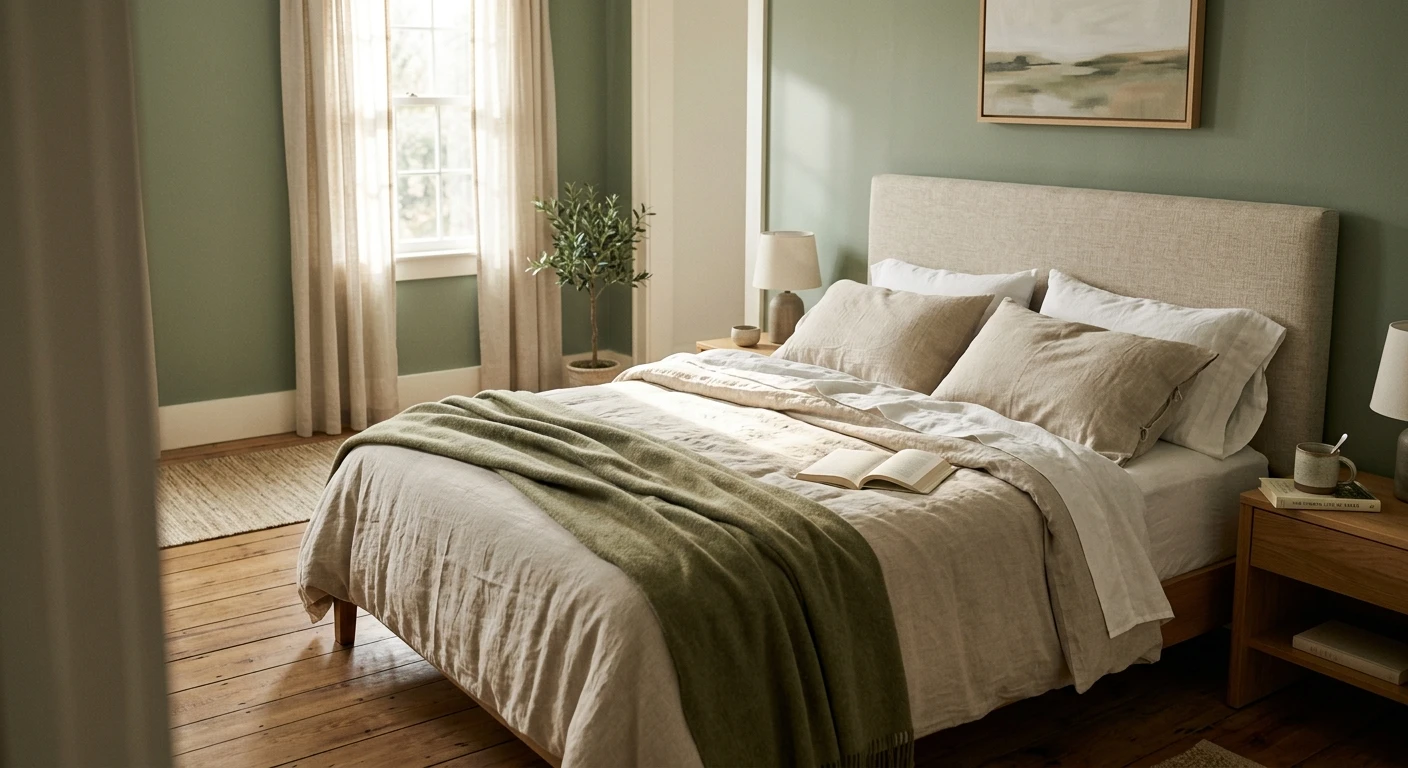
The first time I cut in a green bedroom for a client in Portland, she stood in the doorway at 7 a.m. and went quiet. Soft gray-sage walls, flat cool morning light, and the room read like the inside of a calm exhale. That is the thing nobody tells you about a green bedroom: it is the one wall color that behaves like the room it belongs in. Restful, grounded, a little bit forest. Below are 16 looks I keep coming back to, with real shades, LRV, pairings, and an honest note on how each reads once the lamp is on.
A quick map before the gallery. Green spans a huge range, from a barely-there whisper of sage to a near-black forest, and the bedroom is forgiving of almost all of it because you are mostly in there at low light. This guide sits inside our room-by-room paint color ideas hub, with two companions: the full interior green paint shades breakdown for the chemistry of each color, and our colors that go with green guide for pairings. This page is the bedroom gallery: 16 ideas, room first.
Upload a photo of your bedroom and preview any of these greens under your own light in 30 seconds, free.
How green reads in a bedroom (LRV is the whole game)
Bedrooms are low-light rooms: dawn, dusk, and a 2700K bulb at night, rarely full midday sun. Two numbers decide how a green behaves there. LRV (Light Reflectance Value) is how much light it bounces back, so higher LRV keeps a small or dim room open while lower LRV gives cocoon and drama (but needs windows or warm lamps to not feel like a cave). The undertone matters just as much: gray-greens stay calm and modern, yellow-greens can tip acidic in cool light, blue-greens read coastal. Here is how each family lands.
One constraint a bedroom lets you ignore: how the green treats faces and food. That is the extra filter in a dining room, where a cool blue-leaning green can drain skin tones under cool bulbs and the gray-greens and olives end up dominating for that reason alone. Our green paint for a dining room guide works through the same families with that filter applied.
| Green family | Typical LRV | How it reads in a bedroom | Best light |
|---|---|---|---|
| Soft sage (gray-green) | 40 to 55 | Calm, airy, spa-like; the easiest green to live with | Works in almost any light |
| Smoky gray-green | 28 to 35 | Moody but warm, grounded, current | South, west, or warm lamps |
| Olive / earthy green | 20 to 35 | Organic, nature-led, a touch retro | Good daylight helps |
| Forest / dark green | 6 to 15 | Cocooning, dramatic, jewel-box | Accent wall or well-lit room |
| Mint / pale fresh green | 60 to 75 | Light, youthful, slightly retro | Bright rooms (can go cold in shade) |
Try it on your house
No photo? Try a sample
Sources: Sherwin-Williams and Benjamin Moore color data 2026; The Spruce green-paint coverage; designer field reports compiled by FacadeColorizer.
The yellow-green line in that table is where people most often end up in the wrong family without noticing. Push a sage warm enough to survive a north bedroom and you eventually cross out of green: the pigment stops reading as a muted green and starts reading as a soft warm color in its own right. That is not a failure, it is just a different decision, and it is better made deliberately than discovered on the second coat. If the samples you keep gravitating toward are the warmest ones on the fan, compare them against our yellow bedroom paint ideas before you commit, because the trim and bedding pairings are not the same on either side of that line.
Free AI visualizer. See how a sage or forest green reads on your walls.
Soft sage green bedrooms (ideas 1 to 5): the calm default
If you want one green bedroom that nobody will argue about, start here. Soft sages sit at LRV 40 to 55, light while still reading clearly as a color: gentle enough for a guest room, grown-up enough for a primary. One favorite here (Sea Salt) sits just above that band, at the airy top of the range where sage brushes into pale fresh green.
1. Sherwin-Williams Sea Salt (SW 6204)
The famous one. Sea Salt is a green-gray with a blue whisper, LRV 63, which puts it just above the strict sage band and at the light, fresh end of the range, floating between sage and pale aqua by the light. It reads soft and coastal with white trim and warm oak, the safest first green you can pick, and a much-requested shade in our interior green shades roundup.
2. Clary Sage (SW 6178)
A muted, dustier sage at LRV 41. Where Sea Salt goes airy, Clary Sage feels deeper and herbal, the color of a dried bay leaf. It makes a primary feel like a retreat without going dark. All it asks for: linen, brass hardware, a cream ceiling. The same LRV 41 behaves quite differently one room over: in our sage green kitchen paint ideas guide Clary Sage is the pick for open walls precisely because it stays readable next to hard, reflective surfaces.
3. Benjamin Moore October Mist (1495)
A silvery sage, LRV around 54, with enough gray to stay quiet in any light. You stop reading October Mist as a color and start reading it as a mood. Lovely with white bedding and oak.
4. Saybrook Sage (HC-114)
A richer, more saturated sage with a warm pull. More presence than the silvery sages while staying restful, and it carries a south-facing room where lighter sages wash out.
5. Sage with a warm-white envelope
A strategy more than a shade: any soft sage on the walls, a warm white on trim and ceiling, oak or rattan in the room. The most reliable green bedroom formula there is. Our sage green shades and pairings guide breaks down which whites and woods flatter each sage.
Smoky and earthy green bedrooms (ideas 6 to 10): more mood
Drop the LRV into the 20s and low 30s and a green bedroom stops whispering and starts to hum. These make a room feel collected and nature-soaked.
6. Evergreen Fog (SW 9130)
The color that launched a thousand green bedrooms. Evergreen Fog is a smoky gray-green with a faint gray-brown undertone, LRV 30: moody but warm, modern but not cold, forgiving in mixed light. My top pick for a primary that wants atmosphere without going dark. Cut in clean and give it a full second coat; at this depth, thin spots show.
7. Pewter Green (SW 6208)
Deeper and more blackened, LRV 12. On all four walls of a well-lit bedroom it is a true cocoon; on a single headboard wall it is pure drama. With brass, walnut, and cream bedding it reads like a boutique hotel.
8. Olive / Benjamin Moore Dried Parsley (2147-30)
Olive is having a moment, and a bedroom suits it because low light softens any chance of army-surplus. An olive green bedroom feels organic and grounded with tan, terracotta, and unbleached linen. Daylight brings out the yellow; lamp light deepens it toward brown. If it is that evening reading you keep coming back to, you may actually want the next family over: olive-brown is one of the four browns in our brown bedroom ideas, and a chocolate accent wall at LRV 7 to 10 gets there without waiting for the lamps.
9. Benjamin Moore Acacia Haze (1488)
A gray-green with real depth and a whisper of blue, LRV near 26. It splits the difference between smoky sage and forest, ideal when you want mood but are nervous about going too dark.
10. Earthy green with terracotta accents
A look more than a color: muted earthy green walls warmed with terracotta, rust, and aged wood. Our colors that go with green guide shows which earth tones work.
See the smoky greens against your bedding and trim.
Forest and dramatic green bedrooms (ideas 11 to 13)
Now the deep end. Forest greens at LRV 6 to 15 turn a bedroom into a jewel box. The rule: commit to all four walls and lean into the cocoon, or keep it to one wall and let it be the moment.
11. Benjamin Moore Hunter Green (2041-10)
A classic deep forest, rich and timeless. With good windows it reads lush; under warm lamps it goes velvety. Trim it in a soft white so the architecture breathes, or go tonal for a fully enveloped look.
12. Dark green headboard wall
The most popular way people use dark green: one wall behind the bed, the other three in soft white or pale greige. Drama without darkening the room. For combinations that balance one dark wall, see our bedroom color schemes and palettes guide.
13. Black-green for a true cocoon
At the bottom of the LRV scale, a near-black green reads like a soft black with life in it. Best in a room you want small and protective on purpose. Layer in warm metals and lamp light so it glows rather than swallows.
Fresh and light green bedrooms (ideas 14 to 16)
Not every green bedroom wants to be moody. Higher up the LRV scale, greens turn bright, youthful, and a little retro, ideal for a kid's room, a guest room, or a sunny space.
14. Soft mint (LRV high 60s to 70s)
A pale mint keeps a small bedroom fresh and open. The caution: mint goes cold and clinical in a north room, so steer it warm with cream trim and wood. In a bright room it is charming.
15. Celadon / soft green-blue
Celadon is the gentle green-blue of old porcelain. It reads serene and vintage, lovely with white linens and brass, and bridges green and blue for anyone who cannot decide.
16. Sage with a calming whole-room scheme
To close where we started: a light, restful sage built into a calming palette of soft whites, natural textures, and low contrast that helps you wind down. Our calming master bedroom paint colors guide shows how green sits beside other quiet neutrals.
Trim, ceiling, and bedding pairings for green walls
A green bedroom lives or dies on what surrounds it. Greens hold a lot of yellow or gray, so the trim white either flatters the wall or fights it.
- Warm white trim (most harmonious): a soft cream-white like SW Alabaster or BM White Dove flatters sage and olive without going stark. The safe pairing nine times out of ten.
- Crisp white trim: a cleaner white sharpens deep forest greens and gray-greens for a tailored edge. Best when you want contrast rather than envelope.
- Tonal trim: paint trim the same green (or a half-strength version) for a soft, enveloped, current look. Especially good with the deep forests.
- Ceilings: a warm white keeps a sage bedroom bright; with a dark forest, a tonal or soft-white ceiling stops it feeling top-heavy.
- Bedding and wood: linen, oatmeal, cream, brass, walnut, and oak bring out the warmth. Cool gray-washed wood and chrome push it colder, fine for a coastal sage but flattening on an earthy one.
One rule cuts across all five choices if calm, rather than green, is the actual goal: keep the jumps between wall, trim, and ceiling small. A restful scheme lives in a tight tonal band, which is why the crisp-white option above buys definition at the cost of quiet. Our guide to calming spa-like color palettes builds 12 full schemes on that principle, including the LRV range (roughly 55 to 75 on main walls) that keeps a bedroom soft instead of dim.
See walls, trim, and bedding together in one preview.
How to choose and test your green bedroom before you commit
A fan-deck chip is the number-one reason people pick a green that disappoints: it reads lighter and cleaner than a rolled wall and hides the shift from dawn to lamp light. Two better methods:
- Paint a large swatch: roll a 12-by-12-inch sample (or a peel-and-stick swatch) behind your bed and on one other wall. Check it at 7 a.m., mid-afternoon, and at night under your normal bulbs. Watch dim corners, where green turns gray.
- Preview it digitally first: upload a photo of your bedroom and apply a sage, a smoky gray-green, and a forest side by side before buying samples, narrowing the field to the one or two worth painting.
Preview sage, olive, and forest green side by side, free.
Frequently asked questions
Is green a good color for a bedroom?
Yes, green is one of the best bedroom colors because it reads restful and grounded, the way a room you sleep in should feel. Soft sages keep a bedroom light and calm, while deeper forest and gray-green tones create a cocooning mood. Because bedrooms are mostly seen in low light, green is also forgiving here compared to brighter rooms.
What shade of green is best for a bedroom?
For an easy, calming bedroom, a soft gray-sage like Clary Sage (SW 6178) at LRV 41 or the lighter Sea Salt (SW 6204) at LRV 63 is the most reliable choice. For more mood, the smoky gray-green Evergreen Fog (SW 9130) at LRV 30 is the current favorite. For drama, a deep forest at LRV 6 to 15 works best on a single headboard wall or in a well-lit room.
What colors go with green bedroom walls?
Warm whites (cream-leaning), natural wood like oak and walnut, brass, and unbleached linen all flatter green walls. For trim, a soft cream-white suits sage and olive, while a crisper white sharpens deep forest greens. Cool grays and chrome push green colder, which can flatten an earthy or olive shade.
Does a dark green bedroom make the room feel smaller?
A dark green (LRV 6 to 15) does make a room feel more enclosed, but in a bedroom that cocoon effect is usually desirable. To keep it from feeling cramped, either limit the dark green to one headboard wall, or commit to all four walls with plenty of warm lamp light and reflective metals so the color glows rather than swallows the space.
Will a green bedroom look dated in a few years?
Muted, nature-led greens like sage, olive, and gray-green have proven timeless rather than trendy, because they read as soft neutrals more than bold statements. The shades most likely to feel dated are the very saturated lime or acid greens, so if longevity matters, stay in the muted sage, gray-green, and forest range.
Preview these greens on your real bedroom walls under your own light first.
Disclaimer: Sherwin-Williams, Sea Salt (SW 6204), Clary Sage (SW 6178), Evergreen Fog (SW 9130), Pewter Green (SW 6208), and Alabaster are trademarks of The Sherwin-Williams Company. Benjamin Moore, October Mist (1495), Saybrook Sage (HC-114), Dried Parsley (2147-30), Acacia Haze (1488), Hunter Green (2041-10), and White Dove are trademarks of Benjamin Moore & Co. FacadeColorizer is an independent paint visualization service and is not affiliated with, endorsed by, or sponsored by Sherwin-Williams or Benjamin Moore. LRV figures are drawn from published manufacturer color data and may vary slightly by source. Color reproduction on screens approximates the manufacturer's chip; always confirm with a manufacturer sample under your own light before purchase. Sources: Sherwin-Williams and Benjamin Moore color data 2026, The Spruce green-paint coverage, designer field reports compiled by FacadeColorizer.
Trademarks mentioned (Sherwin-Williams, Benjamin Moore, Behr, Caparol, Brillux, Sto, Alpina, Valspar, PPG, Glidden, Dulux, Crown Trade, Sandtex, Farrow & Ball, Johnstone's, Leyland) are property of their respective owners. FacadeColorizer is independent and not affiliated with any of them. Nominative fair use under Lanham Act §1125.