Try it on your room

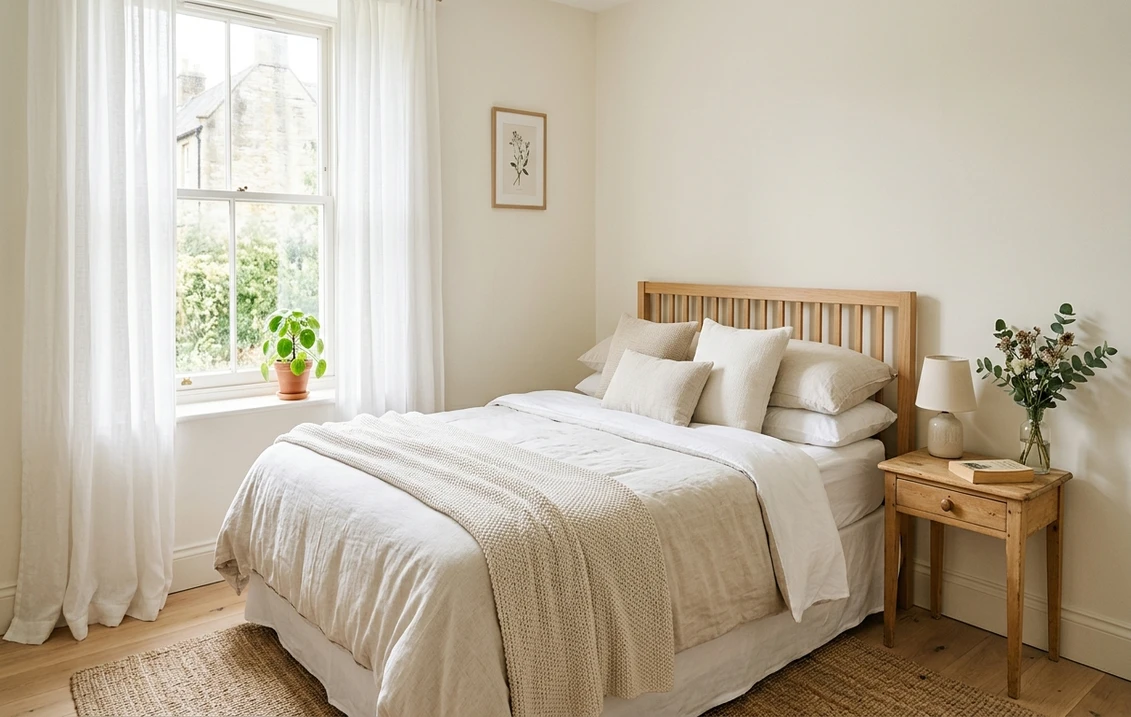
Picture a room that is 9 by 10 feet. The bed eats half the floor, the single window faces a fence, and every color you tape up seems to shrink the space further. A small bedroom does not need a clever color so much as the right light one, a shade with enough Light Reflectance Value to bounce daylight around and the correct undertone to stay clean rather than turning gray, dingy, or nursery-sweet.
Below are twelve light paint colors that genuinely open up a cramped bedroom, with exact Sherwin-Williams and Benjamin Moore codes, published LRV values, the undertone each leans toward, and the window direction that suits it, plus the trim moves that protect the effect and how to test first. For the wider list this belongs to, see our room paint color ideas by room guide.
Upload one photo and preview these light shades on your actual walls in 30 seconds, free.
Why light colors make a small bedroom feel bigger
The trick is reflected light. Light Reflectance Value (LRV) is the percentage of visible light a paint color bounces back (pure black is 0, pure white is 100). A wall at LRV 85 returns most of the daylight that hits it; one at LRV 40 swallows more than half. In a small room with one window, that decides whether the corners glow or fall into the shadow that makes a space feel boxed in.
For a bedroom under roughly 120 square feet, the practical sweet spot is LRV 70 and up. The picks below split in two: bright whites and off-whites (LRV 82 to 90) for maximum expansion, and soft, barely-there tints (LRV 58 to 69) for a hint of color without losing the open feeling. Each names its undertone and best window direction, because the same can behaves differently under cool north light than warm sun. For how a shade shifts across the day, see our interior paint color families guide.
Bright whites and off-whites (LRV 82 to 90)
These are the heavy lifters: the higher the LRV, the more the walls disappear. What separates them is undertone, which keeps a white from feeling like a hospital corridor.
1. Benjamin Moore Chantilly Lace (OC-65)
LRV 90. The cleanest, crispest white here and the maximum-expansion choice. With almost no undertone it reads bright and modern, making the walls vanish in a small bedroom with good light, though in weak north light it can edge cool and clinical, so save it for rooms with some direct sun.
2. Benjamin Moore Simply White (OC-117)
LRV 89.52. Benjamin Moore's 2016 Color of the Year and one of the brightest warm whites made, with a faint warm-yellow base that keeps it from feeling stark. It brings nearly the same wall-erasing brightness as Chantilly Lace but softer and sunnier, forgiving in warm afternoon light, though it can read creamy in dim rooms, so confirm it on the wall first.
3. Sherwin-Williams Pure White (SW 7005)
LRV 84. The most popular white at Sherwin-Williams and the safest all-rounder for a small bedroom. Its faintest warm base stays friendly without reading cream, and it works in nearly every orientation, which is why designers reach for it when they cannot test on site. Bonus: paint it on the trim too, and the walls and woodwork match without a second can.
4. Benjamin Moore White Dove (OC-17)
LRV 83. The most popular off-white in the United States: a soft, warm white with a yellow-beige base and very little green or gray, so it photographs creamy rather than cold. In a small north-facing bedroom where a true white would feel chilly, it holds its warmth and still bounces plenty of light.
5. Sherwin-Williams Alabaster (SW 7008)
LRV 82. A warm off-white with a tiny yellow-beige base and a whisper of green-gray, named SW's 2016 Color of the Year. It reads soft and creamy under warm south and west light, but under cool north light the warm base is stripped and it can read greige, so test it if your only window faces north.
6. Sherwin-Williams Greek Villa (SW 7551)
LRV 84. A hair warmer than Alabaster but with a peachy-cream undertone instead of green-gray, which makes it resist the cool-light shift especially well. The Sherwin-Williams answer to White Dove, it is a strong choice for a Pacific Northwest or New England bedroom, keeping its warm identity on north walls that leave other whites flat.
Free AI paint visualizer. Compare these whites under your own light before buying a sample.
Soft tints that still feel light (LRV 58 to 69)
Not everyone wants a white box. These six shades carry just enough pigment to give a small bedroom a mood, soft green, watery blue, warm greige, pale lavender, while staying high enough in LRV to keep the room open.
7. Benjamin Moore Pale Oak (OC-20)
LRV 68.64. A warm greige between beige and gray, with the faintest pink-taupe softness, and the highest-LRV tint on this list. Pale Oak is for a small bedroom that should feel like a hug: warm enough to be cozy, light enough to stay roomy. It pairs effortlessly with white trim and natural wood, a favorite when the floor is oak.
8. Sherwin-Williams Repose Gray (SW 7015)
LRV 58. The most popular greige at Sherwin-Williams, a touch warmer than Agreeable Gray, with a subtle taupe-violet base that keeps it from going cold. As the deepest shade here, reserve it for a small bedroom with decent light, where the walls read as a soft neutral envelope rather than disappear.
9. Sherwin-Williams Sea Salt (SW 6204)
LRV 63. A soft, spa-like green-blue-gray that has topped bedroom and bathroom lists for a decade. Green in low light, blue by mid-afternoon, gray when clouds roll in: it shifts all day yet never feels jumpy, just calm and watery. The payoff is restful color that does not dim a small room, and it shrugs off the tricky cast of north and east windows.
10. Benjamin Moore Palladian Blue (HC-144)
LRV 60.4. The famous "is it blue or is it green" color, a pale aqua-gray that shifts with the light and keeps a small room fresh. Cooler and bluer than Sea Salt, it shines in a bright south-facing bedroom where the extra light keeps it crisp rather than icy. See the full palette in our blue rooms paint color ideas.
11. Benjamin Moore Quiet Moments (1563)
LRV 60.73. A pale gray-green-blue that designers describe as soft sea glass. Think of it as Sea Salt's quieter cousin, a hair deeper and softer still. The low chroma never raises its voice, which is exactly what you want where you sleep. Pair it with warm 3000K bulbs in a north-facing room and it sings.
12. Benjamin Moore Lavender Mist (2070-60)
LRV 63.19. A whisper-soft lavender that most often reads as "pale gray with a hint of warmth" rather than purple, which keeps it sophisticated instead of childish. It is a high-LRV tint, so it bounces plenty of light while lending the room a hush of color. Give it a north-facing window and the faint warmth comes forward, which is where it looks its best.
Pick by your window direction
Orientation is the biggest variable in how a light color reads, because daylight is not neutral. Match the shade to what your one window gives you:
| Window faces | Light quality | Best picks from this list |
|---|---|---|
| North | Cool, indirect, can feel chilly | White Dove, Greek Villa, Pale Oak, Quiet Moments, Lavender Mist (warm shades resist the cool cast) |
| South | Warm, bright, abundant all day | Chantilly Lace, Pure White, Palladian Blue, Sea Salt (cooler shades stay crisp) |
| East | Bright warm morning, cooler afternoon | Simply White, Sea Salt, Repose Gray |
| West | Cool morning, golden late afternoon | Pure White, Alabaster, Pale Oak (warm picks glow at sunset) |
Try it on your room
No photo? Try a sample
Sources: Sherwin-Williams and Benjamin Moore technical data sheets 2026 (LRV and undertone); The Spruce paint color guides; designer orientation references.
Trim, ceiling, and the moves that protect the effect
A light wall does most of the work, but a few finishing choices decide whether a small bedroom truly feels bigger:
- Keep trim close to the wall, not high-contrast. Sharply contrasting trim chops a small room into segments; stay within a few LRV points, or use the same color in a different sheen.
- Carry the wall color, or something lighter, onto the ceiling. A bright white ceiling over a tinted wall creates a hard "hat" line; the wall color cut to 50% strength, or a soft white, keeps the room tall.
- Choose a matte or eggshell finish. Matte scatters light and hides the small dings common on older walls. Reserve satin and semi-gloss for trim; glossy walls bounce glare.
- Add warm light, not just daylight. Layer in 2700K to 3000K bulbs so the color stays flattering after dark, especially the cool tints, which fall flat under harsh white LED. A pale rug, light bedding, and a white or natural-wood frame reflect still more light onto the walls.
Still weighing a bright white envelope against a soft tint? Our white room paint ideas cover the all-white route in depth, and the broader best interior paint colors for 2026 roundup puts these shades in context.
How to test before you commit
A 3-inch fan-deck chip is the number one reason people pick a light color that disappoints: held against a wall it reads 25 to 35 percent lighter than the finished surface and cannot show how the undertone shifts across the day. In a small bedroom, where the wall is always close to your eye, that gap is brutal.
The reliable physical method is a 12-inch peel-and-stick sample on two walls, viewed in morning, midday, and after-dark light. The faster method is a digital visualizer: upload a photo of your bedroom and apply these shades virtually to see how each reads in your light, the quickest way to narrow twelve options to the two worth sampling.
For the cost side, our interior house painting cost guide breaks down what a small bedroom runs, and if you are torn between the two brands behind most of this list, the Sherwin-Williams vs Benjamin Moore comparison covers coverage, durability, and price.
Preview all twelve light shades on your small bedroom side by side, free, no signup.
Frequently asked questions
What is the best light color for a small bedroom?
Sherwin-Williams Pure White (SW 7005, LRV 84) is the safest all-rounder, with a faint warm base that avoids a clinical look in any orientation. For a bright white with zero undertone, Benjamin Moore Chantilly Lace (OC-65, LRV 90) erases the walls in a room with good light. For a north-facing bedroom that needs warmth, Benjamin Moore White Dove (OC-17, LRV 83) is the cozy pick.
What LRV should I look for in a small bedroom?
For a bedroom under about 120 square feet, aim for LRV 70 and up, where walls reflect most of the daylight and push outward. You can drop into the high 50s to upper 60s (Repose Gray, Sea Salt, Pale Oak) for a soft tint if the room gets decent light, but much below LRV 55 in a single-window room risks a boxed-in feel.
Can I use a color, not just white, in a small bedroom?
Yes, if it is a high-LRV tint with low chroma, a pale soft version of a color rather than a saturated one. Soft green-blues like Sea Salt (SW 6204) and Quiet Moments (1563), the watery Palladian Blue (HC-144), warm Pale Oak (OC-20), and pale Lavender Mist (2070-60) all add personality while keeping a small room open. Keep trim and ceiling light to hold the airy feeling.
How do I test a light bedroom color before painting?
A small fan-deck chip is not reliable; it reads 25 to 35 percent lighter than the finished wall and hides undertone shift. Use a 12-inch peel-and-stick sample on two walls, viewed in morning, midday, and evening light, or apply the shade to a real photo of your bedroom in a digital visualizer first to cut a long list to the two or three samples worth buying.
See all twelve light colors on your real bedroom before buying a single sample pot.
Disclaimer: Sherwin-Williams and its color names are trademarks of The Sherwin-Williams Company; Benjamin Moore and its color names are trademarks of Benjamin Moore & Co. FacadeColorizer is an independent paint visualization service and is not affiliated with, endorsed by, or sponsored by either company. Color reproduction on screens approximates the manufacturer's chip; always confirm with a physical sample before purchase. Sources: Sherwin-Williams and Benjamin Moore technical data sheets 2026 (LRV and undertone values), The Spruce paint color guides, and published designer orientation references.
Trademarks mentioned (Sherwin-Williams, Benjamin Moore, Behr, Caparol, Brillux, Sto, Alpina, Valspar, PPG, Glidden, Dulux, Crown Trade, Sandtex, Farrow & Ball, Johnstone's, Leyland) are property of their respective owners. FacadeColorizer is independent and not affiliated with any of them. Nominative fair use under Lanham Act §1125.