Try it on your room

There is a particular kind of homeowner who comes to Benjamin Moore Clay Beige (968), and I have painted a lot of their living rooms. They tried a gray, found it cold. They tried a greige, found it muddy in the afternoon. What they actually wanted was an honest, soft, warm beige that hugs the room without turning gold or pink. Clay Beige is that color: a gentle, slightly earthy tan that reads warm and welcoming in almost any light, with just enough depth to feel intentional rather than builder-default. The question that fills every search is whether that warmth tips into yellow. The honest answer depends on your light and your trim, and below I walk through exactly how it behaves on a real interior wall.
Quick orientation before the deep dive. Clay Beige 968 has a published LRV of about 60 and a hex approximation of #D8CCB5 (RGB 216, 204, 181). That puts it in light, mid-range beige territory: bright enough to keep a room open, deep enough to read as a real color rather than a tinted white. The undertone is a soft warm yellow-tan with a barely-there earthy gray that keeps it from going custard. This profile is one stop in our wider Benjamin Moore interior paint colors guide, and it sits next to two other warm BM neutrals worth knowing: our Benjamin Moore Manchester Tan HC-81 review and our Benjamin Moore Edgecomb Gray HC-173 review for the cooler greige end of the family.
Upload a photo of your actual room and preview BM Clay Beige under your own light in about 30 seconds. Free: 1 HD preview plus 3 variations.
Clay Beige at a glance: the numbers that matter
Before opinions, here are the verifiable specs straight from the Benjamin Moore color library. These are the values you can take to a paint counter:
| Spec | Clay Beige 968 |
|---|---|
| Color number | 968 (Benjamin Moore Color Preview / classic library) |
| LRV (Light Reflectance Value) | Approximately 60: light mid-beige, keeps a room bright |
| Hex / RGB (approx.) | #D8CCB5 / 216, 204, 181 |
| Color family | Warm beige (soft tan) |
| Primary undertone | Soft warm yellow-tan, with a faint earthy gray that calms it |
| Best base / finish | Medium tint base; eggshell or matte on walls, satin or semi-gloss on trim |
Try it on your house
No photo? Try a sample
The takeaway from those numbers: Clay Beige is a genuine warm beige, not a greige pretending to be neutral and not a cream pretending to be a color. At LRV 60 it lands right in the comfortable middle, light enough to keep a small room open, deep enough that two coats build real coziness on the wall. The warm yellow-tan undertone is the whole identity. In the right rooms it reads soft, grounded, and timeless; pushed too hard by warm light or warm trim it can lean toward gold. That is the entire decision in one sentence.
Is Clay Beige too yellow? The undertone, decoded
Clay Beige is a warm color, full stop. Anyone selling it as a true neutral is overselling. But warm is not the same as gold, and understanding the difference is what separates a room that looks cozy and grounded from one that looks like a 1990s builder beige. Here is what is happening underneath.
The dominant undertone is a soft yellow-tan, and it is loudest in warm, bright light. There is also a quiet earthy gray riding underneath, the calming pigment that keeps Clay Beige from going custard or peachy the way some warmer beiges do. In cool or north light the yellow steps back, the earthy gray surfaces, and the wall reads as a calm, slightly mushroomy soft beige. In warm, bright light (a south or west room in the afternoon, or warm bulbs at night) the yellow-tan marches forward and the wall reads noticeably warmer, golden in the very brightest pools of sun. It does not turn orange or pink, which is why it is such a safe whole-home beige, but it will absolutely lean gold when the light is warm.
Watch out for one quirk. Clay Beige reads warmer and more saturated on a small chip and in staged photos than it does as a finished, rolled wall under real lamps. So if you are choosing from Pinterest alone, assume the actual wall will land a half-step softer and grayer than the image, especially in daytime north light.
| Indoor light | How Clay Beige reads |
|---|---|
| South-facing (bright, warm) | Its warmest, most golden read; cozy and glowing, watch for too much yellow in peak sun |
| West-facing (warm afternoon) | Rich and honeyed in late-day sun, the warm tan deepens beautifully |
| East-facing (cooler after noon) | Warm and inviting in morning, settles into a calmer soft beige by afternoon |
| North-facing (cool, indirect) | At its calmest and grayest; the earthy undertone shows, a great way to tame the warmth |
| Artificial light at night | Warm 2700K bulbs push it golden and cozy; cooler 4000K bulbs keep it a more neutral soft tan |
Sources: Benjamin Moore 968 color data 2026; The Spruce warm-neutral undertone coverage; designer field reports compiled by FacadeColorizer.
Free AI visualizer. Test Clay Beige on your real walls before buying a single sample pot.
Best rooms for Clay Beige
Soft, warm, and grounded, Clay Beige is happiest in rooms where comfort is the goal and a little warmth is welcome. It is the opposite of a cool minimalist gray; it is the beige you reach for when you want a space to feel like an embrace. Here is where it consistently earns its keep:
Living rooms and family rooms
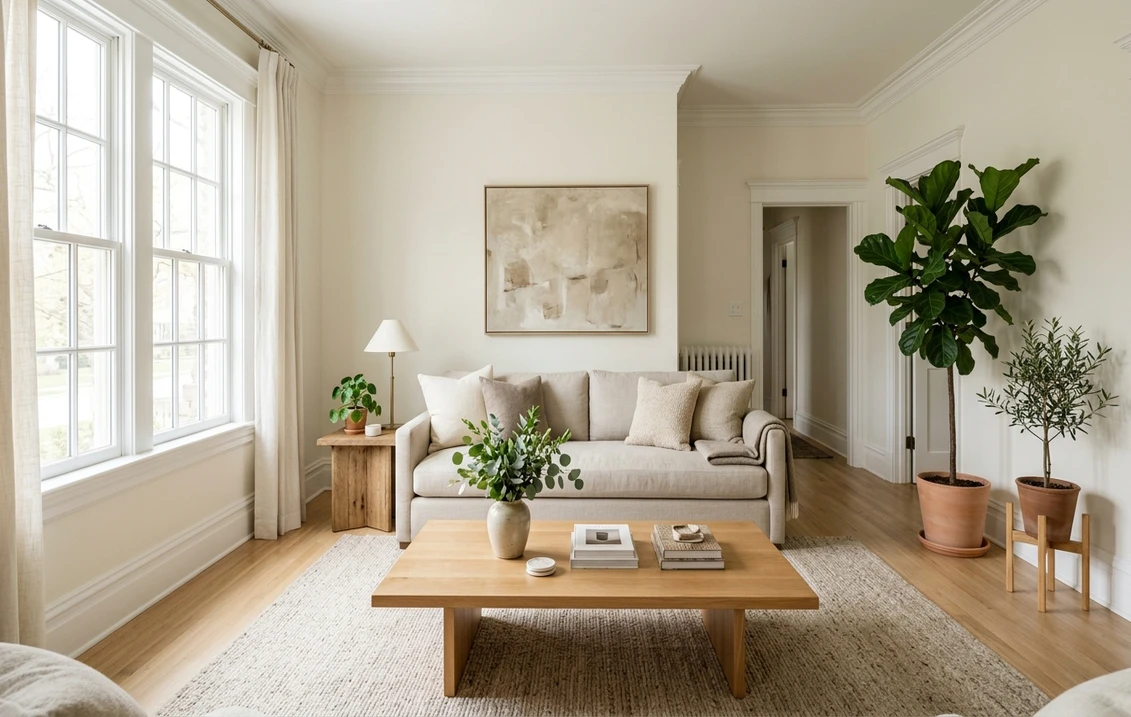
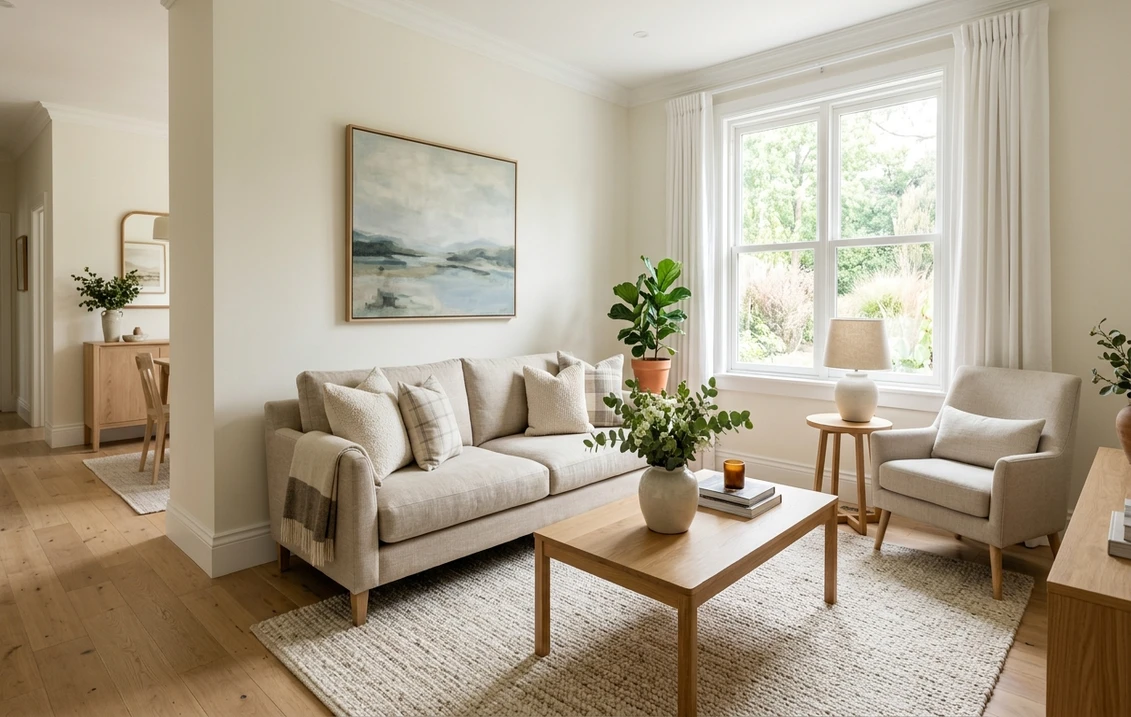
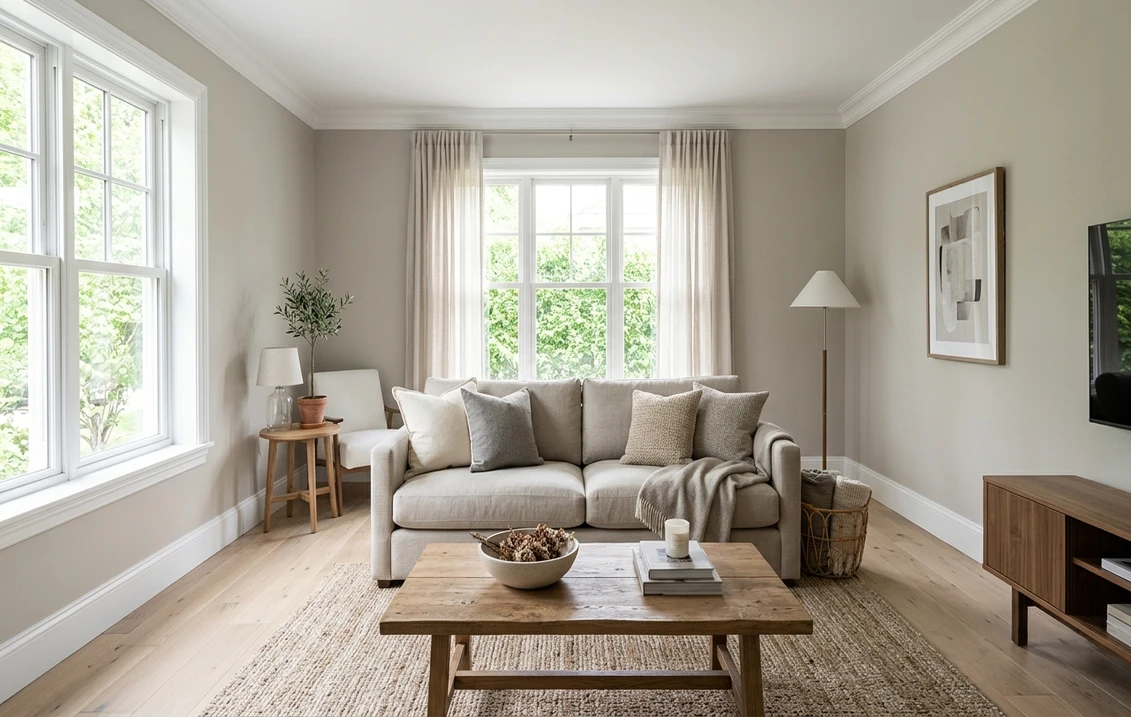
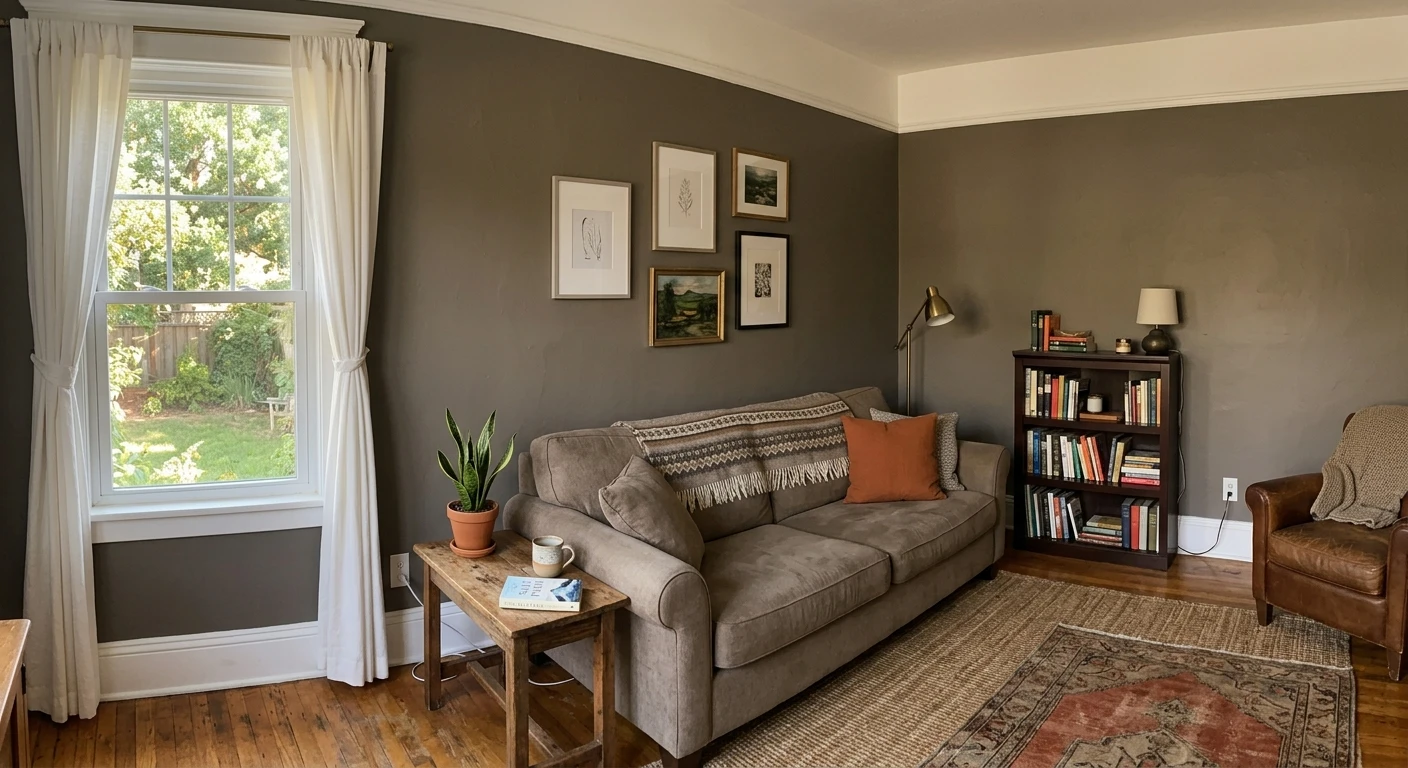
This is Clay Beige's home turf. The warm yellow-tan undertone makes a living room feel instantly cozy and lived-in, and at LRV 60 it keeps the space bright rather than heavy. It plays beautifully with wood furniture, leather, woven textures, and warm metals like brass and bronze. If a warm, inviting gathering space is your project, it sits comfortably among the picks in our roundup of the best beige living room paint ideas for 2026.
Bedrooms and primary suites
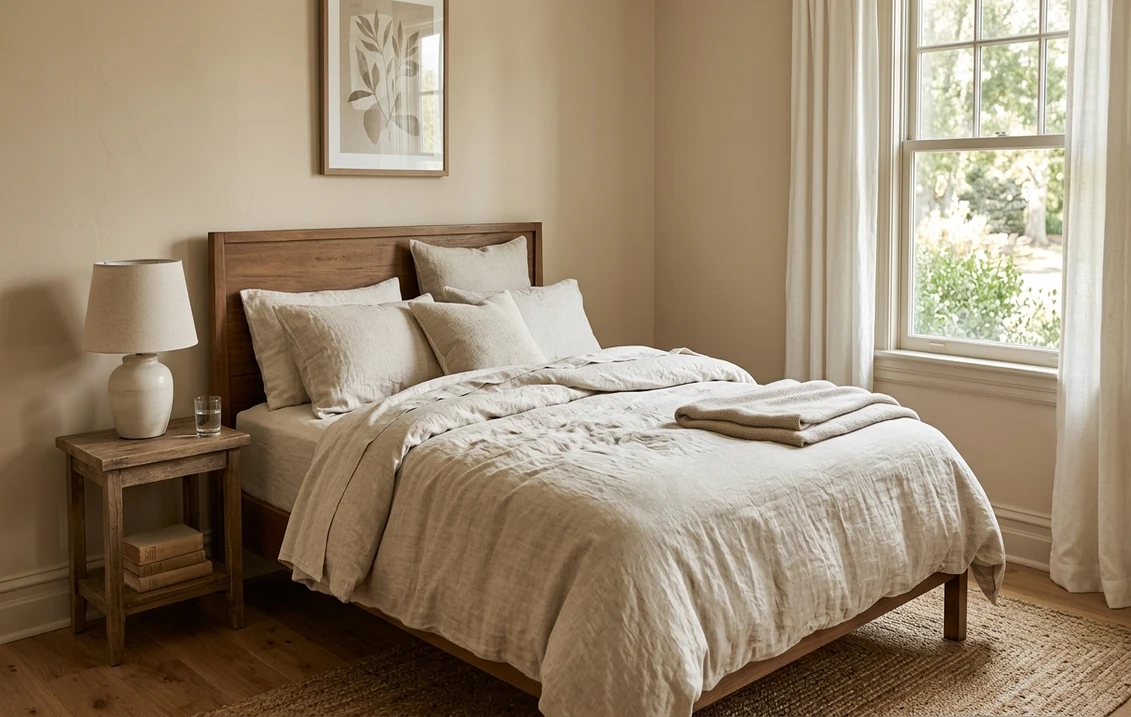
In a bedroom the soft warmth reads restful and enveloping, the kind of color that makes a room feel calm at the end of a long day. It pairs effortlessly with cream and oatmeal bedding, natural linen, rattan, and pale-to-medium wood. Clay Beige is forgiving here because its earthy undertone keeps it from feeling too sweet, which matters when you live with a bedroom color for years.
Hallways, open-plan transitions, and whole-home flow
Because it reads warm but not loud, Clay Beige is an excellent connector color for hallways and open-plan homes where one paint has to flow across many light conditions. It bridges warm wood tones and cream trim without fighting either. For where it lands among the year's other warm neutrals, our guide to beige paint colors and undertones is a useful map.
Where to think twice
A bright, south-facing room flooded with afternoon sun and warm 2700K bulbs is where Clay Beige can tip from cozy to overtly golden. If that room already has a lot of warm wood and gold tones, the wall may read more yellow than you want; consider a cooler greige instead, or switch the brightest fixtures to a more neutral 3000K to 3500K bulb. Clay Beige rewards balance, so do not stack warm on warm on warm.
Trim, ceiling, and decor pairings
A warm beige lives or dies on what sits next to it. Get the trim right and Clay Beige looks intentional and soft; get it wrong and it can read either too yellow or oddly dull.
- Soft warm white trim (most balanced): BM White Dove (OC-17, LRV 85) is the designer default. Its gentle cream bias is warm enough to stay in the same family as Clay Beige, so the trim looks crisp without the jarring cool-white contrast that makes a warm wall look dingy. This is the safe, cohesive pick for most homes.
- Creamy trim (softer, cozier): BM Simply White (OC-117) keeps everything in a warm, low-contrast palette for a serene, enveloping look. Best for bedrooms and traditional rooms where you want softness over crispness.
- Avoid: a stark blue-white trim like a bright cool white next to Clay Beige. The warm-cool clash exaggerates the yellow in the walls and can make the beige look dirty by comparison.
- Ceilings: a soft white (often the trim color) keeps the room cohesive. A very cool flat white above a warm beige can read slightly blue and fight the walls, so favor a warm-leaning white.
- Floors and decor: medium oak, walnut, terracotta, jute, leather, brass, and cream textiles all flatter Clay Beige and reinforce its grounded warmth. Cool gray-blue rugs and chrome can fight the warmth; if you want contrast there, keep it intentional and balanced with warm accents.
For contrast and depth, a soft black or deep bronze-green on a door, built-in, or interior window reads tailored and modern against the warm beige walls. If you want a deeper look at how warm neutrals relate as a family, its closest warmer cousin is covered in our Benjamin Moore Manchester Tan HC-81 review. And if the room on the other side of the doorway is going cool instead of warm, matching the light reflectance is what keeps an open plan from feeling like two houses: Benjamin Moore Wickham Gray in a living room sits at an LRV near 60, the same figure as Clay Beige, but approaches it from the blue-gray side of the temperature line.
See walls, trim, and floor together in one preview, free.
Clay Beige vs Grant Beige vs Shaker Beige: the near-twins, decoded
Almost every Clay Beige search ends in a side-by-side with one of two Benjamin Moore beiges that look nearly identical on a chip but behave differently on a wall. Here is how to tell them apart so you do not paint the wrong one.
- vs BM Grant Beige (HC-83): the most common dilemma. Grant Beige is the more neutral, greige-leaning of the two: it pulls a touch more gray and green-gray, so it reads cooler, calmer, and less openly golden. Clay Beige is the warmer, more straightforwardly yellow-tan and golden of the pair. Choose Grant Beige if you want a more neutral greige-beige that hides cool-toned furnishings; choose Clay Beige when you want a clearly warm, golden, classic beige.
- vs BM Shaker Beige (HC-45): Shaker Beige is a deeper, more golden historical beige with a stronger tan-yellow presence and a lower LRV, so it reads noticeably warmer and heavier on the same wall. Clay Beige is the lighter, calmer, more versatile of the two and is far easier to live with across a whole home. Pick Shaker Beige when you want a richer, more traditional honeyed beige; pick Clay Beige when you want warmth that stays light and flexible.
- vs BM Manchester Tan (HC-81): Manchester Tan is a popular cleaner warm tan that reads a touch more yellow-green in some light. Clay Beige is slightly softer and a hair grayer in its earthy moments, so it can feel a little more grounded. They are close cousins; the deciding factor is usually how much green you want in the warmth.
Spelling note: BM Clay Beige, Clay Beige 968, and Clay Beige Benjamin Moore all point to this same color 968. Do not confuse it with the unrelated Sherwin-Williams or designer "clay" colors, which run far more saturated and terracotta.
How to test Clay Beige before you commit
A 2-inch fan-deck chip is the number-one reason people pick a warm beige that disappoints: it exaggerates the yellow and cannot show how the undertone calms down across a real day on a real wall. Two better methods:
- Paint a large swatch: roll a 12-by-12-inch sample (or a peel-and-stick sample) on two different walls and check it mid-morning, mid-afternoon, and at night under your normal bulbs. Watch specifically for how gold it goes in your brightest, sunniest pool of light; that corner tells you the truth.
- Preview it digitally first: upload a real photo of your room and apply Clay Beige (plus a more neutral, grayer alternative such as Grant Beige and Edgecomb Gray) before you buy any samples, narrowing three contenders to the one worth painting. If you are comparing it against the cooler greige end, our Benjamin Moore Edgecomb Gray HC-173 review shows the difference clearly.
Preview Clay Beige against Grant Beige and a grayer greige, side by side, free.
Frequently asked questions
Is Benjamin Moore Clay Beige warm or cool?
Clay Beige (968) is a warm color with a soft yellow-tan undertone and a faint earthy gray that surfaces in cooler light. In bright south or west light it warms toward gold and reads cozy and glowing, while in north or cool light the earthy undertone steps forward and it reads as a calmer soft beige. It never turns orange or pink, which is why it is a safe whole-home beige, but it is firmly a warm neutral, not a cool gray.
What is the LRV of Clay Beige 968?
Clay Beige has a Light Reflectance Value of about 60 on the Benjamin Moore color data, with a hex approximation of #D8CCB5 (RGB 216, 204, 181). That makes it a light mid-range beige: bright enough to keep a small room open and airy, but with enough depth to read as a real warm color rather than washing out like a high-LRV cream or tinted white.
What are the best rooms for Clay Beige?
Living rooms, family rooms, bedrooms, hallways, and open-plan transitions are where Clay Beige shines, because its warm yellow-tan undertone makes a space feel cozy and grounded against wood, leather, brass, and natural textures. It is least reliable in a very bright south-facing room already full of warm wood and 2700K bulbs, where it can tip toward gold; a cooler greige or a more neutral bulb temperature helps there.
What trim color goes with Clay Beige?
BM White Dove (OC-17) is the most balanced trim because its gentle cream bias stays in the same warm family as Clay Beige, so the trim looks crisp without the jarring cool-white contrast that makes a warm wall look dingy. BM Simply White (OC-117) is the softer, cozier option for bedrooms. Avoid a stark blue-white trim, which exaggerates the yellow in the walls and can make the beige look dirty by contrast.
What is the difference between Clay Beige, Grant Beige, and Shaker Beige?
Grant Beige (HC-83) is the more neutral, greige-leaning option, pulling more gray and green-gray so it reads cooler and calmer. Shaker Beige (HC-45) is a deeper, more golden historical beige that reads noticeably warmer and heavier. Clay Beige (968, LRV near 60) sits in between as the clean, warm, golden yellow-tan that stays bright and flexible across a whole home. Choose Grant Beige for a more neutral greige-beige, Shaker Beige for a richer honeyed tan, and Clay Beige for clear, classic warmth.
Preview BM Clay Beige on your actual walls under your own light before buying a single sample. Free: 1 HD preview plus 3 variations.
Disclaimer: Benjamin Moore, Clay Beige (968), Grant Beige (HC-83), Shaker Beige (HC-45), Manchester Tan (HC-81), Edgecomb Gray (HC-173), White Dove (OC-17), and Simply White (OC-117) are trademarks of Benjamin Moore & Co. FacadeColorizer is an independent paint visualization service and is not affiliated with, endorsed by, or sponsored by Benjamin Moore. Color reproduction on screens approximates the manufacturer's chip; always confirm with a manufacturer sample under your own light before purchase. Sources: Benjamin Moore 968 Clay Beige color data 2026, Benjamin Moore HC-83 Grant Beige and HC-45 Shaker Beige color data 2026, The Spruce warm-neutral undertone coverage, designer field reports compiled by FacadeColorizer.
Trademarks mentioned (Sherwin-Williams, Benjamin Moore, Behr, Caparol, Brillux, Sto, Alpina, Valspar, PPG, Glidden, Dulux, Crown Trade, Sandtex, Farrow & Ball, Johnstone's, Leyland) are property of their respective owners. FacadeColorizer is independent and not affiliated with any of them. Nominative fair use under Lanham Act §1125.