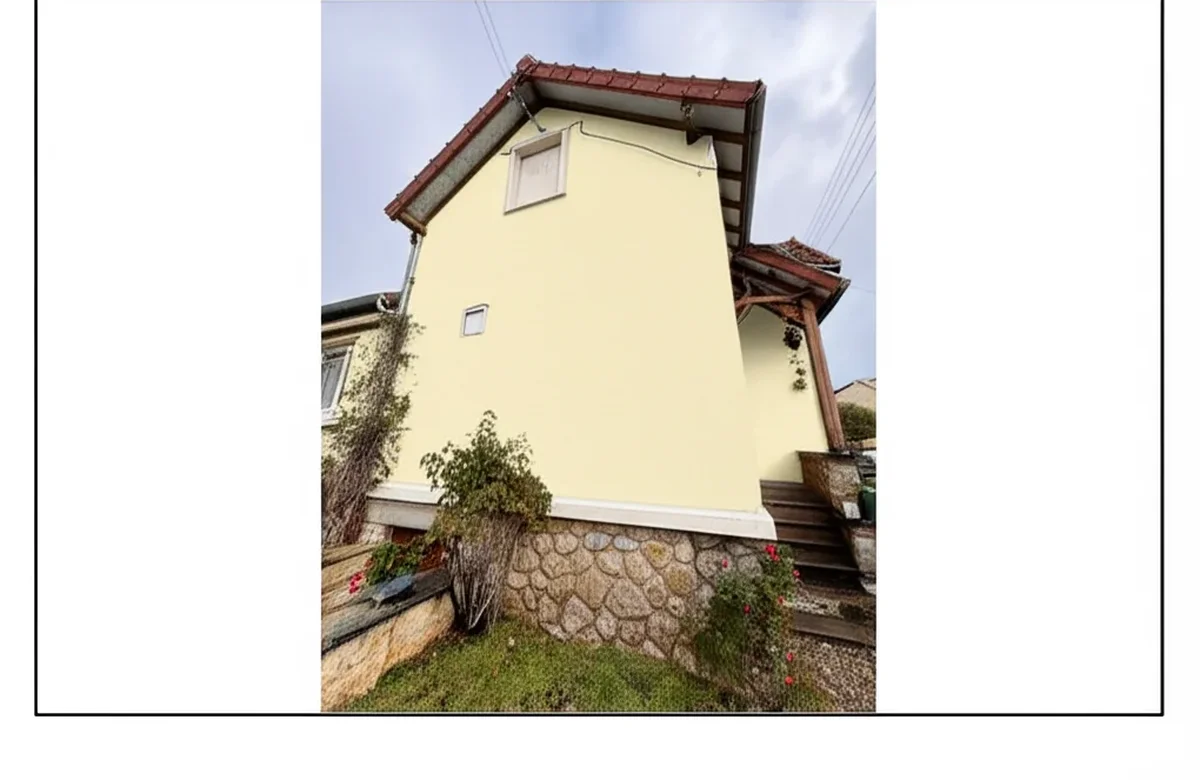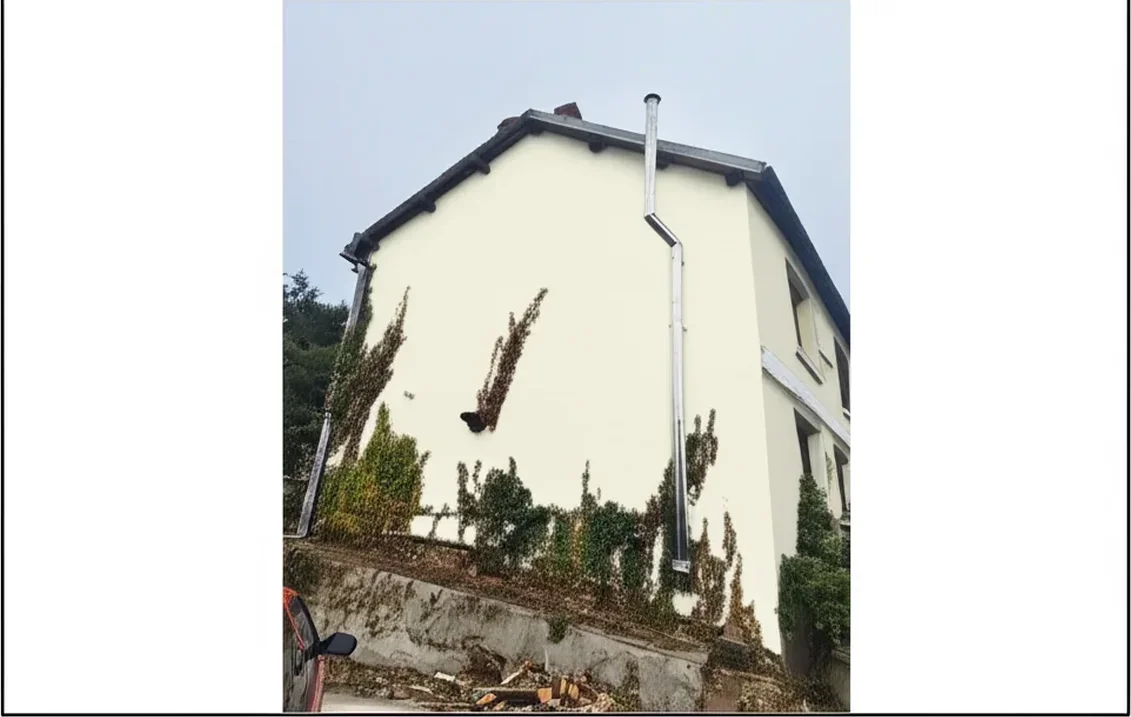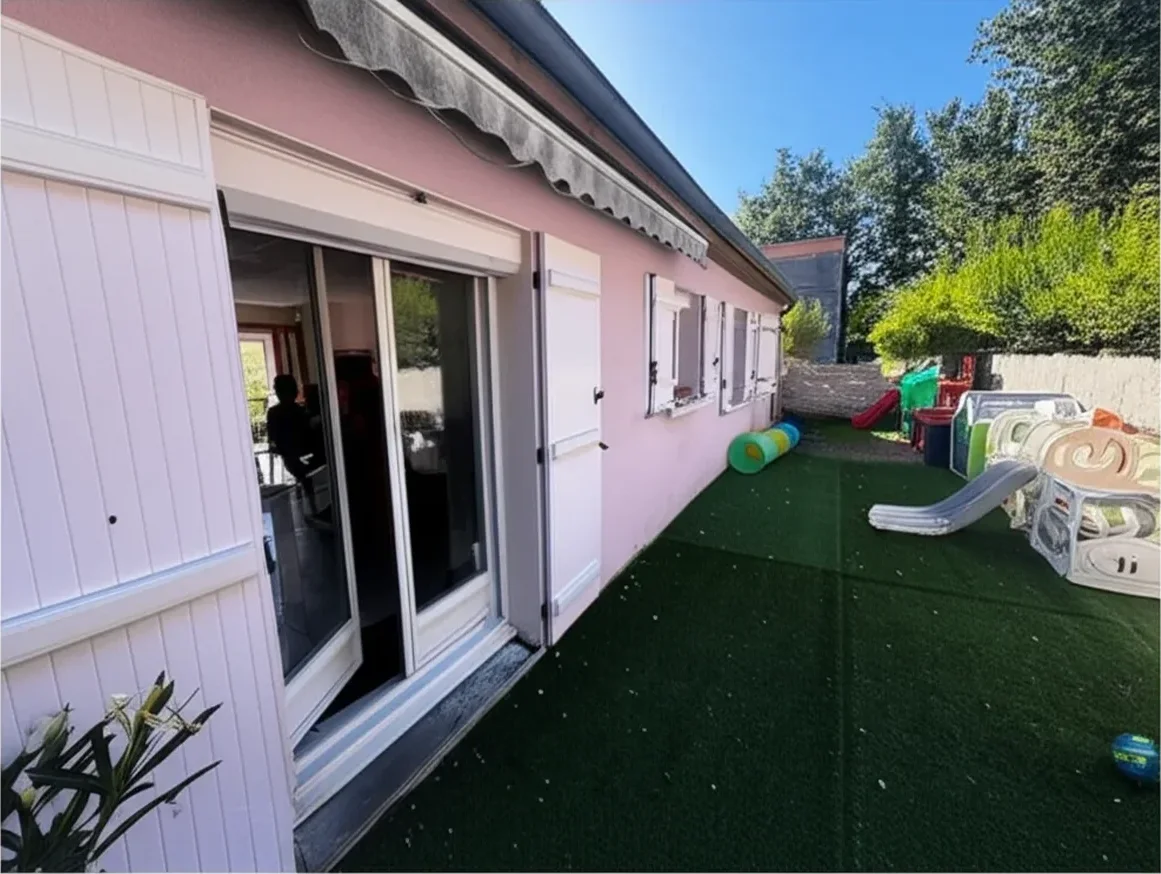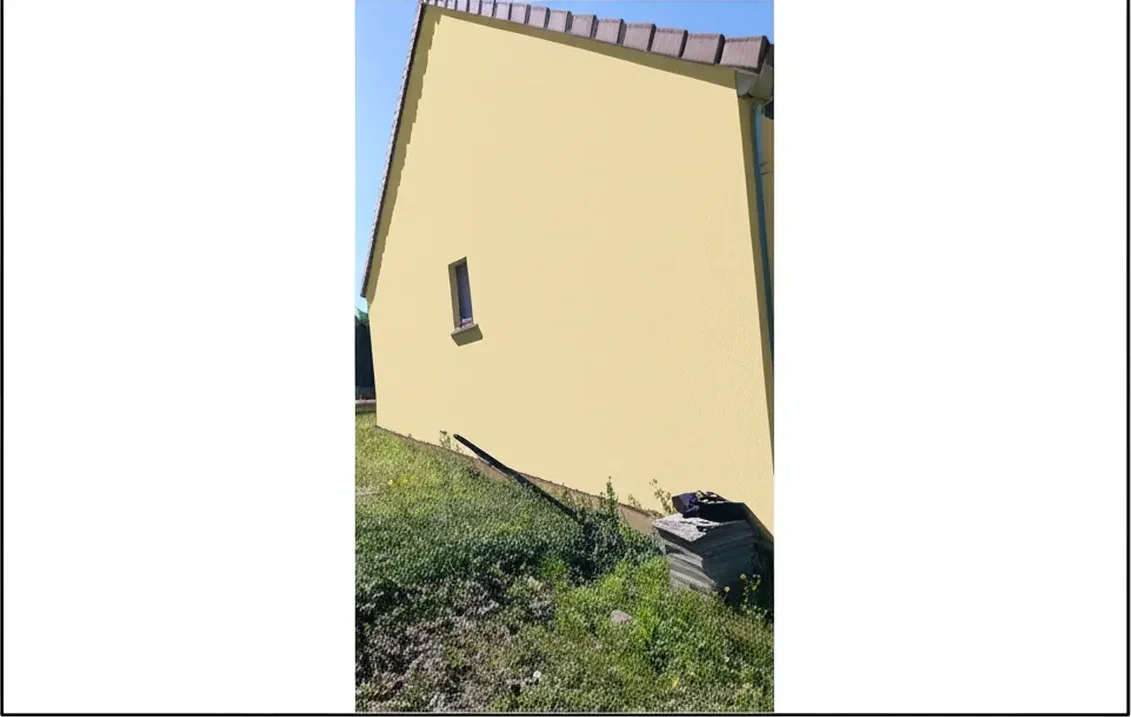
Try it on your house
Aluminum siding clads roughly 12 million US homes, most installed 1955 to 1985. Homeowners from Cleveland to Kansas City face the same 2026 decision: rehab the existing aluminum or replace with James Hardie fiber cement. This is a materials-science comparison covering cost per sqft installed, durability, dent and hail resistance, fire rating, paintability, thermal movement, embodied carbon, and climate fit.
Aluminum runs $4 to $9/sqft installed, fiber cement $6 to $12/sqft. Aluminum lasts 40 to 50 years, fiber cement 50+. Both are Class A fire-rated, but failure modes and resale implications diverge. Sources: Hardie bulletins, Aluminum Association, IBHS, RSMeans 2026.
Materials science: rolled aluminum coil vs autoclaved fiber cement
Aluminum siding is cold-rolled from 3105-H24 or 3004-H16 alloy coil, typically 0.019 to 0.024 inch gauge, roll-formed into lap, vertical, or board-and-batten profiles, then factory-coated with a baked PVDF (Kynar 500) or polyester finish at 0.8 to 1.2 mils DFT. Density 2.70 g/cm3, tensile yield ~22,000 psi. Corrosion protection comes from the native oxide plus the factory coating, the metal itself does not age.
James Hardie fiber cement (HardiePlank, HardiePanel) is produced via the Hatschek process: ~55% Portland cement, 34% silica sand, 8% cellulose fiber slurried, dewatered, and autoclave-cured at 180°C and 150 psi. Result: a crystalline calcium silicate hydrate (C-S-H) matrix at 1.6 to 1.7 g/cm3, compressive strength 4,500 to 6,000 psi, flexural 1,800 to 2,100 psi. ColorPlus adds 3.5 to 4.5 mils DFT of alkali-resistant primer plus acrylic-urethane topcoats.
Practical consequence: aluminum is a thin ductile sheet protected by a coating; fiber cement is a thick cementitious composite that is itself the weather barrier.
Cost per installed square foot (2026 RSMeans)
Aluminum, new install: $4.00 to $9.00/sqft. Material $2.25 to $4.50 (0.024 gauge Kynar-finished), labor $1.75 to $4.50. The range reflects profile (smooth lap cheapest, board-and-batten 20 to 35% more) and wall complexity.
Fiber cement, new install: $6.50 to $12.00/sqft. Material $3.25 to $5.75 (HardiePlank 5/16 in with ColorPlus), labor $3.25 to $6.25, reflecting heavier handling, carbide blade cutting, and dust-collection PPE.
Aluminum rehab (repaint existing): $1.75 to $3.50/sqft for pressure wash, scuff-sand, bonding primer on chalked coatings, and two coats of 100% acrylic (Sherwin-Williams Emerald, Benjamin Moore Aura). A 2,000 sqft wall area renews for $3,500 to $7,000 rather than $12,000 to $24,000 for full Hardie tear-off.
Durability envelopes: 40-50 years vs 50+ years
Aluminum substrate: 40 to 50 years, longer in dry climates. The metal does not rot, but three failure modes accumulate: (1) chalking and fade of the PVDF/polyester coating at 15 to 25 years; (2) oxidation pitting in coastal salt-spray if coating is breached; (3) galvanic corrosion where aluminum contacts copper, steel fasteners, or pressure-treated lumber.
Fiber cement substrate: 50+ years. The C-S-H matrix has no known degradation pathway short of prolonged saturation cycling at the fastener annulus. Hardie's 50-year non-prorated substrate warranty reflects this envelope; ColorPlus finish warrants 15 years on peel/chip/crack with a 30% ΔE fade allowance.
Practical meaning: aluminum repainted every 12 to 18 years routinely exceeds 60 years of service. Aluminum never repainted looks tired at 25 to 30 years even though the metal is fine. Fiber cement shows fewer intermediate demands, but caulk joints still need renewal every 10 to 15 years.
Dent and hail resistance (where fiber cement clearly wins)
This is the single biggest technical weakness of aluminum and the headline advantage of fiber cement.
Aluminum at 0.024 in gauge shows permanent visible denting from 0.75 to 1.0 inch hailstones (roughly 3.5 to 6 J kinetic energy). Baseball strikes, ladder leans, weed-trimmer debris, and kids' toys all leave dents. Once the sheet deforms, it stays deformed, there is no elastic recovery and on-site panel straightening is unreliable. Insurance carriers in CO, NE, OK, and the TX panhandle increasingly rate aluminum-clad homes as higher hail-claim risk.
HardiePlank 5/16 in cracks at 1.5 inch / 11.2 J impact and through-cracks at 1.75 inch / 17.8 J (IBHS Hail Impact Protocol 2023). It does not dent, but at the fracture threshold a plank must be replaced rather than straightened. Sub-1.5-inch hail leaves fiber cement visually untouched.
In hail alleys, fiber cement's dent-immunity up to 1.5 inches is a material advantage that aluminum cannot close through gauge increases alone without pricing itself out of the residential market.
Fire rating: both Class A, different mechanisms
Both materials carry ASTM E84 Class A ratings (Flame Spread Index under 25, Smoke Developed Index under 450). They achieve this differently.
Aluminum is non-combustible in the practical sense: it does not flame-spread. But aluminum melts at 660°C (1,220°F), well below the 800 to 900°C radiant flux of a sustained WUI fire. Once melted, the siding peels away and exposes the underlying sheathing, which then ignites. CAL FIRE Chapter 7A and IBHS Wildfire Prepared Home guidance treat aluminum as not recommended in WUI exposures for this reason.
Fiber cement is classified non-combustible per ASTM E136, a stricter standard than E84 Class A. It does not melt, peel, or conduct heat to the sheathing during typical WUI radiant exposures. HardieZone products are explicitly listed in CAL FIRE Chapter 7A-compliant assemblies.
For urban interface zones in CA, OR, WA, CO, NM, and increasingly parts of NY and NJ, fiber cement has become the de facto spec.
Preview Kynar aluminum refresh colors or Hardie ColorPlus on your actual elevation in 30 seconds
Paintability and repaint cycles
Aluminum takes paint well once properly prepped. On a chalked coating, a bonding primer (Zinsser 1-2-3 Plus, SW Extreme Bond) plus two coats of 100% acrylic yield 12 to 18 years in CZ 3-5. ASTM D4541 pull-off on well-prepped aluminum tests at 320 to 400 psi, above the 300 psi threshold predictive of under 10% failure at 10 years. Top failure causes: ungalvanized fasteners and poor pressure washing, not paint chemistry.
Fiber cement is the most paint-friendly substrate on the market. ASTM D4541 pull-off tests 450 to 520 psi because the alkaline mineral surface reacts with acrylic binders (siloxane bonding). Field repaints on HardiePlank run 10 to 12 year cycles, slightly shorter than aluminum because moisture movement at joints stresses paint films more than a metal sheet.
Takeaway: repainting aluminum is economically rational. Repainting factory-finished Hardie voids the ColorPlus warranty, so many owners run the 15-year ColorPlus window, then field-repaint at 10 to 12-year cycles.
Thermal expansion: where dimensional stability favors fiber cement
Thermal movement drives paint film stress, caulk-joint failure, and fastener loosening.
Aluminum has a coefficient of thermal expansion of 23 x 10-6 /°C. A 12-foot aluminum plank swings through a 120°F summer-to-winter delta by about 0.23 inch. Install manuals require 1/4 inch expansion gap at butt joints and slotted nailing; installers who nail tight cause oil-canning (visible waviness) within the first hot-cold cycle.
Fiber cement has a coefficient of thermal expansion of roughly 6 to 8 x 10⁻⁶ /°C, plus a moisture-expansion component of only 0.04% linear (ASTM C1185). A 12-foot HardiePlank moves under 0.07 inch across the same range. This is why Hardie tolerates tight butt joints and pre-painted mating surfaces without oil-canning or joint telegraphing.
For houses with long uninterrupted wall runs (ranch, contemporary, mid-century), fiber cement's dimensional stability is a visible quality advantage.
Eco credentials and embodied carbon
Aluminum: virgin primary aluminum runs 80 to 120 kg CO2e/m2, but recycled-content coil (85 to 95% post-consumer is common) drops this to 12 to 18 kg CO2e/m2, among the lowest of any cladding. Aluminum is 100% recyclable at end of life with no downcycling.
Fiber cement: 28 to 34 kg CO2e/m2, dominated by Portland cement clinker. End-of-life is landfill. Hardie publishes an industry-wide EPD; fly-ash and slag substitution are narrowing the gap.
For LEED v4.1, Passive House, and LBC projects, recycled aluminum has the strongest embodied-carbon profile among premium claddings. On a durability-weighted 60-year LCA, fiber cement narrows the gap via longer substrate life.
Ten-criteria technical comparison table
Data drawn from Aluminum Association technical bulletins, James Hardie ICC-ES ESR-1844, ASTM C1185/C666/D4541/D4587/D5628, IBHS Hail Impact Protocol 2023, RSMeans 2026, and published EPDs.
| Criterion | Aluminum Siding | Fiber Cement (Hardie) | Edge |
|---|---|---|---|
| Installed cost/sq ft (2026) | $4.00–$9.00 | $6.50–$12.00 | Aluminum |
| Substrate service life | 40–50 yr | 50+ yr | Fiber cement |
| Dent / hail resistance | Dents at 0.75"–1.0" hail | Passes 1.5" hail | Fiber cement |
| Fire rating | Class A, melts at 660°C | Class A, ASTM E136 non-combustible | Fiber cement (WUI) |
| Paint adherence (ASTM D4541) | 320–400 psi (prepped) | 450–520 psi (primed) | Fiber cement |
| Field repaint cycle | 12–18 yr | 10–12 yr | Aluminum |
| Thermal expansion coefficient | 23 x 10-6 /°C | 6–8 x 10⁻⁶ /°C | Fiber cement |
| Embodied carbon (recycled) | 12–18 kg CO2e/m2 | 28–34 kg CO2e/m2 | Aluminum |
| End-of-life recyclability | 100% infinite loop | Landfill (practical) | Aluminum |
| Installation labor demand | 1.75–4.50 USD/sqft | 3.25–6.25 USD/sqft | Aluminum |
Try it on your house
No photo? Try a sample
Raw tally: aluminum 5, fiber cement 5. The scorecard is balanced because these two products optimize for different failure envelopes, aluminum for recyclability, lightness, and labor economy; fiber cement for impact, fire, and dimensional stability.
Best climates per material
Aluminum still makes sense in: (1) dry, low-hail climates, AZ, NM, inland CA, eastern WA, CO high desert; (2) coastal zones 1,500+ ft from salt water with Kynar finish; (3) rehab-over-replace on 1970s-80s stock in good structural condition; (4) low embodied-carbon spec projects.
Fiber cement wins in: (1) hail corridors, OK, TX panhandle, NE, KS, eastern CO; (2) WUI zones in CA, OR, WA, CO, NM and expanding east; (3) humid southeast (GA, SC, NC, AL, FL inland) where aluminum pitting accumulates; (4) Gulf Coast termite zones; (5) new construction where the cost delta is small against total build.
1970s-80s aluminum siding: rehab or replace?
This is the most common live decision in 2026 for owners of mid-century ranches, split-levels, and two-stories clad 40 to 55 years ago.
Rehab (repaint) makes sense when: chalking and fade but no pitting; dents under 25% of panels; caulking and trim intact; J-channels not corroded; owner plans 5 to 15 more years. Outcome: $3,500 to $7,000 on a 2,000 sqft wall, 12 to 18 years of curb appeal, substrate still good for another 20 to 30 years.
Replacement with Hardie makes sense when: pitting visible on south/west walls; dent coverage over 25%; multiple hail insurance claims; WUI fire zone or conditional wildfire insurance; owner plans 15+ years or sells in a Hardie-dominant market (CO Front Range, NC Piedmont, DFW) where resale comps show a 3 to 6% premium.
Rule of thumb: if the aluminum has more than one failed performance axis (dents + fade, fade + pitting), replacement beats rehab over 20 years. If only one axis is compromised, rehab wins on dollar-per-year terms.
Rehab only holds that advantage if the prep is done properly, and on aluminum the prep is roughly 70% of the job: wash, mildew treatment, sanding the chalk, seam repair, then etch primer over the whole house. A skipped etch prime is the single most common reason an aluminum repaint fails early and turns a rehab decision into a replacement one. Our full guide to the cost to repaint aluminum siding breaks the price down by region and walks through those five non-negotiable steps.
Before you decide: preview both finishes on your actual house
Whether you repaint aluminum with Sherwin-Williams Emerald or spec Hardie ColorPlus, the large-format color shift is identical: a 3-inch chip underestimates the saturated wall color by 25 to 30%. Warm beiges read yellow, cool grays read blue, and dark shades push surface temperatures 15 to 25°F above neighboring light colors (a real factor on south-facing aluminum above 140°F surface temperature). Color validation is the single highest-ROI pre-project step.
Free, no signup, preview aluminum refresh colors or Hardie ColorPlus on your own photo
Frequently asked technical questions
Is it worth repainting 1970s aluminum siding or should I replace with Hardie?
Repaint if the aluminum shows chalking and fade but no pitting or perforations, dents are under 25% of panels, and trim and J-channels are intact. Expect $1.75 to $3.50 per sqft and 12 to 18 years of service. Replace with Hardie if pitting is visible, dent coverage exceeds 25%, you are in a WUI or hail corridor, or resale comps show a 3 to 6% fiber-cement premium in your market. If more than one performance axis is failing, replacement usually wins over a 20-year horizon.
Why does fiber cement resist hail better than aluminum siding?
Aluminum at 0.024 in gauge deforms permanently under 3.5 to 6 J impact, equivalent to a 0.75 to 1.0 inch hailstone, because the sheet has no elastic recovery past its yield point. HardiePlank 5/16 in absorbs up to 11.2 J (1.5 inch hail) without visible damage because the crystalline C-S-H matrix distributes stress across a much thicker cross-section. Hardie through-cracks at roughly 17.8 J (1.75 inch hail) and requires plank replacement; aluminum dents accumulate from normal impacts well below any hail threshold.
Are aluminum siding and fiber cement both Class A fire-rated?
Yes, both carry ASTM E84 Class A (Flame Spread Index under 25). But the mechanisms differ. Aluminum does not flame-spread but melts at 660°C / 1,220°F, well below sustained WUI radiant flux, then peels away and exposes sheathing. Fiber cement meets ASTM E136 non-combustible, a stricter standard that covers melting and conduction as well as flame spread, and is listed in CAL FIRE Chapter 7A-compliant assemblies. In WUI zones (CA, OR, WA, CO, NM), fiber cement is the appropriate spec; aluminum is typically not recommended.
Which has the lower embodied carbon, aluminum siding or fiber cement?
Recycled-content aluminum siding (85 to 95% post-consumer typical) runs 12 to 18 kg CO2e per m2, the lowest among premium residential claddings. Virgin primary aluminum is much higher at 80 to 120 kg CO2e per m2. Fiber cement runs 28 to 34 kg CO2e per m2, driven by Portland cement clinker. On a durability-weighted 60-year LCA the gap narrows because fiber cement lasts slightly longer as a substrate, but for LEED v4.1, Passive House, or LBC embodied-carbon targets, recycled aluminum is usually the stronger choice. Aluminum is also 100% recyclable at end of life without downcycling.
Keep comparing siding materials
If aluminum and fiber cement are only two of the options on your list, these related breakdowns cover the rest of the field:
- Vinyl versus wood siding, the budget-and-maintenance decision at the entry end of the market.
- HardieBoard against LP SmartSide, fiber cement versus engineered wood head to head.
- Repair or replace your existing siding before you spend on a full re-clad.
- If stucco is the third option on your list, the color rules move with the substrate: a continuous textured plane scatters light, so the same shade lands lighter and chalkier than it does on shadowed lap boards, and the trim has to carry more of the contrast. Our stucco and trim color pairings work through that adjustment.
Once the material is chosen, test the finish color on your own elevation to avoid a costly repaint.
Aluminum siding and fiber cement are both mature, Class A, code-listed claddings. The right 2026 spec depends on climate zone, hail probability, WUI exposure, and whether you are rehabbing 40-year-old stock or building new. Before committing to paint colors on either, preview them on your actual elevation with our free AI paint visualizer. Sources: James Hardie technical bulletins, Aluminum Association sheet-coil data, ICC-ES ESR-1844, ASTM C1185/C666/D4541/D5628/D4587/E84/E136, IBHS Hail Impact Protocol 2023, RSMeans 2026, CAL FIRE Chapter 7A.
Trademarks mentioned (Sherwin-Williams, Benjamin Moore, Behr, Caparol, Brillux, Sto, Alpina, Valspar, PPG, Glidden, Dulux, Crown Trade, Sandtex, Farrow & Ball, Johnstone's, Leyland) are property of their respective owners. FacadeColorizer is independent and not affiliated with any of them. Nominative fair use under Lanham Act §1125.