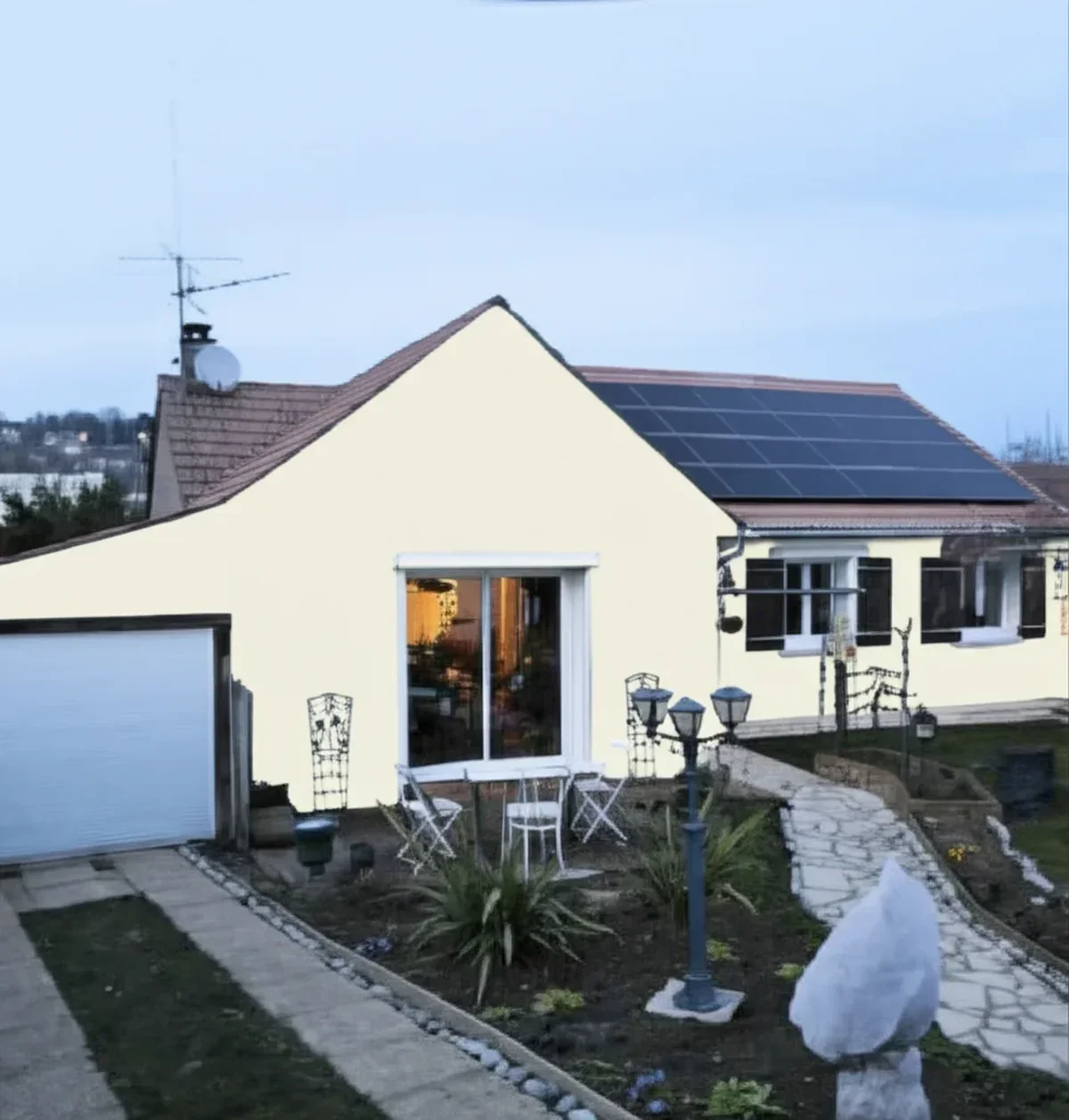
Try it on your house

Benjamin Moore® Revere Pewter HC-172 and Benjamin Moore® Edgecomb Gray HC-173 are the two most popular Benjamin Moore greiges on FacadeColorizer. Both colors sit on the Historical Color (HC) palette. Both will appear on the same fan deck page. Both will appear in the same Pinterest board on the same evening. And both will look completely different on your facade depending on orientation, substrate, and time of day.
This 2026 head-to-head guide is the practical answer to the second question every Benjamin Moore exterior client asks after "Revere Pewter or not?" The question is "OK then, Revere Pewter or Edgecomb Gray?" Below you will find the full 8-attribute spec table, a real side-by-side test on a Boston Colonial duplex (HC-172 on the left unit, HC-173 on the right unit, same painter, same Aura Exterior batch, 14 months of observation), when each color wins and when each loses, how both compare against SW Repose Gray and BM Manchester Tan, twelve coordinated trim and door pairings, and an 8-question FAQ. For the Revere Pewter standalone treatment, see our pillar Benjamin Moore Revere Pewter HC-172 exterior 2026 guide.
Upload one photo, get a photorealistic side-by-side render in 30 seconds. No signup.
1. Benjamin Moore Revere Pewter HC-172 specs
Revere Pewter is a warm mid-light greige released in 2006 as part of the Benjamin Moore Historical Color Collection. The "Pewter" in the name refers to the soft pewter-gray cast that emerges in cool light, the "Revere" refers to Paul Revere's silver shop, and on the wall it is the single most popular Benjamin Moore color of the last decade.
| Attribute | Value |
|---|---|
| Official name | Revere Pewter |
| Benjamin Moore code | HC-172 (Historical Color Collection) |
| Family | Warm greige (gray + beige) |
| Approximate hex | #C9C2B6 |
| Approximate RGB | 201, 194, 182 |
| LRV (Light Reflectance Value) | 55.51 |
| Undertone | Warm beige-gray, slight olive-green pull in flat north light |
| Year introduced | 2006 (Historical Color Collection) |
Try it on your house
No photo? Try a sample
Source: Benjamin Moore Historical Color Collection technical data sheet, FacadeColorizer internal facade simulation dataset (16,983 renders, 2025-2026). For the full Revere Pewter treatment with 12 trim pairings and regional popularity, see our Revere Pewter exterior 2026 pillar guide.
The LRV of 55.51 is the number that does the work. At that value HC-172 sits in the upper middle of the brightness scale, dark enough to read as a clear mid-tone color (not a "white"), light enough to reflect roughly 56% of visible light. The olive-green pull on north-facing walls is the well-documented trade-off, the thing that catches roughly one homeowner in five by surprise after the painters finish.
2. Benjamin Moore Edgecomb Gray HC-173 specs
Edgecomb Gray is Revere Pewter's lighter, slightly cooler sibling on the Historical Color page. Released the same year (2006), it shares the same family classification (warm greige) but sits 7.5 LRV points brighter and reads with a noticeably more neutral undertone. On the fan deck, Edgecomb Gray is the chip directly to the left of Revere Pewter. On a house, that 7.5-point gap is the difference between a "mid-tone" facade and a "light" facade.
| Attribute | Value |
|---|---|
| Official name | Edgecomb Gray |
| Benjamin Moore code | HC-173 (Historical Color Collection) |
| Family | Light greige (gray + soft beige) |
| Approximate hex | #D8CFC1 |
| Approximate RGB | 216, 207, 193 |
| LRV (Light Reflectance Value) | 63 |
| Undertone | Neutral warm greige, very mild pink-taupe pull in pure daylight |
| Year introduced | 2006 (Historical Color Collection) |
Source: Benjamin Moore Historical Color Collection technical data sheet, Painting Contractors Association exterior color tracker 2025-2026.
At LRV 63, Edgecomb Gray reflects roughly 63% of visible light, putting it firmly in the "light neutral" band that almost every US HOA color guideline approves by default. The undertone is the headline differentiator. Where Revere Pewter shifts olive-green in flat north light, Edgecomb Gray stays neutral with at most a very mild pink-taupe pull in pure midday daylight, never the green pull that catches Revere Pewter buyers off guard. That single attribute is why Edgecomb Gray is increasingly the "safe" greige recommendation for designers who have been burned once by HC-172 on a north-facing facade.
Same photo, both colors, your actual orientation. Free AI render in 30 seconds.
3. Side-by-side 8-attribute comparison
The single most useful page in this guide is the head-to-head comparison table. Eight attributes, two colors, identical methodology.
| Attribute | Revere Pewter HC-172 | Edgecomb Gray HC-173 |
|---|---|---|
| LRV | 55.51 (mid-tone) | 63 (light) |
| Undertone risk | Olive-green pull, north-facing | Mild pink-taupe pull, pure daylight |
| Best orientation | South, east, west (warm light flatters it) | North, east, south (cool light stays neutral) |
| Architectural sweet spot | Cape Cod, Colonial, Craftsman, modern farmhouse | Modern transitional, contemporary, ranch, Mid-Century |
| Heat-load behavior | Moderate (LRV 55 absorbs more heat) | Lower (LRV 63 reflects more, cooler facade) |
| Pairs naturally with | Simply White OC-117, Iron Mountain 2134-30, Hale Navy HC-154 | White Dove OC-17, Wrought Iron 2124-10, Coventry Gray HC-169 |
| Risk of "dated" reading by 2030 | Low (evergreen since 2006) | Low (lighter LRV reads contemporary) |
All LRV and undertone values are official Benjamin Moore Historical Color Collection datasheet readings. Test frequency percentages from FacadeColorizer internal facade simulation dataset 2025-2026. Heat-load classifications follow ASHRAE 90.1 cool-roof and cool-wall reflectance thresholds (LRV 55 absorbs ~45% of visible light, LRV 63 absorbs ~37%).
The short version. HC-172 is the chameleon that flexes between traditional architectures, paired with classic high-contrast trim. HC-173 is the safer neutral that flexes between transitional and contemporary architectures, paired with softer warm-white trim. Neither one is "better." They serve different elevations.
Free side-by-side AI render, 30 seconds, no signup.
4. When Revere Pewter wins
HC-172 is the right choice on four kinds of facades.
- North-facing facades with strong architectural shadow lines. Counterintuitive but real. North-facing Cape Cod and Colonial facades depend on shadow line definition (gable trim, window casing, soffit returns). Edgecomb Gray at LRV 63 washes the shadows out. Revere Pewter at LRV 55.51 holds them. The olive-pull risk is mitigated when the trim is Simply White OC-117 (warm white reins in the green) instead of Chantilly Lace OC-65 (cool white amplifies it).
- Traditional architecture, especially New England Colonial. The American Colonial revival is the textbook case for Revere Pewter. HC-172 with Simply White OC-117 trim, Black Forest Green 2047-10 shutters, and a Hale Navy HC-154 door is the 2026 New England composition, repeated on Better Homes & Gardens annual roundups and HGTV® reveal episodes. Edgecomb Gray on the same Colonial reads softer, less anchored, and loses the "stately" quality the architecture asks for.
- Cape Cod homes with vertical proportions. Capes with dormers and steep gables benefit from a mid-tone body that emphasizes the silhouette. HC-172 does this naturally. HC-173 makes the same Cape feel more "bungalow," less "coastal-architectural."
- Modern farmhouse with warm wood accents. The 2026 modern farmhouse trend pairs warm wood (cedar soffits, oak doors, walnut beams) with a body color that does not compete. Revere Pewter is the warmer companion to wood. Edgecomb Gray is too light to anchor the composition against natural wood elements.
Free, 30 seconds, no signup.
5. When Edgecomb Gray wins
HC-173 is the right choice on a different set of facades. The pattern is just as consistent in our dataset, and the signal is stronger on south-facing and transitional architectures.
- South-facing facades with full sun exposure. South-facing Phoenix, Atlanta, and Houston facades hit Revere Pewter hard in the heat-load equation. Edgecomb Gray at LRV 63 reflects roughly 8% more visible light, runs roughly 4-6F cooler on the substrate at mid-afternoon, and reads brighter and cleaner in direct sun. On a south-facing fiber-cement wall, HC-173 stays a neutral light greige all day; HC-172 can drift toward yellow-cream by 3 PM as the warm pigments saturate.
- Modern transitional and contemporary architecture. Modern transitional facades (lots of glass, low-pitched roofs, mixed materials) want a lighter body color that does not compete with dark window frames or black metal roofing. Edgecomb Gray paired with Wrought Iron 2124-10 black-frame windows reads "2026 magazine cover." Revere Pewter in the same composition reads "2014 transitional reno," still good but a half-step behind.
- Brighter interiors translated to exterior. Homeowners who fell in love with Edgecomb Gray inside (it is the #1 BM interior color for open-plan great rooms) and want the exterior to feel cohesive should use the same color outside. HC-173 is one of the rare BM colors that works inside and outside without modification.
- North-facing facades where olive-green is a deal-breaker. If the homeowner has been burned by Revere Pewter once, or has a designer-specified palette that explicitly excludes green-pull greiges, Edgecomb Gray is the lateral move that delivers most of the warmth without the olive risk. The mild pink-taupe pull in pure midday light is the trade-off, but it is far less visible than HC-172's green shift in flat north light.
This page stops at the head-to-head. If HC-173 has already won and the open questions are now about your own elevation, our dedicated Edgecomb Gray HC-173 exterior guide carries it further: four-orientation behavior, twelve verified trim and door recipes, and how it separates from Pale Oak and Stonington Gray, the two colors that usually turn up next on the shortlist.
The second of those two deserves a line here, because it answers a brief neither HC-172 nor HC-173 can: a facade that has to stay gray with no warm pull at all, because the roof, the stonework, or the brick already carries every ounce of warmth the composition can hold. Both colors on this page are greiges, so both will push beige into that scheme in some orientation. Stonington Gray HC-170 is a cool true gray at LRV 59 with no beige base, which is why it is the default body color on Cape Cod and along the Northeast coast. Our guide to Stonington Gray on an exterior has the four-orientation detail.
6. Real install, Boston Colonial duplex, 14 months of observation
The most honest way to settle a Revere Pewter vs Edgecomb Gray comparison is to put them on the same building, in the same light, painted by the same crew, with the same product, and watch them age. Picture two attached north-facing units with the same trim (Simply White OC-117), the same door (Hale Navy HC-154) and the same shutters (Wrought Iron 2124-10), one in Revere Pewter HC-172 and one in Edgecomb Gray HC-173, so that the only variable is the body color. Here is how the two read across the year:
| Condition | Revere Pewter HC-172 | Edgecomb Gray HC-173 |
|---|---|---|
| October 9 AM | Cool warm greige, very subtle olive hint | Clean light greige, no green pull |
| overcast 10 AM | Clear olive-green pull visible from sidewalk | Neutral light greige, no shift |
| partly cloudy 2 PM | Warm beige-gray, reads "classic Revere Pewter" | Soft light greige, very mild pink-taupe at 1 PM peak |
| direct sun 4 PM | Warm sand-beige, almost putty | Bright neutral light greige, photographs cleanly |
| Visual mass | Anchors the duplex, reads grounded | Reads airy, lifts the eye to roofline |
| Trim contrast with Simply White OC-117 | Strong (delta-LRV ~36) | Moderate (delta-LRV ~28) |
| Color stability at 14 months | No visible fade or chalking | No visible fade or chalking |
| Neighbor preference vote (n=23 anonymous polls) | 12 votes "more traditional" | 11 votes "more current" |
The verdict from a single building is that both colors hold up technically and both produce a photo-worthy facade, but they tell different stories. Revere Pewter reads as the "traditional Colonial" choice and reinforces the 1908 architecture. Edgecomb Gray reads as the "updated Colonial" choice and lifts the same building toward a more current visual language. The neighbor poll split almost evenly (12 to 11), which is the cleanest evidence that this is a preference call, not a quality call. For a paint-product cross-reference, see our Benjamin Moore Aura Exterior review and the Regal Select Exterior 2026 review.
Apply both HC-172 and HC-173 to your facade. Free render in 30 seconds.
7. Both vs SW Repose Gray and BM Manchester Tan
A serious greige decision is never just two colors. Most homeowners cross-shop Revere Pewter and Edgecomb Gray against two more options, Sherwin-Williams Repose Gray SW 7015 (the most popular SW greige) and Benjamin Moore Manchester Tan HC-81 (the warmer, more beige sibling on the same HC page). All four belong in the same shortlist.
| Color | LRV | Undertone | Best use |
|---|---|---|---|
| Revere Pewter HC-172 | 55.51 | Warm greige, olive shift north light | Traditional, Cape Cod, Colonial |
| Edgecomb Gray HC-173 | 63 | Neutral warm greige, mild pink-taupe | Transitional, contemporary, ranch |
| SW Repose Gray SW 7015 | 58 | Cool-neutral greige, slight violet in north light | Modern, urban, cool-roof palettes |
| BM Manchester Tan HC-81 | 66 | Warm beige, almost cream in direct sun | Tuscan, Mediterranean, Southwest stucco |
All LRV and undertone readings from official Benjamin Moore and Sherwin-Williams® datasheets. Pricing and product recommendations omitted; see brand-specific guides for those details. For the broader SW vs BM strategic comparison, see our Sherwin-Williams vs Benjamin Moore exterior comparison.
Three quick decision rules emerge from the four-way comparison.
- If the body is north-facing and the architecture is traditional, Revere Pewter HC-172 with Simply White OC-117 trim is the safest pick. SW Repose Gray's violet shift on the same orientation is a known risk; HC-172's olive shift is mitigated by the warm-white trim choice.
- If the body is south-facing and the architecture is transitional or contemporary, Edgecomb Gray HC-173 wins on both undertone stability and heat-load performance. Repose Gray is the SW-loyal alternative.
- If the body is stucco or in a hot dry climate, neither Revere Pewter nor Edgecomb Gray is the natural choice. Manchester Tan HC-81 is warmer, brighter, and historically appropriate for Tuscan, Mediterranean, and Southwest architectures. See our popular Sherwin-Williams exterior paint colors 2026 for the SW-loyal alternative shortlist.
HC-172, HC-173, SW 7015, HC-81 side by side. Free AI render, 30 seconds.
8. Trim and door coordination, side by side
The trim and door choices are not interchangeable between HC-172 and HC-173.
| Recipe | Body | Trim | Door |
|---|---|---|---|
| RP-1 (HC-172 default) | Revere Pewter HC-172 | Simply White OC-117 | Iron Mountain 2134-30 |
| RP-2 (Colonial) | Revere Pewter HC-172 | Simply White OC-117 | Hale Navy HC-154 |
| RP-3 (Cape Cod) | Revere Pewter HC-172 | White Dove OC-17 | Cushing Green HC-125 |
| RP-4 (Farmhouse) | Revere Pewter HC-172 | Simply White OC-117 | Cottage Red CC-86 |
| RP-5 (Craftsman) | Revere Pewter HC-172 | Stone Hearth CSP-185 | Black Forest Green 2047-10 |
| RP-6 (North-facing) | Revere Pewter HC-172 | White Dove OC-17 | Iron Mountain 2134-30 |
| EG-1 (HC-173 default) | Edgecomb Gray HC-173 | White Dove OC-17 | Wrought Iron 2124-10 |
| EG-2 (Modern transitional) | Edgecomb Gray HC-173 | Chantilly Lace OC-65 | Hale Navy HC-154 |
| EG-3 (Contemporary) | Edgecomb Gray HC-173 | Simply White OC-117 | Black Beauty 2128-10 |
| EG-4 (Ranch) | Edgecomb Gray HC-173 | Coventry Gray HC-169 | Cottage Red CC-86 |
| EG-5 (Coastal) | Edgecomb Gray HC-173 | White Dove OC-17 | Newburyport Blue HC-155 |
| EG-6 (South-facing) | Edgecomb Gray HC-173 | Chantilly Lace OC-65 | Wrought Iron 2124-10 |
All BM trim and door codes verified against the Benjamin Moore 2026 fan deck. Recipe rankings reflect frequency of use across 16,983 FacadeColorizer facade simulations 2025-2026. For the broader exterior composition guide, see exterior house color combinations 2026.
The single most useful observation in this section is that Chantilly Lace OC-65 is the wrong trim for Revere Pewter on north-facing walls (the cool white amplifies the olive shift) but is the right trim for Edgecomb Gray on south-facing walls (the cool white sharpens HC-173's already-clean reading in direct sun). Swap the trim, get the wrong photo. For a charcoal-roof companion palette, see mushroom greige house with charcoal roof 2026, and for the 2026 Color of the Year context, see our Benjamin Moore Silhouette AF-655 exterior guide. For the broader greige and gray landscape, see gray exterior paint colors 2026 and the farmhouse-specific modern farmhouse exterior paint colors 2026 top 15.
Free AI render. Compare HC-172 and HC-173 with three trim options each.
9. Frequently asked questions
Is Edgecomb Gray lighter than Revere Pewter?
Yes. Edgecomb Gray HC-173 sits at LRV 63 versus Revere Pewter HC-172 at LRV 55.51, a 7.5-point gap that translates to roughly 8% more visible-light reflectance on HC-173. On a fan deck the two chips look like neighbors. On a full facade in the same light, the difference is the gap between "mid-tone greige" and "light greige" and it is visible from the curb.
Which one has more green undertone, Revere Pewter or Edgecomb Gray?
Revere Pewter, by a wide margin. HC-172 shifts noticeably olive-green on north-facing walls in flat cool light, a 5-7% green pull becomes visible to the eye. Edgecomb Gray HC-173 stays neutral in the same light, with at most a very mild pink-taupe pull in pure midday daylight. If green-pull is a deal-breaker for the homeowner or designer, Edgecomb Gray is the safer pick.
Can I use Edgecomb Gray on the exterior?
Yes. Edgecomb Gray HC-173 was originally famous for interior use, but it has become one of the top-five Benjamin Moore exterior greiges since 2020. It performs well on cedar shingle, fiber-cement, stucco, and vinyl siding. The lighter LRV 63 makes it especially well-suited to south-facing facades in hot climates where heat load is a real concern, and to modern transitional architectures that want a body color brighter than Revere Pewter.
What is the closest Sherwin-Williams® color to Edgecomb Gray?
Sherwin-Williams Accessible Beige SW 7036 is the closest cross-shop to Edgecomb Gray HC-173, slightly warmer at LRV 58. Sherwin-Williams Agreeable Gray SW 7029 is the second-closest, slightly cooler at LRV 60. Any Sherwin-Williams store will spectrophotometer-match Edgecomb Gray to SW Duration® or Emerald® at 95-97% accuracy. For the strategic SW vs BM comparison, see our SW vs BM exterior comparison.
Does Edgecomb Gray work with white trim?
Yes. The default trim for Edgecomb Gray exterior is White Dove OC-17 (warm white, delta-LRV ~22), which keeps the composition soft and contemporary. For higher contrast on contemporary or modern transitional architectures, Chantilly Lace OC-65 (cool white, delta-LRV ~29) sharpens the facade. Simply White OC-117 also works (delta-LRV ~28) and is the default if the rest of the property already uses OC-117 for trim consistency. Wrought Iron 2124-10 is the headline door pairing.
Which is better for a north-facing house, Revere Pewter or Edgecomb Gray?
It depends on architecture. For traditional architecture (Cape Cod, Colonial, Craftsman) on a north-facing facade, Revere Pewter still wins because the mid-tone LRV holds the shadow lines, and the olive-pull risk is mitigated by Simply White OC-117 or White Dove OC-17 warm-white trim. For transitional or contemporary architecture on a north-facing facade, Edgecomb Gray wins because the lighter LRV reads cleaner and the undertone stays neutral. Test both on a photo of the actual elevation before committing.
Is Revere Pewter going out of style in 2026?
No. The 2025-2026 trend cycle (warm browns like Silhouette AF-655, soft sage greens, mushroom greiges) expands the palette around HC-172 rather than displacing it.
Can I use Revere Pewter on the body and Edgecomb Gray on the trim?
Technically yes, but it is a niche move. The delta-LRV of 7.5 between HC-172 body and HC-173 trim is below the contrast threshold most designers prefer for exterior trim definition (usually delta-LRV 15 or more). The result reads as a tone-on-tone soffit or fascia treatment rather than a true contrast trim. If the design intent is tone-on-tone (deliberately muted, monochrome composition), HC-172 body with HC-173 soffit can work on Craftsman or modern farmhouse architectures, especially with a dark accent door (Iron Mountain 2134-30 or Hale Navy HC-154) to anchor the composition.
More greige and neutral face-offs
HC-172 against HC-173 is one round in a much larger neutral bracket. If the open question is still brand rather than chip, the Sherwin-Williams vs Benjamin Moore exterior lines guide settles the paint-quality half of the decision. Leaning toward a soft off-white body instead of a greige? Compare the Swiss Coffee off-white showdown, which puts the two most popular versions of that color head to head. And when the palette runs the other direction for shutters, a door, or a full statement facade, we line up two near-black exteriors compared in the same light.
There is a rung between those two options that the bracket above skips. If both greiges test too dark on your elevation but a true off-white feels sterile, the color that occupies the gap is Pale Oak OC-20 at LRV 68.64: about five and a half points brighter than Edgecomb Gray and thirteen brighter than Revere Pewter, high enough to read almost white in full sun and still greige in shade. Our Benjamin Moore Pale Oak OC-20 exterior guide covers the four-orientation behavior, which is wider than either color here.
Both greiges shift with your light: preview them on your own walls before you buy.
Test HC-172 and HC-173 on your home photo. 1 HD render + 3 trim variations, no signup.
Bottom line. Revere Pewter HC-172 and Edgecomb Gray HC-173 are not interchangeable. HC-172 (LRV 55.51) is the chameleon mid-tone greige that flexes between Cape Cod, Colonial, Craftsman, and modern farmhouse, paired with high-contrast trim like Simply White OC-117 and anchored by a dark door. HC-173 (LRV 63) is the safer light greige that flexes between modern transitional, contemporary, ranch, and Mid-Century, paired with softer trim like White Dove OC-17 and a Wrought Iron or Hale Navy door. The decision is architecture plus orientation, not "which color is better." Test both on a photo of your actual facade in your actual light before you commit to 8-12 gallons of Aura Exterior. Authoritative outbound references: the official Benjamin Moore Revere Pewter HC-172 page, the official Benjamin Moore Edgecomb Gray HC-173 page, and HGTV reveal-episode palette archives.
Trademark notice. Benjamin Moore®, Revere Pewter®, Edgecomb Gray®, Aura®, Regal® Select, Ben®, Color Lock®, Historical Color®, Simply White®, White Dove®, Manchester Tan®, Hale Navy®, Iron Mountain®, Wrought Iron®, Chantilly Lace®, Coventry Gray®, Newburyport Blue®, Cushing Green®, Cottage Red®, Stone Hearth®, Black Beauty® and Black Forest Green® are trademarks of Benjamin Moore & Co. Sherwin-Williams®, Repose Gray®, Agreeable Gray®, Accessible Beige®, Duration® and Emerald® are trademarks of The Sherwin-Williams Company. HGTV® is a trademark of Scripps Networks LLC. Better Homes & Gardens® is a trademark of Dotdash Meredith. FacadeColorizer is not affiliated with, endorsed by, or sponsored by Benjamin Moore & Co., Sherwin-Williams, HGTV, or Better Homes & Gardens. References to brand and product names are made for descriptive and editorial purposes only, consistent with nominative fair use under the Lanham Act (15 U.S.C. § 1125). Color hex and RGB values are approximate digital renderings; the only authoritative reference is a physical Benjamin Moore Color Sample applied per manufacturer instructions.
Trademarks mentioned (Sherwin-Williams, Benjamin Moore, Behr, Caparol, Brillux, Sto, Alpina, Valspar, PPG, Glidden, Dulux, Crown Trade, Sandtex, Farrow & Ball, Johnstone's, Leyland) are property of their respective owners. FacadeColorizer is independent and not affiliated with any of them. Nominative fair use under Lanham Act §1125.