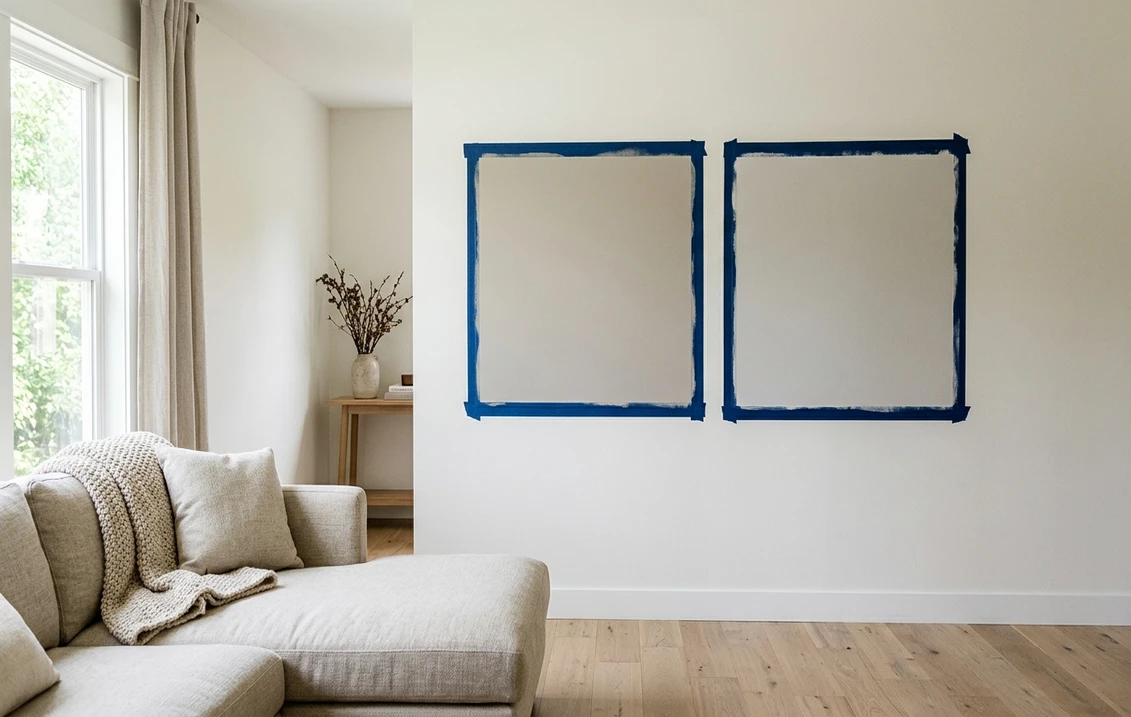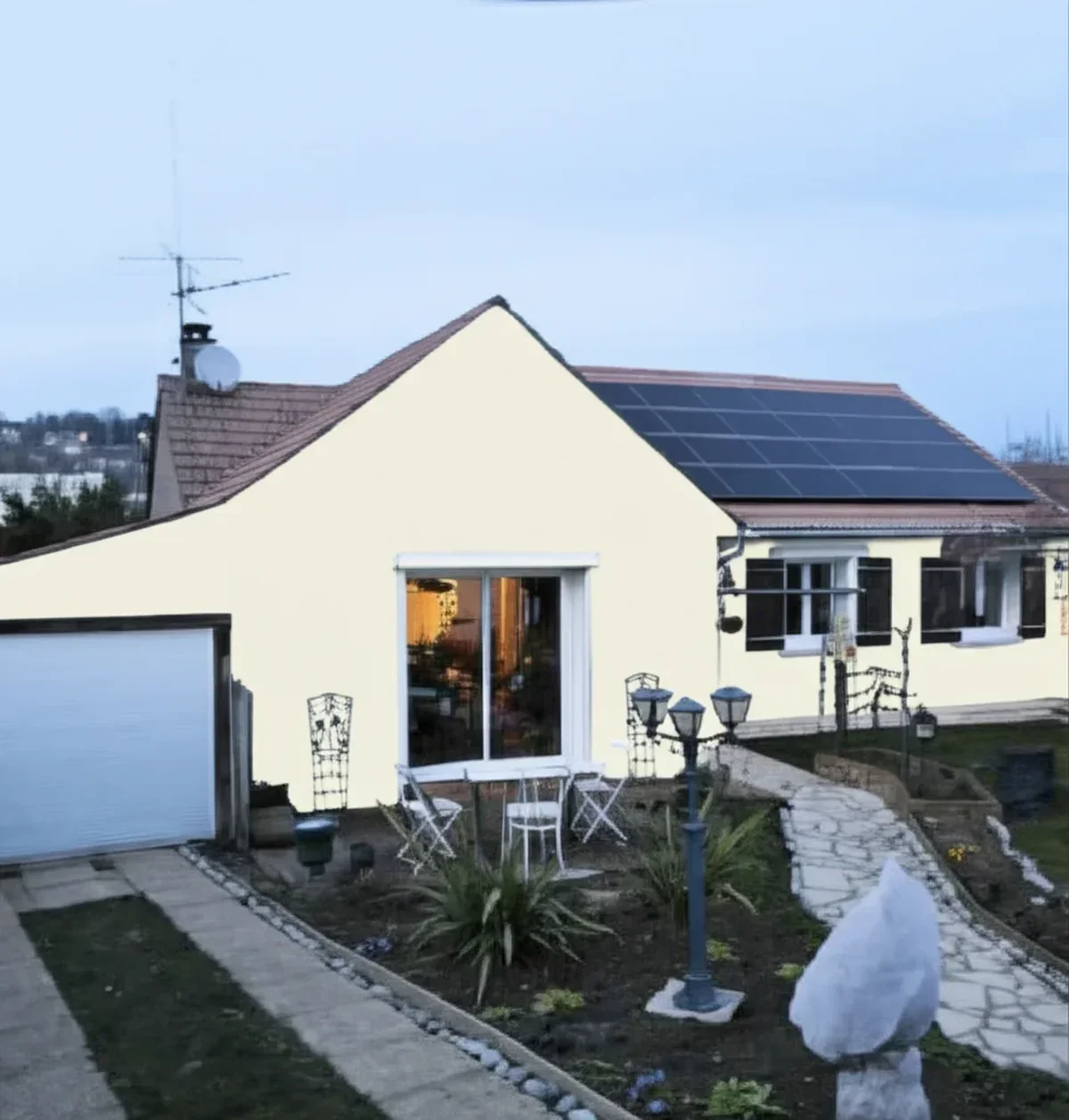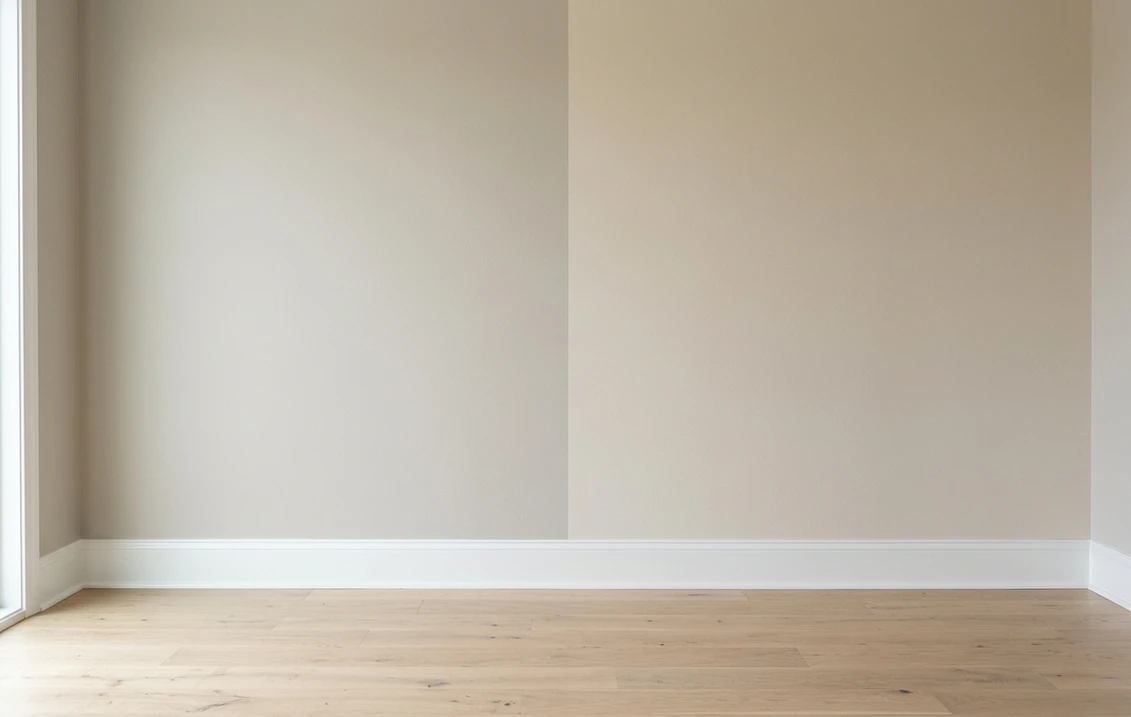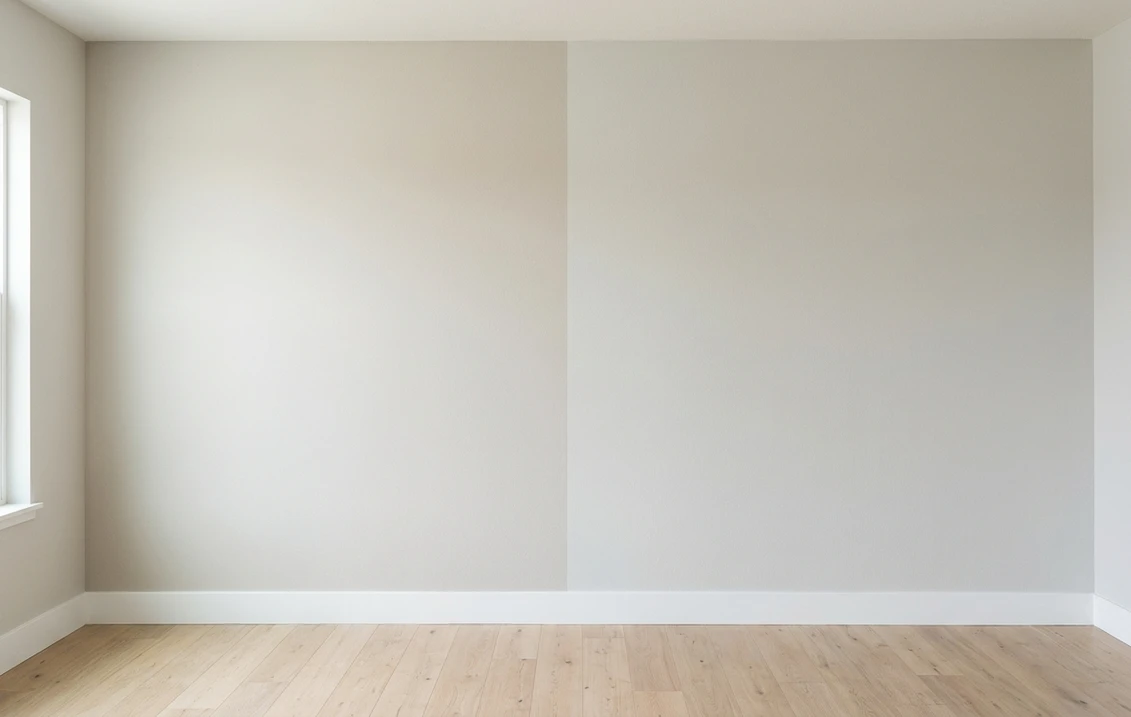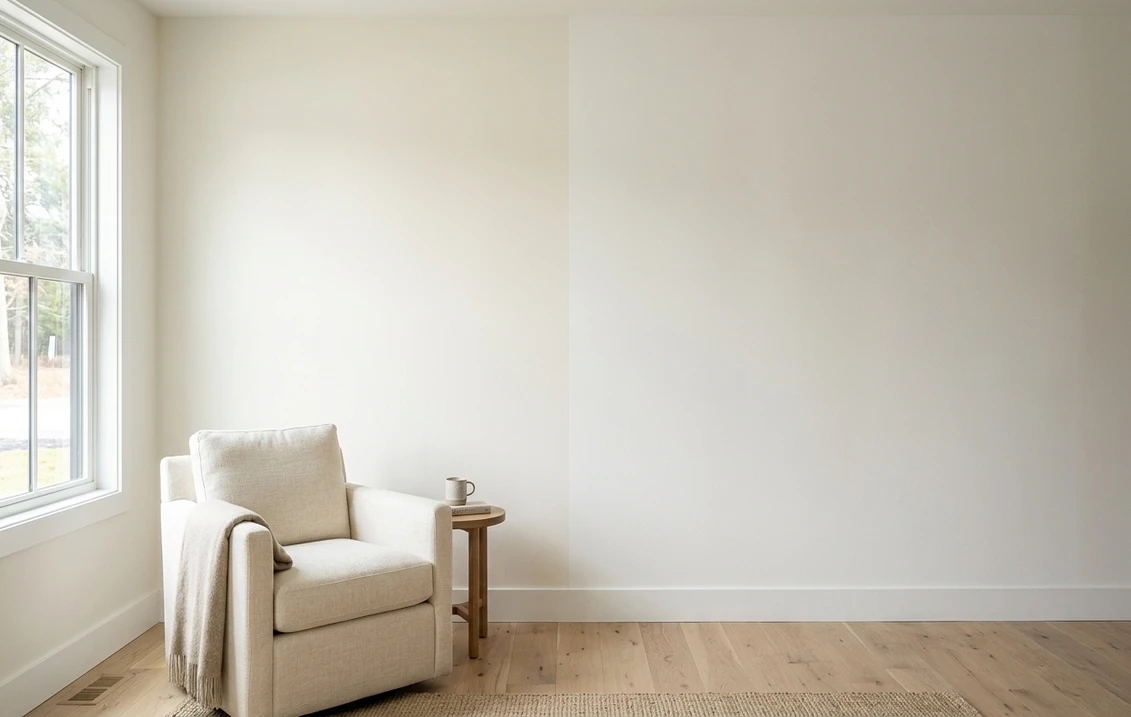
Try it on your house

The verdict in three lines. Sherwin-Williams Alabaster SW 7008 (LRV 82) is the creamier, cozier warm white: pick it when you want walls that read soft and gently ivory, especially in cool north light. Benjamin Moore White Dove OC-17 (LRV 85.38) is a hair brighter and turns slightly gray in shadow: pick it for trim, cabinets, and rooms with generous natural light. Alabaster on cabinet doors is a real option too, with its own rules for counters, hardware and sheen, laid out in the Alabaster kitchen cabinets guide. The gap is small but visible side by side, so settle it on a photo of your own room before you buy either.
Alabaster vs White Dove is the most common cross-brand white duel in American paint aisles. Both are soft warm whites and perennial best-sellers. Alabaster was Sherwin-Williams® Color of the Year in 2016 and became the signature modern farmhouse white. White Dove has been Benjamin Moore®'s go-to soft white for trim, cabinetry, and full-room schemes for decades. On a chip they look nearly identical. On a full wall, in your light, they behave differently, and that difference is what this duel settles.
This page is one round of our side-by-side paint comparison method applied to a single matchup. If you want the deep standalone treatment of either color, we keep those separate: the SW Alabaster undertones and north-facing guide and the full White Dove OC-17 review each cover one color in depth. Here we only care about the head-to-head.
Upload one photo of your room or facade and see SW 7008 at full-wall scale in about 30 seconds. Free: 1 HD render plus 3 color variations.
The numbers, side by side
Both colors sit near the top of the brightness scale, but not at the same spot. The 3.38-point LRV gap is right at the threshold where a lighter-darker difference becomes visible when the two whites share a wall.
| Attribute | Alabaster SW 7008 | White Dove OC-17 |
|---|---|---|
| Brand | Sherwin-Williams | Benjamin Moore |
| LRV | 82 | 85.38 |
| Approximate hex | #EDEAE0 | #F0EFE6 |
| Approximate RGB | 237, 234, 224 | 240, 239, 230 |
| Undertone | Creamy yellow-beige, reads gently ivory | Soft warm base with a faint gray cast in shadow |
| Reads as | A warm white, never stark | A white first, warmth second |
| Signature use | Whole-house walls, farmhouse exteriors | Trim, cabinets, ceilings, full rooms |
Try it on your house
No photo? Try a sample
LRV values are the published Sherwin-Williams and Benjamin Moore datasheet figures. Hex and RGB are approximate digital renderings.
The one-sentence translation: Alabaster carries more cream, White Dove carries more light. In bright rooms they nearly converge; in dim corners Alabaster stays warm while White Dove drifts toward a soft pale gray.
Room by room and exposure by exposure
| Situation | Winner | Why |
|---|---|---|
| North-facing living room | Alabaster | Cool flat light strips warmth from whites. Alabaster's cream survives it; White Dove can read gray and flat. |
| South-facing bedroom | White Dove | Strong warm sun amplifies cream. Alabaster can drift toward ivory-yellow at midday; White Dove stays cleaner. |
| Kitchen cabinets | White Dove | The brighter, more neutral read handles under-cabinet lighting and pairs with almost any countertop. |
| Whole-house wall color | Alabaster | The extra cream keeps large connected spaces cozy instead of gallery-like, especially with wood floors. |
| Trim and ceilings | White Dove | A hair brighter than the wall color it borders, which is exactly what trim should be. |
| Exterior body | Tie | Both are proven exterior whites; orientation and roof color decide it. See the dedicated exterior guides below. |
Outdoors, the same logic scales up. Alabaster is the standard-bearer of the modern farmhouse look; the Alabaster exterior guide for all orientations covers siding, stucco, and brick. For the facade case on the other side, the White Dove OC-17 exterior guide details where its brighter, grayer read wins the curb view.
Run OC-17 on the exact same picture and compare the two renders side by side. Free, no signup.
When to choose Alabaster
- You want warmth you can feel. If the brief is cozy, collected, lived-in, Alabaster delivers it without tipping into beige. It flatters wood tones, linen, brass, and warm-toned floors.
- The room faces north or gets little direct sun. Cool light is the classic white-paint killer, and Alabaster's creamy base is the more resilient of the two in it.
- You are painting a whole open-plan level one color. At LRV 82 it is light enough to bounce light around, warm enough that a big continuous sweep of it never feels clinical.
- The palette around it is warm. Terracotta, camel, olive, aged brass: Alabaster joins that family natively, while White Dove sits slightly apart from it.
When to choose White Dove
- You want a white that still reads white. White Dove is the choice when cream feels like a compromise: it stays soft but never looks tinted next to true whites.
- Trim, doors, cabinets, ceilings. Its slightly higher LRV and more neutral base make it the classic millwork white, including against walls painted Alabaster's warmer cousins.
- The room is flooded with warm southern light. Where Alabaster can go ivory by mid-afternoon, White Dove's faint gray cast keeps the walls calm and clean.
- The palette leans cool or mixed. With grays, blues, black window frames, or marble, White Dove bridges warm and cool more gracefully than a cream can.
Duel or match? Do not confuse the two questions
One clarification saves a lot of forum arguments. "Alabaster vs White Dove" is a duel: two different whites, and you pick the behavior you want. That is not the same as asking "what is the Benjamin Moore equivalent of Alabaster?", which is a matching problem: reproducing one target color in another brand's line. These two are close cousins, not twins. If matching is your real question, our cross-brand color matching guide walks through how stores match formulas and where those matches drift.
Frequently asked questions
Is White Dove brighter than Alabaster?
Yes, slightly. White Dove OC-17 has a published LRV of 85.38 versus 82 for Alabaster SW 7008. That 3.38-point gap is right at the threshold most people can see: side by side on the same wall, White Dove reads a hair brighter and Alabaster a touch deeper and creamier.
Which is warmer, Alabaster or White Dove?
Alabaster is the warmer of the two. Its creamy yellow-beige base reads gently ivory in most light and holds that warmth even on gray days. White Dove starts from a warm base too, but it carries a faint gray cast that shows up in shadow and dim corners, which makes it read more neutral overall. If "cozy" is the goal, Alabaster; if "clean but soft" is the goal, White Dove.
Can I use Alabaster and White Dove together in one room?
You can, but do not expect contrast. With only about 3 LRV points between them, the pairing reads as a subtle tone-on-tone shift, not a wall-versus-trim statement. It works best as White Dove on trim and ceilings over Alabaster walls, where the trim just barely lifts off the wall. If you want visibly defined millwork, pick a brighter trim white instead and let one of these two own the walls.
What is the Benjamin Moore equivalent of SW Alabaster?
White Dove OC-17 is the closest popular Benjamin Moore cross-shop, but it is an equivalent in role, not in color: it is slightly brighter and grayer in shadow than Alabaster's cream. Any Benjamin Moore or Sherwin-Williams store can spectrophotometer-match the other brand's color, with small formula drift.
Settle it on your photo, not on a chip
Every paragraph above comes with the same caveat: your light decides. Two whites separated by 3 LRV points cannot be judged on a 2-inch chip under store lighting. The fastest honest test is to upload one photo of the actual room or facade, render Alabaster on it, render White Dove on it, and put the two results next to each other. The weaker candidate is usually obvious within a minute; one physical sample pot then confirms the winner.
One upload, both colors, your real light. Free: 1 HD render plus 3 color variations, no signup.
Trademark notice. Sherwin-Williams®, Alabaster® and Greek Villa® are trademarks of The Sherwin-Williams Company. Benjamin Moore®, White Dove® and Simply White® are trademarks of Benjamin Moore & Co. FacadeColorizer is not affiliated with either company; brand names are used for descriptive purposes only. Hex and RGB values are approximate digital renderings; the authoritative reference is a physical manufacturer sample.
Trademarks mentioned (Sherwin-Williams, Benjamin Moore, Behr, Caparol, Brillux, Sto, Alpina, Valspar, PPG, Glidden, Dulux, Crown Trade, Sandtex, Farrow & Ball, Johnstone's, Leyland) are property of their respective owners. FacadeColorizer is independent and not affiliated with any of them. Nominative fair use under Lanham Act §1125.