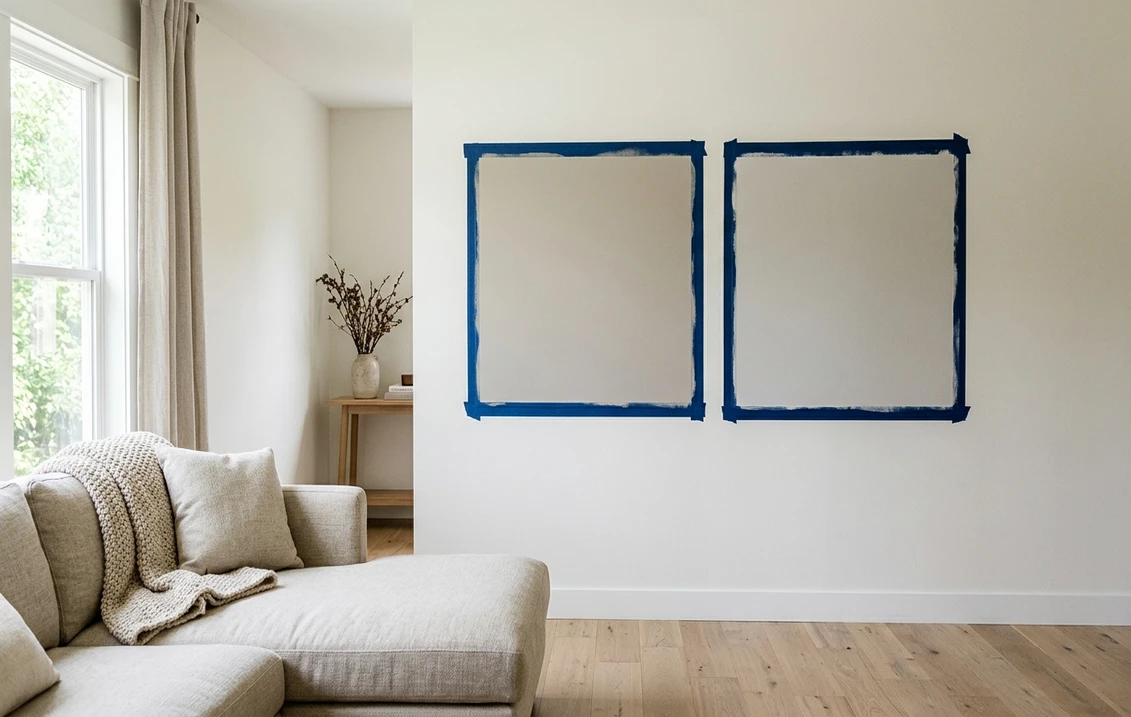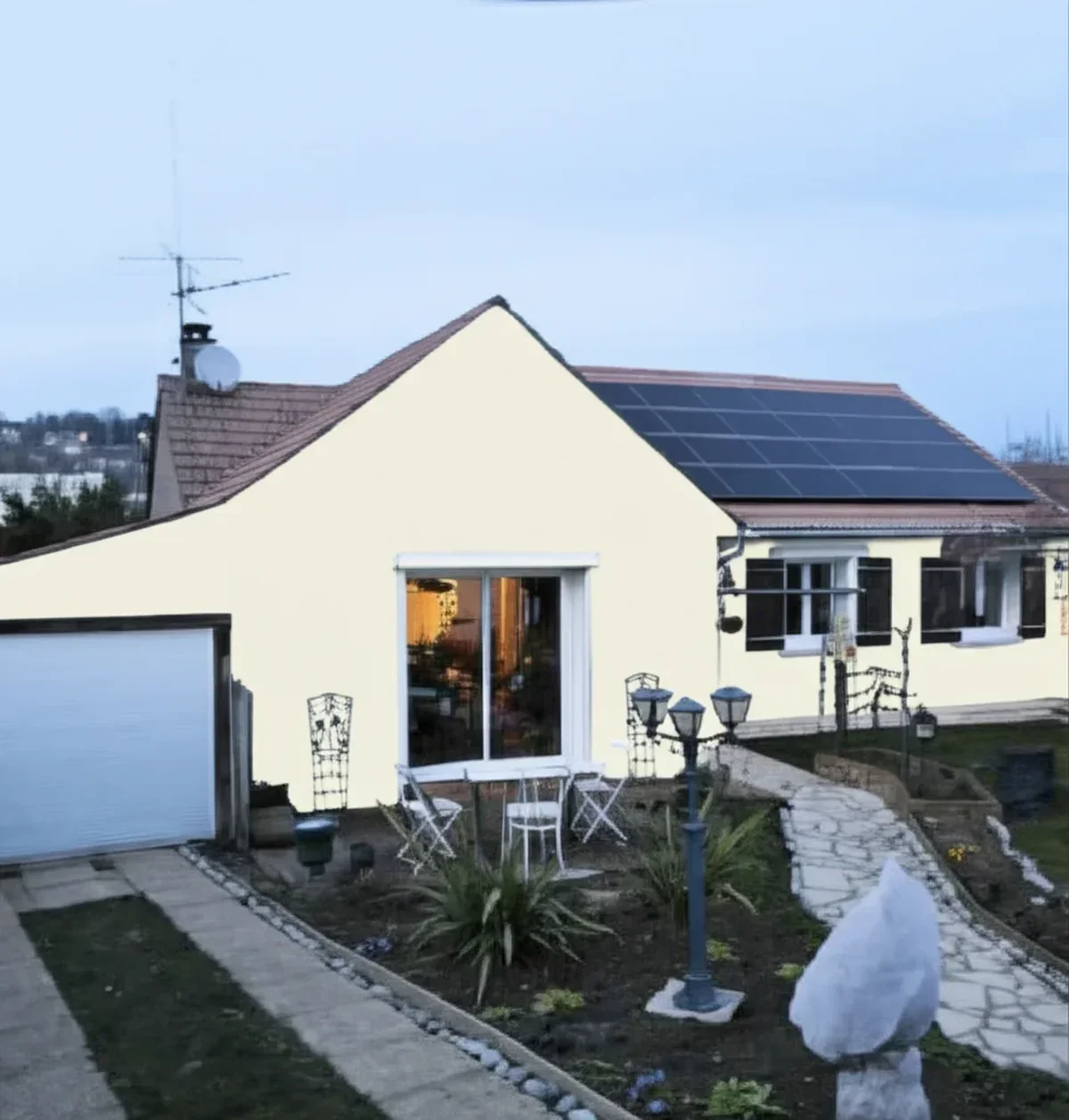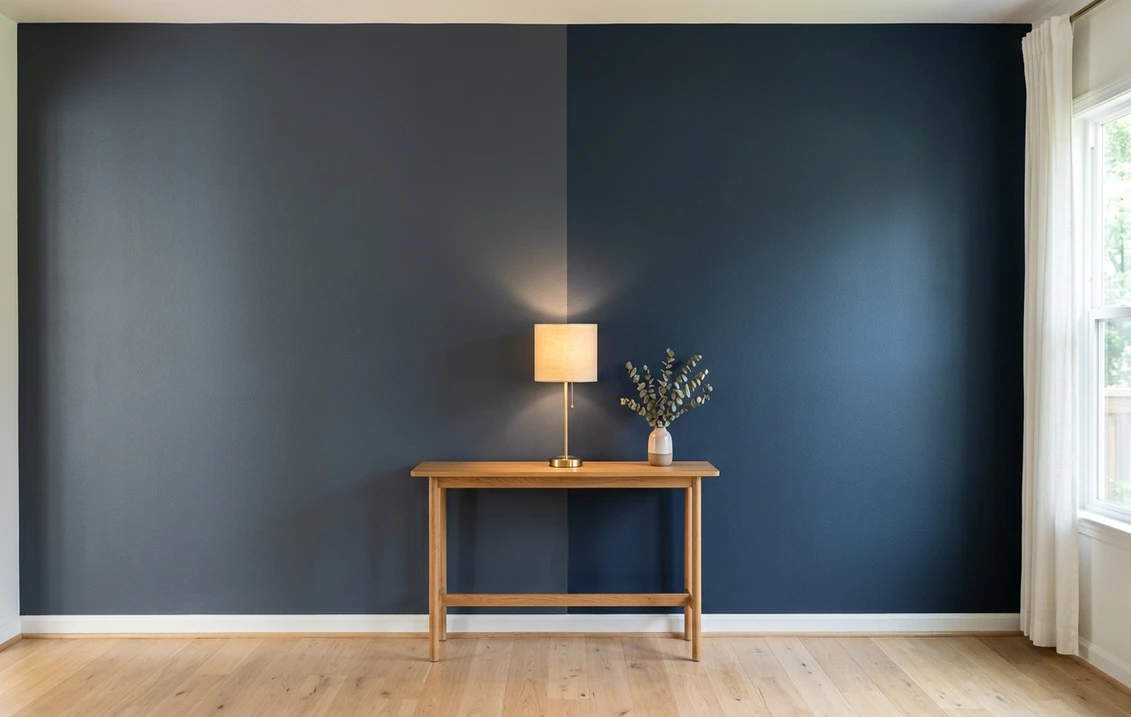
Try it on your house

The verdict in three lines. Benjamin Moore Hale Navy HC-154 (LRV about 8) is the lighter, grayer navy: a warm gray base keeps it soft, so it stays readable as blue even in dim rooms.
Sherwin-Williams Naval SW 6244 (LRV about 4) is the deeper, more saturated navy: dramatic in daylight, and it slides toward an inky near-black once the sun goes down.
If the room is dim or north-facing, Hale Navy is the safer call. If you have good light and want maximum drama, Naval wins. The only real tiebreaker is seeing both on a photo of your own wall.
Hale Navy vs Naval is the classic cross-brand navy duel: Benjamin Moore's most popular navy against Sherwin-Williams' most popular navy. On chips they look like siblings. On a full wall, an LRV gap of roughly 4 points and two different undertone stories pull them apart, and the winner changes from room to room. This head-to-head puts the numbers side by side and tells you exactly when each color wins. For the general method behind any two-color decision, start with our side-by-side method for comparing paint colors.
The numbers side by side
| Attribute | Hale Navy HC-154 (Benjamin Moore) | Naval SW 6244 (Sherwin-Williams) |
|---|---|---|
| Approximate hex | #434B56 | #2F3D4C |
| Approximate RGB | 67, 75, 86 | 47, 61, 76 |
| LRV | About 8 | About 4 |
| Undertone | Warm gray base; reads slate-navy, never purple or teal | Slightly muted saturated navy; reads inky near-black in low light |
| Behavior at night | Darkens but stays recognizably blue-gray | Goes deeper and inkier; blue only under direct light |
| Character | Softened, traditional, forgiving | Bolder, moodier, higher contrast |
| Typical trim partner | Soft warm white such as White Dove OC-17 | Clean white; crisp contrast flatters the depth |
Try it on your house
No photo? Try a sample
Read the table in one sentence: Hale Navy is a step lighter and grayer, Naval goes deeper and inkier at night. Hale Navy at #434B56 carries more gray in every channel, while Naval at #2F3D4C keeps a stronger blue lean with less light to give back. Each color has its own full breakdown on this site: the Hale Navy HC-154 interior profile covers its rooms, trim, and metals in detail, and the Naval SW 6244 undertones and best rooms guide does the same for its rival.
Upload one photo of your room, preview Hale Navy, then swap to Naval in one click. Free: 1 HD render plus 3 free color variations.
Room by room, exposure by exposure
With colors this deep, the duel comes down to how much light each room can spare. A navy at LRV 4 absorbs almost everything that hits it; a navy at LRV 8 gives roughly twice as much back, and you see it on the same accent wall at 8 pm.
| Room or exposure | Winner | Why |
|---|---|---|
| North-facing living room | Hale Navy | Cool flat light starves dark colors. Hale Navy's gray base keeps reading as blue; Naval can sit at near-black all day. |
| South-facing living room | Naval | Generous sun unlocks Naval's saturation and depth. Hale Navy also works but reads noticeably softer and more casual here. |
| Bedroom or media room | Naval | Rooms meant to feel enveloping at night benefit from the inkier reading; the near-black shift is the point. |
| Kitchen island or lower cabinets | Tie, by intent | Hale Navy for a softer, traditional kitchen; Naval for crisp contrast against white counters and brass. |
| Home office with average light | Hale Navy | On camera and under mixed lighting, the grayer navy holds detail; Naval collapses into a dark backdrop. |
| Small powder room | Naval | A windowless jewel box is the one small room where going darkest pays off; committing beats compromising. |
Outdoors the same logic holds, with sunlight raising both colors about a step. Both are proven exterior picks: the Hale Navy exterior guide and the SW Naval 6244 exterior guide cover siding, shutters, and front doors for each.
When to choose Hale Navy
- Your light is limited or cool. North-facing rooms, basements, hallways: the grayer base keeps the color legible instead of letting it fall into black.
- You want navy as a calm neutral. Hale Navy behaves like a deep slate that happens to be blue, so it coexists easily with the rest of the house.
- The style is traditional or transitional. Shaker cabinets, board and batten, classic Colonial doors: the softened character suits heritage detail.
- You are nervous about going dark. Between the two, Hale Navy is the forgiving one. If this is your first dark wall, start here.
When to choose Naval
- You want the room to feel dramatic. Naval's depth is the feature: it makes white trim, brass, and art pop harder than Hale Navy can.
- The room has real light to spend. With sun or strong layered lighting, Naval shows its full navy identity instead of staying at near-black.
- The mood is intentional at night. Dining rooms, bedrooms, dens: the inky evening reading is exactly what a cocooning space wants.
- You are already color-matched to Sherwin-Williams. If the rest of the project is SW, staying in one deck simplifies sheens and touch-ups.
One photo, 30 seconds, no signup. Then run Hale Navy on the same shot and compare like for like.
Can one substitute for the other?
Almost, but not quite. The two are nearest published neighbors across brands, which is why they appear as an equivalence pair in our cross-brand paint color matching guide. Treat them as cousins rather than twins: swap one for the other and the room still works, but the evening mood changes. Hale Navy also has an in-house rival worth ruling out before you cross brands at all: Newburyport Blue HC-155 sits on the same Benjamin Moore strip and holds a cleaner blue where Hale Navy grays down, and our Newburyport Blue vs Hale Navy duel runs that comparison without the brand switch. If neither feels right, our roundup of navy paint colors for interiors lines both up against the other deep blues people shortlist.
There is a third case worth naming: Naval wins the duel for you, but the room still asks for more. Sherwin-Williams answers that with In the Navy SW 9178, a step deeper and more saturated than Naval, a cleaner and more deliberate blue where Naval carries a faint gray softness. It is the same trade you just made against Hale Navy, pushed one notch further, and it comes with the same warning: the deeper the base, the more light the room needs before the wall reads navy rather than black. Our Naval vs In the Navy comparison runs that second duel room by room.
Frequently asked questions
Is Hale Navy lighter than Naval?
Yes. Hale Navy HC-154 has a published LRV of about 8 versus about 4 for Naval SW 6244. On paper that gap looks tiny; on a wall it is the difference between a navy that stays readable as blue in a dim room and one that slides toward near-black.
What is the real difference between Hale Navy and Naval?
Depth and character. Hale Navy is grayer: a warm gray base softens the blue and makes it behave like a deep slate neutral. Naval is more saturated and goes deeper and inkier at night, reading almost black in low light and fully navy under direct light. Hale Navy is the forgiving traditional pick, Naval the bolder statement.
Which is better for a north-facing or dark room, Hale Navy or Naval?
Hale Navy, in most homes. Cool, flat north light starves dark colors, and Naval at LRV about 4 can sit at near-black all day in that exposure. Hale Navy's grayer base keeps enough lift to stay recognizably blue. The exception is a room designed to be moody on purpose, like a den or windowless powder room, where Naval's depth is the goal.
Can I use Naval as a substitute for Hale Navy?
As a near substitute, yes: they are the closest published navy neighbors across the two brands. But they are not identical formulas. Naval runs deeper and inkier in the evening, while Hale Navy stays softer and grayer. If a designer specified one, previewing both on a photo of your actual room is the fastest way to confirm the swap before buying gallons.
Test Hale Navy and Naval on your own photo: 1 HD render plus 3 free color variations, no signup.
Bottom line. Hale Navy HC-154 and Naval SW 6244 solve the same brief with two temperaments. Hale Navy (about LRV 8, #434B56) is the step-lighter, grayer navy that forgives weak light and suits traditional rooms. Naval (about LRV 4, #2F3D4C) is the deeper, inkier navy that rewards good light with real drama. Decide by room, light, and the mood you want at 8 pm, then confirm on a photo of your own wall before the first gallon.
Trademark notice. Benjamin Moore, Hale Navy, and White Dove are trademarks of Benjamin Moore & Co. Sherwin-Williams, Naval, and Iron Ore are trademarks of The Sherwin-Williams Company. FacadeColorizer is an independent paint visualization service and is not affiliated with, endorsed by, or sponsored by any paint manufacturer. References to brand and product names are made for descriptive and editorial purposes only. Color hex and RGB values are approximate digital renderings; always confirm with a physical manufacturer sample. LRV figures are drawn from the respective manufacturer technical data sheets.
Trademarks mentioned (Sherwin-Williams, Benjamin Moore, Behr, Caparol, Brillux, Sto, Alpina, Valspar, PPG, Glidden, Dulux, Crown Trade, Sandtex, Farrow & Ball, Johnstone's, Leyland) are property of their respective owners. FacadeColorizer is independent and not affiliated with any of them. Nominative fair use under Lanham Act §1125.