Try it on your house

The verdict in three lines. Wrought Iron 2124-10 (LRV 6) is the near-black: a soft, green-leaning off-black built for drama, cabinets, doors, and bold exteriors.
Kendall Charcoal HC-166 (LRV about 12) is the warm charcoal: it reflects roughly twice as much light, keeps its texture in dim rooms, and sits comfortably with wood and brass.
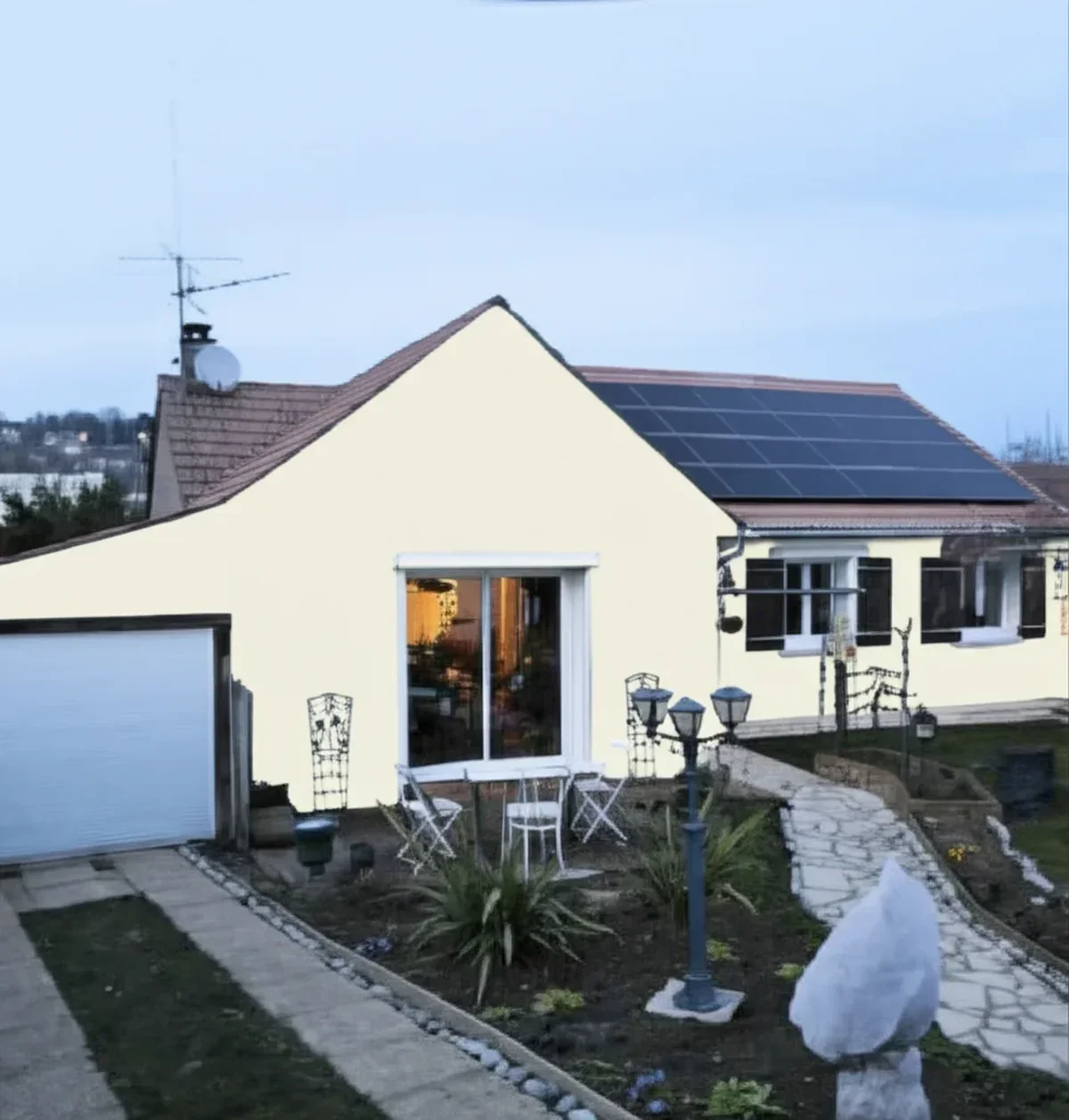
Unlike most duels, depth decides this one as much as undertone. The only honest tiebreaker is seeing both on a photo of your own wall or facade.
Benjamin Moore Wrought Iron (2124-10) and Kendall Charcoal (HC-166) are the two Benjamin Moore darks that end up on the same shortlist whenever a homeowner wants a moody wall, a black-ish kitchen island, or a charcoal exterior. On a small chip they can both pass for "dark gray." On a full surface they are two very different decisions. This head-to-head puts the numbers side by side, walks the duel room by room and exposure by exposure, and tells you exactly when each color wins. For the general method behind any two-color decision, start with our side-by-side method for comparing paint colors.
The numbers side by side
| Attribute | Wrought Iron 2124-10 | Kendall Charcoal HC-166 |
|---|---|---|
| Family | Soft near-black | Warm charcoal gray |
| LRV | 6 | About 12 |
| Approximate hex | #4A4B4C | #666662 |
| Approximate RGB | 74, 75, 76 | 103, 102, 98 |
| Undertone | Cool, with a subtle green-gray cast that keeps it softer than jet black | Warm, with a green-brown lean that reads earthy rather than steely |
| Loves | Crisp white trim, black metal, glass, modern lines | Oak and walnut, leather, brass, cream trim, stone |
| Watch out for | Collapses to flat black in dim rooms; absorbs more heat outdoors | Can show its green side in strong sun or under warm bulbs |
| Overall vibe | Dramatic, architectural, high contrast | Cozy, grounded, easier to live on four walls |
Try it on your house
No photo? Try a sample
LRV values are the published Benjamin Moore figures. Hex and RGB are approximate digital renderings; the authoritative reference is a physical Benjamin Moore chip or sample.
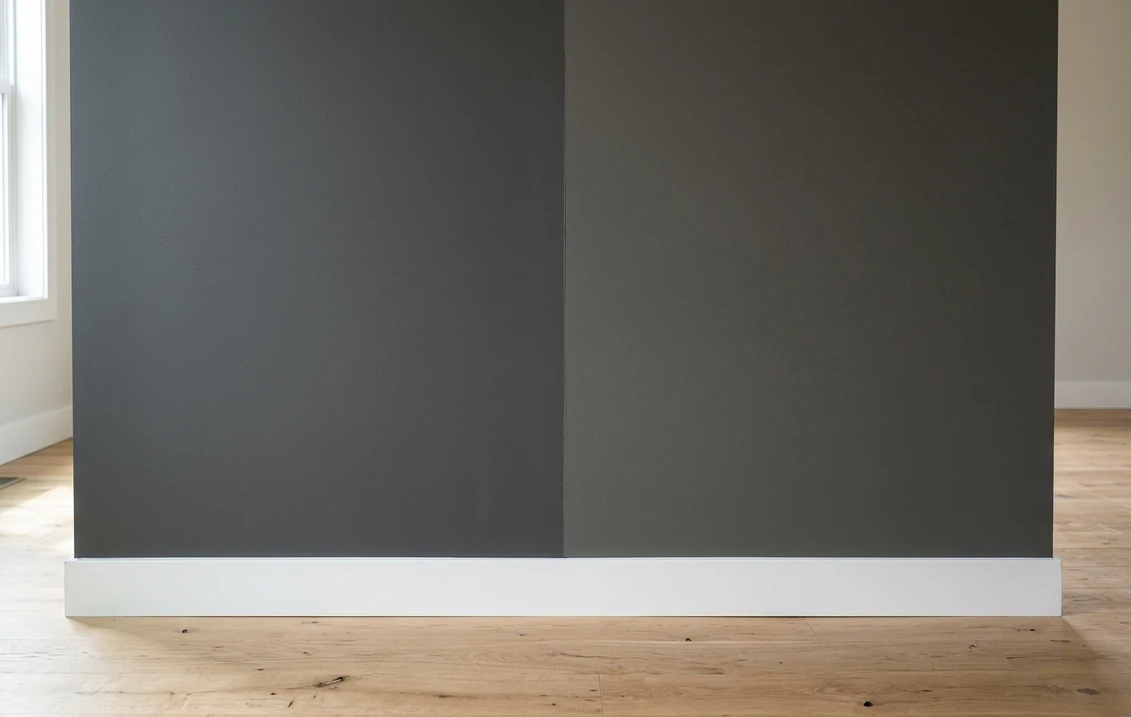
Read that table once and the shape of the duel is clear. At LRV 6 versus about 12, Kendall Charcoal reflects roughly twice as much light as Wrought Iron, and on a wall your eye registers that gap immediately. Wrought Iron holds shadow detail only when a room or facade feeds it plenty of light; starve it and it reads as a flat black plane. Kendall Charcoal keeps a visible charcoal texture even in modest light, and its green-brown warmth pulls it toward wood tones instead of fighting them. Hold each chip against white printer paper and the second axis appears: Wrought Iron sits cool and inky, Kendall Charcoal shows a soft, earthy warmth.
Upload one photo, get a photorealistic render, then swap to Kendall Charcoal in one click. Free, no signup.
Room by room, exposure by exposure
Because the depth gap is real, the deciding question is how much light the surface gets and how dark you actually want to go. Here is how the duel typically plays out across common situations.
| Situation | Usual winner | Why |
|---|---|---|
| Dim or north-facing room, all four walls | Kendall Charcoal | At LRV about 12 it keeps corners and texture legible where Wrought Iron goes flat |
| Bright, well-lit accent wall | Wrought Iron | Generous light lets the near-black show depth instead of reading as a void |
| Kitchen island or cabinets | Wrought Iron | Crisp near-black millwork against white counters is exactly its home turf |
| Cozy den, office, or library wrap | Kendall Charcoal | Warm charcoal wraps a room without the bunker effect of a true near-black |
| Front door and shutters | Wrought Iron | Outdoor light lifts it to a refined charcoal-black with strong curb presence |
| Full siding on heat-sensitive materials | Kendall Charcoal | The higher LRV absorbs less heat, a safer call on vinyl and engineered siding |
Outdoors, daylight lightens both colors by a step, which flatters Wrought Iron: a chip that looks severe becomes a composed charcoal-black on a facade. Orientation, trim pairings, siding materials, and the heat question are covered in depth in the complete Wrought Iron exterior guide. If the shortlist also includes Sherwin-Williams' rival soft black, the Iron Ore vs Wrought Iron duel settles that matchup. And if Kendall Charcoal is the color you keep coming back to, Iron Ore vs Kendall Charcoal runs the same LRV 6 against LRV 12 contest with the Sherwin-Williams near-black standing in for Wrought Iron.
When to choose Wrought Iron
- You want near-black drama that still breathes. The subtle green-gray cast keeps Wrought Iron a shade softer than jet black, so it delivers the modern look without the harshness.
- The surface gets real light. A bright accent wall, a well-lit kitchen island, or an exterior in open daylight gives the LRV 6 depth room to read as color rather than shadow.
- Your palette is crisp and cool. Bright white trim, black window frames, glass, and chrome all sharpen against a near-black rather than muddying it.
- You are painting doors, shutters, or millwork. High-contrast architectural details are where this color has earned its reputation.
On those same doors, shutters, and siding, a near-black is not the only way to get that weight. The two deep navies specified for exactly those jobs, Benjamin Moore Hale Navy and Sherwin-Williams Naval, react to sunlight the same way (open daylight lifts them about a step) while keeping a blue cast that a neutral dark does not have. Their own duel turns on the same question as this one: Hale Navy sits around LRV 8, Naval around 4, so one stays readable in modest light and the other goes inky.
When to choose Kendall Charcoal
- You want dark walls in a room with modest light. At LRV about 12 it stays a readable charcoal in the same light that turns Wrought Iron into a black box.
- Your fixed finishes are warm. Oak or walnut floors, leather, brass hardware, and cream trim sit naturally with its green-brown warmth.
- You are wrapping a whole room. Dens, offices, and bedrooms take a full Kendall Charcoal wrap gracefully; it feels enveloping rather than oppressive.
- You are painting siding that dislikes heat. The higher reflectance makes it the more conservative pick on vinyl and other heat-sensitive exteriors.
For its full undertone breakdown, lighting behavior, and companion shades, see the dedicated Kendall Charcoal undertone review. If both finalists run darker than you actually want, the Chelsea Gray HC-168 profile covers the lighter warm gray from the same Historical collection.
Same wall, both darks, your actual light. Free render in about 30 seconds.
Frequently asked questions
What is the difference between Wrought Iron and Kendall Charcoal?
Depth first, then undertone. Wrought Iron 2124-10 (LRV 6) is a soft near-black with a cool green-gray cast, while Kendall Charcoal HC-166 (LRV about 12) is a warm charcoal with a green-brown lean that reflects roughly twice as much light. On a wall, Wrought Iron reads as black-ish drama and Kendall Charcoal reads as a livable dark gray.
Is Wrought Iron darker than Kendall Charcoal?
Yes, clearly. Wrought Iron has an LRV of 6 against about 12 for Kendall Charcoal, so Kendall Charcoal bounces back roughly double the light. In a dim room the gap widens: Wrought Iron can collapse into flat black while Kendall Charcoal keeps visible charcoal texture.
Which is better for a dark exterior, Wrought Iron or Kendall Charcoal?
It depends on the look and the siding. Wrought Iron delivers the bolder near-black facade and excels on doors, shutters, and board-and-batten in open daylight. Kendall Charcoal gives a warmer, slightly lighter charcoal and its higher LRV absorbs less heat, which makes it the safer choice on vinyl and other heat-sensitive materials.
Can I use Wrought Iron and Kendall Charcoal together?
Yes, and it works better than most dark-on-dark pairings because the depth gap is large enough to read as intentional. A common recipe is Kendall Charcoal on the walls with Wrought Iron on the island, built-ins, or the front door, so the near-black lands only on the pieces meant to be the focal point.
Settle it on your photo
Chips lie, screens lie, and dark colors lie hardest of all: nothing shifts more between a two-inch swatch and a full wall than a color under LRV 15. The fastest honest answer to Wrought Iron vs Kendall Charcoal is to test both on a photo of your actual room or facade and let your own light, trim, and floor pick the winner.
1 HD render plus 3 free color variations. Start with Wrought Iron, swap to Kendall Charcoal in one click.
Trademark notice. Benjamin Moore®, Wrought Iron®, Kendall Charcoal® and Chelsea Gray® are trademarks of Benjamin Moore & Co. Sherwin-Williams® and Iron Ore® are trademarks of The Sherwin-Williams Company. FacadeColorizer is not affiliated with, endorsed by, or sponsored by Benjamin Moore & Co. or The Sherwin-Williams Company. Brand and color names are used for descriptive and editorial purposes only, consistent with nominative fair use. Hex and RGB values are approximate digital renderings; the only authoritative reference is a physical manufacturer color sample.
Trademarks mentioned (Sherwin-Williams, Benjamin Moore, Behr, Caparol, Brillux, Sto, Alpina, Valspar, PPG, Glidden, Dulux, Crown Trade, Sandtex, Farrow & Ball, Johnstone's, Leyland) are property of their respective owners. FacadeColorizer is independent and not affiliated with any of them. Nominative fair use under Lanham Act §1125.