Try it on your house

The verdict in three lines. Iron Ore SW 7069 (LRV 6) is the soft black: it lifts to a deep, slightly warm charcoal in daylight and forgives dust, texture, and touch-ups.
Tricorn Black SW 6258 (LRV 3) is the true black: a neutral base with no obvious color cast that stays black in almost any light.
This duel is about depth, not undertone. Choose Iron Ore for black that relaxes in the sun, Tricorn Black for maximum contrast, and let a photo of your own home break the tie.
Sherwin-Williams Iron Ore (SW 7069) and Tricorn Black (SW 6258) are the two names on nearly every American black-paint shortlist, and they are not interchangeable: one is a charcoal that flirts with black, the other is black, full stop. This head-to-head puts the numbers side by side, plays the duel out room by room and exposure by exposure, and tells you exactly when each color wins. For the general method behind any two-color decision, start with our side-by-side method for comparing paint colors.
The numbers side by side
| Attribute | Iron Ore SW 7069 | Tricorn Black SW 6258 |
|---|---|---|
| Family | Soft black / dark charcoal | True neutral black |
| LRV | 6 | 3 |
| Approximate hex | #434341 | #2F2F30 |
| Approximate RGB | 67, 67, 65 | 47, 47, 48 |
| Character | Faintly warm, muted; lightens toward charcoal in strong light | Neutral, no obvious cast; holds its black reading |
| Loves | Sunlit siding, cabinets, board and batten, natural wood, brass | Front doors, shutters, window frames, crisp white trim |
| Watch out for | Reads "almost black" next to true-black metal and fixtures | Shows dust and pollen on large sunlit walls; check siding guidance for very dark colors |
| Overall vibe | Softened, lived-in, forgiving | Sharp, graphic, maximum contrast |
Try it on your house
No photo? Try a sample
LRV values are the published Sherwin-Williams figures. Hex and RGB are approximate digital renderings; the authoritative reference is a physical Sherwin-Williams chip or peel-and-stick sample.
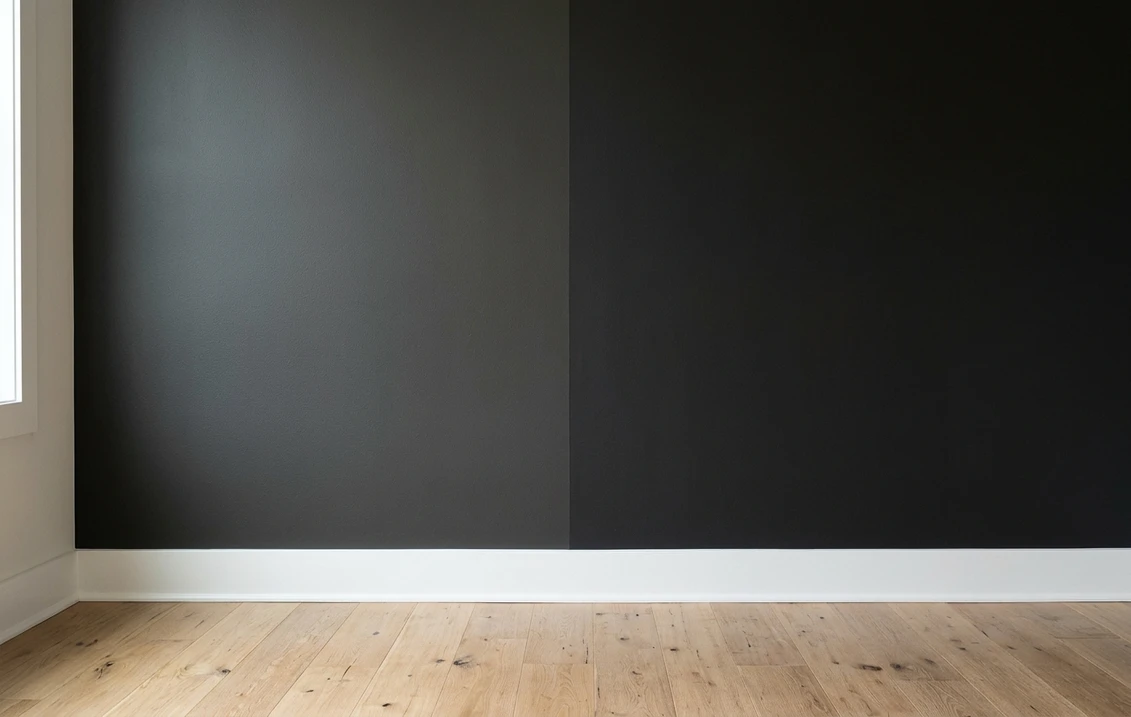
Read the LRV row twice, because it decides this duel. At LRV 3, Tricorn Black reflects about half as much light as Iron Ore at LRV 6: in full sun, an Iron Ore wall visibly lifts into charcoal territory while a Tricorn Black wall stays inky. At night the two converge. So the real question is not which black you like on a chip, but what you want the color to do at 2 p.m. in July. If the answer is soften, Iron Ore. If the answer is hold the line, Tricorn Black.
Upload one photo, get a photorealistic render, then swap to Tricorn Black in one click. Free, no signup.
Room by room, exposure by exposure
Because the gap is in depth rather than undertone, the winner flips with light levels and viewing distance. Here is how the duel typically plays out.
| Situation | Usual winner | Why |
|---|---|---|
| Full-sun exterior body | Iron Ore | Sun lifts it to a deep charcoal that flatters texture and hides everyday grime |
| Front door and shutters | Tricorn Black | Small doses of true black stay crisp and classic against any siding color |
| Modern farmhouse trim and windows | Tricorn Black | The neutral black keeps lines graphic against white board and batten |
| Accent wall in a bright room | Iron Ore | Daylight reveals its charcoal softness, so the wall reads deep rather than flat |
| Kitchen island or cabinets | Iron Ore | The softer black flatters wood counters and brass hardware at close range |
| Media room or moody den | Either | In low light both read black; pick by sheen and the finishes around them |
Outdoors the stakes rise, because dark colors face sun, dust, and heat all day. If the true black is your siding front-runner, the Tricorn Black exterior guide covers orientation, materials, and trim pairings in full; if the soft black is headed outside against a budget rival, the Behr Cracked Pepper vs Iron Ore exterior comparison runs that bracket.
When to choose Iron Ore
- You want black drama without the severity. Iron Ore delivers the dark, grounded look, then relaxes into charcoal when daylight hits: the black for people who hesitate at true black.
- The surface is large and sunlit. Whole-house bodies, garage doors, fence runs: the higher LRV keeps the mass from going void-black and makes dust less obvious.
- Your palette is warm. Natural wood, brass, terracotta, and cream trim all sit comfortably next to Iron Ore's faintly warm, muted base.
- People will stand close to it. On islands, built-ins, and interior doors, the soft black reads refined at arm's length where a true black can feel hard.
For its full character breakdown, best rooms, and trim pairings, see the dedicated Iron Ore undertones and best rooms profile. If your shortlist crosses brands, the Iron Ore vs Wrought Iron duel settles the Sherwin-Williams versus Benjamin Moore bracket.
When to choose Tricorn Black
- You want true black, full stop. Doors, shutters, window sash, railings: it is the standard-issue black of the Sherwin-Williams deck, neutral enough to read simply as black.
- Maximum contrast is the design. Against bright white siding or walls, LRV 3 gives the sharpest possible line. Iron Ore in the same spot reads a half-step softer.
- You are matching existing black finishes. Black window frames, matte black hardware, and iron light fixtures pair cleanly with a true black; next to them, a soft black can look like a near miss.
- The dose is small and high-impact. In accents, the dust and heat concerns of big sunlit walls mostly disappear, and you keep all of the graphic punch.
If the shortlist keeps sliding toward black because nothing else feels deep enough, the deep navies are the usual way out: Benjamin Moore Hale Navy against Sherwin-Williams Naval is the same soft-versus-severe argument played out in blue, with Naval at LRV about 4 reading close to black after dark and Hale Navy at about 8 staying visibly navy.
Same wall, both blacks, your actual light. Free render in about 30 seconds.
Frequently asked questions
Which is darker, Iron Ore or Tricorn Black?
Tricorn Black. At LRV 3 it reflects about half as much light as Iron Ore at LRV 6. The gap is most obvious in bright daylight, where Tricorn Black stays true black while Iron Ore lifts to a deep charcoal. In dim light the two converge and both read black.
Does Iron Ore look black or charcoal on a wall?
Both, depending on the light. In full sun or a bright room it reads as a soft charcoal black with a faintly warm, muted character. At night and in low light it reads black. That shape-shifting is exactly why many homeowners pick it over a true black: the drama stays, the harshness goes.
Is Tricorn Black too harsh for a whole exterior?
It is the boldest option, and it shines on modern and farmhouse designs built around crisp contrast. On large sunlit walls, expect dust and pollen to show more than on a softer charcoal, and check your siding manufacturer's guidance for very dark colors. Many homeowners reserve Tricorn Black for doors, shutters, and windows and give the body to a softer dark like Iron Ore.
Can I use Iron Ore and Tricorn Black together?
Yes, if each gets a distinct role. Side by side on equal surfaces they are close enough in depth to look like a batch mismatch. The pairing that works is hierarchy: Iron Ore on the body or large built-ins, Tricorn Black on the door, sash, or metalwork, where the true black reads as a deliberate accent.
Settle it on your photo
Chips lie, and blacks lie more than most: a two-inch sample cannot show you how LRV 6 breathes in afternoon sun while LRV 3 holds firm. The fastest honest answer is to test both on a photo of your actual house or room and watch what your own light does. If the duel widens into a full dark-neutral shortlist, the 2026 Sherwin-Williams interior color guide maps the rest of the deck.
1 HD render plus 3 free color variations. Start with Iron Ore, swap to Tricorn Black in one click.
Trademark notice. Sherwin-Williams®, Iron Ore®, Tricorn Black® and Peppercorn® are trademarks of The Sherwin-Williams Company. Benjamin Moore® and Wrought Iron® are trademarks of Benjamin Moore & Co. FacadeColorizer is not affiliated with, endorsed by, or sponsored by either company. Brand and color names are used for descriptive and editorial purposes only, consistent with nominative fair use. Hex and RGB values are approximate digital renderings; the only authoritative reference is a physical manufacturer color sample.
Trademarks mentioned (Sherwin-Williams, Benjamin Moore, Behr, Caparol, Brillux, Sto, Alpina, Valspar, PPG, Glidden, Dulux, Crown Trade, Sandtex, Farrow & Ball, Johnstone's, Leyland) are property of their respective owners. FacadeColorizer is independent and not affiliated with any of them. Nominative fair use under Lanham Act §1125.