Try it on your room

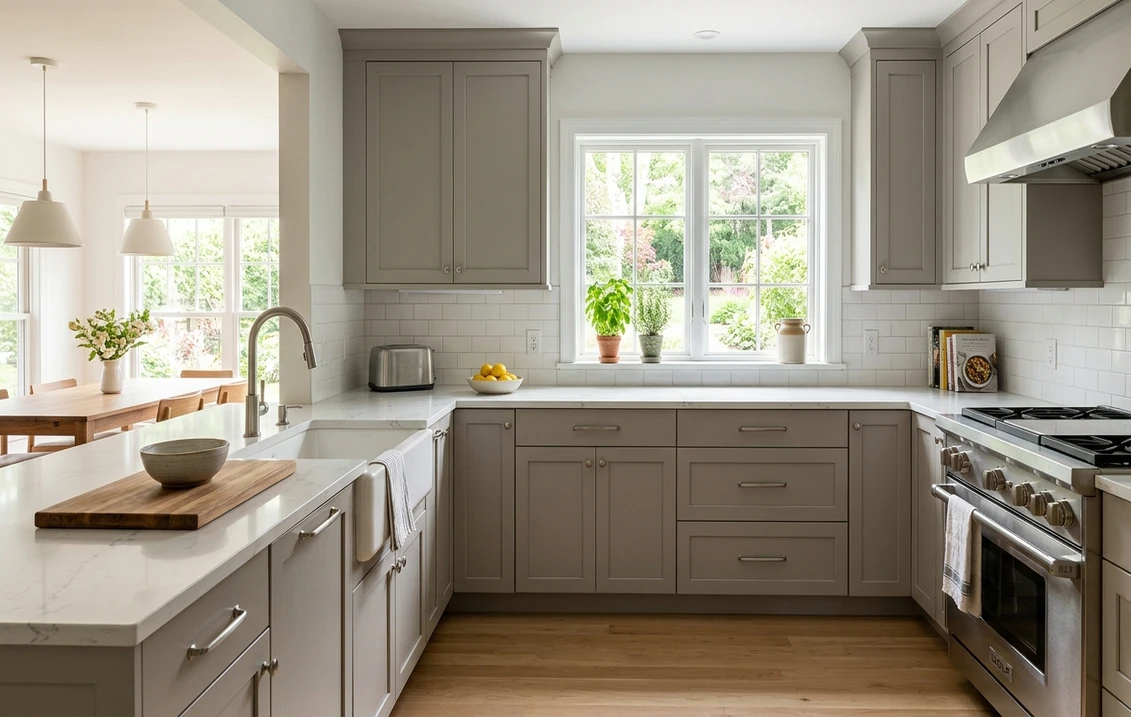
"Gray" is not one color. It is a family that runs from a barely-there greige to a near-black charcoal, and each shade hides an undertone (blue, green, purple, or brown) that only shows once it is rolled onto a full cabinet door and lit by your kitchen window. That is why the same can of gray paint looks warm and inviting in one kitchen and cold and industrial in another. Picking the right gray is less about the chip and more about matching the undertone to your light, countertop, and floor.
This is a deep profile of gray on cabinets specifically: how to read the undertones, the 12 shades designers reach for most (every one with a real, published Sherwin-Williams or Benjamin Moore code and LRV), and how each behaves from light greige to charcoal. For the full menu of cabinet color families, start from our complete kitchen cabinet color guide.
Upload a photo of your real kitchen and preview any gray in about 30 seconds, free. No sample pots, no painter's tape.
First, decode the undertone
A gray is a desaturated color, and whatever pigment is left over once you strip out the saturation is the undertone. On a 1-inch chip you cannot see it; on a full run of cabinets it is the whole story. There are four undertone camps, and naming yours before you shop is the best way to avoid a repaint.
- Greige (gray plus beige): the warmest, most forgiving group. Reads soft and livable, leans taupe in warm light. Best for north-facing kitchens and warm wood floors. Repose Gray and Agreeable Gray live here.
- True neutral gray: balanced, no strong cast. The "designer gray" most people picture. Stonington Gray and Mindful Gray sit close to this line.
- Cool blue-gray: a touch of blue makes it crisp and a little cooler. Stunning in south-facing light, but can turn icy or "hospital" in cool north light. Gauntlet Gray and Chelsea Gray carry a blue-violet edge.
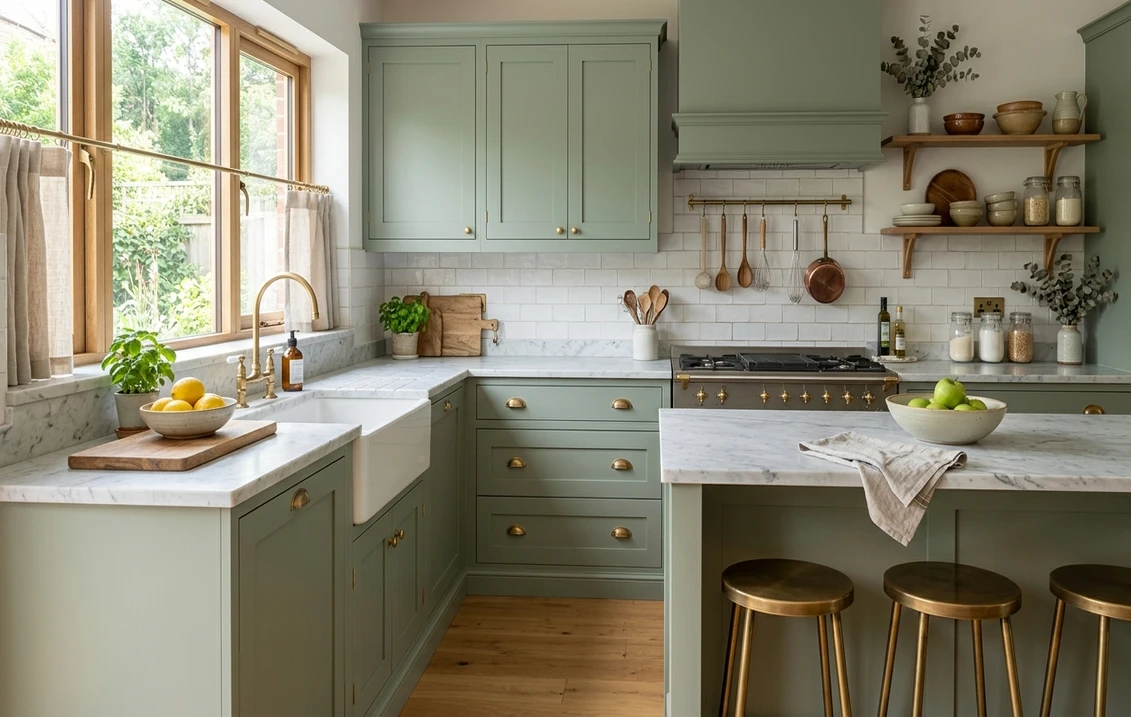
- Green-gray (sage-adjacent): a hint of green warms gray without making it beige. Worldly Gray and many "sage gray" picks fall here, and all flatter warm brass hardware.
Want the physics behind why undertones swing with window direction? Our interior paint color families guide maps how gray sits next to greige, taupe, and the cooler neutrals. It holds for cabinet doors just as much as walls.
One line worth drawing before you shop the third camp: a gray with a blue cast is not the same thing as a blue-gray. In the first, the blue is a side effect you manage; in the second, the blue is the point, and the color is chosen to read as color rather than as neutral. If your samples keep drifting toward the second, you are shopping a different category and the shortlist changes with it. Our roundup of blue-gray cabinet paint ranks twelve of them from pale to near-black with the LRV and the read on doors for each.
The 12 best gray cabinet colors, light to deep
At the deepest end of the gray range, below Gauntlet Gray's LRV of 17.428, Peppercorn SW 7674 (9.681) is the charcoal that stays neutral on a vanity or island: no blue lean like Cyberspace (RGB 68, 72, 77), no brown like Urbane Bronze (84, 80, 74). See the Peppercorn color profile for pairings.
Organized by depth so you can match the gray to how much drama you want. LRV (Light Reflectance Value) runs 0 (black) to 100 (white): the higher the number, the more light a cabinet bounces back. A higher LRV reads airy, a lower one reads moody and grounding.
Light grays (LRV roughly 55 to 65): airy, almost-greige
- 1. Sherwin-Williams Repose Gray (SW 7015), LRV 58. The most-painted light greige in the country. A warm gray with a faint purple-taupe undertone that keeps it from going cold. The safe "gray but not gloomy" pick, though that purple base can read mauve in low light, so sample it in place.
- 2. Sherwin-Williams Agreeable Gray (SW 7029), LRV 60. Slightly warmer and more beige than Repose. A true greige that practically disappears into warm wood and travertine, and the go-to when the goal is timeless and resale-safe.
- 3. Benjamin Moore Stonington Gray (HC-170), LRV 59. The closest to a "perfect neutral" gray here, with a barely-there cool blue undertone. Crisp without going icy, and a go-to for transitional kitchens with white counters.
- 4. Sherwin-Williams Worldly Gray (SW 7043), LRV 57. A warm greige with a soft green-taupe lean. Pairs beautifully with brass or aged-bronze hardware and warm-toned quartz.
Mid-tone grays (LRV roughly 37 to 55): the confident middle
- 5. Sherwin-Williams Mindful Gray (SW 7016), LRV 48. Repose Gray's deeper sibling, one shade darker. A balanced warm gray with enough depth to feel intentional, and one of the most popular full-kitchen cabinet grays of the last decade.
- 6. Benjamin Moore Coventry Gray (HC-169), LRV 48. A clean medium gray with a subtle blue undertone. Reads a little cooler than Mindful Gray, a favorite for south-facing kitchens that can carry the coolness.
- 7. Sherwin-Williams Dorian Gray (SW 7017), LRV 39. A rich mid-to-deep greige that grounds a kitchen without going dark. Excellent on an island below lighter perimeter cabinets.
- 8. Sherwin-Williams Network Gray (SW 7073), LRV 37. A true medium gray with minimal undertone, so it reads cleaner and more neutral than the warm greiges. The pick when you want a solid mid-tone gray with no blue or green cast.
Deep and charcoal grays (LRV roughly 10 to 25): moody and modern
- 9. Benjamin Moore Chelsea Gray (HC-168), LRV 23. A designer-favorite deep gray with a faint blue-violet undertone. Reads expensive and architectural, especially on flat-panel and Shaker doors with nickel hardware.
- 10. Sherwin-Williams Gauntlet Gray (SW 7019), LRV 17. A strong charcoal gray with a cool, slightly blue edge. Dramatic on a full kitchen in good light, best balanced with plenty of white counter and backsplash.
- 11. Benjamin Moore Kendall Charcoal (HC-166), LRV 13. A warm, earthy charcoal with a green-brown undertone. The cozy, organic end of dark gray, lovely with brass and warm wood shelving.
- 12. Sherwin-Williams Peppercorn (SW 7674), LRV 10. Nearly the darkest gray most people will use before crossing into black. A soft charcoal with a touch of warmth that avoids the flatness of true black, stunning on a base run or island under bright light.
Free AI cabinet visualizer. Upload your photo and preview light, mid-tone, and charcoal grays before you commit to one.
How light direction changes a gray cabinet
Gray is more sensitive to light direction than almost any other cabinet color, because its undertone has so little saturation to anchor it. A cool blue-gray that looks crisp at a southern window can turn flat and steely on a north wall, so use your window orientation as the first filter.
| Kitchen orientation | Typical light | Grays that flatter it |
|---|---|---|
| North-facing | Cool, indirect, no direct sun | Warm greiges (Repose, Agreeable, Worldly) so the room does not read blue |
| South-facing | Strong warm light most of the day | Can carry cool blue-grays and charcoals (Coventry, Gauntlet, Chelsea) without going cold |
| East-facing | Warm at breakfast, cooler by afternoon | True neutrals (Stonington, Mindful, Network) hold their identity across the swing |
| West-facing | Golden and intense late day | Mid-tone greiges; test charcoals in the evening because gray can pick up a peach cast at sunset |
Try it on your room
No photo? Try a sample
Sources: Sherwin-Williams and Benjamin Moore published color technical data; The Spruce undertone reference; designer practice notes.
Bulbs matter as much as the window. A warm 2700K bulb pulls a gray toward greige, while a cool 4000K bulb sharpens its blue undertone.
Countertop, backsplash, and hardware pairings
Gray plays backdrop. That is exactly why it bends to so many materials, and the pairings below keep its undertone working for you.
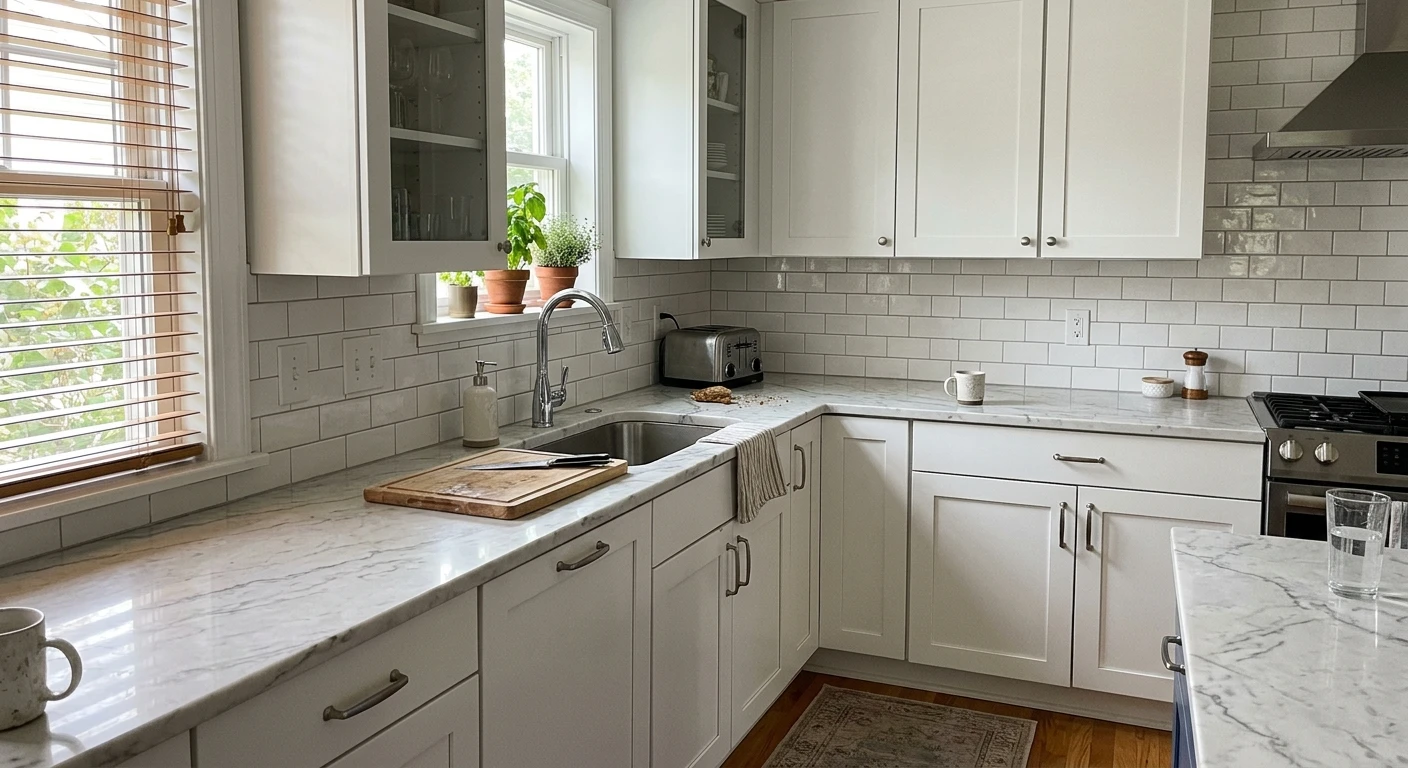
- Countertops: warm-white or creamy quartz flatters greiges and keeps light grays from looking cold. For charcoal cabinets, a bright white or marble-look counter gives the contrast that makes dark doors read intentional rather than heavy.
- Backsplash: a white subway or zellige tile is the safest companion for any gray. For green-grays like Worldly or Kendall, a warm handmade tile amplifies the cozy undertone.
- Hardware: for cool and true grays, brushed nickel and matte black go with anything. Warm greiges and green-grays come alive against brass, champagne bronze, or aged bronze.
- Wood floors and trim: warm oak, walnut, and hickory bounce warm light back onto cooler grays. Pair gray cabinets with a clean warm-white trim and ceiling so the gray stays the star.
- Walls: the surface these lists usually skip, and the one that decides whether the cabinets look deliberate. Most of a kitchen wall hides behind cabinets and backsplash, so the paint you actually see sits in concentrated patches that read a shade darker than the swatch did. Keep the wall a half-step lighter and warmer than the doors, or take it to a warm off-white and let the cabinets carry the color. Our gray kitchen paint ideas works the wall side light to dark, with the LRVs.
For how gray fits alongside white, green, and blue this year, see the best interior paint colors for 2026.
Two-tone: where gray earns its keep
In 2026, hardly anyone runs gray wall-to-wall anymore. Two-tone is where it lives now. A gray island, or gray base cabinets set against a lighter perimeter, adds depth without committing the whole kitchen to a darker color. Classic combinations:
- White perimeter + charcoal island: Benjamin Moore Chelsea Gray or SW Peppercorn on the island against creamy white uppers. The most popular two-tone scheme of the year.
- Greige base + lighter greige upper: Mindful Gray below, Repose Gray above. A subtle tone-on-tone look that feels custom and stays calm.
- Gray + natural wood: painted gray cabinets with a wood-tone island, where the warm wood offsets a cooler gray.
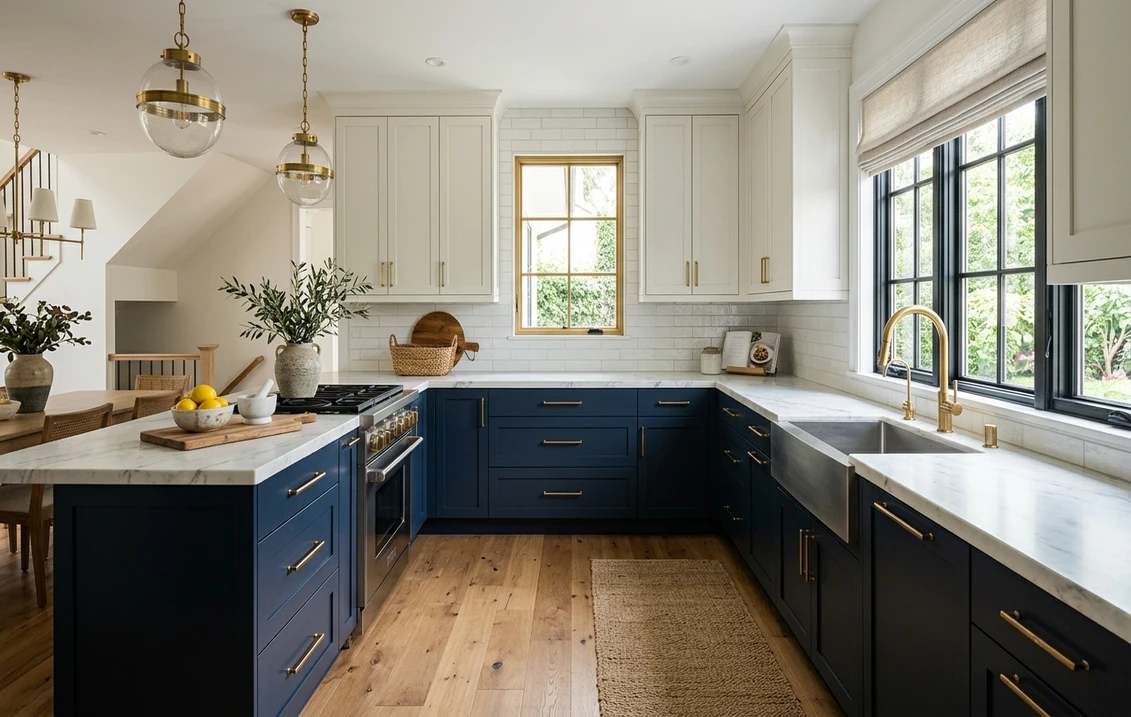
- Gray perimeter + navy island: the combination that gets asked for almost as often as charcoal and is easy to get wrong, because a navy at LRV 4 in a dim kitchen turns the island into a black hole. Our roundup of dark navy paint colors from Sherwin-Williams ranks the deep blues by LRV, so you can pick a navy your light can actually carry against the gray.
Weighing gray against the other big cabinet stories? Compare our deep dives on blue kitchen cabinet colors, green kitchen cabinet colors, and the volume leader, white kitchen cabinet colors. Working with existing oak? Our guide to white cabinets with oak covers the warm-wood balancing act that applies to gray too.
One family that shortlist leaves out is worth naming, because it answers the single most common complaint about gray cabinets. If every gray you have sampled has come back reading cold in your kitchen, the fix is often not a warmer gray but a different column of the fan deck: the warm greiges at the light end of the brown range are the direct neighbors of the warm grays here, and they carry the warmth in the pigment instead of borrowing it from your bulbs. Our profile of the best brown paint for kitchen cabinets uses the same twelve-shade format, from pale greige tan through to espresso.
SW vs BM: which gray formula?
Both brands pour excellent cabinet-grade enamels, and their gray ranges overlap so much that the real deciders are two things: the exact undertone you are after, and which store sits closer to your house. A rough map: Sherwin-Williams Repose, Agreeable, and Mindful lean warm-greige and forgiving; Benjamin Moore Stonington, Coventry, and Chelsea lean slightly cooler and crisper. For the full breakdown of finish, durability, and price, read our Sherwin-Williams vs Benjamin Moore interior comparison, and our interior house painting cost guide puts a cabinet repaint in context.
How to test a gray before you commit
Cabinet paint is expensive to redo, and gray is the family most likely to surprise you, so test before you buy gallons. Two methods:
- Peel-and-stick or painted board: paint a large sample and tape it to an actual cabinet door. Look at it in the morning, mid-afternoon, and at night under your kitchen lights. A 1-inch chip cannot show undertone; a board can.
- Digital preview first: before you order any sample, upload a real photo of your kitchen into a visualizer and apply several grays virtually. Nothing rules out the obvious misses faster. You walk away with maybe two finalists worth sampling for real, instead of a dozen maybes.
Upload your kitchen and preview Repose, Mindful, Chelsea Gray, and more on your real cabinets, free.
Frequently asked questions
What is the most popular gray for kitchen cabinets?
For light cabinets, Sherwin-Williams Repose Gray (SW 7015, LRV 58) and Agreeable Gray (SW 7029, LRV 60) are the two most-painted greiges in the United States, because they read warm and forgiving rather than cold, and they are the safe, resale-friendly picks when you cannot test in your own kitchen. For a deeper, more dramatic look, Benjamin Moore Chelsea Gray (HC-168, LRV 23) is the designer-favorite charcoal.
Are gray kitchen cabinets going out of style?
Cool, stark gray that dominated the mid-2010s has cooled off, but warm greige and deep charcoal remain firmly in style for 2026, especially in two-tone schemes where a gray island anchors a lighter perimeter. The shift is toward warmth: greiges like Repose and soft charcoals like Peppercorn are favored over the icy blue-grays of a decade ago. Paired with warm wood and brass, gray reads current.
What undertone should I avoid in a north-facing kitchen?
Avoid cool blue-gray undertones in a north-facing kitchen. North light is cool and indirect, so a blue-leaning gray such as Gauntlet Gray can turn flat, steely, or "hospital" cold. Choose a warm greige (Repose, Agreeable, Worldly) so the room reads soft and inviting instead of blue, and save the cooler, bluer grays for strong south light.
What hardware looks best on gray cabinets?
Brushed nickel and matte black are the most versatile partners for cool and true grays. Warm greiges and green-grays (Worldly Gray, Kendall Charcoal) look richer with brass, champagne bronze, or aged bronze, which pull out the warm undertone. Matte black gives charcoal cabinets a clean, modern edge.
See greige, mid-tone, and charcoal grays on your actual kitchen before buying a single sample pot.
Disclaimer: Sherwin-Williams, Benjamin Moore, and the color names and codes referenced here are trademarks of their respective owners. FacadeColorizer is an independent paint visualization service and is not affiliated with, endorsed by, or sponsored by Sherwin-Williams, Benjamin Moore, or Behr. LRV values cited are from the manufacturers' published color data and may be revised by the manufacturer. Color reproduction on screens approximates the manufacturer's chip; always confirm with a manufacturer sample before purchase. Sources: Sherwin-Williams and Benjamin Moore published color technical data 2026, The Spruce paint undertone references, and professional designer practice notes.
Trademarks mentioned (Sherwin-Williams, Benjamin Moore, Behr, Caparol, Brillux, Sto, Alpina, Valspar, PPG, Glidden, Dulux, Crown Trade, Sandtex, Farrow & Ball, Johnstone's, Leyland) are property of their respective owners. FacadeColorizer is independent and not affiliated with any of them. Nominative fair use under Lanham Act §1125.