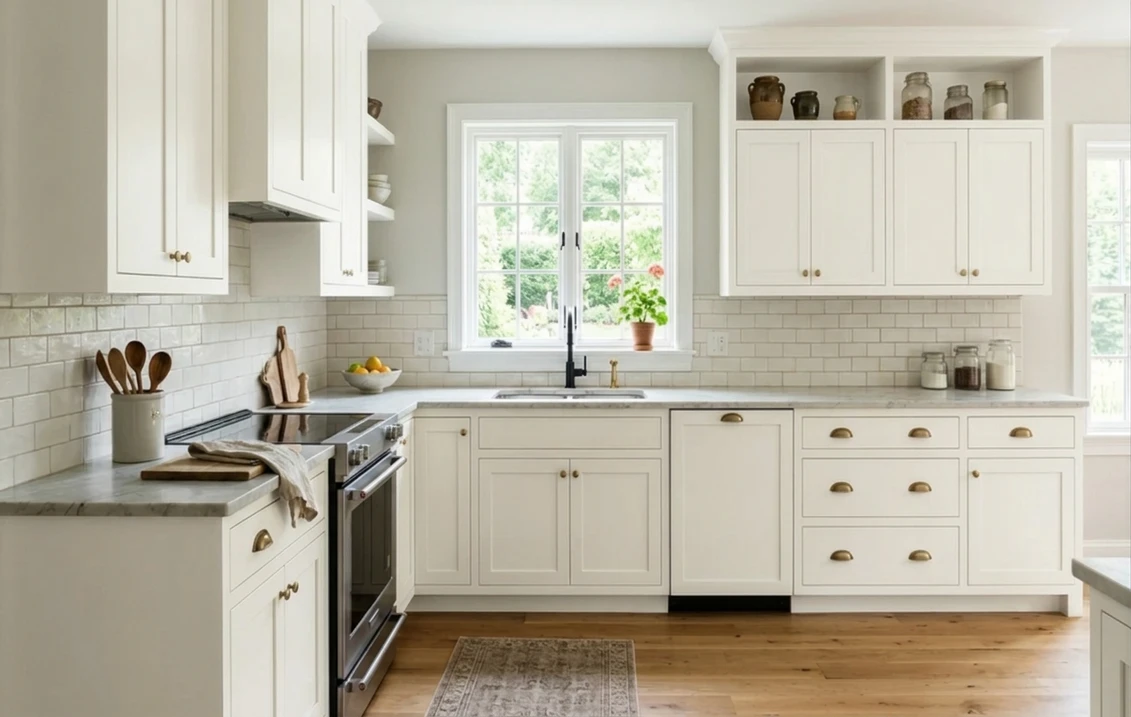
Try it on your room

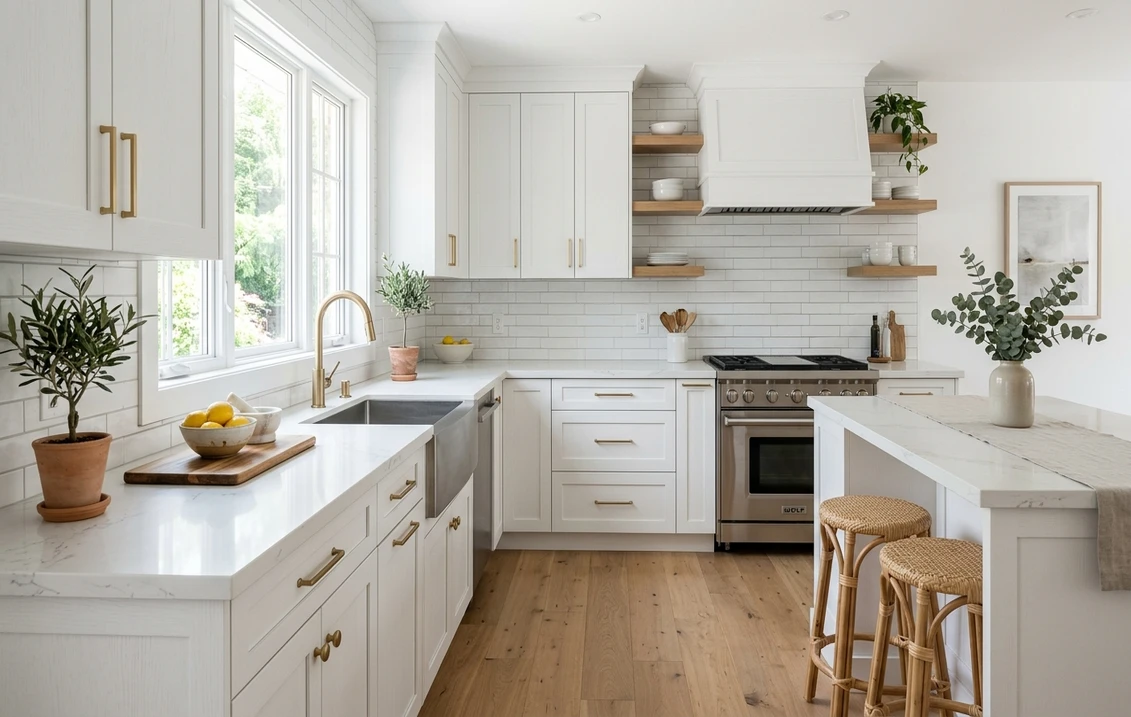
Benjamin Moore White Dove OC-17 is a safe cabinet white when your kitchen makes other whites look gray or blue, and a risky one next to a bright white tile or counter. Its LRV is 83.16, Benjamin Moore lists it among its popular white cabinet colors, and it puts White Dove on the cabinets, trim and ceiling on the cover of its own Advance cabinet refinishing guide. For the paint, Advance is the maker's recommendation for cabinets: 16 hours between coats, at least 5 to 7 days before heavy use and up to 30 days to reach final hardness and sheen. The trade-off for a white this light is a yellowing note on the Advance data sheets, which is why dim cabinet interiors and airflow during the cure deserve some thought.
How this page works: colors, LRVs, prices and product figures were read on Benjamin Moore's pages and data sheets on October 30, 2026. Calculations are ours and labeled as such. No paint was applied for this page and no durability test is claimed. For White Dove on walls and around the house, see our White Dove OC-17 review; for siding and trim, the White Dove exterior guide.
Opens the interior tool with White Dove and "Cabinets" preselected. How it works: our interior paint visualizer.
White Dove against the other cabinet whites, in numbers
Benjamin Moore's White Dove color page gives an LRV of 83.16 and calls the color "clean and classic". You will find other values online, often around 85; the figure on the maker's page is the one used here. LRV runs from 0 for absolute black to 100 for pure white. Its white kitchen cabinets page lists six popular colors, White Dove among them, and describes it as a warmer off-white.
LRV only measures lightness, so it cannot say whether a white leans yellow. To get at that, we converted the digital values used by our simulator to the CIELAB color space, where b* is the blue-to-yellow axis: the higher the number, the yellower. These are our calculations from approximate screen values, not paint measurements, and Benjamin Moore publishes no such figure. Treat them as a way to rank the whites, nothing finer.
| Color | LRV (maker's page) | Gap to White Dove (our calculation) | b* from digital value (our calculation) |
|---|---|---|---|
| Chantilly Lace OC-65 | 90.04 | +6.88 | 2.2 |
| Simply White OC-117 | 89.52 | +6.36 | 4.3 |
| Super White OC-152 | 87.36 | +4.20 | 1.8 |
| White Heron OC-57 | 86.69 | +3.53 | 3.3 |
| Cloud White OC-130 | 85.05 | +1.89 | 5.4 |
| White Dove OC-17 | 83.16 | 0 | 4.5 |
| Decorator's White OC-149 | 82.68 | −0.48 | 1.2 |
| SW Alabaster SW 7008 | 82.215 | −0.95 | 5.2 |
| Swiss Coffee OC-45 | 81.91 | −1.25 | 5.6 |
Try it on your room
No photo? Try a sample
Two things stand out. Decorator's White has almost the same lightness as White Dove, yet Benjamin Moore describes it as a cool white with "a touch of cool gray", and its b* is about a quarter of White Dove's. That pair isolates warmth from brightness. Then Simply White: by these values it carries about the same warmth as White Dove, but it is more than 6 LRV points lighter. So if White Dove looks heavy to you, the fix may be more light rather than less warmth. If it looks yellow next to something, that something is probably a much cooler white such as Chantilly Lace or Super White.
How White Dove cabinets change with the light
Benjamin Moore's rule is simple and is the best starting point for this color: if whites look too gray or blue in your kitchen, try warmer off-whites such as White Dove and Simply White; if they look warmer than you want, look at cool off-whites such as Decorator's White and White Heron.
Window direction sets that light. Benjamin Moore's UK site explains in its guide to how light affects color that north light is cool and blue-toned, south light warm and sometimes intense, east light warm in the morning and cool by late afternoon, and west light muted until the late afternoon sun. Bulbs add a second layer: the ENERGY STAR bulb purchasing guide says a lower Kelvin number means warmer, yellowish light and a higher one means cooler, bluer light. Our reading for White Dove on doors, not a measurement:
| Kitchen light | What to expect on the doors | What to check |
|---|---|---|
| North window | The cool light works against the warmth, which is the case Benjamin Moore suggests warmer off-whites for | Lower doors on an overcast afternoon, when they may look grayest |
| South window | Warm direct light on top of a warm color | Midday, on the doors the sun actually reaches |
| East or west window | Warmer at one end of the day, cooler or muted at the other | Both ends of the day |
| Low-Kelvin under-cabinet LEDs | Yellowish light right on the door faces and backsplash | After dark, with every kitchen light on |
| High-Kelvin LEDs | Bluer light that can cool the warmth | After dark, next to any warm counter or wood |
Cabinets add a problem that walls do not have. Lower doors sit under a counter overhang, upper doors sit next to a light source, and an inside corner may never see the window. A test on a single door tells you about one of those positions, so move your sample through all three.
White Dove with countertops and backsplash
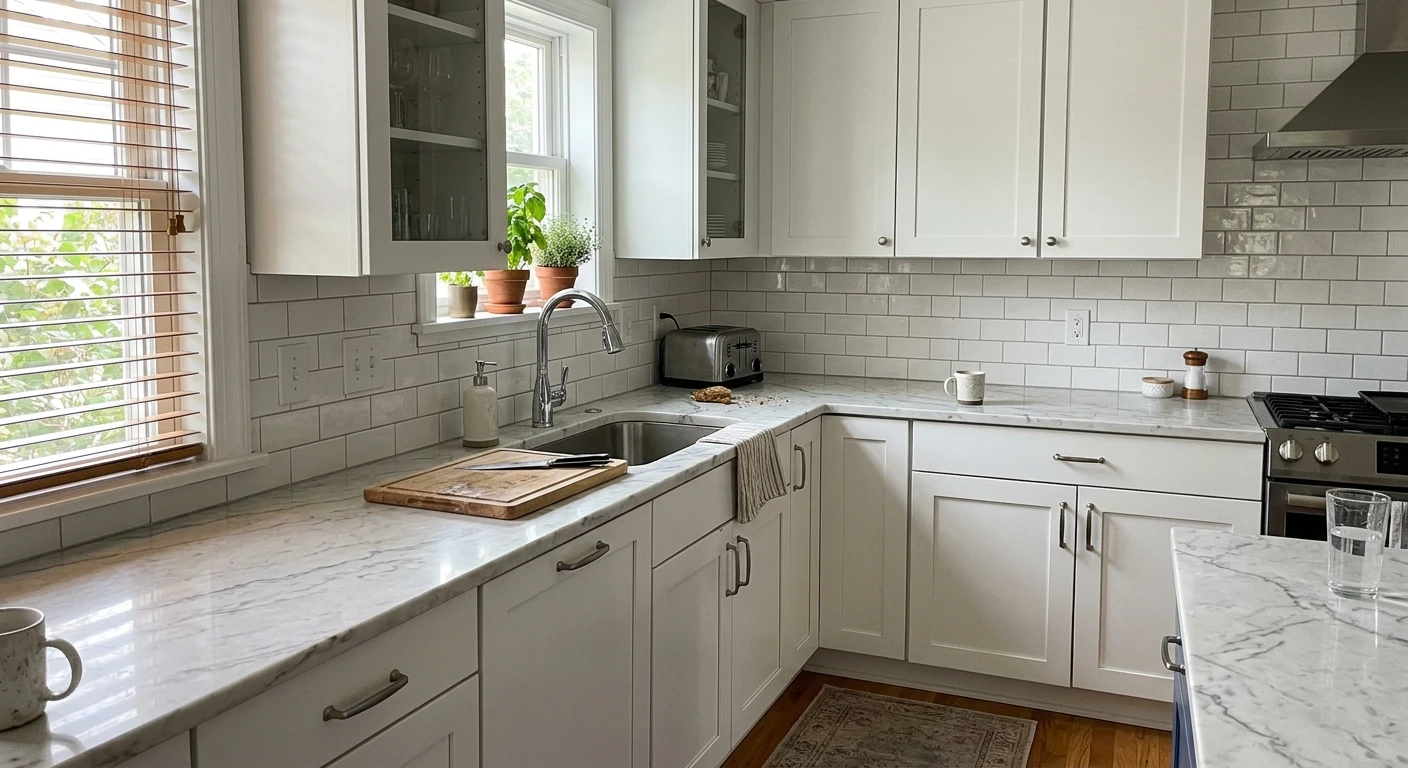
This is where a warm white wins or loses, because the counter and tile are usually staying and they set the reference white. Benjamin Moore's cabinet page says Chantilly Lace and Super White pair well with hard surfaces such as tile and countertops, and it tells you to check any white against the backsplash, counters and wall color. We looked for published LRV figures for white quartz from Caesarstone, Silestone and Cambria and did not find any, so no number on this page compares a counter with a door. What follows is color reasoning, to be checked with real samples.
| Staying in the kitchen | Likely effect on White Dove | Our suggestion |
|---|---|---|
| Bright white quartz or glossy white tile | The door can look darker and creamier beside a cleaner white | Compare with Chantilly Lace or Super White before deciding |
| White stone with cool gray veins | The warm-versus-cool difference becomes visible at the edge of the counter | Test on the actual slab, or a large offcut, not a small chip |
| Cream or beige stone, off-white handmade tile | Warmth on warmth: the door and the surface look related | Check that the door does not look like a darker version of the tile |
| Butcher block or oak | Wood brings the warmth, so the door tends to read whiter by contrast | See our page on white kitchen cabinets with oak |
| Black granite, soapstone or stainless | Strong contrast, little competition with a second white | Usually the easiest case; still check under the kitchen's LEDs |
Replacing the tile as well? Our white kitchen backsplash guide compares the options around a white cabinet.
Check White Dove against your own counter
Upload a photo of your kitchen: the doors change, the counter and tile stay put. Then run Chantilly Lace or Simply White on the same photo. A preview shows color, not sheen.
Try White Dove on my kitchen photoWall colors that go with White Dove cabinets
The pairings below are Benjamin Moore's, from its color pages and the colors credited on its Advance guide. Which color goes on which surface is our suggestion, except for the guide's cover, and the gaps are our subtraction.
| Partner color | LRV | Gap to White Dove | Where Benjamin Moore pairs it | Use |
|---|---|---|---|---|
| Silver Satin OC-26 | 74.9 | 8.26 | Advance guide cover: walls | Quiet walls, gray undertones against warm doors |
| Balboa Mist OC-27 | 65.53 | 17.63 | White Dove page | Pale gray walls with a clearer edge |
| Revere Pewter HC-172 | 55.05 | 28.11 | White Dove and Revere Pewter pages | Greige walls, doors stand out plainly |
| Kendall Charcoal HC-166 | 14.61 | 68.55 | White Dove page | Island or lower run |
| Hale Navy HC-154 | 8.36 | 74.80 | Hale Navy page | Island or lower run |
The cover of the guide is a useful model: the same color on doors, trim and ceiling, with a slightly darker wall. Matching cabinets and trim removes the question of two whites competing in one sightline, and Silver Satin's "crisp gray undertones" keep the walls from reading as a second cream. If the walls are White Dove too, only sheen and shadow separate them from the doors, so the room reads as one surface. Preview that first if you expect the cabinets to stand out. Deep islands are covered in our guide to two-tone kitchen cabinets, and every other family in our complete guide to kitchen cabinet colors.
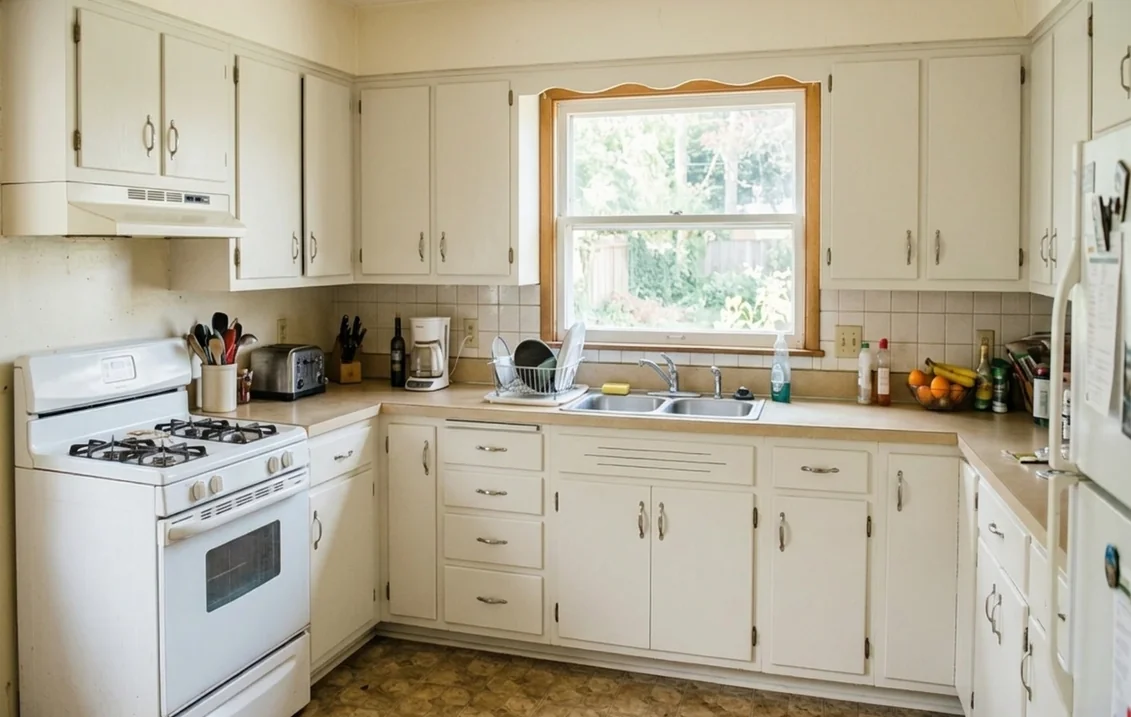
Advance or Aura for a White Dove kitchen
Benjamin Moore's cabinet page calls a durable, high-end paint a must and recommends Advance. Aura also lists cabinets among its projects. Our Benjamin Moore Advance cabinet paint review compares Advance with Emerald Urethane in depth, and the Aura interior paint review covers Aura's other uses. Here is only what changes the choice for a light warm white, from the data sheets for Advance Satin 792, Advance Semi-Gloss 793, Aura Satin N526 and Aura Semi-Gloss N528:
| Spec | Advance Satin / Semi-Gloss | Aura Satin / Semi-Gloss |
|---|---|---|
| Resin | Waterborne alkyd | 100% acrylic latex with proprietary resins |
| Gloss at 60° | 25 to 35 / 50 to 60 | 28 to 38 / 50 to 60 |
| Spread rate per gallon | 400 to 500 sq ft | 350 to 400 / 400 to 450 sq ft |
| Touch / recoat (77°F, 50% RH) | 4 to 6 h / 16 h | 1 h / 1 h |
| Cure statement | At least 5 to 7 days before heavy abrasion; up to 30 days to optimum hardness and final sheen | Washable after two weeks |
| Yellowing note on the sheet | Yes: slight yellowing may occur, more visible in lighter colors | None on the sheet |
| Gallon price, Oct 30, 2026 | $88.99 (Satin) | $108.99 (Semi-Gloss) |
The yellowing note is the White Dove question. The Advance sheets say the paint yellows less than conventional alkyds, but that a slight amount may still occur, faster in dark or poorly ventilated areas and more visibly in lighter colors. An LRV of 83 counts as a lighter color, so think of the inside of a door or a pantry that stays closed. Aura's sheets contain no such note. That is an absence on a data sheet, not a test result, and Benjamin Moore publishes no yellowing measurement for either paint.
What Advance gives back is leveling. Its sheets list excellent flow and leveling plus extended open time, and the Advance cabinet refinishing guide asks you to paint doors flat so the paint can level out completely. That matters on a pale, even color, where a brush mark shows as a line of shadow. Our calculation at mid-range coverage: about $20 per 100 sq ft per coat for Advance Satin against about $26 for Aura Semi-Gloss.
- Choose Advance if you brush or roll, can leave the doors off for a week or more, and can keep air moving during the cure.
- Consider Aura if the kitchen cannot give up 16 hours between coats, or if yellowing inside dim cabinets worries you more than brush marks.
- Satin or semi-gloss. Advance Satin measures 25 to 35 and Semi-Gloss 50 to 60. The shinier finish shows more of what lies under it; our guide to semi-gloss paint for kitchen cabinets explains the trade-off. If your prep will be less than perfect, satin is the more forgiving of the two.
Primers under White Dove
A light color gives old stain or tannin bleed little to hide behind, so choose the primer for what is underneath. The Advance guide calls for one coat of primer and at least one finish coat, with more top coats depending on the surface:
- Wood cabinets. Fast-Sanding Primer (507), tinted to the approximate finish color, so ask for it tinted toward White Dove.
- Laminate, MDF and Thermofoil. Fresh Start High-Hiding All Purpose Primer (046). Sand first: the Advance sheets want all cabinet surfaces roughened with 220 grit or coarser, and the guide says 150 to 220 along the grain.
- Stained or dark cabinets. The guide warns that a stain-blocking primer may be required. The 046 data sheet says it seals most bleeding stains, tannin included, but is not recommended for knots or pine sap.
- Never lacquer-based primers under Advance: the guide says they can impede adhesion.
Oak deserves a separate decision, because grain shows through a light color unless it is filled. Our painted oak cabinets guide sets out both versions, and the step-by-step cabinet painting guide gives the full sequence. If the home was built before 1978, sanding may also release lead dust, as the data sheets warn. The EPA's lead-safe renovation guidance for DIYers covers sheeting, misting and HEPA vacuuming.
Drying, curing and judging the color
On Advance's published times, primer plus two coats on both faces takes about three painting days, with a rehang around day 8 to 10 (our planning, detailed in the Advance review). What matters most with White Dove:
- Do not judge the sheen too early. The sheets say Advance can take up to 30 days to reach optimum hardness and final sheen, so give it a month before deciding the finish is wrong.
- Keep the air moving. The guide asks for open windows or fans while it dries. Since the yellowing note points to dark or poorly ventilated areas, our suggestion is to leave doors ajar for the first weeks instead of closing up the boxes as soon as they are rehung.
- Plan one gallon for a typical kitchen. Our worked example in the Advance review comes to about 175 sq ft per coat, or 0.7 to 0.9 gallon for two coats, plus 0.4 to 0.5 gallon of primer.
How to test White Dove before you sand anything
- Preview it on a photo. Take a daylight photo that shows the doors, counter and backsplash together, and run White Dove against one brighter white and one cooler white. The cabinets option also recolors freestanding furniture, so ignore a stool that changes.
- Order a real sample. Benjamin Moore's sample page listed an 8 oz paint sample at $5.99 and a 9 by 14.75 inch peel-and-stick sheet at $6.95 on October 30, 2026. Both are listed as eggshell, so they will not show the shine of a satin or semi-gloss door.
- Paint a board, not the door. The maker's sampling guide suggests white foam core so you can move it around, and two coats for accurate color. One 8 oz jar covers about 2 by 2 feet.
- Hold it where it will live. Stand it upright against the counter and backsplash, under an upper cabinet and in the darkest corner, beside a sample of the rival white, through a full day and after dark.
When another white is the better call
- Your tile or quartz is a clean bright white. Look at Chantilly Lace or Super White, the two Benjamin Moore singles out for hard surfaces. Our White Dove vs Chantilly Lace comparison goes further.
- You like the warmth but want more light. Simply White OC-117 is 6.36 LRV points lighter. See White Dove vs Simply White.
- You want a small step only. Cloud White OC-130, 1.89 points lighter, appears on White Dove's own list of similar colors. See White Dove vs Cloud White.
- You are weighing a Sherwin-Williams white. See Alabaster on kitchen cabinets and our roundup of white kitchen cabinet paint colors.
Settle the white before you take the doors off
Three painting days and a week of cure are a lot to spend on a white that fights your counter. Compare the alternatives on a photo of your kitchen first.
Preview White Dove on my cabinetsSources and references
- Benjamin Moore, color pages for White Dove, Chantilly Lace, Simply White, Super White, White Heron, Cloud White, Decorator's White and Swiss Coffee: LRVs and descriptions.
- Benjamin Moore, color pages for Silver Satin, Balboa Mist, Revere Pewter, Kendall Charcoal and Hale Navy: pairings.
- Benjamin Moore, White Paint Colors for Kitchen Cabinets: popular colors, light, hard surfaces, Advance.
- Benjamin Moore, Advance Cabinet Refinishing Guide: prep, primers, cure, cover colors.
- Benjamin Moore, data sheets for Advance Satin 792, Advance Semi-Gloss 793, Aura Satin N526, Aura Semi-Gloss N528 and Fresh Start 046: specs and yellowing note.
- Benjamin Moore, product pages for Advance Satin, Aura Semi-Gloss and Fast-Sanding Primer: prices, October 30, 2026.
- Benjamin Moore, Paint and Color Samples and How to Use Paint Color Samples: samples.
- Benjamin Moore UK, How light affects colour: window direction.
- Sherwin-Williams, Alabaster SW 7008: LRV 82.215, from the maker's color data.
- ENERGY STAR (U.S. EPA and DOE), Light Bulb Purchasing Guide: Kelvin scale.
- U.S. EPA, Lead-safe renovations for DIYers.
Frequently asked questions
Is Benjamin Moore White Dove good for kitchen cabinets?
Does White Dove look yellow on cabinets?
What is the LRV of White Dove?
What wall color goes with White Dove cabinets?
What paint should I use for White Dove cabinets?
What primer goes under White Dove cabinets?
Should White Dove cabinets be satin or semi-gloss?
Trademarks mentioned (Sherwin-Williams, Benjamin Moore, Behr, Caparol, Brillux, Sto, Alpina, Valspar, PPG, Glidden, Dulux, Crown Trade, Sandtex, Farrow & Ball, Johnstone's, Leyland) are property of their respective owners. FacadeColorizer is independent and not affiliated with any of them. Nominative fair use under Lanham Act §1125.