Try it on your room

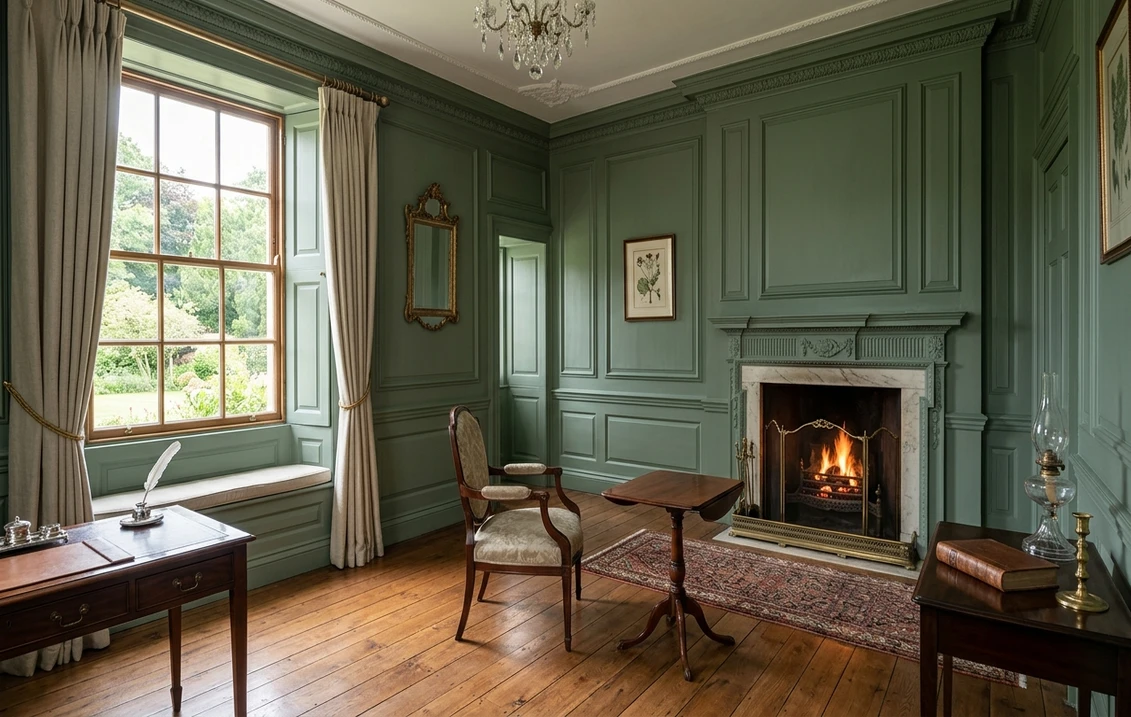
Georgian panelling (1714-1830) is one of the most enduring features in British period homes, and in 2026 it is enjoying a quiet renaissance as homeowners rediscover the calm proportions of dado rails, raised-and-fielded panels and half-wall wainscoting. Get the colour right and a modest terrace feels like a Bath townhouse; get it wrong and you end up with magnolia woodwork that fights the room.
This guide explains the three traditional panelling treatments used in Georgian interiors, the two-tone strategy favoured by period decorators, ten tested colour pairings across Farrow & Ball, Little Greene and Dulux Heritage, the correct eggshell finish for woodwork, and realistic 2026 costs of £400 to £1,200 for a mid-sized room.
For full pricing, see our complete UK cost guide.
Before committing to a scheme, try our free AI interior colour visualiser to see Hague Blue or Invisible Green on your own panelling before buying sample pots.
Georgian panelling types: raised, flat and shiplap
Before choosing colours, you need to identify what you are painting. Georgian joiners used three distinct panelling systems, each with its own ideal finish:
- Raised-and-fielded panels, the grandest form, with a bevelled central field surrounded by moulded stiles and rails. Common in drawing rooms and entrance halls of the 1740-1780 period. The shadow lines demand a matt-to-eggshell finish so the bevel reads properly.
- Flat-fielded panels, simpler, flush panels with ovolo or ogee moulded mouldings. Typical of modest Georgian townhouses and back rooms. Takes two-tone schemes beautifully because the moulding is the only decoration.
- Shiplap and bead-edge boarding, vertical tongue-and-groove boards with a simple bead, used below dado height in servant areas, cottages and late Georgian farmhouses. Looks authentic in deep, matt heritage colours.
Three heights also matter: dado-height wainscoting (about 900 mm, matching the top of a chair back), chair-rail height (around 1,050 mm) and full-height panelling reaching to the cornice. The taller the panel, the deeper the colour tends to work.
The two-tone rule: panelling darker than the wall above
The two-tone rule is at its most useful in the hall, where the lower wall takes coats and bags: Hague Blue or Green Smoke on the panelling and spindles, a warm white such as Wimborne White or Setting Plaster above, as set out in our hallway colours guide.
The single most important Georgian colour principle is simple: the panelling below the dado should be darker than the plaster wall above. This was practical (lower walls caught scuffs and candle soot) and visual, the dark dado visually anchors the room and makes the ceiling appear higher.
In 2026, the strongest-performing combination in British period homes remains Farrow & Ball Hague Blue No.30 on the panelling with Wimborne White No.239 on the walls above. It gives the depth of a Regency library without reading too gloomy in our overcast British light. For greener, softer rooms try Little Greene Invisible Green below and Slaked Lime above, a pairing that photographs particularly well in east-facing morning light.
Three rules of thumb from restoration practice:
- Aim for at least three LRV points of difference between panelling and wall, less and the contrast disappears in evening lamplight.
- Keep the cornice, ceiling and architrave in the wall colour (or a lighter tint), never the panelling colour, this was the Georgian convention and still reads most correct.
- Paint the dado rail itself in the panelling colour, not the wall colour, so the transition feels joined rather than striped.
Upload a photo of your panelling, test 100+ Farrow & Ball, Little Greene and Dulux Heritage shades in 30 seconds.
Period-accurate colour palettes (Georgian 1714-1830)
Early Georgian interiors (1714-1760) favoured stone whites, drab greens and pea greens, driven by the cost of pigments, lead white and verdigris were affordable, while blues and pinks were luxuries. By the late Georgian and Regency years (1790-1830), wealthier owners showed off with Prussian blue, deep burgundy, terracotta and chrome yellow. If you own a Georgian property, matching the palette to the decade of build keeps the scheme honest.
Period-accurate options to shortlist:
- Farrow & Ball Hague Blue No.30, deep Prussian blue, perfect for late Georgian and Regency drawing rooms.
- Farrow & Ball Wimborne White No.239, a warm lead-white substitute, soft on plaster, ideal above the dado.
- Little Greene Invisible Green, an almost-black olive green used historically on Georgian front doors and libraries.
- Little Greene Slaked Lime, a chalky off-white that mimics lime-washed Georgian plaster.
- Dulux Heritage Bone China Blue, a soft powder blue echoing Wedgwood jasperware; brilliant for bedrooms and north-facing sitting rooms.
- Farrow & Ball Eating Room Red No.43, deep Pompeiian red, documented in 1790s Regency dining rooms.
- Little Greene Stone-Mid-Warm, the classic Georgian stone tone for halls and staircases.
One caveat before you order: panelling is not proof of a Georgian build. Plenty of dado-height wainscoting sits in Edwardian houses, and those rooms reacted against Victorian heaviness rather than continuing the Georgian contrast, so walls went to soft sage, dove grey, powder pink or pale duck-egg and the woodwork moved to off-white or pale stone, much closer in tone to the wall above it. Apply the two-tone rule above to a 1905 room and it will read as costume. Our guide to Edwardian paint colours covers that palette alongside the Regency and Victorian ones, so you can date the scheme before you date the panelling.
Ten tested wainscoting and panelling combinations for 2026
These ten pairings are drawn from period restoration projects completed across London, Bath, Edinburgh and the Cotswolds in 2025-2026. Every combination respects the "darker below, lighter above" rule and uses paints widely available from UK merchants.
| # | Panelling (below dado) | Code | Wall above | Code | Best room |
|---|---|---|---|---|---|
| 1 | Hague Blue | F&B No.30 | Wimborne White | F&B No.239 | Drawing room |
| 2 | Invisible Green | LG 75 | Slaked Lime | LG 105 | Library / study |
| 3 | Bone China Blue Mid | DH Heritage | Bone China Blue Pale | DH Heritage | Bedroom |
| 4 | Eating Room Red | F&B No.43 | Joa's White | F&B No.226 | Dining room |
| 5 | Stone-Mid-Warm | LG 35 | Stone-Pale-Warm | LG 36 | Entrance hall |
| 6 | Pitch Black | F&B No.256 | Shaded White | F&B No.201 | Snug / games room |
| 7 | Sage & Onions | LG 288 | China Clay | LG 95 | Kitchen / boot room |
| 8 | Green Smoke | F&B No.47 | Strong White | F&B No.2001 | Sitting room |
| 9 | Regency Cream Deep | DH Heritage | Regency Cream Pale | DH Heritage | Morning room |
| 10 | Down Pipe | F&B No.26 | Cornforth White | F&B No.228 | Home office |
Try it on your house
No photo? Try a sample
Why eggshell sheen is mandatory on Georgian panelling
Georgian panelling was traditionally finished in linseed-oil paint with a subtle sheen, halfway between matt and gloss. The modern equivalent is eggshell (around 20 per cent sheen), and it is the only finish we recommend on raised-and-fielded or flat-fielded panelling. Here is why matt and full gloss both fail:
- Matt emulsion marks instantly, every knock from a chair leg or kicked skirting shows, and it cannot be cleaned with a damp cloth. It also softens the shadow lines on raised panels, making the bevels disappear.
- Full gloss reflects too aggressively in overhead lighting, catches every ripple in the original timber and looks anachronistic, Georgian interiors were never glossy.
- Eggshell sits in the sweet spot: it is washable, it crisply defines mouldings under a picture light, and it ages to a soft patina that matches the original finishes in stately homes.
Recommended 2026 products: Farrow & Ball Estate Eggshell, Little Greene Intelligent Eggshell (the water-based version, better for interior air quality) and Dulux Heritage Eggshell. All three are low-VOC, touch-dry in 2-4 hours and re-coatable after 16 hours.
Cost: £400-£1,200 for a mid-sized room (DIY vs pro)
For a typical mid-sized Georgian sitting room (around 18-22 m² floor, with dado-height wainscoting running the full perimeter), 2026 costs fall into a clear bracket:
- DIY materials only, £400 to £550. Typically 2.5 litres of eggshell for the panelling (£65-£95), 2.5 litres of emulsion for the walls (£45-£70), primer and undercoat (£55), sugar soap, filler, caulk, masking tape, sandpaper and brushes (£80-£120), plus dust sheets. Allow four weekends for a first-timer.
- Decorator labour + mid-range materials, £700 to £950. Includes prep, two coats of eggshell on panelling and two coats of emulsion above, masking and making good. Assumes 2-3 days on site at £200-£300/day.
- Specialist period decorator + heritage paints, £950 to £1,200. Factors a conservation-grade decorator who understands lead-paint safety, uses Farrow & Ball or Little Greene throughout, and properly fills historic shrinkage cracks before re-coating.
A word on pre-1960s paint: any Georgian panelling that has never been stripped almost certainly carries lead-based layers underneath. Do not dry-sand aggressively. Use chemical strippers, wet-sanding and an FFP3 mask, or commission a decorator with a CITB lead-awareness certificate. Full lead testing kits cost about £12 from UK merchants.
Dado rail treatment: five practical rules
The dado rail is the horizontal band where panelling meets wall. Get it wrong and a good scheme falls apart:
- Paint the rail itself in the panelling colour, never split it across both colours.
- Keep the rail height consistent with the skirting, top of rail should align visually with the top of any fireplace plinth or window seat.
- If you do not have a dado rail, you can still create the two-tone effect: mark a horizontal line at 900 mm and paint up to it with a straight edge. Add a simple 20 mm moulding afterwards if budget allows.
- Never use gloss on the rail, it draws the eye to every dent and nail hole.
- Caulk the top edge of the rail to the wall before painting to stop a hairline shadow gap appearing after the first winter.
Frequently asked questions
Should Georgian panelling really be darker than the wall above?
Yes, for period accuracy and for practical hard-wearing reasons. Historic paint archives at the National Trust show consistent use of darker tones below the dado from the 1720s onwards. The darker colour hid candle soot, chair scuffs and boot marks; the lighter wall above reflected daylight. If you prefer the reversed modern look (pale panelling, bold wall), it will read as contemporary rather than Georgian, that is a legitimate choice but no longer historically accurate.
Can I use Farrow & Ball Hague Blue in a small, north-facing room?
You can, but test it thoroughly first. Hague Blue reads almost black in poor natural light, which is dramatic in a study but can feel oppressive in a small sitting room that is used all day. In a north-facing box room, consider Dulux Heritage Bone China Blue or Farrow & Ball Stiffkey Blue No.281 instead, they hold their blue character in cold light rather than shifting to grey-black. Always use a visualiser or paint an A3 sample board to check the colour at 7 am, midday and under evening lamps before committing.
Is eggshell really necessary, or can I use modern matt emulsion on panelling?
Eggshell is strongly recommended. Modern "durable matt" emulsions are a compromise: they are more washable than standard matt but still lack the mar resistance required on skirting, dado rails and raised panels that get bumped by furniture. Water-based eggshell (Little Greene Intelligent Eggshell or F&B Estate Eggshell) gives you the washability of traditional oil eggshell without the yellowing or the 16-hour recoat wait. If you insist on matt, at least use it only on full-height panelling above chair-contact height.
How do I match colours on panelling that has been painted many times?
Panelling with eight to twelve layers of paint loses its crisp moulding detail. Before repainting, decide whether to live with the built-up profile (faster, cheaper, £0) or strip back to bare pine (conservation option, £30-£60/m² if done professionally). If you strip, use a chemical stripper such as PeelAway 1, heat guns risk releasing lead fumes. Once stripped, prime with an oil-based wood primer before your eggshell topcoats; water-based primers struggle on century-old tannin-rich pine.
Upload your room photo, compare 10 Georgian combinations side-by-side, no sign-up needed.
A successful Georgian scheme is about proportion as much as colour. Identify your panelling type, respect the darker-below rule, choose eggshell for the woodwork, and test every shade on your own walls before buying full tins. Sources: Farrow & Ball Heritage Archive, Little Greene Historic Colours, Dulux Heritage Range, SPAB Panelling Technical Advice Note.
Trademarks mentioned (Sherwin-Williams, Benjamin Moore, Behr, Caparol, Brillux, Sto, Alpina, Valspar, PPG, Glidden, Dulux, Crown Trade, Sandtex, Farrow & Ball, Johnstone's, Leyland) are property of their respective owners. FacadeColorizer is independent and not affiliated with any of them. Nominative fair use under Lanham Act §1125.