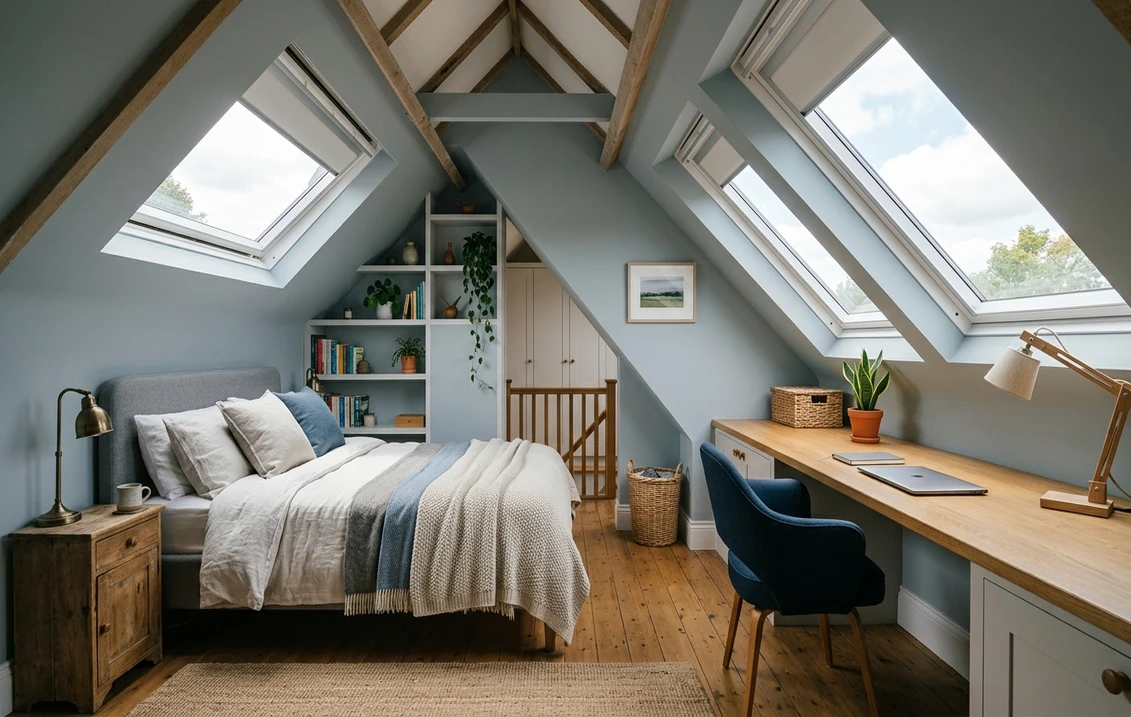
Try it on your room

According to the Federation of Master Builders, loft conversions now account for nearly one in five UK home extensions, adding on average 20 percent to a property's value. Yet the paint specification for these awkward spaces is often treated as an afterthought. A loft is not a normal bedroom: it has sloping ceilings, Velux roof windows, restricted head height and unusual light angles. The right colour strategy can make 15 sqm feel like 25, while the wrong one will crush the eaves and expose every plasterboard joint.
This guide covers the 2026 paint colours UK loft conversion specialists actually recommend, the sloping-ceiling rule used by every period-property decorator, Velux light treatment, dormer vs mansard vs hip-to-gable differences, and the £280 to £680 budget to paint a typical 15-20 sqm loft. Sources: Farrow & Ball, Little Greene, Dulux Heritage, Federation of Master Builders and Building Regulations Part E (noise).
For full pricing, see our complete UK cost guide.
The sloping ceiling rule: walls and ceiling the same colour
Ask any UK loft conversion decorator with ten years' experience and they will give the same advice: paint the walls, the sloping ceiling and the flat ceiling in the same colour. The reason is optical. A loft has at least three ceiling planes meeting at awkward angles; painting each one differently creates harsh lines that the eye reads as boundaries, shrinking the room. Using a single envelope colour erases those lines and lets the eye travel smoothly from floor to ridge.
This principle was popularised by Joa Studholme (Farrow & Ball Colour Curator) and is now standard in UK period-property renovation. Apply it whether you choose a soft white or a saturated deep tone. The only exception is when you have a true flat section above 2.3 m, in which case you can drop the ceiling by half a tone for subtle definition.
Why contrasting ceilings fail in lofts
A white ceiling over a coloured wall works in a square Victorian bedroom because the wall-ceiling junction is a clean 90 degree line. In a loft, that junction is a 30 to 45 degree slope, and the eye reads the contrast as a diagonal stripe cutting the room in half. Decorators call it the "pizza-slice effect": the brain sees triangular wedges of ceiling rather than a continuous volume. The single-envelope approach eliminates this entirely.
Roof glazing changes how a wall colour behaves, and the extreme case is the conservatory, where the whole ceiling is glass: walls absorb far more sun, dark colours fade and heat the room, and condensation runs down the solid wall on winter mornings. The lessons transfer to a loft with large roof windows; our guide to conservatory paint colours explains the light-reflectance rule and the washable finishes the brands recommend.
Velux and roof window light treatment
A Velux roof window lets in roughly 30 percent more daylight than a vertical window of the same size, because sky light is more intense than ground-reflected light. This is the single biggest variable in loft colour choice. A colour that reads as warm cream at ground floor can swing to cold grey under a pair of Veluxes at midday, then back to peachy at sunset.
Test your chosen tone on all four aspects of the loft (north, south, east, west wall) and leave the samples up for 48 hours. Pay particular attention to the reveals of the Velux itself: these are often painted white by default, but painting them the same envelope colour as the walls softens the light transition and avoids a "searchlight" effect at night. For blackout performance, specify blinds separately, not dark paint, which only makes the room feel smaller without blocking light.
Velux glare and high-LRV paints
A Light Reflectance Value (LRV) above 80 will bounce Velux daylight onto the opposite wall, effectively doubling the brightness of the loft. Farrow & Ball All White No.2005 (LRV 85) and Wimborne White No.239 (LRV 83) are the UK trade go-to for this reason. Below LRV 60 you lose the reflective benefit; below LRV 40 (e.g. Hague Blue) you commit to the moody envelope approach and should compensate with warm artificial lighting at 2700K.
Dormer, mansard and hip-to-gable: what changes
The three main UK loft conversion types create very different light conditions, and each suits a different colour strategy.
- Dormer (flat-roof or pitched-roof): vertical window gives good wall-height daylight, usable head space up to the dormer front. Suits mid-range neutrals like Pointing or Skimming Stone (LRV 70-75). The flat dormer ceiling can handle slightly darker tones than the main slope.
- Mansard (double-pitched, Paris-style): nearly vertical lower pitch plus shallow upper pitch. Reads almost like a normal room, so you can treat it like a standard bedroom. Saturated colours (Hague Blue, Inchyra Blue, Green Smoke) work brilliantly here because the vertical walls anchor the eye.
- Hip-to-gable: the new gable wall becomes the dominant feature; the opposite slope is usually long and low. Single-envelope white (All White, Wimborne White) is almost mandatory here because contrast accentuates the asymmetry and makes the room feel unbalanced.
The 12 best paint colours for UK loft conversions in 2026
These 12 colours combine UK trade recommendations, 2026 Farrow & Ball, Little Greene and Dulux Heritage bestseller data, and proven performance in the three major loft conversion types. Finishes are Modern Emulsion or Estate Emulsion for walls and sloping ceilings; never use a different sheen level on the slope versus the wall, or the envelope illusion breaks down.
| Colour | Brand & Code | LRV | Best for |
|---|---|---|---|
| All White | Farrow & Ball No.2005 | 85 | Hip-to-gable, low head height |
| Pointing | Farrow & Ball No.2003 | 80 | Dormer, warm envelope |
| Wimborne White | Farrow & Ball No.239 | 83 | North-facing loft, subtle warmth |
| Slipper Satin | Farrow & Ball No.2004 | 76 | South-facing dormer, creamy |
| Shadow White | Farrow & Ball No.282 | 74 | East-facing mansard, greige |
| Slaked Lime | Little Greene No.105 | 82 | Cottage lofts, chalky finish |
| French Grey Pale | Little Greene No.161 | 71 | Mansard, period dormer |
| Timeless | Dulux Heritage DH30 | 78 | Budget-friendly neutral envelope |
| Skimming Stone | Farrow & Ball No.241 | 74 | Dormer with multiple Veluxes |
| Hague Blue | Farrow & Ball No.30 | 11 | Moody envelope, mansard only |
| Inchyra Blue | Farrow & Ball No.289 | 14 | Dramatic master loft suite |
| Green Smoke | Farrow & Ball No.47 | 19 | Home-office loft conversion |
Try it on your house
No photo? Try a sample
Upload a photo of your loft. See Farrow & Ball, Little Greene and Dulux Heritage on your real walls in 30 seconds.
The moody option: Hague Blue No.30 whole envelope
Counter-intuitively, one of the most effective loft palettes is a deep, saturated single-colour envelope. Painting walls, slopes and ceiling in Farrow & Ball Hague Blue No.30 (LRV 11) or Inchyra Blue No.289 (LRV 14) makes the edges of the room disappear entirely, creating what Studholme calls a "colour immersion" effect. The eye cannot detect the junctions, so the brain stops measuring the room and simply perceives atmosphere.
This works best in mansard and larger dormer conversions used as master suites, cinema rooms, or home offices. Combine with warm 2700K lighting, brass or aged-bronze fittings, and pale natural-oak flooring to avoid the "cave" trap. Avoid the moody envelope in hip-to-gable lofts and in any loft under 12 sqm: the low LRV needs volume to breathe.
Floorspace optical illusions that actually work
Beyond the single-envelope rule, three tricks consistently enlarge the perceived footprint of a loft:
- Paint skirting and architrave the same colour as the wall. Contrasting white skirting cuts the room horizontally and shrinks it. Wall-colour skirting in eggshell (same hue, different sheen) is a continuous visual line that pushes the floor outward.
- Paint the back of built-in eaves storage a deeper tone. The classic Farrow & Ball pairing is wall colour plus one tone darker inside the cupboards. When doors are open, the contrast creates perceived depth.
- Keep the floor pale. Light oak, pale herringbone or wool carpet in biscuit / oat tones reflects Velux light upward and makes the floor feel larger. Dark floors crush the low eaves.
Building Regulations: Part E noise and paint
A loft conversion must comply with UK Building Regulations Part E (resistance to the passage of sound). This typically means 100 mm mineral wool between joists, plus a resilient bar and double 15 mm plasterboard on the ceiling below. Paint does not affect Part E compliance directly, but two points matter for the decorator:
- Never skimp on plasterboard skim before painting. A 3 mm skim is the minimum for a Class O acoustic finish. Patchy skim lets sound transmission increase and shows through paint as shadowed plasterboard joints under Velux light.
- Avoid perforated or acoustic-textured paint systems in lofts. They collect dust via the Velux stack-effect and go grey within 18 months. Stick to Modern Emulsion (wipeable) or Estate Emulsion (chalky, period look).
Cost to paint a UK loft conversion in 2026
A typical 15 to 20 sqm UK loft conversion costs £280 to £680 to paint in 2026, supply-and-fit. The range reflects paint brand (trade vs Farrow & Ball), number of Velux reveals, and whether you include storage interiors and skirting.
| Loft size | Trade paint (Dulux Trade, Crown) | Premium (F&B, Little Greene) | Labour days |
|---|---|---|---|
| 15 sqm (small dormer) | £280 - £380 | £420 - £540 | 2 days |
| 18 sqm (dormer / hip-to-gable) | £340 - £460 | £500 - £620 | 2.5 days |
| 20 sqm (mansard / large dormer) | £390 - £520 | £560 - £680 | 3 days |
Add roughly £80 to £140 if the conversion is brand new and requires mist-coat priming of fresh plasterboard. Farrow & Ball typically needs three coats over primer on loft slopes (gravity-assisted drip marks otherwise), which is the main driver of the premium-paint price step.
Frequently asked questions about loft conversion paint colours
Should I paint the sloping ceiling of my loft the same colour as the walls?
Yes, in almost every case. UK loft conversion decorators recommend painting the walls, sloping ceiling and flat ceiling in a single colour (single envelope) because the multiple angles otherwise create harsh visible junctions that shrink the room. This is the standard Farrow & Ball and Little Greene recommendation. The only exception is a true flat section above 2.3 m, where you can drop the ceiling by half a tone.
What is the best white paint for a loft with Velux windows?
Farrow & Ball All White No.2005 (LRV 85) is the UK trade favourite because its high Light Reflectance Value maximises the 30 percent extra daylight Velux roof windows provide. For a slightly warmer feel, Wimborne White No.239 (LRV 83) is the standard north-facing alternative. Paint the Velux reveals in the same colour as the walls, not bright white, to avoid the "searchlight" effect at night.
How much does it cost to paint a loft conversion in the UK in 2026?
Expect £280 to £680 supply-and-fit for a typical 15-20 sqm UK loft conversion in 2026. Trade paint (Dulux Trade, Crown) sits at £280-£520 depending on size; premium paints (Farrow & Ball, Little Greene) add roughly £140-£160 because they need three coats on sloping surfaces. Fresh plasterboard mist-coat priming adds another £80-£140.
Can I use a dark colour like Hague Blue in a small loft?
Yes, but only in a mansard or large dormer of at least 12 sqm with good Velux daylight. Painting the entire envelope (walls, slopes, ceiling) in Hague Blue No.30 or Inchyra Blue No.289 makes the junctions disappear and creates an immersive atmosphere. Avoid dark envelopes in hip-to-gable lofts (the asymmetry gets worse) and in any loft under 12 sqm.
See All White, Pointing or Hague Blue on your actual loft photo before you buy a single tester pot.
The best UK loft conversion paint job in 2026 follows three rules: single-envelope colour across walls and slopes, LRV above 80 for light-starved lofts (or below 20 for a committed moody scheme), and Velux reveals painted in the wall colour. Test every shortlisted tone on all four aspects with our free AI interior colour visualiser before you commit. Sources: Farrow & Ball, Little Greene, Dulux Heritage, Federation of Master Builders, Building Regulations Part E.
Trademarks mentioned (Sherwin-Williams, Benjamin Moore, Behr, Caparol, Brillux, Sto, Alpina, Valspar, PPG, Glidden, Dulux, Crown Trade, Sandtex, Farrow & Ball, Johnstone's, Leyland) are property of their respective owners. FacadeColorizer is independent and not affiliated with any of them. Nominative fair use under Lanham Act §1125.