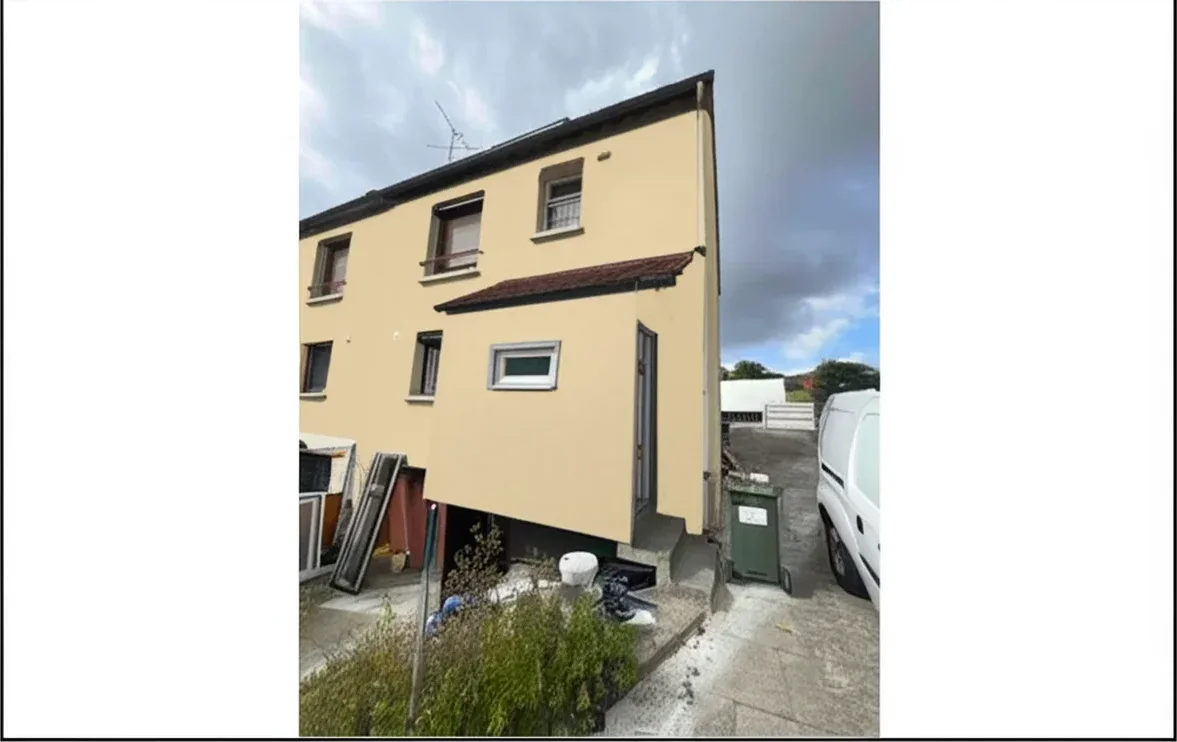
Try it on your house

Painting a house exterior in Boston in 2026 typically runs $4,800 to $11,500 for a 2,200 sqft colonial, with per-square-foot rates between $3.25 and $8.50 depending on neighborhood, siding, and historic-district overlay. Back Bay brownstones and Beacon Hill row houses sit at the top of the range; Quincy and Dorchester triple-deckers anchor the lower end.
This guide breaks down 10 Boston-area neighborhoods, the Boston Landmarks Commission review process, the federal Lead RRP rule that applies to nearly every pre-1978 home (the vast majority in Boston), and how winter freeze-thaw cycles and ocean salt air shape paint and prep choices. All figures are pulled from 2026 contractor bids in Suffolk, Middlesex, and Norfolk counties. For citywide pricing benchmarks, see our exterior house painting cost by city guide.
Test Sherwin-Williams, Benjamin Moore and California Paints colors on your Boston home photo - free, no signup
Boston exterior painting cost: 2026 average
For the typical 2,200 sqft two-story colonial with wood clapboard, vinyl, or hardboard siding, expect to pay between $4,800 and $11,500 in greater Boston. That spread reflects four big drivers: substrate condition, prep level (especially lead paint containment), height and access, and labor rates that are 22 to 30 percent above the national average per Bureau of Labor Statistics Boston-Cambridge MSA wage data.
A clean repaint on intact wood clapboard with no rot lands near $4,800 to $6,500. Add full scrape, prime, and lead-safe containment (mandatory under the EPA Lead RRP rule for any home built before 1978) and the bid jumps $1,800 to $3,200. Brick repointing, sash window glazing, or a third-story dormer push the total past $10,000. Before you gather bids, our painting cost calculator gives a quick Boston estimate straight from your home's square footage.
Cost by neighborhood: 10 Boston areas
Pricing varies sharply across Boston. Historic districts with brownstone, brick, and ornate millwork command the top dollar; outer neighborhoods with vinyl-clad triple-deckers sit at the bottom. Use this table as your 2026 baseline before getting bids.
| Neighborhood | Typical home | Cost per sqft | Avg total (2,200 sqft) |
|---|---|---|---|
| Back Bay | Brownstone row house | $5.50 - $8.50 | $12,100 - $18,700 |
| Beacon Hill | Federal / Greek Revival brick | $5.25 - $8.25 | $11,550 - $18,150 |
| North End | Italianate brick, narrow access | $4.75 - $7.50 | $10,450 - $16,500 |
| South End | Bowfront row house | $4.75 - $7.25 | $10,450 - $15,950 |
| Cambridge | Victorian / colonial wood frame | $4.25 - $6.75 | $9,350 - $14,850 |
| Brookline | Colonial Revival, Tudor | $4.25 - $6.50 | $9,350 - $14,300 |
| Newton | Center-entrance colonial | $4.00 - $6.25 | $8,800 - $13,750 |
| Jamaica Plain | Queen Anne, triple-decker | $3.75 - $5.75 | $8,250 - $12,650 |
| Dorchester | Triple-decker, vinyl / wood | $3.50 - $5.25 | $7,700 - $11,550 |
| Quincy | Cape, ranch, vinyl-clad | $3.25 - $5.00 | $7,150 - $11,000 |
Try it on your house
No photo? Try a sample
Numbers above include labor, two coats of premium paint, basic prep, drop cloths, and standard 2-year warranty. They exclude full siding replacement, heavy carpentry, and scaffolding for buildings over 35 feet.
Why Back Bay and Beacon Hill cost the most
Both neighborhoods sit inside Boston Landmarks Commission historic districts, which means any visible exterior work, including a simple repaint, requires review. The Back Bay Architectural Commission (BBAC) and the Beacon Hill Architectural Commission (BHC) approve every color, sheen, and trim profile.
For routine repaints in approved palettes, contractors file an administrative review (turnaround 7 to 14 days, no fee). For non-approved colors or substrate changes, a full hearing is required: monthly meetings, drawings, photos of adjacent buildings, and 4 to 8 weeks lead time. A rejected color forces a re-spray, which can cost $2,500 to $4,500 on a brownstone front facade.
Working pros know the approved palettes by heart: muted earth tones, soft blacks, off-whites, and historic greens dominate. Cost premiums also come from the work itself: cast-iron railings, granite stoops, slate-roof flashing, and ornate cornices that require hand-brushing and oil-based primer on iron.
Lead paint RRP rule: the biggest hidden cost
The vast majority of Boston housing stock predates 1978: per the U.S. Census American Community Survey, more than 70 percent of Suffolk County housing units were built before 1980. That means the federal EPA Lead Renovation, Repair, and Painting (RRP) Rule applies to nearly every exterior repaint in the city.
RRP requires the contractor to be EPA Lead-Safe Certified, post warning signs, lay 6-mil poly ground cover extending 10 feet from the work surface, use HEPA vacuums for cleanup, and document containment with photos. In Massachusetts, the state-delegated program is administered by MA DLS (Department of Labor Standards) and contractors must hold a Lead-Safe Renovation Contractor License.
Practical impact on your bid: $0.75 to $1.40 per sqft added for full lead-safe scrape and containment, or $1,650 to $3,080 on a 2,200 sqft colonial. Skipping a certified contractor exposes you to fines up to $37,500 per day under EPA enforcement, plus liability if a child is poisoned.
Climate factors: freeze-thaw and salt air
Boston averages 30 to 40 freeze-thaw cycles per year. Each cycle expands moisture trapped behind paint, lifts the film, and creates the classic peeling pattern on south- and west-facing clapboards. Two responses are non-negotiable in 2026 spec sheets:
- Back-priming all replacement clapboards on six sides before installation
- Vapor-permeable acrylic topcoats that let interior moisture escape rather than blistering
For homes within 1.5 miles of the harbor (East Boston, Charlestown, Dorchester waterfront, Quincy shore), ocean salt air accelerates corrosion on iron rails, copper flashing, and galvanized fasteners. Spec a direct-to-metal (DTM) primer like Sherwin-Williams Pro Industrial Pro-Cryl on all ferrous metal, and rinse the substrate with fresh water before priming. Expect a 6- to 8-year repaint cycle near the coast versus 9 to 12 years inland.
Storm windows and painted sash
Many Boston homes pair painted wood sash with exterior dual-pane storm windows. The combination protects single-pane historic glass and cuts heating bills, but it traps moisture against the sash if storm windows lack weep holes. Symptoms: paint peeling within 18 months, glazing putty cracking, sill rot.
Before painting, confirm storm-window weep holes are open (a $0 fix), reglaze with linseed-oil glazing compound on historic sash, and prime bare wood with an oil-based or alkyd-modified acrylic primer. The MassCEC weatherization program sometimes co-funds storm-window upgrades, which can offset paint prep on the same sash. Check Mass Save before signing a paint contract.
Best paint brands for Boston exteriors in 2026
Three product lines dominate professional bids in greater Boston:
- Sherwin-Williams Emerald Exterior Acrylic Latex - $95 to $115/gal, self-priming, lifetime warranty when applied with SW primer. Strongest pick for clapboard and Hardie.
- Benjamin Moore Aura Exterior - $98 to $120/gal, Color Lock technology resists fading on dark trims, excellent on shingle.
- California Paints Fres-Coat 100% Acrylic (Andover, MA based) - $72 to $88/gal, locally manufactured, strong adhesion in cold-weather application down to 35 degrees F.
For brick and brownstone, mineral-based silicate paints (Keim, Beeck) outperform acrylic by allowing 10x more vapor transmission and lasting 20+ years, but cost $4.50 to $6.00/sqft applied versus $2.75 to $4.00 for acrylic. Worth it on Beacon Hill where the next repaint is two decades out.
See SW Emerald, BM Aura and California Paints colors on your photo in 30 seconds
Massachusetts contractor licensing: what to verify
Massachusetts requires anyone performing work over $1,000 on a 1- to 4-family owner-occupied home to register as a Home Improvement Contractor (HIC) under G.L. c.142A. The HIC is administered by the Office of Consumer Affairs and Business Regulation. Registration includes a $1,000 surety bond contribution to the Guaranty Fund, which protects homeowners from contractor default.
Before signing, verify three things:
- HIC registration number (search the OCABR online registry)
- EPA Lead-Safe firm certification for any pre-1978 home
- General liability insurance minimum $1M per occurrence and workers comp
Massachusetts contracts over $1,000 must also be in writing, contain a 3-day right of cancellation, and limit the deposit to one-third of the total or the cost of special-order materials, whichever is greater. A contractor who refuses these terms is non-compliant.
When to paint in Boston: timing and weather
The reliable exterior painting window in Boston runs late April through mid-November. Manufacturers spec application above 35 to 50 degrees F (depending on product) with no precipitation in the next 24 hours. New England humidity and the Atlantic dew point compress the daily working window: figure 9 a.m. start after dew burns off, 4 p.m. cutoff before evening dew returns.
Booking in March or November gets you 8 to 12 percent off list price as crews fill schedules; June through August commands the highest rates. Avoid the first two weeks of October if your home is exposed to the harbor: leaf debris and wind-driven rain off the water can ruin a fresh coat overnight.
Frequently asked questions
How much does it cost to paint a 2,200 sqft house in Boston in 2026?
Expect $4,800 to $11,500 all-in for a typical 2,200 sqft two-story colonial in greater Boston. The lower end applies to clean repaints on intact siding in Dorchester, Quincy, or Newton. The upper end reflects full lead-safe scrape, carpentry, and historic-district work in Beacon Hill or Back Bay. Per square foot, plan for $3.25 to $5.25 in outer neighborhoods and $5.50 to $8.50 in landmark districts.
Do I need approval to repaint my Beacon Hill or Back Bay home?
Yes. Both neighborhoods are Boston Landmarks Commission districts. The Beacon Hill Architectural Commission (BHC) and Back Bay Architectural Commission (BBAC) review every exterior change, including color and sheen. Repainting in an approved palette goes through administrative review (7 to 14 days). New colors need a public hearing and 4 to 8 weeks lead time. Painting without approval can trigger a stop-work order and forced repaint at your expense.
Why does the EPA Lead RRP rule matter for Boston homes?
More than 70 percent of Suffolk County housing was built before 1980, so almost every Boston exterior repaint falls under the EPA Lead RRP rule. Your contractor must be Lead-Safe Certified, contain debris with 6-mil poly, use HEPA vacuums, and document the work. Skipping certified contractors exposes you to fines up to $37,500 per day and significant lead-poisoning liability. Budget $0.75 to $1.40/sqft extra for proper containment.
What is the Massachusetts HIC registration and why should I check it?
Under G.L. c.142A, anyone doing more than $1,000 of work on a 1- to 4-family owner-occupied home must register as a Home Improvement Contractor with OCABR. Registration includes a $1,000 contribution to the state Guaranty Fund, which reimburses homeowners when a registered contractor defaults. Always verify the HIC number on the OCABR online registry, plus confirm EPA Lead-Safe certification and proof of $1M general liability before signing.
Free - no signup - 100+ Sherwin-Williams, Benjamin Moore and California Paints colors
A successful Boston exterior repaint comes down to three things: pricing the right neighborhood band, hiring an HIC-registered, EPA Lead-Safe contractor, and locking in your color before the BLC or BHC review. Test your color choices on a photo of your actual home with our free AI paint visualizer before approving any bid. Sources: EPA RRP, MA OCABR, Boston Landmarks Commission, MassCEC, Bureau of Labor Statistics.
Trademarks mentioned (Sherwin-Williams, Benjamin Moore, Behr, Caparol, Brillux, Sto, Alpina, Valspar, PPG, Glidden, Dulux, Crown Trade, Sandtex, Farrow & Ball, Johnstone's, Leyland) are property of their respective owners. FacadeColorizer is independent and not affiliated with any of them. Nominative fair use under Lanham Act §1125.