Exterior painters near me in Columbus, Ohio
Before you call a Columbus painter, upload one photo and preview real Sherwin-Williams, Benjamin Moore or Behr colors on your own facade in about 30 seconds. Free, no account, no obligation.
- No sign-up
- No card
- Result in ~30s
Your photo is private, used only to create your preview, never sold. You keep full ownership.
✓ No sign-up ✓ Result in ~30s
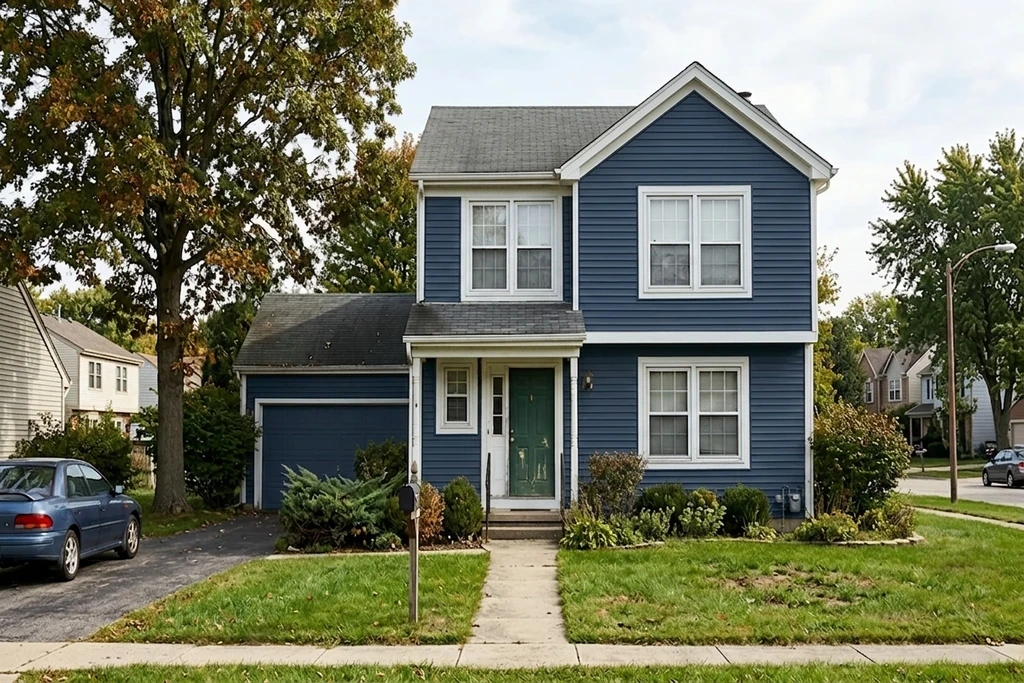
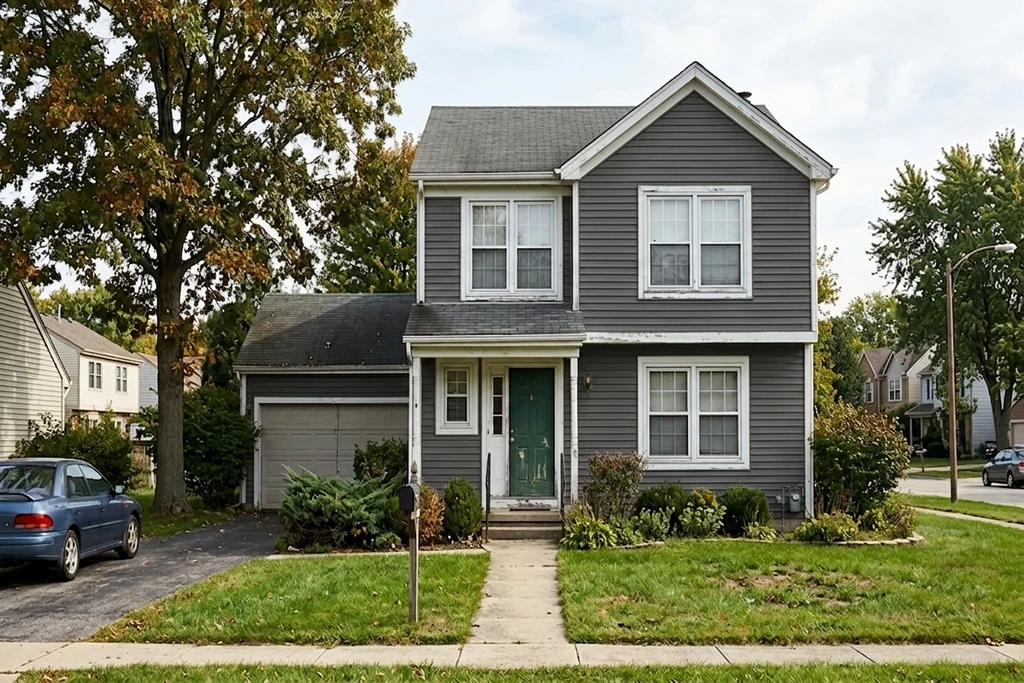
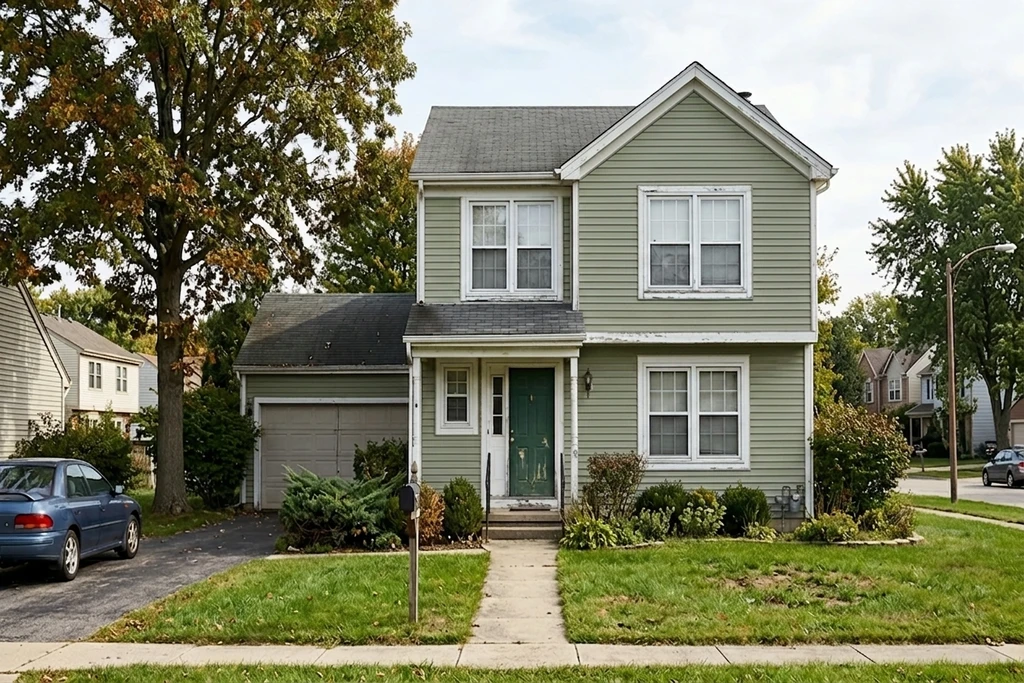
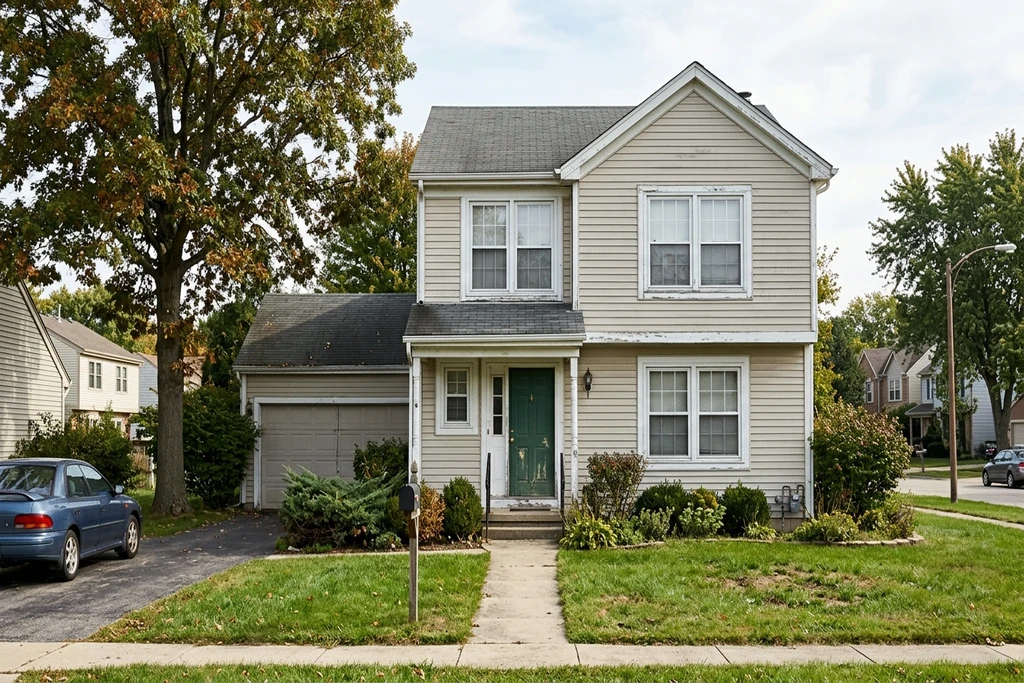
Real AI renders, your own photo, any shade
Try it on your house
No photo? Try a sample
Columbus painter wages and labor data (BLS, 2024)
Source: US Bureau of Labor Statistics, Occupational Employment and Wage Statistics (OEWS), May 2024. Wage figures are for the state as a whole; Columbus metro pricing typically tracks at or above the state mean.
Columbus climate and what it does to exterior paint
Humid continental climate (Koppen Dfa) with about 180 sunny days per year, 41.6 in of annual precipitation, and 28 in of snow. Summers are hot and humid, winters cold, and the spring and fall freeze-thaw swing is the defining stress on exterior paint.
The real enemy in Columbus is not UV but moisture and the freeze-thaw cycle. Water trapped in older wood siding or a hairline caulk gap freezes overnight in March and November, expands, and pops the paint film off in sheets the following spring. High summer humidity (annual mean near 70 percent) feeds mildew on shaded north walls, so quality exterior coats here carry mildewcide and crews prime bare wood the same day they scrape to keep moisture out.
Source: NOAA National Centers for Environmental Information, climate normals 1991 to 2020.
What Exterior Painting Actually Costs in Columbus in 2026
Columbus sits a little below the national average for exterior house painting, and the reason is straightforward: Ohio labor is cheaper than the coasts and the dominant substrate (wood siding and brick rather than stucco) needs less specialty product. Most Columbus homeowners on a 1,800 to 2,400 sq ft single-family home land in the $3,400 to $9,800 band for a two-coat acrylic system, which works out to roughly $1.80 to $4.20 per square foot of wall area. The spread inside that band is wide because prep, not paint, drives the bill here. A 1990s vinyl-sided home in Hilliard or Westerville that only needs a wash and a refresh sits at the low end. A 1915 wood-sided four-square in Clintonville or German Village that needs scraping, lead-safe containment, spot priming, and full caulk replacement climbs toward the top. Two-story homes add staging and rigging time, and a detached garage or wraparound porch each add a few hundred dollars. Because the painting season is compressed into roughly seven warm months, the best Columbus crews book out by April, so collecting quotes in late winter usually buys both a better calendar slot and a sharper price.
The Freeze-Thaw Cycle Is the Real Story in Central Ohio
San Diego paint dies of sunburn. Columbus paint dies of water and ice. The metro logs about 41.6 inches of precipitation and 28 inches of snow a year, and the single most destructive force on a painted exterior is the freeze-thaw swing across March, late autumn, and any January thaw. Moisture wicks into a hairline crack in old wood siding or a tired bead of caulk during a rainy afternoon, the temperature drops below freezing overnight, the trapped water expands roughly nine percent, and it levers the paint film away from the wood. Repeat that a few dozen times across a winter and south-facing trim that looked fine in October is flaking by April. This is why a competent Columbus painter spends real time on the boring parts: cutting out and re-caulking every joint, back-priming exposed wood, and never painting a wall that has not had at least two dry days to release moisture. NOAA places the metro in USDA hardiness zone 6a, which is shorthand for a genuine winter, and the paint spec has to respect that.
Humidity, Mildew, and the North-Wall Problem
Columbus summers are hot and sticky, with average relative humidity near 70 percent and dewpoints that sit in the 60s for weeks in July and August. That humidity, combined with the heavy tree canopy in neighborhoods like Upper Arlington, Bexley, and Worthington, creates the classic central Ohio failure: a green-black film of mildew on shaded north and east elevations while the sunny south wall still looks clean. The fix is product selection, not pressure. Reputable crews here specify a 100 percent acrylic exterior with a mildewcide package (Sherwin-Williams Duration or SuperPaint, or Benjamin Moore Aura and Regal Select are the lines most often pulled from the local stores) and they treat existing mildew with a cleaning solution before priming rather than painting over it, because mildew grows straight through a fresh coat if it is sealed in alive. Gutter and downspout condition matters too: a leaking gutter keeps a fascia board permanently damp, and no paint system survives standing water.
Brick, Wood, and the German Village Rule You Cannot Ignore
Columbus housing stock skews older than the Sun Belt metros, and the substrate mix changes how a quote is written. Pre-war neighborhoods run heavily to painted wood clapboard and original brick, while the suburban ring from the 1980s onward is mostly vinyl and aluminum siding with brick fronts. The single most important local rule: in the German Village Historic District, the German Village Commission generally does not permit painting original unpainted brick, and exterior color and material changes in that district (and in Victorian Village and Italian Village) require commission review before a brush touches the wall. If your home predates 1978, which covers most of Clintonville, German Village, Olde Towne East, and the older pockets of Bexley, the paint very likely contains lead, so federal EPA Renovation, Repair and Painting (RRP) rules apply and your contractor must be Lead-Safe certified. Ask to see the RRP certification card; it is not optional on those homes, and Ohio also runs a Lead Abatement Tax Credit that can offset remediation on qualifying older properties.
HOA Color Approval in Tartan Fields, New Albany, and Jerome Village
If your home sits inside a Columbus-area HOA, color is a committee decision, not a personal one. In Tartan Fields in Dublin, the Architectural Review Board steers homeowners toward earth-tone and gray bodies that let individual houses blend into the whole, actually prefers stains to paints on some surfaces, and charges a modest fee for an exterior paint submission, with electronic submissions accepted. New Albany is stricter still: the New Albany Communities Master Association enforces a tight American Georgian aesthetic, and its review committee requires matching materials and approved colors so that no single repaint breaks the white-trim, brick-body continuity the community is known for. Jerome Village, the 2,000-acre master plan on the northwest edge of Dublin, runs exterior changes (including any repaint or material change) through a Design Review Board with a written approval step before work starts. In every case, sending the committee a realistic mockup of the proposed color on your actual house, rather than a paper chip, shortens the back-and-forth, which is why a lot of local owners run their two or three finalist colors through the FacadeColorizer exterior paint visualizer before they fill out the architectural request form.
When to Paint in Columbus: The Seven-Month Window
Unlike the year-round metros, Columbus has a hard painting season. The reliable window runs roughly mid-April through mid-October, when daytime temperatures hold above the 50 deg F floor most acrylics need to cure and overnight lows stay above freezing. May, June, September, and early October are the sweet spots: warm, lower humidity than midsummer, and long dry stretches. July and August work fine but the afternoon humidity slows cure and the occasional pop-up thunderstorm can interrupt a wall mid-coat, so crews often start at dawn. The shoulders are where homeowners get burned. A warm spell in late March or early November tempts people into painting, but a single freezing night before the film has fully cured ruins adhesion, and once mid-November arrives the freeze-thaw risk makes exterior work a gamble. Because the calendar is genuinely tight, the good crews fill up fast; booking in February or March for a May start is the move, and it usually comes with better pricing than a panicked June phone call. One local quirk worth planning around: Ohio State home football Saturdays in the fall snarl traffic and parking across the central neighborhoods, so crews near campus, Victorian Village, and the Short North often schedule around the game calendar, and a Saturday start date can quietly slip.
Where Columbus Painters Buy: High Street and Dublin
Knowing where a crew sources its paint tells you something about the job. The Sherwin-Williams store on North High Street in Clintonville (5340 N High St) is a workhorse for contractor accounts and stocks Duration, SuperPaint, and Emerald, the lines most often specified on Columbus wood and fiber-cement siding. A few blocks south, Creative Paints at 4738 N High St is the local Benjamin Moore retailer, the place to go for Aura, Regal Select, and the Historical color collection that several area HOAs reference by name. On the northwest side, the Sherwin-Williams on Hospital Drive in Dublin (7044 Hospital Dr) serves the Dublin, New Albany, and Jerome Village trade. Most established painters hold a contractor account at one of these with a trade discount in the 25 to 35 percent range, and that discount flows through to your quote, so it is fair to ask which store and which product line a bid is built on. A vague answer about generic paint is a flag; a specific product line with a stated number of coats is what you want. It is also worth asking whether the bid includes spot-priming bare wood and a separate primer on raw fascia and trim, because on the older Clintonville and German Village stock those primer steps, not the topcoat, are what decide whether the job lasts eight years or starts peeling in three.
Top Columbus HOAs with exterior color approval rules
Before painting, confirm your HOA palette and submit your color selections to the architectural review committee. Most Columbus HOAs respond within 14 to 21 days.
Paint stores near Columbus
Painter licensing in Ohio
Ohio does not issue a statewide painting contractor license: the Ohio Construction Industry Licensing Board (OCILB) only licenses specific trades (HVAC, electrical, plumbing, refrigeration, hydronics), and painting is not one of them. Painters are regulated locally instead, so a legitimate Columbus crew registers with the city or Franklin County as a contractor and carries general liability plus workers compensation. Always ask for the insurance certificate and local registration rather than a state license number, because no state painting license exists to verify.
Frequently asked questions about Columbus exterior painting
How much does it cost to paint a house exterior in Columbus in 2026?
Most Columbus single-family homes run $1.80 to $4.20 per square foot for a two-coat acrylic system, putting a typical 1,800 to 2,400 sq ft home in the $3,400 to $9,800 band. Older wood-sided homes in Clintonville or German Village cost more because of scraping, lead-safe prep, and full caulk replacement, while newer vinyl-sided suburban homes sit at the low end.
Do Columbus painters need a license?
Ohio has no statewide painting license: the Ohio Construction Industry Licensing Board only licenses trades like HVAC, electrical, and plumbing. Painters register locally with the city or Franklin County instead. Ask for the local contractor registration, a general liability certificate, and workers compensation rather than a state license number.
What is the best time of year to paint a house exterior in Columbus?
Mid-April through mid-October is the reliable window, with May, June, September, and early October the best for low humidity and dry stretches. Avoid the early-spring and late-fall shoulders: a single freezing night before the paint cures ruins adhesion thanks to the central Ohio freeze-thaw cycle.
Can I paint the brick on my German Village home?
Usually not. The German Village Commission generally does not allow painting original unpainted brick, and exterior color or material changes in German Village, Victorian Village, and Italian Village require historic commission review before work begins. Submit your plan and proposed colors for approval first, and use a visualization mockup to speed the review.
Want a deeper cost breakdown? Read our 2026 Columbus cost guide .
House painters in nearby metros
Popular exterior colors for Columbus homes
In Columbus's cold-winter climate, timeless grays, deep navy and barn red suit brick and clapboard exteriors.
Browse painting costs in other metros: all US city guides.