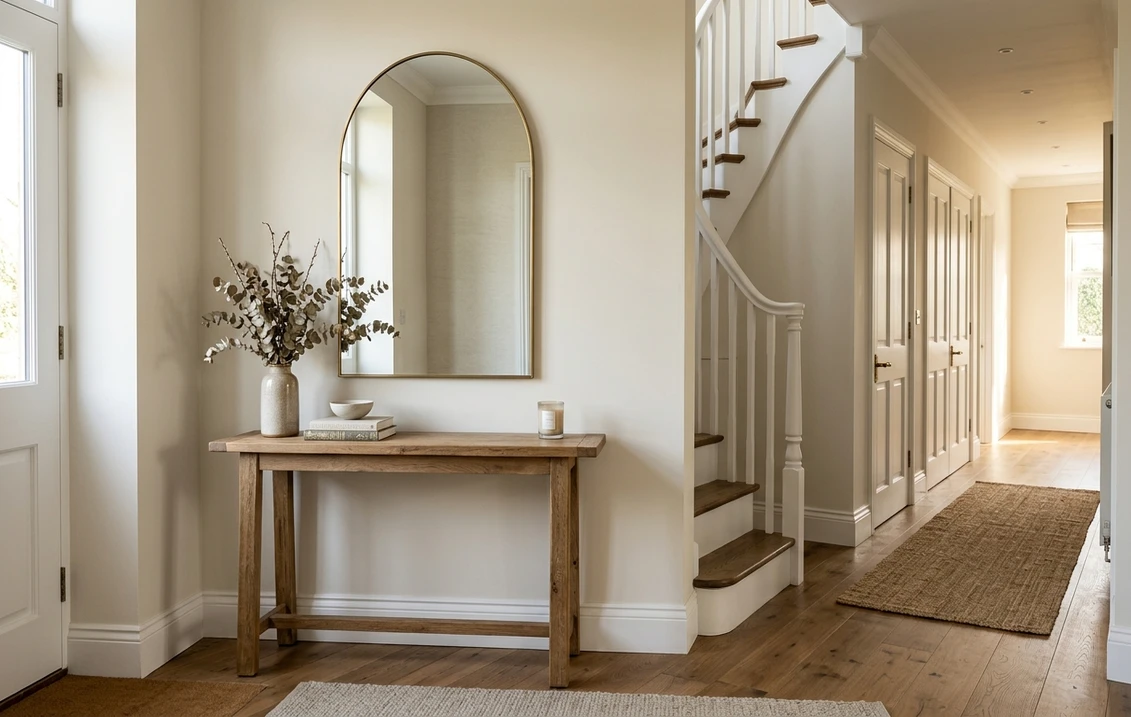
Try it on your room

A hallway is the one room in a British house that is painted for borrowed light: there is rarely a window, the daylight arrives through a fanlight or the glazed front door, and the walls take coats, bags and bicycle handlebars every day. This guide lists fifteen hallway paint colours for UK homes in 2026 with the makers' own descriptions rather than numbers they do not publish, says what Dulux itself recommends for a dark hall, explains why the durable finish matters more here than anywhere else, and gives the coverage figures that turn a shortlist into a shopping list.
Why hallway colour selection is harder than any other room
Three things make the hall different. First, the light is borrowed and changes hourly, so a colour that is warm at nine in the morning can read grey by four in the afternoon. Second, the proportions are usually long and narrow, which exaggerates any dark colour. Third, the walls get touched: Dulux's own advice for halls and stairs is blunt about it, calling them high-traffic areas that need a durable paint and recommending its Easycare range for the job (Dulux, how to brighten dark hallways and stairs). So the choice is not only a colour but a finish, and the two decisions are made together.
One honest note on numbers. Many hallway guides rank colours by light reflectance value. Farrow & Ball does not publish an LRV on any of its colour pages, and Dulux's colour articles do not quote one either, so any figure attached to Wimborne White or Skimming Stone is a third-party measurement. This guide uses the makers' descriptions instead; where a figure matters, such as coverage per litre, it comes from a data sheet and is linked.
Dulux hallway colours: what Dulux itself recommends
Dulux publishes two hallway guides, and between them they name the colours it would put in a hall. For a dark or narrow hallway the Dr Dulux article says "A light grey like Rock Salt will lend your hallway a contemporary feel", that "Gentle Fawn is good because it doesn't draw too much attention to itself", and offers "a peachy pastel – Soft Peach, for example – as a playful alternative". Its trick for depth is to "paint the inside of your front door in a fresh, vibrant shade like Mineral Mist" and continue the colour across the ceiling, and for the stairs it suggests "a flourish of colour like Banana Dream 3" on the risers.
The hallway ideas article adds the rest of the Dulux list: "One of our favourite hall paint colours is Banana Split", an ombré staircase with "Banana Dream 3 in-between Polished Pebble", Denim Drift for an under-stairs study nook ("a sophisticated and secluded space that aids concentration"), Brave Ground with Coastal Grey as the alternative pairing, White Mist "to open it up" in a small hall, Mineral Mist as "a soothing paint shade" for a coat-rack wall, and skirting in Pure Brilliant White "for a crisp finish" (Dulux, hallway colour ideas). Dulux Heritage, the period range, publishes four complete schemes of its own: York White below and Grecian White above for a light hall, Ravens Flight below with Forest Grey above for a dark one ("This luxurious cool black, when paired with Forest Grey, creates a striking and dramatic statement"), Roman White with Brushed Gold or Raw Cashmere on the lower wall, and Waxed Khaki with Midnight Teal, "a very deep and seductive shade that lends a certain grandeur and substance to a space" (Dulux Heritage, hallways 4 ways).
The top 15 hallway paint colours for UK homes in 2026
Fifteen colours, each with a maker's page behind it and the hall it suits. The Farrow & Ball descriptions are quoted from the colour pages; the Dulux and Dulux Heritage entries come from the two guides above.
| # | Colour | What the maker says | Best for |
|---|---|---|---|
| 1 | F&B Wimborne White No. 239 | "Only a shade away from a pure white", with "the smallest amount of warm yellow pigment"; complementary white All White | End wall of a narrow hall, ceilings, cornices |
| 2 | F&B Skimming Stone No. 241 | "This stony off white", with "warm light grey undertones" | North-facing, narrow, Edwardian |
| 3 | F&B Setting Plaster No. 231 | "A dusty plaster pink", "a certain softness to it due to the inclusion of yellow pigment"; complementary white School House White | North-facing Victorian terrace, with Minton tiles |
| 4 | F&B Cromarty No. 285 | "This very light green grey", "neither too green nor too grey"; complementary white School House White | South-facing, larger halls, original timber |
| 5 | F&B Pavilion Gray No. 242 | "This classic mid grey", "the subtle blue undertones of Pavilion Gray add a contemporary touch"; complementary white Blackened | South-facing, medium, Edwardian |
| 6 | F&B Slipper Satin No. 2004 | A traditional off-white from the maker's range | Small period halls, above a dado |
| 7 | F&B Hague Blue No. 30 | A deep, dramatic blue from the maker's range | Below the dado, panelling, spindles |
| 8 | F&B Green Smoke No. 47 | A smoky, blue-toned green from the maker's range | Panelling and banisters in a wide period hall |
| 9 | Dulux Rock Salt | "A light grey like Rock Salt will lend your hallway a contemporary feel" | Dark halls, modern joinery |
| 10 | Dulux Gentle Fawn | "Gentle Fawn is good because it doesn't draw too much attention to itself" | Dark halls, any period, family use in Easycare |
| 11 | Dulux White Mist | "Select a shade such as White Mist to open it up" | Small halls |
| 12 | Dulux Mineral Mist | "A soothing paint shade"; also Dulux's pick for the inside of the front door and the ceiling | Coat-rack wall, front door, ceiling |
| 13 | Dulux Denim Drift | "A sophisticated and secluded space that aids concentration" | Under-stairs nook, lower wall |
| 14 | Dulux Heritage York White and Grecian White | "A timeless neutral colour scheme", lower and upper wall | Light period halls |
| 15 | Dulux Heritage Ravens Flight and Forest Grey | "A striking and dramatic statement" | Wide halls with a strong sidelight |
Try it on your house
No photo? Try a sample
Little Greene's French Grey Pale (161) and Wood Ash (229) belong on the same shortlist for period halls, as a pale warm grey and a deep grey-green respectively; the maker's site blocks automated checks, so they are named here without a link rather than described second-hand.
Solving the north-facing hallway problem
A north-facing hallway in a typical UK terrace receives a cool daylight all year. Pair that aspect with a brilliant white and the walls look cold by mid-afternoon. The fix is not to chase brightness with cooler whites but to lean into warm whites and soft plasters with a yellow or pink undertone, which is exactly what the makers' descriptions point to: Wimborne White's "warm yellow pigment", Setting Plaster's "inclusion of yellow pigment", and on the Dulux side Gentle Fawn and Soft Peach, the two the Dr Dulux article offers for a dark hall. For drama without losing the light, keep the warm white above the dado and put Hague Blue or Green Smoke below it, where the panelling also hides the scuffs from coats and bags.
The long narrow hallway: end-wall and lighter end trick
If the hall is more than three times longer than it is wide, as most London and Manchester terraces are, it reads as a tunnel. The decorator's trick is to paint the far end wall a step lighter or warmer than the side walls: Skimming Stone on the sides, Wimborne White at the end, or Gentle Fawn with White Mist. Dulux's version of the same idea runs the front door colour across the ceiling, so the eye travels the length of the hall in one colour. Painting the end wall darker only works in halls wide enough to stand back from it. A second move is to carry the same skirting and architrave colour through every doorway; stop-start trim chops the corridor into segments, a continuous line lengthens it.
Edwardian and Victorian terraces with original Minton tile floors
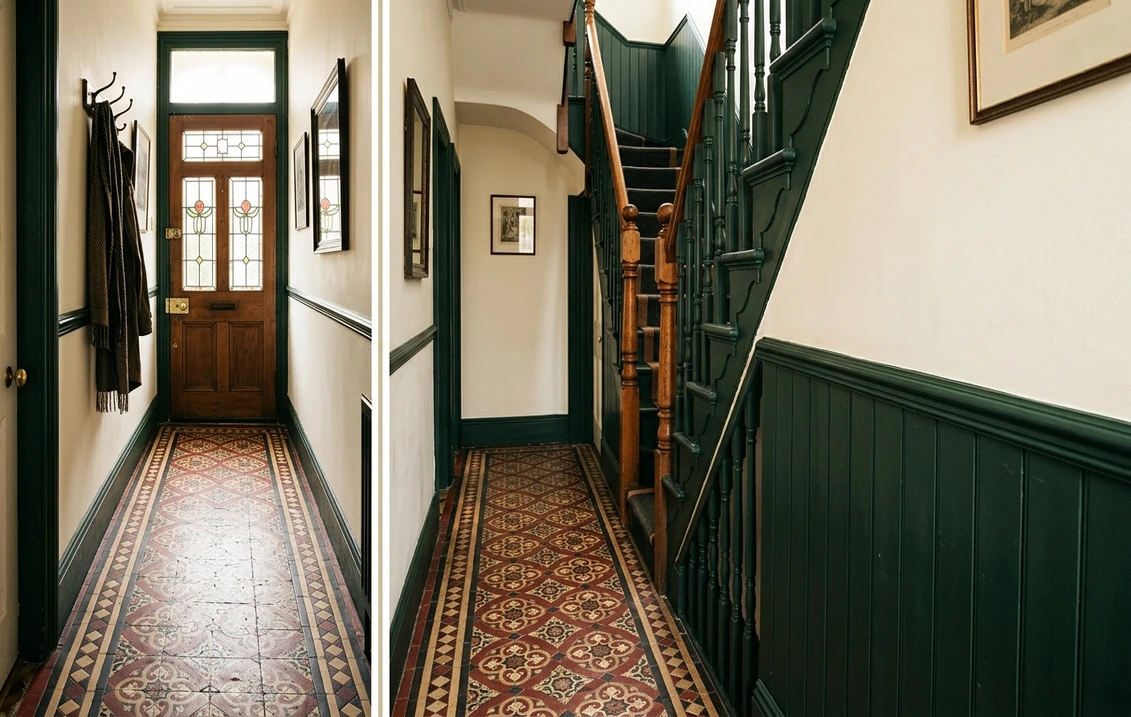
If you have an original encaustic tiled floor, the floor sets most of the colour story and the walls must support it rather than compete. Match the wall undertone to the warmest tone in the tiles, not to the black or grey lines. With red, cream and black tiles, Skimming Stone or Setting Plaster above and a Hague Blue or Green Smoke dado below keep the floor in charge; with ochre and terracotta tiles, Setting Plaster's dusty pink echoes the clay; with green and cream tiles, Cromarty's "very light green grey" sits inside the same family. Avoid cool greys and brilliant whites with these floors: they make the glaze read orange. Our period property interior colours guide covers the rest of the house.
The half-painted banister rail
The scheme that photographs best in a period hall is the half-painted staircase: spindles and string in the dado or panelling colour, the handrail left in waxed or oiled timber or painted a third colour. Hague Blue spindles with an oiled oak rail, Green Smoke spindles with a waxed pitch-pine rail on an Edwardian original, or a pale grey staircase with a matt black rail. It works because the handrail is the only part of the stair the eye and the hand actually meet; giving it a different finish flatters the architecture and stops painted spindles from looking heavy. It is also a forgiving job: the handrail takes an afternoon including masking, and a single sample-sized tin covers a flight.
The finish matters more than the colour: what the Easycare data sheet says
Because the hall takes the most knocks in the house, the product is half the decision. Dulux's data sheet for Easycare Washable & Tough Matt (issued 09/25) describes "a stain repellent, grease proof, and washable paint" that "will withstand repeated washing", suitable for kitchens, with a matt sheen under 10%, an acrylic copolymer binder, a practical coverage of "up to 13m² per litre", touch dry in 1 to 2 hours and a recoat time of 2 to 4 hours, applied by brush or roller and not below 7°C (Dulux, Easycare Washable & Tough technical data sheet). The sheet also says "the normal finishing process is two full coats", with one coat possible over a sound similar colour, and tells you to buy all the tinted paint for a job at once from the same place for colour consistency. Two limits on the same sheet: "Chemical Resistance: Not suitable" and not for heated surfaces such as radiators.
Farrow & Ball's equivalent decision is between Estate Emulsion and Modern Emulsion for the walls, with the eggshell finishes on woodwork; whichever brand you choose, the hall is the room to pay for the washable grade and to put the eggshell on the dado and spindles. The conservatory paint guide walks through a full data sheet line by line for the room that destroys a weak paint film fastest.
How much paint a hallway needs
On the Easycare figure of up to 13 m² per litre and two coats, the sums are short. A small terrace hall with about 30 m² of wall needs 4.6 litres, so one 5 litre tin; a hall with stairs and landing of about 50 m² needs 7.7 litres, so a 5 litre tin and a 2.5 litre tin; a large or double-height hall of 80 m² needs just over 12 litres, so two 5 litre tins and a 2.5 litre. Porous or freshly plastered walls take more, and the sheet asks for a thinned first coat on new or bare surfaces. Buy the lot in one order, as Dulux advises, and keep the leftover for the touch-ins a hallway always needs. For what a decorator charges to put it on, our interior decorator cost guide has the day rates by region; the home office colours guide is the companion for the room most halls lead to.
How to test a colour before you commit
Hallway colours shift more than any other room because the light is borrowed and changes hourly. Three stages: first a digital test, uploading a photo of the hall and trying every shortlist colour against the real floor and trim; then one sample pot per finalist, two coats on A2 card, moved around the hall across a full day; then a square metre on the wall itself, next to the front door and at the far end, before the tins are ordered.
Sources and references
- Dulux, Hallway colour ideas: Banana Split, Banana Dream 3, Polished Pebble, Denim Drift, Brave Ground, Coastal Grey, White Mist, Mineral Mist, Pure Brilliant White.
- Dulux, How to brighten dark hallways and stairs: Rock Salt, Gentle Fawn, Soft Peach, Mineral Mist, Easycare recommendation.
- Dulux Heritage, Hallways 4 ways: the four published schemes and their colours.
- Dulux (AkzoNobel), Easycare Washable & Tough technical data sheet (09/25): properties, coverage, drying and recoat times, coats, limits.
- Farrow & Ball colour pages: Wimborne White, Skimming Stone, Setting Plaster, Cromarty, Pavilion Gray, Slipper Satin, Hague Blue, Green Smoke: descriptions and complementary whites; none publishes an LRV.
Frequently asked questions
What is the best paint colour for a north-facing hallway in the UK?
Which Dulux colours are recommended for hallways?
How do I make a long narrow hallway look wider?
Which hallway colours work with original Minton tile floors?
Which paint finish should I use in a hallway?
How much paint does a hallway need?
Trademarks mentioned (Sherwin-Williams, Benjamin Moore, Behr, Caparol, Brillux, Sto, Alpina, Valspar, PPG, Glidden, Dulux, Crown Trade, Sandtex, Farrow & Ball, Johnstone's, Leyland) are property of their respective owners. FacadeColorizer is independent and not affiliated with any of them. Nominative fair use under Lanham Act §1125.