Try it on your room

If you own a pre-1919 cottage, a listed building, or any solid-wall property in the UK, modern acrylic emulsion is quietly working against you. It traps moisture, blisters off damp walls and starves old timber and lime plaster of the air it needs. Interior lime wash paint is the breathable, zero-VOC, mineral finish that Georgian and Victorian decorators took for granted and that heritage specialists have rediscovered.
This 2026 guide explains exactly what lime wash is, why its Sd value below 0.05 metres matters for solid walls, how to apply it without streaks (or how to celebrate the streaks), which brands are worth buying in the UK, and the properties where you should not use it at all.
Before committing to a chalky bone white or a ferrous-oxide ochre, try our free AI interior colour visualiser to see how any lime-wash shade sits on your actual walls.
What Lime Wash Actually Is
Lime wash (also called limewash or whitewash) is one of the oldest architectural paints in Europe. The recipe is brutally simple: calcium hydroxide (slaked lime putty or hydrated lime) suspended in water, tinted with natural mineral pigments such as yellow ochre, raw umber, red oxide or terre verte. There are no acrylic binders, no plasticisers, no biocides and no petrochemical solvents.
Once applied, the calcium hydroxide reacts with carbon dioxide in the air and reverts back to calcium carbonate, effectively microscopic limestone. The film becomes part of the wall rather than a skin stuck on top. That is why genuine lime wash on a lime-plastered cottage can last 40 to 80 years with occasional refresher coats, while cheap emulsion on the same wall can fail inside five.
Breathability: the Sd value below 0.05 m
Breathability in paint is measured by Sd value (water-vapour diffusion-equivalent air layer thickness). The lower the number, the more easily the wall can dry to the inside. For a solid-wall pre-1919 property, Historic England guidance recommends finishes with an Sd below 0.1 m, ideally below 0.05 m. Quality lime wash typically sits around Sd 0.01 to 0.03 m, while standard vinyl matt emulsion is around Sd 0.4 m, roughly 20 times less breathable.
That is not a technicality. Trap moisture behind a plastic film on a soft lime wall and you get salting, blown plaster, rotting skirting boards and black mould. Lime wash lets the building behave the way its 19th-century builders designed it to behave.
Antimicrobial and zero-VOC
Fresh lime wash has a pH of roughly 12 to 13. That high alkalinity is naturally antimicrobial, inhibiting mould, mildew, bacteria and dust mites, useful in Victorian bathrooms, old larders and any room prone to cold-surface condensation. It is also genuinely zero-VOC, with no off-gassing, making it a sensible choice for bedrooms, nurseries and households with asthma or chemical sensitivities.
Four Lime Wash Brands Compared for UK Interiors
Not all lime washes are equal. Some are genuine slaked-lime recipes; others are hybrid acrylic-lime products that mimic the look without the breathability. The four brands below are the ones heritage decorators specify most often on UK projects in 2026.
| Brand | Type | Breathability (Sd) | Price per m² | Best for |
|---|---|---|---|---|
| Bauwerk Colour | Genuine mineral lime wash | ~0.02 m | £12 – £18 | Designer interiors, rich colour palette |
| Limestrong | Hydraulic-lime based, UK-made | ~0.03 m | £10 – £14 | Listed buildings, harder surfaces |
| Old Village Lime Wash | Traditional putty lime wash | ~0.01 m | £8 – £12 | Cottages, barns, outbuildings |
| Little Greene Intelligent ABS | Modern breathable silicate hybrid | ~0.05 m | £14 – £18 | Kitchens and bathrooms in period homes |
Try it on your house
No photo? Try a sample
Three quick notes. Bauwerk Colour has become the celebrity-decorator favourite for the deeper earth tones; expect to pay for coverage as it takes four to five coats. Limestrong, made in the Cotswolds, is a pragmatic choice for working listed buildings. Old Village is the most traditional recipe and the most forgiving for barns, cottage kitchens and utility rooms. Little Greene Intelligent ABS is not a true lime wash but a highly breathable acrylic-siloxane product: useful where you need the wipeable resilience of modern paint with most of the vapour openness of lime.
See any lime wash shade on your own room photo, no sample pots required
Application Technique: How to Apply Lime Wash Properly
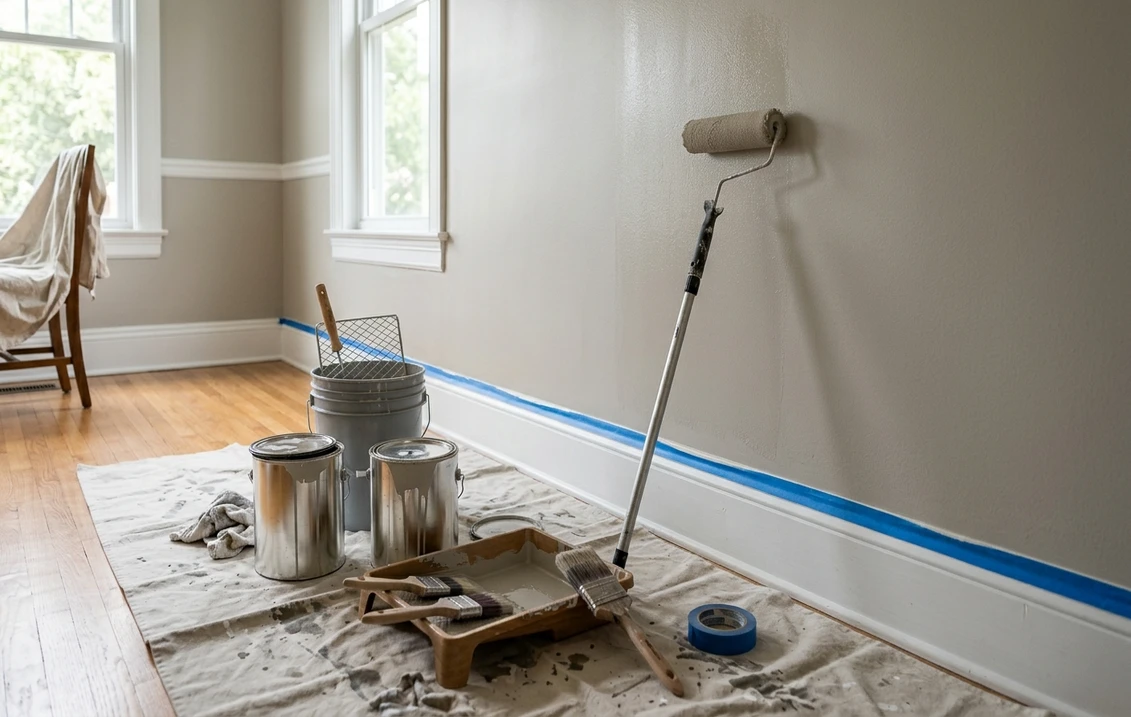
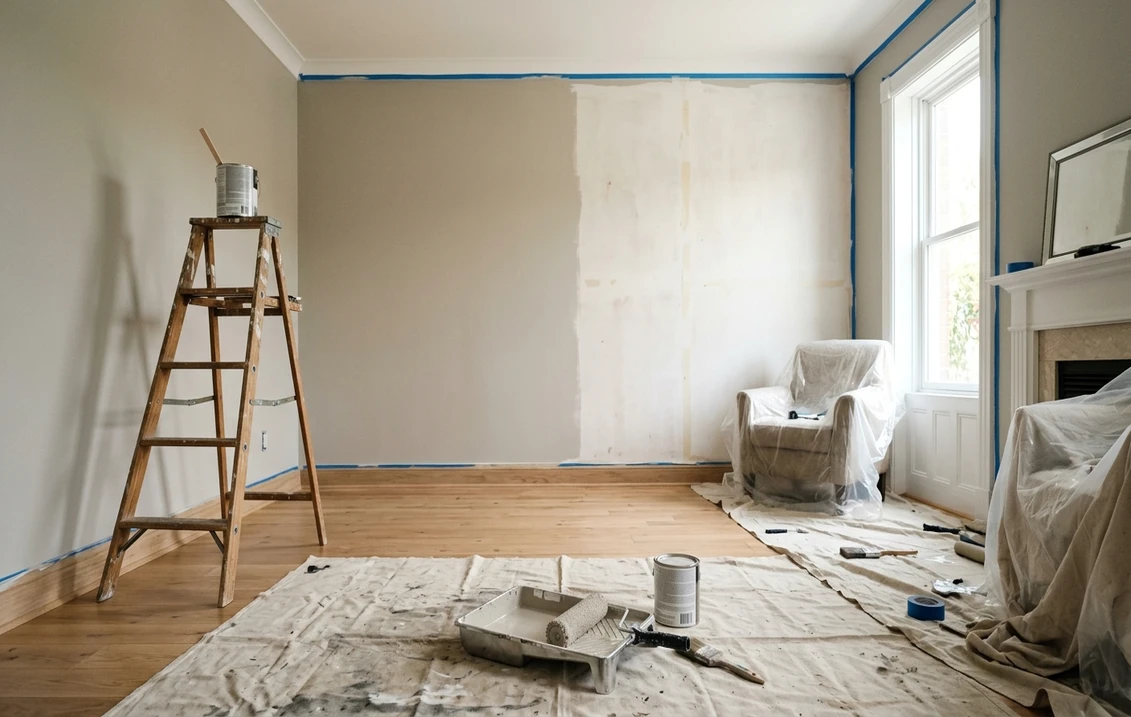
Applying lime wash is closer to watercolour than to modern painting. It is thin, translucent, goes on looking alarmingly patchy and only reveals its character after drying and carbonating. Here is the technique UK heritage decorators use.
1. Preparation: damp, porous, mineral
Lime wash needs a mineral, porous, absorbent substrate: lime plaster, earth plaster, bare brick, limestone, soft stone or a previous lime-washed surface. Vacuum the wall, brush off loose material, repair any defective lime plaster first, then mist-spray the wall with clean water 15 to 30 minutes before painting. A damp wall slows suction and stops the first coat flashing off and powdering away.
2. Stir constantly, apply thin
Pigment settles fast. Stir the bucket every few minutes, not just at the start. Use a wide natural-bristle block brush (150 to 180 mm) rather than a roller. Load lightly and apply in random, criss-cross strokes, never stripes. Each coat should look almost too thin, like cold tea. If it looks like emulsion, you are putting it on too heavily and it will craze as it dries.
3. Multiple coats, 12–24 hours apart
Plan for four to six coats on a previously unpainted wall, two to three on a refresh. Leave 12 to 24 hours between coats so each layer can start carbonating. The colour looks bleached and unfinished until coat three or four, resist the urge to pile it on. Work in temperatures between 8 °C and 25 °C, out of direct sun and strong draughts, which dry the film too fast and cause chalking.
4. Embrace the streaky, cloudy look
A properly applied lime wash is never perfectly flat. It has a soft, cloud-like movement, with faint brush marks and gentle tonal shifts across the wall. This is the feature, not the bug: it is what gives lime-washed rooms their depth and their flattering, candlelit quality. Clients who want a dead-flat finish should not be sold lime wash, they want modern matt emulsion.
Colour Palette: Why Lime Wash Looks Earthy
Because lime wash is tinted only with alkali-stable mineral pigments, the achievable palette is narrower than modern emulsion, and that is precisely why it suits heritage properties. Expect chalky bone whites, warm limestone creams, clay ochres, putty pinks, soft sage greens, dusty terracotta, donkey browns, French blue and deep charcoal. Bright primaries and synthetic pastels are effectively impossible; vivid lemon yellow, neon pink or electric teal lie outside the chemistry.
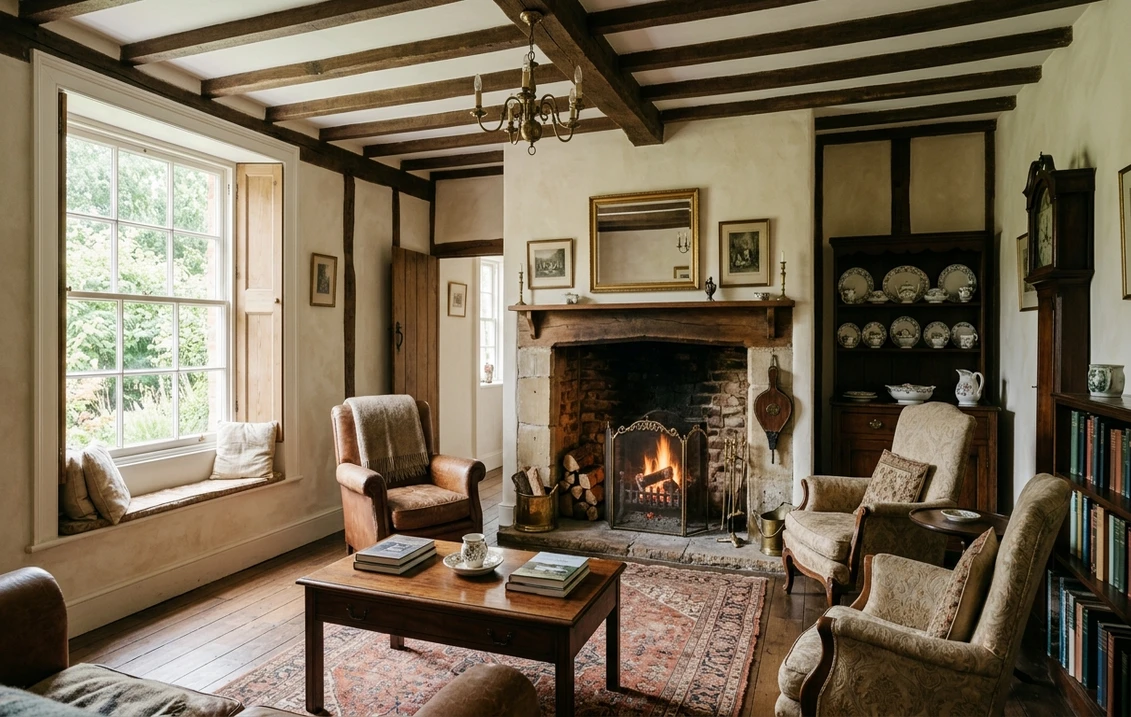
The upshot is a scheme that looks inevitable in an 18th-century farmhouse, a Georgian rectory or a Cotswold barn conversion. Pair lime-washed walls with unlacquered brass, oiled oak, linen, rush matting and wrought iron, and avoid glossy plastics, which fight the texture.
Cost of Interior Lime Wash in the UK
Budget in 2026 for £8 to £18 per m² for paint alone, reflecting the higher number of coats. A typical 20 m² bedroom (around 55 m² of wall) therefore uses £440 to £990 of paint. Add decorator labour at £180 to £350 per day and allow two to three days for a standard room including preparation, which adds £400 to £1,000 in labour.
That is roughly double the cost of a standard emulsion redecoration, but on a pre-1919 wall it typically lasts three to five times longer, does not trap damp, and is demonstrably the correct specification for a listed building. For current labour benchmarks see our interior decorator cost UK guide.
When NOT to Use Interior Lime Wash
Lime wash is a specialist product, not a universal upgrade. On the wrong substrate it will flake, powder or simply refuse to bond. Avoid it in the following situations.
- Modern plasterboard / drywall, gypsum is non-porous and slightly acidic; lime wash will chalk off. Use a breathable clay or mineral paint instead.
- Walls previously painted with vinyl or acrylic emulsion, lime wash cannot penetrate a plastic film. It must be mechanically removed first or you will get peeling.
- Gypsum plaster skim coats (common on post-1960 UK houses), unsuitable without a lime-based base coat.
- Very high-traffic surfaces, hallway dados, children’s rooms, or any wall that gets regularly wiped. Consider Little Greene Intelligent ABS or a clay paint for wipeability.
- Showers and wet-splash zones, lime wash is breathable but not waterproof. Use tadelakt or a tanked tile finish.
- MDF, timber or metal, lime wash needs a mineral substrate. For joinery in a heritage scheme, specify traditional linseed oil paint.
If you are unsure whether your wall is lime plaster or gypsum, scratch an inconspicuous spot with a coin: lime is softer and produces a slightly pinkish-buff dust; gypsum gives a pure white, chalky powder and is noticeably harder.
Heritage Applications: Listed Buildings and Pre-1919 Homes
Outside, the same material faces a harder test: external limewash is sacrificial and needs renewing regularly, it will not bond to hard cement render, gypsum, hard brick or sandstone, and on a listed building changing it for a masonry paint is unlikely to be accepted. The exterior comparison, with the mineral silicate alternative, is our limewash versus masonry paint guide for solid walls.
For Grade I and Grade II listed buildings, lime wash is often the only finish a conservation officer will accept on original lime-plastered walls. Listed Building Consent is normally required for any change of internal finish on a statutorily listed property; check with your local authority heritage team before stripping existing schemes.
For unlisted pre-1919 solid-wall cottages and Victorian terraces, lime wash is not legally required but is strongly recommended by Historic England, the SPAB (Society for the Protection of Ancient Buildings) and most specialist surveyors, especially where damp or salt contamination has been diagnosed.
Frequently Asked Questions
Is lime wash paint waterproof?
No. Lime wash is breathable, not waterproof. It tolerates occasional damp and will dry out again, which is exactly why it suits solid-wall heritage properties. For splash zones such as shower surrounds, bathroom ceilings or behind sinks, combine lime wash on the main walls with tiled splashbacks or a tadelakt finish in the wet area itself.
Can I use lime wash over existing emulsion?
Generally no. Vinyl and acrylic emulsions form a plastic film that lime wash cannot grip or penetrate, so it will flake. Your options are: (1) strip the emulsion mechanically or with a specialist breathable paint stripper, (2) replaster with a thin lime skim, or (3) switch product to a breathable silicate or clay paint formulated for previously painted surfaces, such as Little Greene Intelligent ABS. Always test a square metre first.
How long does interior lime wash last?
On a correctly prepared lime-plastered wall, interior lime wash typically lasts 15 to 40 years before a full redecoration is needed, with a refresher coat every 8 to 15 years if desired. Colour may deepen slightly with carbonation in the first few months and will gently age rather than chip. That compares with a realistic 5 to 10 years for vinyl emulsion on the same wall before visible failure.
Is lime wash safe for bedrooms and children’s rooms?
Yes. Once cured, lime wash is zero-VOC, fully inert and does not off-gas. Its natural alkalinity is antimicrobial, which is helpful for allergy-prone households. The only caveat is during application: wet lime wash is strongly alkaline and can irritate skin and eyes, so decorators wear gloves and goggles. Keep children out of the room until each coat has dried, which is usually 4 to 8 hours.
Test every lime wash tone on your own room photo in 30 seconds
Lime wash is not a nostalgic indulgence: on a pre-1919 solid-wall home it is usually the correct technical specification. Pair the right brand with proper preparation, four or more thin coats and an earth-toned palette, and you will have a finish that outperforms emulsion, protects the fabric of the building and looks unmistakably period. Sources: Historic England, SPAB, Bauwerk Colour, Limestrong, Little Greene technical data sheets.