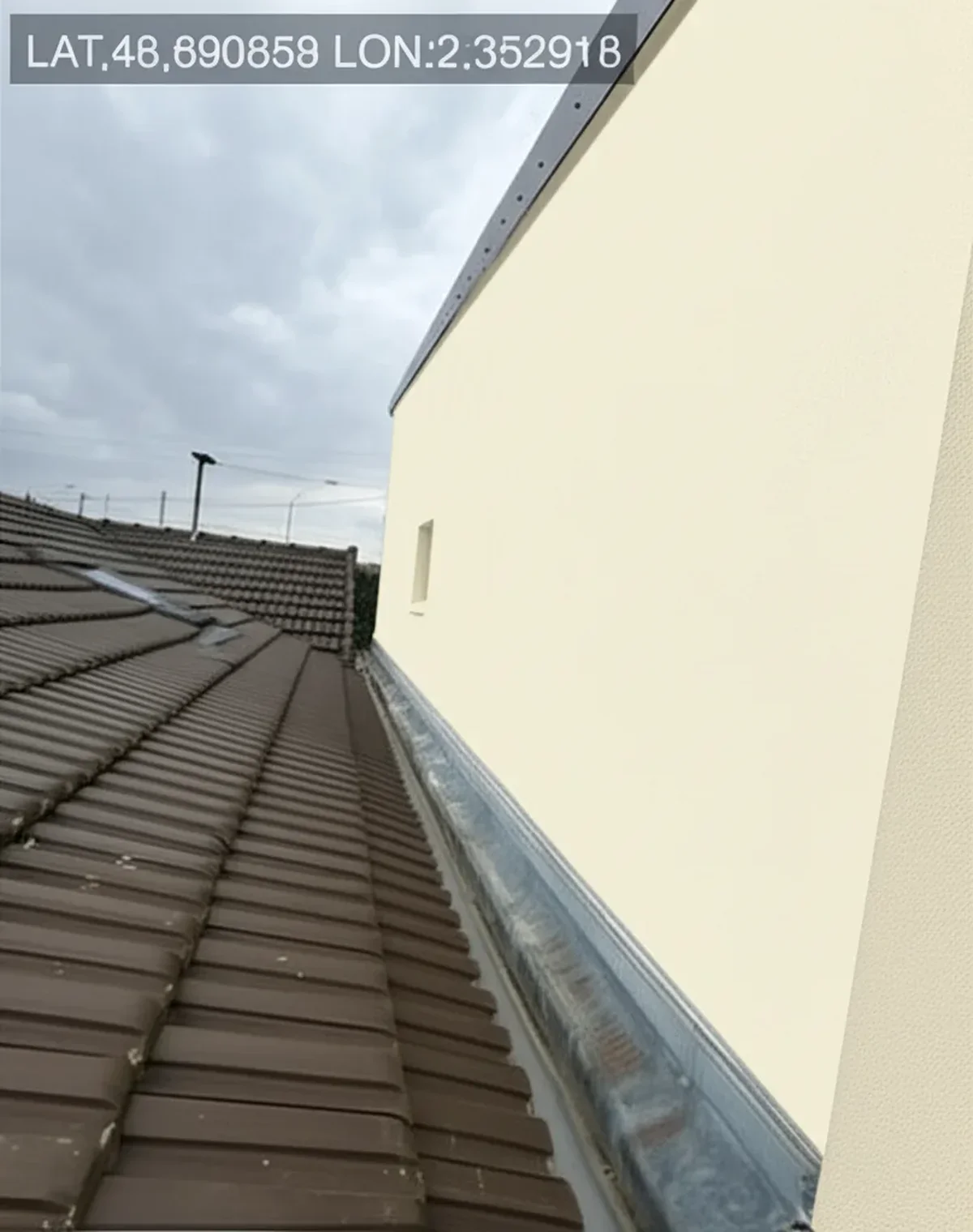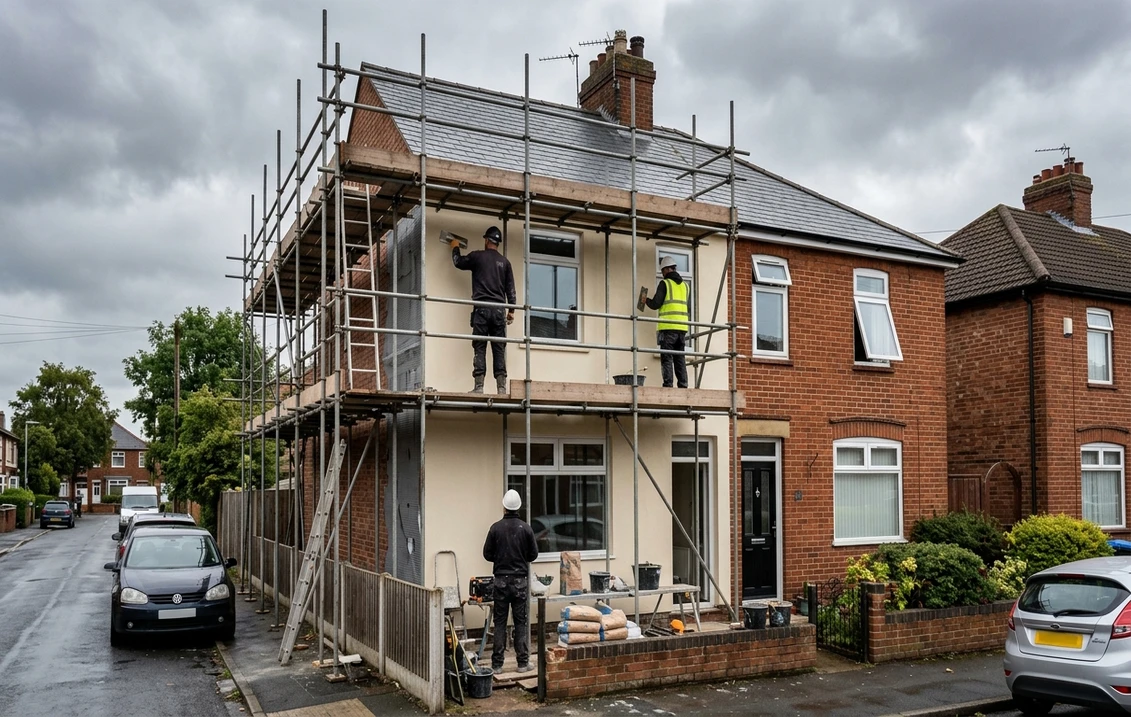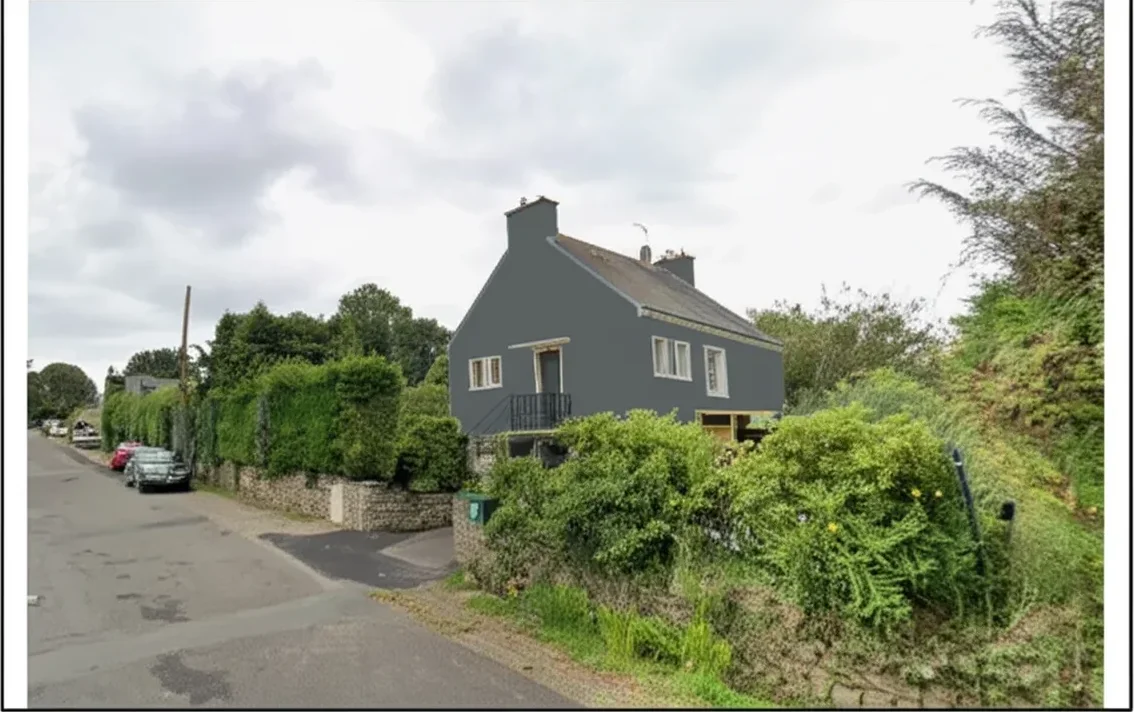
Try it on your house

Historic England estimates that roughly one in five pre-1919 UK homes has suffered structural damp or spalling because cement render was applied where lime should have been used. If you own a Victorian terrace, an Edwardian semi, or anything with solid walls, the choice between lime and cement render is not a matter of taste, it is a building-physics decision that will dictate the fabric's health for the next eighty years. Here is the technical comparison, with 2026 UK pricing and heritage guidance.
Lime vs Cement Render: The Full Comparison
| Criterion | Lime Render | Cement Render (OPC) |
|---|---|---|
| Breathability (vapour permeability) | Very high (mu value 8-12) | Low (mu value 35-100+) |
| Flexibility | Excellent, accommodates movement, self-heals hairline cracks | Rigid, prone to cracking and debonding |
| Cost per m² (supply + fit, 2026) | £45-£75 | £25-£40 |
| Lifespan | 80+ years (often 100+ when maintained) | 25-40 years |
| Application difficulty | High, specialist skills, slow set, weather-sensitive | Moderate, most general builders can apply |
| Best suited for | Solid-wall pre-1919 homes, listed buildings, conservation areas, cob, stone, soft brick | Post-1930s cavity-wall homes, blockwork, concrete substrates |
| Maintenance | Occasional limewash every 7-10 years; easy patch repairs | Low short-term; costly full replacement when failed |
| Carbon footprint | Low, reabsorbs CO₂ during carbonation (up to 80% of firing emissions) | High, Portland cement accounts for ~8% of global CO₂ |
| Damp risk on solid walls | Minimal, moisture evaporates outward | High, traps moisture, causes interstitial damp and frost damage |
| Compatibility with listed buildings | Approved by Historic England and SPAB | Usually refused by Listed Building Consent |
Try it on your house
No photo? Try a sample
Pricing sourced from Checkatrade (2026) and Federation of Master Builders rate cards. Breathability values per SPAB technical guidance.
When Lime Render Wins
A lime render only keeps its advantage if the finish on top breathes too: limewash or a mineral silicate paint rather than a resin masonry paint, which conservation officers describe as relatively unbreathable. Our limewash versus masonry paint guide takes the decision from the render to the coating.
If your home was built before 1919, which covers the majority of Victorian and Edwardian stock, along with Georgian, Regency, and most rural cottages, the walls are almost certainly of solid masonry construction. There is no cavity to block wind-driven rain, and the original mortar is soft lime. Such walls rely on a continuous cycle: moisture soaks in during wet weather and evaporates back out through the render. Lime render permits that exchange; cement render seals it shut.
The consequences of getting it wrong are not cosmetic. When cement render caps a solid wall, trapped moisture migrates inward, rotting timber lintels, blowing internal plaster, and accelerating frost damage behind the render itself. SPAB (the Society for the Protection of Ancient Buildings) has documented countless cases where stripping 1970s cement render and reinstating lime has reversed decades of "rising damp" that was actually trapped moisture.
Lime is also the only legally viable option for many properties. Listed buildings (Grade I, II* and II) almost always require lime, using cement without Listed Building Consent is a criminal offence under the Planning (Listed Buildings and Conservation Areas) Act 1990. Homes within conservation areas or subject to an Article 4 direction may also have their permitted development rights removed, meaning the local authority must approve render type and finish. Historic England's guidance is unambiguous: lime for pre-1919 fabric.
Finally, lime is kinder to the planet. As it carbonates, it reabsorbs a significant share of the CO₂ released during quarrying and firing, a property Portland cement cannot match.
When Cement Render Makes Sense
Cement render is not the villain it is sometimes painted. On the right substrate it performs admirably for decades. If your property is a post-1930s cavity-wall home, standard brick-and-block construction with an air gap and modern DPC, the wall already has built-in moisture management. The outer leaf does not need to breathe in the same way, and cement's compressive strength and weather resistance become genuine advantages.
Cement also wins on budget. At £25-£40 per square metre supplied and fitted (Checkatrade, 2026), a typical three-bed semi can be fully rendered in OPC for £3,500-£5,500, compared with £6,500-£10,000 for lime. For landlords, budget refurbishments, and modern extensions, the sums can be decisive.
Modern polymer-modified cement renders (K Rend, Weber, Parex) further narrow the gap, offering improved flexibility and a wide palette of through-coloured finishes. For blockwork garages, rendered concrete retaining walls, or a 1990s new-build needing a facelift, these systems are often the pragmatic choice.
Speed is the other practical factor. Cement render cures predictably within 24-48 hours per coat and can be applied from March to November in most of the UK. Lime, by contrast, carbonates slowly and is intolerant of frost, meaning most heritage specialists restrict application to April-October. If you have a tight completion deadline on a non-heritage property, cement's forgiving timeline is a genuine advantage.
Where cement is the wrong choice: every time
Never specify cement render on cob, rubble-filled stone walls, soft handmade brick, or any wall with a lime mortar bed. The mismatch in permeability and rigidity will cause the render to debond within a decade, usually taking chunks of the original fabric with it when it falls. The Federation of Master Builders now routinely advises members to refuse cement-on-heritage jobs to protect their professional indemnity cover.
Our Verdict: The Rule of Thumb
The simplest heuristic we give clients is the 1919 rule: if the house predates 1919, specify lime. If it was built from the 1930s onwards and has cavity walls, cement (or a polymer-modified equivalent) is acceptable. Inter-war homes (1919-1935) fall into a grey zone, check the wall construction with a borescope or invasive survey before deciding.
Yes, lime costs roughly double. But amortised over its 80-year lifespan versus cement's 30, lime is the cheaper option per year of service, and that is before you count the avoided damp-repair bills, the protected heritage value, and the possibility that unapproved cement on a listed building could force costly removal under a Listed Building Enforcement Notice.
A final word on specification. If you choose lime, ask your contractor whether they are quoting NHL (natural hydraulic lime) or hot-mixed lime putty. NHL 3.5 is the most common modern product, suitable for most sheltered walls. Hot-mixed lime, traditional quicklime slaked on site, is softer, more breathable, and the correct specification for Grade I and II* listed work. If you choose cement, insist on a polymer-modified product with a recognised BBA certificate and confirm that the contractor is installing bell-cast beads, expansion joints, and a proper scratch coat rather than skimming over bare blockwork.
Once you have settled on the right render, the next question is colour. Whether you are limewashing in traditional earth pigments or choosing a through-coloured silicone topcoat, preview your render colour on a photo of your own home before committing. It is the fastest way to avoid an expensive mistake on a façade that will be seen for the next three decades.
{"@context":"https://schema.org","@type":"FAQPage","mainEntity":[ {"@type":"Question","name":"Can I put cement render over lime render on a Victorian house?","acceptedAnswer":{"@type":"Answer","text":"No. Applying cement render over existing lime or directly onto solid Victorian walls traps moisture, causes interstitial damp, and accelerates frost damage to the original fabric. Historic England and SPAB advise that pre-1919 properties should always be rendered in lime. If the house is listed, using cement without Listed Building Consent is a criminal offence."}}, {"@type":"Question","name":"How much does lime render cost per square metre in the UK in 2026?","acceptedAnswer":{"@type":"Answer","text":"Lime render costs £45-£75 per square metre supplied and fitted in 2026, according to Checkatrade and Federation of Master Builders rate cards. The variation depends on the number of coats (typically three), the type of lime (NHL 3.5 or hot-mixed), scaffolding requirements, and regional labour rates. London and the South East sit at the upper end."}}, {"@type":"Question","name":"Do I need planning permission to change from cement to lime render?","acceptedAnswer":{"@type":"Answer","text":"In most cases you do not need full planning permission, but if your property is listed you will need Listed Building Consent, and homes in conservation areas or those under an Article 4 direction may require consent if the external appearance changes materially. Always check with your local conservation officer before work begins."}}, {"@type":"Question","name":"How long does lime render take to cure?","acceptedAnswer":{"@type":"Answer","text":"Lime render carbonates slowly. Each coat needs 3-7 days before the next, and full carbonation through the thickness can take 6-12 months. Work should be carried out between April and October to avoid frost damage on green lime, and the render must be protected with hessian and kept damp during the first two weeks to prevent shrinkage cracking."}} ]}Related render comparisons
Lime versus cement is not the only render decision to make. These companion guides cover the rest:
- Masonry paint versus a render finish, whether to coat the wall or re-render it.
- Sandtex against Dulux Weathershield if you take the painted route.
- Crown versus Dulux exterior for a wider brand view.
Deciding on a colour? Test it on a photo of your own home before committing.
Frequently asked questions
Can I put cement render over lime render on a Victorian house?
How much does lime render cost per square metre in the UK in 2026?
Do I need planning permission to change from cement to lime render?
How long does lime render take to cure?
Trademarks mentioned (Sherwin-Williams, Benjamin Moore, Behr, Caparol, Brillux, Sto, Alpina, Valspar, PPG, Glidden, Dulux, Crown Trade, Sandtex, Farrow & Ball, Johnstone's, Leyland) are property of their respective owners. FacadeColorizer is independent and not affiliated with any of them. Nominative fair use under Lanham Act §1125.