Try it on your room

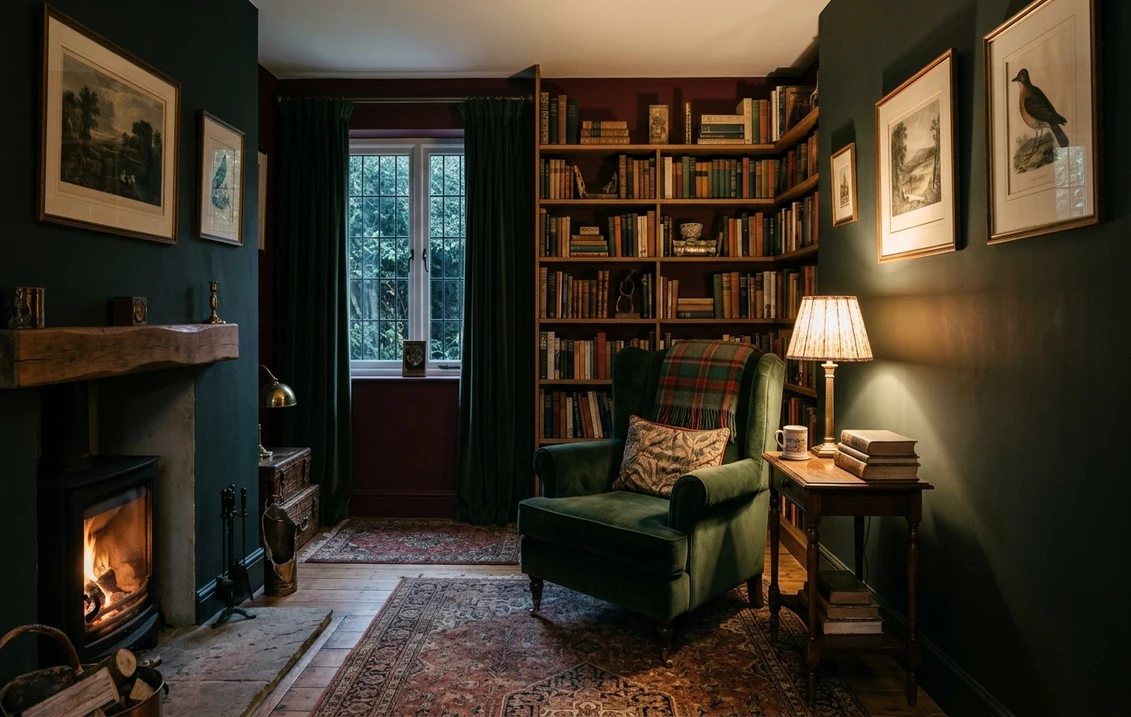
The snug is one of the oldest and most distinctly British domestic rooms: a small, low-ceilinged retreat originally found beside a Victorian pub's bar, then adopted into the home as the secondary sitting room where families withdrew after dinner for cards, reading and the fireside. According to the House & Garden UK 2026 interior tracker, the snug is the fastest-growing room type in refurbishment briefs, overtaking the home office for the first time since 2021. The reason: after a decade of open-plan living, UK homeowners are rediscovering the need for a small, deliberately enclosed, deliberately moody space.
This guide covers the 15 best snug paint colours for UK homes in 2026, with exact Farrow & Ball, Little Greene and Dulux Heritage codes, the envelope technique, fireplace and leather chair coordination, bookshelf treatment, eggshell finish and a cost breakdown of £220 to £520 per snug.
For full pricing, see our complete UK cost guide.
The British snug: a small cosy retreat with a long history
In Victorian public houses the snug was a small partitioned room near the bar, separated from the taproom by a wooden screen and frosted glass. Its defining features, low ceiling, dark woodwork, fire in the corner, two or three deep chairs, no wasted floor space, travelled into the home as the "back parlour" of terraced houses and the "morning room" of larger villas.
A modern UK snug inherits the same logic. It is typically 7 to 12 square metres, set at the back of the house or carved from a former dining room, and its job is to feel enveloping rather than impressive. The 2026 palette reflects this: deep burgundies, dusty pinks, oxblood reds, inky teals and warm burnt umbers, the colours of fire-lit leather, old library books and worn Persian rugs.
That small footprint is exactly what makes the palette work, and also why it does not transfer wholesale to the room next door. A compact cellular lounge can still take a saturated colour on all four walls, but the moment the space opens up the same shade reads heavier and usually belongs on a single zone wall instead. Our guide to living room paint colours in the UK sets out where that line falls between a cellular room and an open plan.
The 15 best snug paint colours in the UK for 2026
These 15 shades combine 2026 trend data, proven performance in small fire-lit rooms and availability from every major UK paint merchant. All recommended in eggshell on walls, the correct finish for a room where the light source is low (lamps, fire, candles) and the sheen needs to catch gently rather than reflect harshly.
| Colour | Brand & Code | Mood | Best for |
|---|---|---|---|
| Preference Red | Farrow & Ball No.297 | Rich smoky burgundy | Classic fire-lit snug |
| Dead Salmon | Farrow & Ball No.28 | Muted dusty pink | North-facing snug, soft mood |
| Eating Room Red | Farrow & Ball No.43 | Warm historic red | Panelled Victorian snug |
| Hague Blue | Farrow & Ball No.30 | Deep enveloping navy | Masculine library snug |
| Burnt Umber | Little Greene 268 | Earthy clay brown | Natural fibres, rattan, wool |
| Burnt Umber | Dulux Heritage | Warm chestnut brown | Budget-conscious envelope |
| Deep Teal | Dulux Heritage | Inky blue-green | Cottage and Arts & Crafts snug |
| Invisible Green | Little Greene 57 | Near-black bottle green | Panelled reading corner |
| Bronze Red | Little Greene 15 | Warm terracotta-red | Farmhouse and cottage snug |
| Tanner's Brown | Farrow & Ball No.255 | Deep leather brown | Chesterfield-led scheme |
| Studio Green | Farrow & Ball No.93 | Near-black forest green | Book-lined alcove snug |
| Book Room Red | Farrow & Ball No.50 | Dusty rose-terracotta | Georgian morning-room mood |
| Mahogany | Little Greene 36 | Rich polished brown-red | Bookcase-and-walls envelope |
| Tuscan Red | Dulux Heritage | Sunbaked terracotta | West-facing snug, evening glow |
| Olive Colour | Little Greene 72 | Muted warm olive | Arts & Crafts and cottage snug |
Try it on your house
No photo? Try a sample
The envelope technique: walls, ceiling and woodwork in one colour
The single most important decorating move in a UK snug is the envelope technique: painting the walls, ceiling, skirting, architrave, door and any built-in joinery in the same colour at the same finish. This is the technique Farrow & Ball calls "colour drenching", Little Greene calls "full-room colour" and British decorators have quietly used in country libraries since the eighteenth century.
The logic is counter-intuitive but consistent: when a brilliant-white ceiling meets a deep wall, the eye snaps to the contrast line and highlights how small the ceiling is. When everything is the same shade, that line dissolves and the room reads as a single volume, bigger in feel, not smaller.
The envelope technique is particularly effective with:
- Farrow & Ball Preference Red No.297: walls, ceiling and woodwork all in the same soft burgundy eggshell. The result is an intimate "supper-club" envelope that flatters leather, brass and candlelight.
- Farrow & Ball Hague Blue No.30: the classic masculine library envelope, walls, ceiling, built-in bookshelves and door all in Hague Blue, finished in eggshell throughout.
- Little Greene Burnt Umber 268: the warmer 2026 alternative to dark greens and blues. Envelopes a snug in earthy clay-brown that reads organic rather than gothic.
- Farrow & Ball Eating Room Red No.43: historically accurate for a Georgian or early-Victorian snug; the same red on cornice and ceiling echoes the original mid-eighteenth-century scheme.
The rule of thumb: if your snug has a ceiling lower than 2.4 m, a footprint under 12 m², or both, the envelope technique will almost always outperform the traditional "walls-colour, ceiling-white" scheme in feel.
Fireplace as the focal point: accent colour or full envelope
Nearly every traditional British snug has a fireplace. Two approaches dominate in 2026: absorb the fireplace into the envelope, paint the chimney breast the same colour as the walls so the fire becomes a point of light and warmth against an unbroken moody backdrop (ideal with Preference Red, Hague Blue and Burnt Umber); or use the chimney breast as a contrasting accent, one shade deeper than the rest, walls in Dead Salmon No.28 with a chimney breast in Eating Room Red No.43, or walls in Book Room Red No.50 with a chimney breast in Tanner's Brown No.255. The deeper shade frames the fire like a picture mount.
Cast-iron Victorian surrounds are best left black or matt graphite; painted timber surrounds should be picked out in the envelope colour in semi-gloss eggshell. Avoid painting a stone or limestone surround, it rarely improves the texture and is almost impossible to strip back.
Leather chair coordination: chestnut, oxblood and tan
A snug is a leather-chair room. Chesterfield, wingback, club chair, each has a dominant leather hue that the wall colour should flatter rather than fight. UK decorators in 2026 follow three reliable pairings:
- Oxblood or burgundy leather: pair with Hague Blue No.30, Studio Green No.93 or Tanner's Brown No.255. The deep cool shades let the red leather glow; putting oxblood against Preference Red muddies both.
- Tan or chestnut leather: pair with Preference Red No.297, Eating Room Red No.43, Little Greene Burnt Umber 268 or Olive Colour 72. Warm earthy shades amplify the honeyed tones of worn-in tan.
- Black or dark brown leather: pair with Dead Salmon No.28, Book Room Red No.50 or Dulux Heritage Deep Teal. Softer dusty shades stop black leather reading severe.
A useful field rule: look at the warmest tone in the leather (not the shadow) and pick a wall colour from the same family. Warm-with-warm, cool-with-cool reads as considered; warm-leather-against-cool-wall looks accidental.
Upload your snug photo, test 15+ F&B, Little Greene & Dulux Heritage shades in 30 seconds
Painting the bookshelves: the library snug move
Most UK snugs have at least one run of built-in bookshelves, often flanking the chimney breast. The 2026 consensus is to paint bookshelves the same colour as the wall behind them, rather than leaving them white or bare wood. Painted shelves recede so the coloured spines pop, a single continuous colour from wall to shelf back suggests depth (especially in Hague Blue, Studio Green or Mahogany 36), and colour-drenching disguises the uneven shelf depths and repaired notches typical of old built-ins.
Use semi-gloss eggshell on bookshelves so edges catch lamplight. Paint the back wall of the shelf in the same colour at the same sheen, the old trick of "bookshelf back in a lighter shade" now reads dated.
Ceiling treatment: envelope, or a half-shade lighter
In a snug, the ceiling is the fifth wall and always coloured in 2026. You have two options:
- Full envelope (ceiling in wall colour): the cocoon approach. Best for snugs under 2.4 m ceiling height, or where there is no interesting cornice to preserve. Use on Preference Red, Hague Blue, Burnt Umber and Eating Room Red.
- Ceiling one shade lighter: paint the ceiling in the wall colour at a 50 percent tint. Farrow & Ball and Little Greene both tint down their own shades on request. Works best in snugs with taller ceilings (2.6 m+), ornate cornice detail or a shallow bay window you want to preserve visually.
Almost never: pure brilliant white ceiling above a deep wall colour. It creates a hard horizontal line that halves the height of the room, cancels the cocoon effect, and, with firelight flickering, reads flat and clinical. If you want a lighter ceiling, use a warm off-white such as Farrow & Ball Slipper Satin No.2004 or Slaked Lime 105, never a cool white.
The opposite room to the snug is the conservatory: all glass, all light, all temperature swings. The envelope of deep colour that makes a snug work is exactly what a conservatory cannot take, because dark walls under a glass roof absorb the sun and fade; there, the brief is pale colours in a washable finish. Our guide to conservatory paint colours sets out the rules for the bright room next door.
Best finish for a snug: eggshell throughout
The UK trade consensus for snugs in 2026 is simple, use eggshell on everything: walls, ceiling, woodwork, panelling, bookshelves, doors. Farrow & Ball Modern Emulsion and Little Greene Intelligent Eggshell both land around 6-7 percent sheen, wash clean of glass rings and fingerprints, and do not amplify old plaster flaws. On woodwork and bookshelves, use semi-gloss eggshell: the slight sheen catches lamplight and defines mouldings without the plastic look of full gloss.
Avoid full matt on snug walls, the whisky-glass-and-fire lifestyle leaves permanent marks on a chalky finish. Avoid full gloss on period woodwork; it reads plastic and fights the candlelight. Eggshell sits squarely between the two.
Cost per snug: £220 to £520 in 2026
Painting a UK snug in 2026 typically costs between £220 and £520, depending on room size, whether bookshelves are involved, choice of paint brand and whether you DIY or hire a decorator. Snugs are cheaper than dining or living rooms, the small footprint means one or two 2.5L tins of premium emulsion cover the whole envelope.
| Snug type | Paint only (DIY) | Decorator labour | Total |
|---|---|---|---|
| Very small snug (7 m²) | £90 - £140 | £130 - £200 | £220 - £340 |
| Standard snug (10 m²) | £120 - £180 | £180 - £260 | £300 - £440 |
| Snug with built-in bookshelves (12 m²) | £150 - £220 | £240 - £330 | £390 - £520 |
Farrow & Ball Modern Emulsion retails around £58 per 2.5L, Little Greene Intelligent Eggshell £54, and Dulux Heritage £45. Deep shades like Preference Red, Hague Blue and Tanner's Brown need a tinted undercoat plus two top coats, budget £30-£40 extra per snug.
How firelight and lamplight transform snug colours
A snug is an evening-and-weekend room, lit mostly by lamps, candles and fire. The paint colour on your sample card under harsh daytime light is not the colour you will live with. UK decorators apply three rules:
- Reds deepen under 2700K lamps: Preference Red can read pink in daylight but glows burgundy under fire and candles; Eating Room Red and Book Room Red behave similarly.
- Blues cool further after dark: Hague Blue becomes almost black under incandescent bulbs, pair with warm brass lamps and tan leather to counterbalance.
- Browns, umbers and teals: Burnt Umber and Tanner's Brown read almost identically day to night, the safest envelope. Dulux Heritage Deep Teal shifts most: test at 8pm opposite the fireplace before committing.
Always test sample pots on the wall behind the chair you will sit in, and view at 8pm with lamps on and (if possible) the fire lit.
Frequently asked questions on UK snug paint colours
What is the most popular snug paint colour in the UK in 2026?
Farrow & Ball Preference Red No.297 is the single most popular snug colour of 2026, followed by Hague Blue No.30, Eating Room Red No.43 and Little Greene Burnt Umber 268. The 2026 direction is moody, saturated shades, reds, burgundies, deep teals and warm umbers, that flatter firelight, leather and books. Pale greys and brilliant whites are out of favour for snugs.
Should I paint the ceiling of my snug the same colour as the walls?
In most UK snugs, yes, the envelope technique (walls, ceiling, woodwork and bookshelves all in the same shade) dissolves the contrast line between wall and ceiling and makes the room feel cocooning rather than boxy. It is particularly effective with Preference Red, Hague Blue, Burnt Umber and Eating Room Red in eggshell. If the snug has a taller ceiling (2.6 m+) or ornate cornice, consider the wall colour tinted 50 percent lighter on the ceiling instead of an exact match, but avoid pure brilliant white above a deep wall.
What finish should I use on snug walls and woodwork?
Use eggshell throughout: walls, woodwork, skirting, architrave, door, bookshelves and (if colour-drenching) the ceiling. Modern Emulsion from Farrow & Ball and Intelligent Eggshell from Little Greene are both washable, around 6-7 percent sheen, and flatter lamplight without the plastic look of gloss. Avoid full matt, stain-prone in a whisky-and-fire room, and avoid full gloss on period woodwork.
Can I paint a small 8 m² snug in a very dark colour?
Yes, dark colours almost always work better than pale ones in small UK snugs. Deep shades like Preference Red, Hague Blue or Studio Green visually dissolve the walls rather than highlighting them, making a 7-to-12 square-metre snug feel enveloping rather than boxed-in. The trick is to colour-drench (walls, ceiling, woodwork all in the same shade in eggshell) and add three warm lighting points: a table lamp beside the chair, a picture light over the fireplace, and candles. The result is intimate, not claustrophobic.
Free - No sign-up - 100+ F&B, Little Greene & Dulux Heritage shades
The right snug colour is the one that flatters firelight, hugs your leather chair and makes an 8 m² back room feel like the best seat in the house. Before committing to 5 litres of Preference Red or Hague Blue, visualise the shade on your own snug photo with our free AI interior colour visualiser, then order A4 sample pots from Farrow & Ball, Little Greene or Dulux Heritage. Sources: Farrow & Ball, Little Greene, Dulux Heritage, House & Garden UK.
Trademarks mentioned (Sherwin-Williams, Benjamin Moore, Behr, Caparol, Brillux, Sto, Alpina, Valspar, PPG, Glidden, Dulux, Crown Trade, Sandtex, Farrow & Ball, Johnstone's, Leyland) are property of their respective owners. FacadeColorizer is independent and not affiliated with any of them. Nominative fair use under Lanham Act §1125.