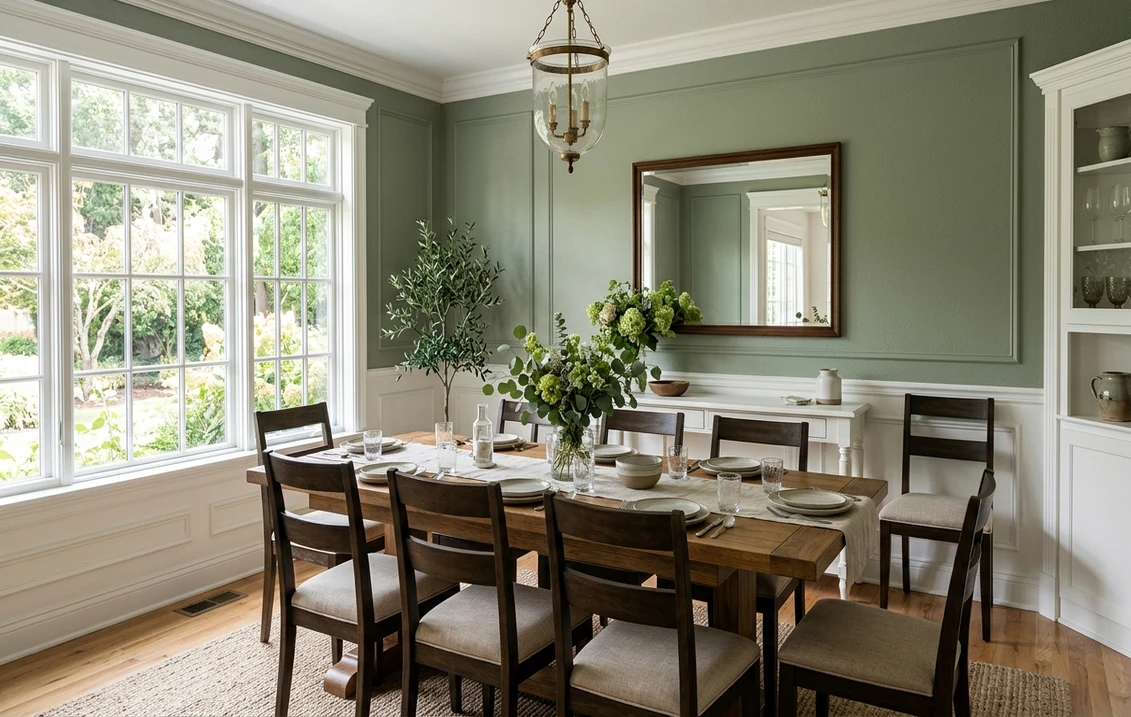
Try it on your house

If you want the Benjamin Moore version of Sherwin-Williams Cascade Green (SW 0066), the closest widely recommended match is Saybrook Sage HC-114, a muted gray-green that runs about five LRV points lighter (roughly 32 versus 27).
Prefer Behr? Terrarium Moss (about T18-16) is the closest widely cited Behr option: it reads a few points deeper and slightly grayer than Cascade Green.
Every delta here is small but real. No brand publishes an official cross-brand twin, so treat these as the closest recommended matches and confirm the winner on your own wall.
Sherwin-Williams Cascade Green SW 0066 is a soft, dusty gray-green with an LRV near 27, the kind of quiet sage that shifts between gray and green depending on the light. It is popular on kitchen cabinets, front doors, and shaded exterior siding precisely because it never shouts. If your painter carries Benjamin Moore or Behr instead of Sherwin-Williams, you do not have to give up that look. You just need to know which color lands closest and by how much. This guide lays out the numbers so you can see exactly where each match agrees with Cascade Green and where it drifts, then leaves the final call to a physical sample. If you want the full method first, here is how cross-brand paint matching works.
The closest matches, side by side
| Color | Brand + code | Approx LRV | Undertone vs Cascade Green | Verdict |
|---|---|---|---|---|
| Cascade Green (reference) | Sherwin-Williams SW 0066 hex approx #7E8A78 |
27 | Reference gray-green | The color you are matching |
| Saybrook Sage | Benjamin Moore HC-114 hex approx #9AA189 |
32 | Slightly grayer, a touch warmer | Closest overall; reads a hair lighter (delta about +5 LRV) |
| Kittery Point Green | Benjamin Moore HC-119 hex approx #A1A78E |
33 | More yellow-green, warmer | Alternative if you want extra warmth (delta about +6 LRV) |
| Terrarium Moss | Behr T18-16 hex approx #77816C |
24 | A little deeper and grayer | Closest Behr; reads slightly darker (delta about -3 LRV) |
Try it on your house
No photo? Try a sample
LRV and hex values are approximate and rounded for comparison. Screens, sheen, and lighting all shift how a color reads, so the only authoritative reference is a physical paint chip pulled from the brand fan deck.
Upload one photo, preview Cascade Green and its Benjamin Moore match side by side. Free, no signup.
Why there is no exact Cascade Green equivalent
Each brand mixes its colors from a proprietary set of colorants, so two paints that look like siblings on a screen are almost never built from the same recipe. Cascade Green leans on a specific balance of gray and green pigment that Benjamin Moore and Behr approach from slightly different angles. That is why the closest Benjamin Moore option, Saybrook Sage, lands about five LRV points lighter, while the closest Behr option, Terrarium Moss, sits a few points deeper. The family is the same; the exact weight and warmth are not.
Muted gray-greens are especially hard to translate between brands because so much of their character comes from the gray load rather than the green itself. Add or remove a little black or umber and the same green can swing from crisp sage to soft olive to a colder, almost slate cast. That sensitivity is why Cascade Green can look like three slightly different colors depending on whether it sits in morning light, afternoon light, or under warm interior bulbs, and it is why a match that nails the undertone in one room can drift in the next.
This is normal for cross-brand matching, and it is why you should never trust a claim of an official or exact equivalent. Sherwin-Williams does not license Cascade Green to anyone, and neither Benjamin Moore nor Behr publishes a one-to-one twin. What you get instead is a closest recommended match with a small, measurable gap. Knowing the size of that gap (a few LRV points here, a warmer undertone there) is what lets you decide whether the substitute is close enough for your project or whether it is worth ordering Cascade Green directly. As a rough rule, a difference of three or four LRV points is hard to spot once the paint is on the wall, five or six starts to become visible in even light, and anything past that reads as a clearly different color.
When the Benjamin Moore match works (and when to stay Sherwin-Williams)
- Use Saybrook Sage HC-114 when your painter is a Benjamin Moore shop and you want the same quiet gray-green mood. On a bright, south-facing wall the extra five points of LRV read as a slightly airier version of Cascade Green, which many people actually prefer.
- Consider Kittery Point Green HC-119 if you want a hair more warmth and a touch more visible green. It is the alternative to reach for when Saybrook Sage feels a shade too cool for your trim or cabinets.
- Stay with Sherwin-Williams Cascade Green when you are matching existing paint, touching up a wall, or working in low north light where a five-point LRV shift is easy to notice. In those cases the exact original is worth the special order. The Cascade Green undertones and best rooms profile shows how the original behaves across exposures.
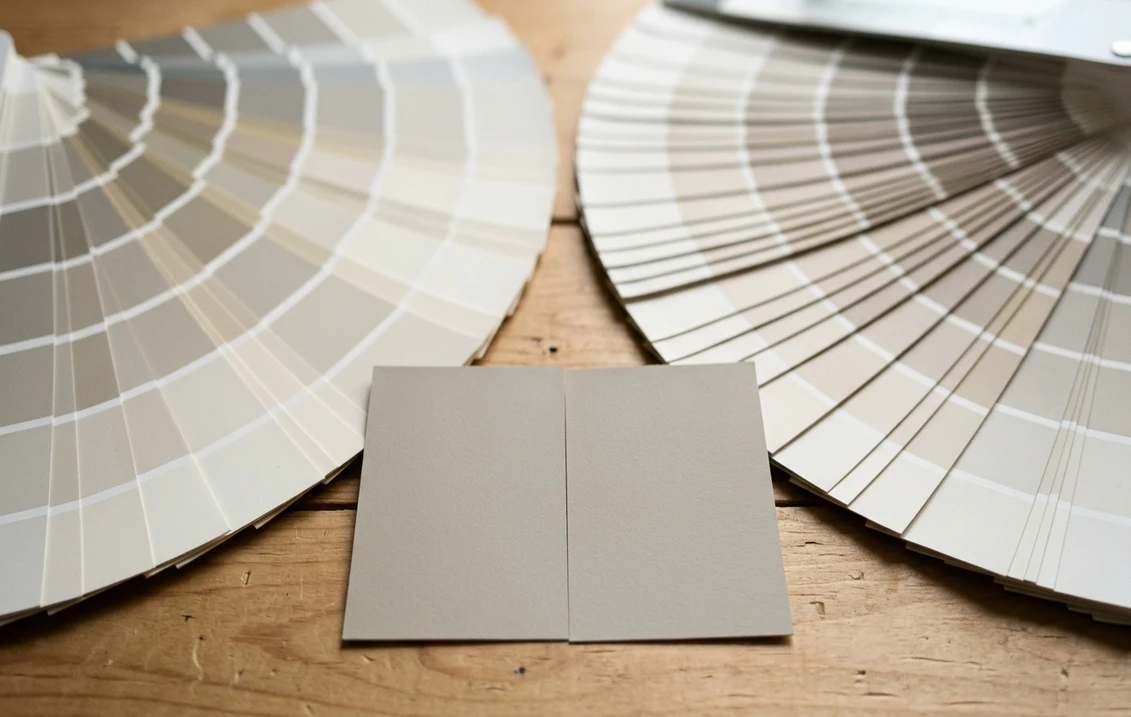
- Compare the samples the right way before you commit. Line up the chips under the same light, at the same time of day, next to your flooring and trim, and judge undertone and depth together rather than one at a time. Our full walkthrough on how to compare paint colors covers the process step by step.
Related matches
If you are cross-shopping a whole palette of soft greens, two neighbors are worth a look. See the closest Benjamin Moore match for Sherwin-Williams Rosemary, a deeper and moodier green, and the Benjamin Moore match for Halcyon Green, a softer, grayer sage. Reading them side by side makes it easier to see where Cascade Green sits on the gray-to-green scale, and it can save you a trip back to the paint counter if a neighboring shade turns out to be the one you actually wanted. Cascade Green tends to land in the middle: greener and more saturated than Halcyon Green, but lighter and calmer than Rosemary. At LRV 27 it is also dark enough that the white beside it does most of the work of keeping a room from closing in, and a warm greige-white near LRV 71 such as Sherwin-Williams Natural Linen opens a gap of more than forty points. The Benjamin Moore equivalent of Natural Linen covers that partner if your trim is coming off a Benjamin Moore deck.
Frequently asked questions
What is the closest Benjamin Moore equivalent of Cascade Green?
The closest widely recommended Benjamin Moore match is Saybrook Sage HC-114. It shares the same muted gray-green family, though it reads about five LRV points lighter than Cascade Green (roughly 32 versus 27), so it can look a touch softer on a sunny wall. Confirm with a physical chip before you commit.
Is there a Behr version of Cascade Green?
Behr does not publish an official match, but Terrarium Moss (about T18-16) is the closest widely cited option. It sits a few LRV points deeper than Cascade Green (about 24 versus 27) and reads slightly grayer, so it can feel a little heavier in a north-facing room. Test a sample before buying a full gallon.
Do the LRV numbers really matter when matching Cascade Green?
Yes. LRV (light reflectance value) tells you how light or dark a color reads. A gap of four or five points, like the one between Cascade Green and Saybrook Sage, is usually acceptable, but it means the match is close, not identical. Pair the LRV with the undertone note before you decide.
Can I trust a hex code to match Cascade Green?
Not on its own. Hex and RGB values are approximate digital renderings that shift with your screen, lighting, and sheen. Use them to get in the neighborhood, then judge the final choice from a physical paint chip or a brushed sample on your own wall.
1 HD render plus 3 free color variations.
Trademark notice. Sherwin-Williams and Cascade Green, Benjamin Moore, and Behr are trademarks of their respective owners. FacadeColorizer is not affiliated with, endorsed by, or sponsored by these companies. Brand and color names are used descriptively (nominative fair use). Hex and RGB values are approximate digital renderings; the only authoritative reference is a physical paint chip.
Trademarks mentioned (Sherwin-Williams, Benjamin Moore, Behr, Caparol, Brillux, Sto, Alpina, Valspar, PPG, Glidden, Dulux, Crown Trade, Sandtex, Farrow & Ball, Johnstone's, Leyland) are property of their respective owners. FacadeColorizer is independent and not affiliated with any of them. Nominative fair use under Lanham Act §1125.