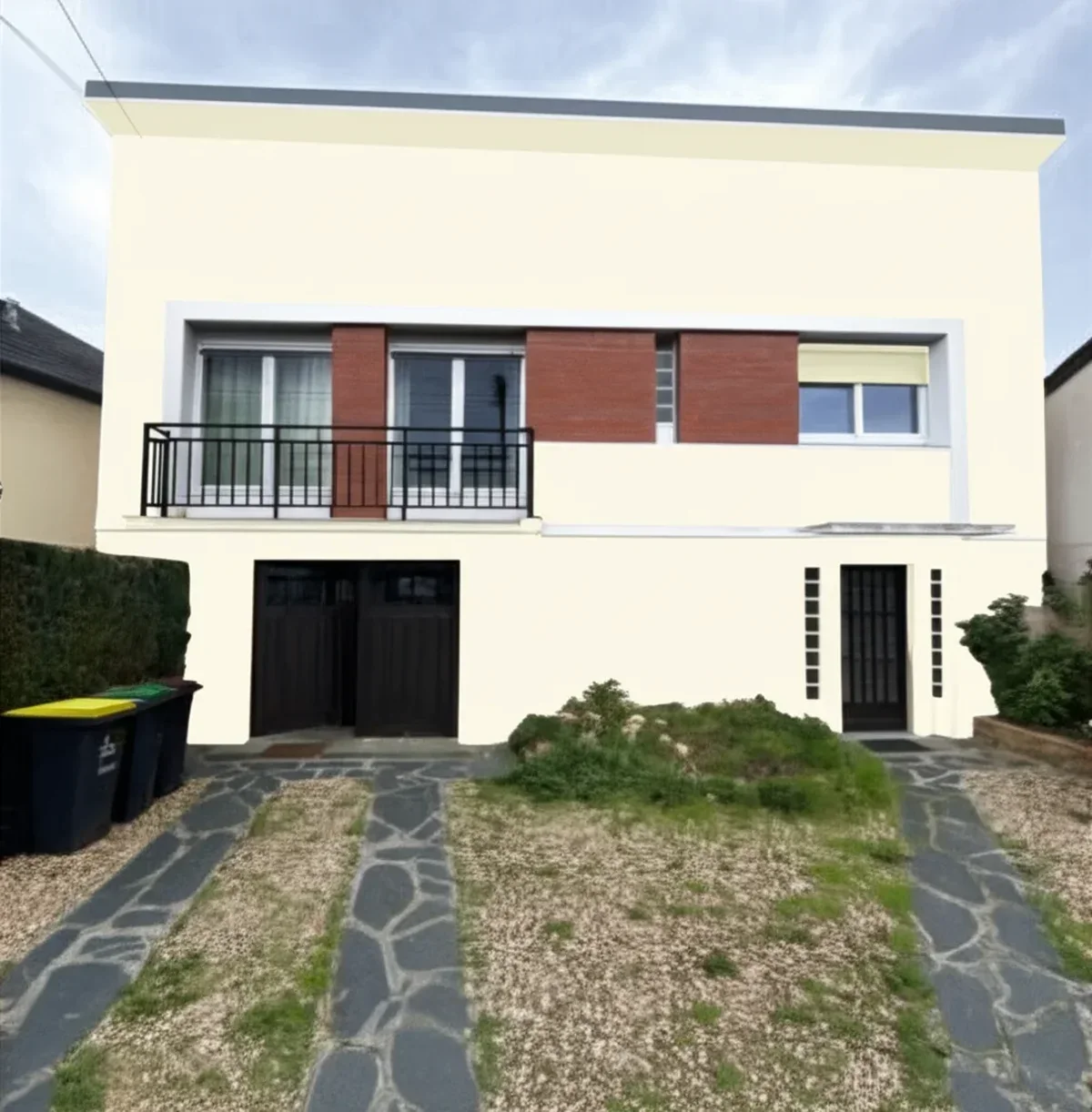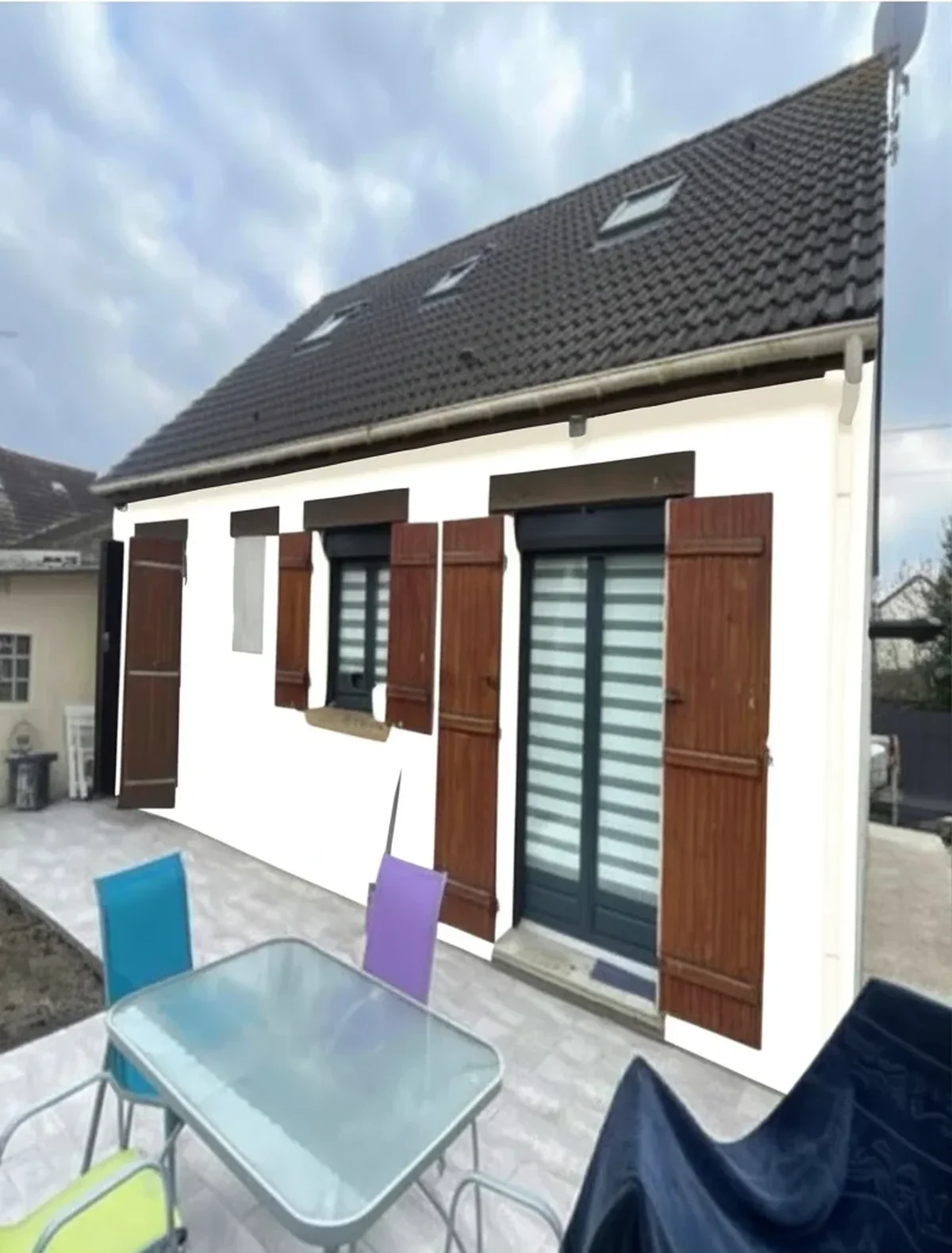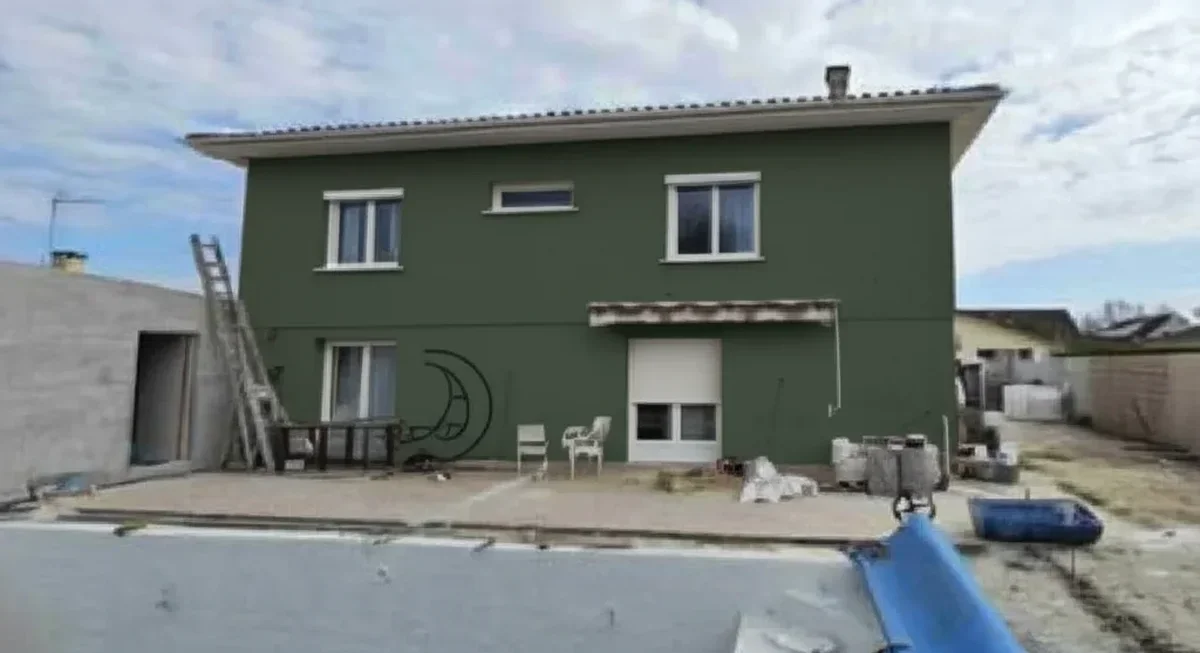
Try it on your house

Picking the right paint color is only half the job. The finish, flat, satin, or semi-gloss, controls how your home reads in morning light, how fast dirt shows up after a storm, and how long until the next repaint. Pick the wrong sheen and even a premium Sherwin-Williams or Benjamin Moore job can look chalky, cheap, or plastic within 18 months.
Quick answer: For most US homes in 2026, use satin (or low-luster) on the siding body, semi-gloss on trim, fascia, and doors, and flat on stucco or rough-textured walls. Save high-gloss for the front door as an accent only. Satin sheds dirt and hides minor waviness, semi-gloss resists abrasion and wipes clean, and flat masks surface flaws on rough substrates. Satin body with semi-gloss trim is the pairing every major manufacturer's residential spec sheet defaults to.
| Surface | Recommended finish |
|---|---|
| Siding (wood, fiber cement, vinyl) | Satin / Low Lustre |
| Stucco, cedar shake, rough texture | Flat or low sheen |
| Trim, fascia, window frames | Semi-gloss |
| Front door, entry door | Semi-gloss or high-gloss |
| Garage door, shutters | Satin |
Try it on your house
No photo? Try a sample
This guide walks through each finish level, the surfaces it is built for, and the rules paint specifiers actually apply on residential exteriors. Everything here is traced to published manufacturer guidance and to the ASTM test methods that define what "gloss" and "chalking" mean in measurable terms, listed in full at the end. For pricing context, see our complete exterior house painting cost guide.
What "sheen" actually means
Sheen is the share of light a painted surface reflects back at the viewer, and it is a measured quantity, not a marketing adjective. The reference method is ASTM D523, the standard test method for specular gloss, whose scope covers "the measurement of the specular gloss of nonmetallic specimens for glossmeter geometries of 60, 20, and 85 degrees". The 60-degree reading is the one quoted on paint datasheets and the one used throughout this guide. Manufacturers then group those gloss unit (GU) numbers into the familiar names: flat, matte, eggshell, satin, semi-gloss, and gloss. Here is how they line up.
Why three geometries matter to you in practice: the 85-degree reading is the one that picks up sheen on very low-gloss surfaces, which is exactly where "flat" and "matte" products separate from each other. Two paints both sold as flat can read differently on a sunlit wall because one sits at the top of its band. This is why the only reliable comparison is the GU figure on the technical datasheet, never the word on the can.
| Finish | Gloss units (60 deg) | Appearance | Best exterior use |
|---|---|---|---|
| Flat | 0-5 GU | No reflection | Stucco, rough siding, ceilings |
| Matte | 5-10 GU | Very soft sheen | Modern body color |
| Eggshell / Low-luster | 10-25 GU | Soft pearl | Wood siding body |
| Satin | 25-35 GU | Subtle sheen | Siding, shutters, garage doors |
| Semi-gloss | 35-70 GU | Clearly shiny | Trim, doors, window frames |
| Gloss / High-gloss | 70+ GU | Mirror-like | Front doors (accent only) |
Source: ASTM D523 60-degree specular gloss; Sherwin-Williams & Benjamin Moore product datasheets 2026.
The universal rule: sheen climbs with wear
Sheen is chosen after the primer, not instead of it. The makers' sheets make the schedule easy to plan: Zinsser Bulls Eye 1-2-3 and Cover Stain both allow a topcoat after 1 hour at 70 to 80°F, Kilz Premium and Benjamin Moore Fresh Start 046 the same, and only the alkyd Fresh Start 094 needs 8 hours; which of the four chemistries a given wall needs is the subject of our guide to the best exterior primer by data sheet.
The single rule that governs every exterior sheen decision: the more a surface gets touched, washed, splashed, or weather-exposed, the glossier the paint should be. Higher gloss means more resin and less pigment, which means a harder film, better water-shedding, and easier cleaning.
That's why trim and doors get semi-gloss (they get hosed down, bumped, touched) while siding gets satin or eggshell (it covers more area, shows less imperfection, fades less obviously). A body-color satin paired with semi-gloss trim is the default American exterior spec, and it is the pairing that manufacturer literature has recommended for decades.
Flat vs satin exterior paint: the decision most homeowners actually face
Semi-gloss on trim is close to automatic. The real argument happens over the body of the house, and it is almost always flat against satin. Here is the honest version: neither one is better. They fail differently, and the substrate decides which failure you can live with.
| What you care about | Flat (0-9 GU) | Satin (25-35 GU) |
|---|---|---|
| Hiding a wavy or patched wall | Best in class, absorbs light instead of raking across the flaw | Shows lap marks and dents at a grazing angle |
| Washing off dirt and pollen | Porous film holds grime, needs a soft wash | Tighter film, rinses far more easily |
| Touching up a small area later | Easiest sheen to spot-repair invisibly | Touch-ups can flash as a visible patch |
| Deep or saturated colors | Reads rich and velvety, no plastic look | Can look glassy on a large dark wall |
| Mildew-prone, shaded elevations | Higher risk, spores settle into the film | Preferred, water sheets off faster |
| Rough substrates (stucco, shake) | The right answer | Sheen breaks unevenly across the texture |
Read the table as a single question: is your wall smooth or not? On a smooth substrate, satin wins because you gain washability and lose nothing, since there is no texture for the sheen to break across. On a rough or previously patched substrate, flat wins because the thing satin does best, reflect light evenly, is exactly the thing that will expose every trowel mark and every repair.
The compromise that resolves most arguments is the band between the two. Eggshell and low-luster products sit at roughly 10 to 25 GU: from the sidewalk they read as flat, but the film is tight enough to hose down. If you like the matte look and your painter is pushing back on maintenance grounds, that is the sheen to ask for by its GU number rather than by name. Sherwin-Williams describes matte in exactly those terms, as a finish that "helps make walls smooth and washable", and eggshell as "easily washable" and suited to "areas prone to nicks and scuffs".
Flat exterior paint: when to use it (and when not to)
Flat finishes hide surface flaws better than any other sheen, they absorb light rather than reflect it, which masks drywall patches, stucco texture variation, and old nail pops. On rough or textured exteriors like stucco, cedar shake, or old board-and-batten, flat is often the best choice.
The downside: flat paint holds dirt. On a smooth surface, dirt and mildew embed in the pores of the paint film and resist pressure washing. In humid climates (Florida, Gulf Coast, Pacific Northwest), flat siding paint typically needs washing every 18-24 months to stay clean.
Use flat on: stucco, rough stone, cement block, rough-sawn cedar.
Avoid flat on: smooth fiber cement (Hardie board), aluminum siding, trim, any surface at arm's reach.
There is a second reason low-sheen exteriors age the way they do, and it has a formal name: chalking. When UV breaks down the binder at the very top of the film, loose pigment is left on the surface as a powder that rubs off on your hand and washes down onto whatever sits below the wall. The industry measures it with ASTM D4214, the standard test method for evaluating the degree of chalking of exterior paint films, which scores the effect on a numbered scale instead of leaving it to opinion.
Two practical consequences. First, chalking is a binder-quality question far more than a sheen question, so a cheap satin will chalk sooner than a premium flat. Second, chalk is the single most common reason a repaint fails to bond: if the old surface powders when you wipe it, no topcoat of any sheen will hold until it has been washed back to a sound film and, where the powdering is heavy, sealed with a bonding primer. Check for it with a dark cloth on the sunniest elevation before you order a single gallon.
Satin: the workhorse body finish
Satin is the default siding finish for most of the United States in 2026. It has enough sheen to shed dirt and resist mildew, but not so much that it highlights every dent, waviness, or brush mark. Premium exterior satins (Sherwin-Williams Duration Satin, Benjamin Moore Aura Low Lustre) are the go-to for wood clapboard, fiber cement, and vinyl siding repaints.
One note: different manufacturers use different names for the 25-35 GU range. Sherwin-Williams calls it "Satin." Benjamin Moore calls it "Low Lustre." Behr calls it "Satin Enamel." They're all the same sheen range, just different marketing. If your spec sheet says "satin," ask for the gloss unit target (27-32 GU is the sweet spot for siding).
Before you commit to a sheen, test the body color you actually want in each finish on your own elevation. A warm greige reads very differently at 5 GU versus 30 GU, especially on south-facing walls in late afternoon light. Walk through our visualizer to see how a warm greige like Universal Khaki SW 6150 looks in each finish across siding, trim, and shutter combinations.
Upload a photo of your home and preview your color choice in any finish, free.
Semi-gloss: trim, doors, and everything that takes a hit
Semi-gloss is the standard for exterior trim, fascia boards, window surrounds, garage doors, and entry doors. The harder film resists abrasion from hose nozzles, lawn equipment, and packages being dropped against a front door. It also wipes clean, bird droppings, pollen, and road grime come off with a soapy sponge.
The trade-off with semi-gloss is that it shows every brush mark, sag, and substrate imperfection. That's why trim needs to be sanded smooth before semi-gloss goes on. If your trim is rough or has old drip marks, you either sand first or step down to satin (which hides flaws better but cleans slightly less well).
High-gloss: front door accent only
High-gloss (70+ GU) is strictly a front-door finish in 2026. It makes a bold color (red, navy, black, forest green) read as a jewel-like focal point against a matte body. Used anywhere else, trim, siding, shutters, it looks plastic. A single quart of high-gloss in a saturated hue runs $22-$35 and is one of the highest-return paint purchases a homeowner can make.
Sheen matters a little more on a thinner film: on Sherwin-Williams' entry-level A-100, satin or low sheen on the body sheds dirt that flat would hold, and gloss is reserved for doors and trim. Our A-100 exterior review covers the sheen choice for the budget line.
Sheen by siding material, one material at a time
The by-surface table above is the shorthand. The material underneath changes the reasoning enough that it is worth going through the common ones explicitly, because the same sheen behaves differently on each.
Wood clapboard and lap siding. Satin or low-luster. Old wood siding is rarely flat: boards cup, nails have been set and filled, and previous coats have built up unevenly. Satin at the low end of its band, around 25 to 28 GU, gives you washability without turning every cupped board into a highlight. Going up to semi-gloss on a full elevation of wood is the classic overreach.
Fiber cement (Hardie and equivalents). Satin, comfortably. This is the smoothest substrate on a typical house, factory-flat with a consistent texture, so nothing is hiding that a sheen could expose. Satin is also the sheen that reads closest to the factory-applied finish these boards ship with, which matters if you are repainting only part of the house.
Vinyl siding. Satin, and it must be a vinyl-safe formulation. The binding constraint here is not sheen at all but heat: a color darker than the original panel absorbs more energy and can warp the siding. Sheen choice is secondary to that check, which our guide to Sherwin-Williams vinyl-safe exterior paint covers in full.
Stucco and EIFS. Flat, or the lowest sheen the product line offers. Stucco is a textured, slightly absorbent surface, and any reflection will trace the float marks and the patch lines where repairs were made. Flat also tolerates the mild alkalinity of a cementitious surface better than higher-resin films do.
Brick and masonry. Flat, with one caveat: painted brick is a decision you cannot easily undo, and the sheen will not save a bad prep job. A flat masonry coating breathes better than a tight glossy film, which matters on a wall that can carry moisture from the inside out. See our guide to painting a brick exterior before you commit.
Cedar shake and shingle. Flat on the field, semi-gloss on the trim that frames it. Shakes have deep texture and irregular edges, so sheen breaks across them in a way that looks restless rather than crisp. This is one of the few places where flat is not a compromise but the correct specification.
Aluminum and steel siding. Satin, over a bonding primer. Metal is smooth and non-porous, so adhesion is the whole game, and an old chalking metal panel must be washed to a sound surface first. Satin holds up better than flat here because the panel is usually within reach and gets touched.
What your climate does to the sheen decision
Sheen is not climate-neutral. On a humid, shaded elevation, the argument for satin gets stronger: water sheets off a tighter film faster, and a surface that dries quicker gives mildew less to work with. Gulf Coast, Southeast and Pacific Northwest homes with north-facing walls under tree cover are the clearest case for stepping up from flat.
In high-UV, low-humidity climates, the Southwest and the high desert, the dominant failure mode flips from mildew to chalking and fade, and neither is fixed by sheen. There the choice is driven by the binder quality and the pigment, which is why a premium flat on a Phoenix stucco wall outperforms a budget satin. Our guide to the best exterior paint for hot climates goes through the products that hold up.
In freeze-thaw country, the Upper Midwest and Northeast, the sheen conversation is really a moisture conversation. Any film that traps water behind it will be pushed off the substrate when that water freezes, so a breathable lower sheen on masonry and a properly primed higher sheen on trim are both doing the same job: keeping liquid water out while letting vapor leave.
The standard American exterior spec
Here is the default sheen pairing that manufacturer specification guidance converges on for residential exteriors. Treat it as the starting point you deviate from with a reason, not as a rule.
| Surface | Recommended finish | Why |
|---|---|---|
| Wood clapboard siding | Satin / Low Lustre | Sheds dirt, hides minor waviness |
| Fiber cement (Hardie) | Satin | Smooth surface reads elegant at 27 GU |
| Stucco / EIFS | Flat or low sheen | Hides texture irregularity |
| Trim & fascia | Semi-gloss | Abrasion resistance, washability |
| Shutters | Satin or semi-gloss | Color pop without glare |
| Front door | Semi-gloss or gloss | Focal point, easy to clean |
| Garage door | Satin | Less glare than trim, more durable than flat |
Cost difference between sheens
Sheen level changes paint cost only modestly. Within a single product line (say, Benjamin Moore Aura), the price delta between flat and semi-gloss is typically $3-$6 per gallon. On a whole-house repaint that uses 8-14 gallons of body paint and 2-4 gallons of trim paint, the all-in price difference between all-satin and mixed-sheen specs is usually under $40, a rounding error on a $6,000 project.
Don't choose a lower sheen to save money. Choose the sheen that matches the surface. The lifetime cost of repainting bad sheen selection (peeling semi-gloss on stucco, chalking flat on Hardie) dwarfs the upfront difference.
Once you have settled on a sheen, preview exterior colors on your own photo before you buy a single gallon. For the deeper sheen tradeoffs on trim and siding, see the semi-gloss vs satin durability data.
Four sheen mistakes that force an early repaint
1. Semi-gloss on an unsanded trim board. Semi-gloss reflects enough light to trace every ridge left by the old coating. If the trim has drip marks, raised grain or a failed previous film, the choice is to sand it properly or to step down to satin. Painting semi-gloss over it and hoping is how a job that was technically sound ends up looking amateur from the driveway.
2. Flat on a smooth, reachable surface. Flat earns its place by hiding texture. On a smooth fiber cement wall at ground level there is no texture to hide, so all you have bought is a porous film in the one spot that gets splashed by the sprinkler and brushed by the recycling bin. That is the combination that needs washing twice as often as it should.
3. Any topcoat over a chalking surface. Covered above, and worth repeating because it is the most expensive of the four. Sheen has nothing to do with it: a perfect satin over powdered old paint will peel in sheets, and the failure shows up a year or two later, long after the crew has gone.
4. Choosing the sheen from a sample card. A two-inch chip held at arm's length tells you almost nothing about how 900 square feet of the same product will read at 30 feet in afternoon sun. Gloss is an angle-dependent effect, which is exactly why ASTM D523 specifies the measuring geometry. Paint a real patch, or at minimum preview the color on a photograph of your own elevation before you order.
Sources and references
- ASTM D523, Standard Test Method for Specular Gloss, the method behind every gloss unit figure quoted here, covering the 20, 60 and 85 degree geometries.
- ASTM D4214, Standard Test Methods for Evaluating the Degree of Chalking of Exterior Paint Films, the reference for the chalking scale used in the flat-paint section.
- Sherwin-Williams paint sheen guide, manufacturer definitions of flat, matte, eggshell, satin, semi-gloss and gloss, including the maintenance trade-offs quoted above.
- Behr, how to choose an exterior paint sheen, a second manufacturer view on matching sheen to exterior surface.
See how your color choice looks on your home before you commit to a finish.
Right color, right sheen, right substrate. Get those three aligned and a quality exterior paint job will hold up for well over a decade. Get the substrate wrong and no sheen will save it.
Frequently asked questions
Flat or satin for exterior paint?
Is satin or semi-gloss better for exterior paint?
Can I use the same sheen for body and trim?
Does a higher sheen last longer?
What sheen is best for dark exterior colors?
What sheen should I use on stucco?
Trademarks mentioned (Sherwin-Williams, Benjamin Moore, Behr, Caparol, Brillux, Sto, Alpina, Valspar, PPG, Glidden, Dulux, Crown Trade, Sandtex, Farrow & Ball, Johnstone's, Leyland) are property of their respective owners. FacadeColorizer is independent and not affiliated with any of them. Nominative fair use under Lanham Act §1125.