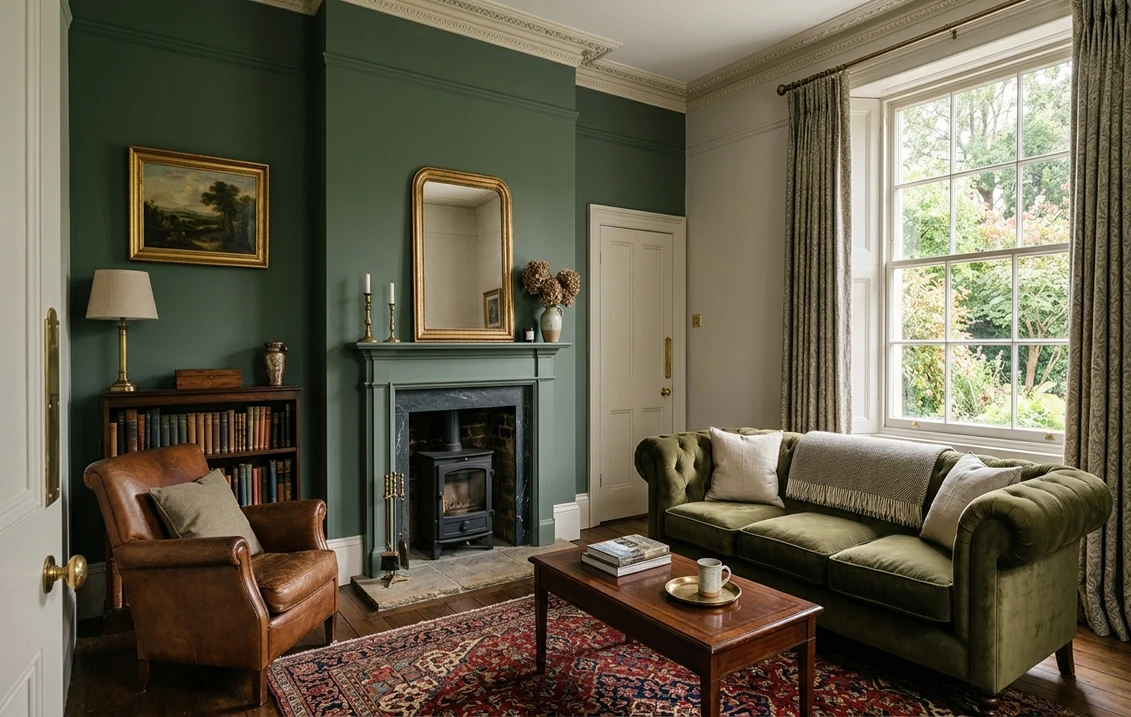
Try it on your room

According to Which? emulsion testing and Painters and Decorators Association surveys, Dulux Heritage has emerged as the strongest value-led challenger to Farrow & Ball for UK interior schemes in 2026. Both offer period-accurate colours and traditional matt finishes, yet one costs roughly 35 percent less per 2.5 L tin. The question for most homeowners is simple: do you actually see the premium on the wall?
This guide compares Dulux Heritage Matt against Farrow & Ball Estate Emulsion across ten interior-critical criteria: price, coverage, pigment depth, finish options, breathability, durability, sample availability and real-world application. Data drawn from each brand's 2025-2026 technical data sheets, Which? testing and UK trade merchant pricing verified in March 2026. If you are weighing other heritage options, we also pit Farrow & Ball against Little Greene, and for a value-led alternative our take on Crown Paint against Dulux covers the budget end of the range.
For full pricing, see our complete UK cost guide.
Price per 2.5 L: Dulux Heritage lands 35 to 40 percent cheaper
On the 2.5 L tin that most UK decorators use for a single room, Dulux Heritage Matt sells for £35 to £42 depending on retailer, while Farrow & Ball Estate Emulsion is £56. Per litre that is £14 to £16.80 for Dulux Heritage against £22.40 for Farrow & Ball.
Over a typical three-bedroom UK house repaint of about 20 litres, the gap is meaningful: Dulux Heritage totals roughly £112 to £134, Farrow & Ball runs to £179. The £45 to £67 saving is enough to fund an extra tin of trim paint or a week of testers, without compromising the heritage look at the walls.
Trade discount narrows the gap slightly. Farrow & Ball Trade offers up to 15 percent off through accredited decorators, while Dulux Decorator Centres discount Heritage ranges 10 to 20 percent on volume orders. Even at best-case trade pricing, Dulux Heritage remains 30 to 35 percent cheaper per tin. For a homeowner funding materials directly, the saving is clearest at Leyland SDM, Brewers and independent merchants who rarely discount Farrow & Ball below RRP.
Tester pots tell another story. Farrow & Ball samples are £8.50 for 100 ml, while Dulux Heritage Peel & Stick samples are £2.50 (no paint waste, reposition freely) with 250 ml pourable testers at £5.50. Testing five shades costs £12.50 for Dulux Heritage against £42.50 for Farrow & Ball, a real factor when you realistically want to try eight to ten colours in the room light before committing.
Coverage: near-identical at 12 to 14 sqm per litre
Both brands quote 12 to 14 sqm per litre on the standard matt emulsion data sheet under ideal conditions (smooth, primed, well-lit wall). In practice, coverage on mid-toned colours is broadly equivalent: a 40 sqm bedroom with two coats needs roughly 5.7 L of either brand, so plan for three 2.5 L tins with leftover for touch-ups.
The divergence shows on deep, saturated colours. Farrow & Ball's darker shades (Hague Blue, Railings, Studio Green) are well-known among UK decorators for needing three coats over white primer, a quirk even the brand's technical line acknowledges. Dulux Heritage deep shades (Proud Peacock, Indigo Shade, Teal Touch) typically reach full opacity in two coats thanks to a slightly higher titanium dioxide loading in the tinting bases. On a dark-scheme room, that extra Farrow & Ball coat adds about 4 hours of labour and one additional tin.
Scale changes the weight of that gap. Indoors, one extra tin on a bedroom is an annoyance. The same third coat on an elevation is a different order of spend, and on a dashed wall it is worse again: pebbledash carries roughly 30 to 50 percent more surface than smooth render and drinks paint at close to twice the rate. So the brand question that is largely aesthetic in a living room becomes a budget question outside, which is one reason our pebbledash paint colour ideas guide starts from the wall rather than from the colour card.
Colour depth and pigment character
Farrow & Ball built its reputation on a proprietary blend of rich pigments that gives its signature chalky, light-absorbing finish. The paint looks soft, almost powdery, and shifts noticeably through the day as natural light changes. This is the house style that has defined F&B since the 1940s: a shade feels different at 8 am, noon and 5 pm, which is why the brand is insistent on testing in situ.
Dulux Heritage was launched in 2019 as ICI's direct response to the heritage paint premium. It uses traditional pigment recipes based on Victorian and Edwardian archive colours, reformulated in a modern acrylic emulsion binder. The finish is flatter and more uniform than F&B, with less daylight variation. For many homeowners this is actually preferable: the colour you approve in the tester pot is closer to what you see on the wall at 7 pm. For purists chasing the exact Farrow & Ball mood, Dulux Heritage sits a shade short of the benchmark.
Side-by-side swatches in professional showrooms (Brewers and Leyland SDM both display Dulux Heritage and Farrow & Ball boards) make the difference clear: Farrow & Ball has slightly more visible pigment particle texture, Dulux Heritage looks cleaner and more digital. Neither is objectively better. The right question is which look suits your room and lifestyle.
Preview Dulux Heritage and Farrow & Ball shades on your hallway photo, free, 30 seconds.
Compare both on my roomFinish options: matt and eggshell dominate both ranges
Dulux Heritage offers a tight lineup of four core finishes designed for whole-house interior use: Matt Emulsion (walls and ceilings), Eggshell (woodwork, trim, low-traffic walls), Velvet Sheen (interior wood and metal, mid-sheen), and Satin Gloss (high-traffic trim and doors). The Heritage palette carries 114 archive-inspired colours, curated from British period homes.
Farrow & Ball runs a broader eight-finish interior range: Estate Emulsion (matt walls), Modern Emulsion (washable matt, for wet areas), Dead Flat (ultra-matt, no sheen at all), Estate Eggshell, Modern Eggshell, Full Gloss, Wood Primer & Undercoat and Dead Flat Metal Primer. The curated palette holds 132 shades, deliberately narrow so homeowners commit rather than drift.
For most standard UK interior projects, the four Dulux Heritage finishes cover every need. The Farrow & Ball range matters if you want Dead Flat's specialist no-sheen look for listed buildings, or Modern Emulsion's scrub-resistance for high-traffic hallways and kitchens.
Breathability and period property compatibility
Breathability matters inside pre-1919 homes with lime plaster or solid stone walls, where trapped moisture causes blown plaster and mould. Standard acrylic emulsions (both Dulux Heritage Matt and Farrow & Ball Estate Emulsion) are moderately breathable rather than fully permeable.
Technical data shows Farrow & Ball Estate Emulsion at an Sd value of roughly 0.1 m (class V1 per EN 1062-1), while Dulux Heritage Matt sits at roughly 0.15 m (also V1). Both are acceptable on dry lime plaster in living rooms and bedrooms. Neither replaces a true breathable paint like silicate or clay for damp-prone walls. For listed buildings in conservation areas, specify a mineral or distemper paint where your surveyor flags moisture concerns; both Dulux and F&B offer bespoke sympathetic ranges but these are different products from standard Heritage Matt and Estate Emulsion.
Durability and washability
For bathrooms the comparison has a third contender: Zinsser Perma-White, whose data sheet guarantees the paint film against mould and mildew for five years when two coats are applied, but rules out shower enclosures, saunas and steam rooms. How it compares with Modern Emulsion and Dulux's bathroom paint is in our bathroom paint guide.
Dulux Heritage publishes four complete hallway schemes (York White with Grecian White, Ravens Flight with Forest Grey, Roman White with Brushed Gold, Waxed Khaki with Midnight Teal), while Farrow & Ball's hallway favourites, Wimborne White, Skimming Stone, Setting Plaster and Hague Blue, are described colour by colour on its pages; both sets are compared in the hallway paint colours guide.
In day-to-day UK homes, both standard matt finishes hold well for 8 to 12 years in low-traffic rooms (drawing rooms, bedrooms, dining rooms). The gap opens in high-traffic zones such as hallways, kitchens and children's rooms.
Dulux Heritage Matt achieves a Class 2 scrub rating per EN 13300, meaning it tolerates occasional damp-cloth cleaning without burnishing. Farrow & Ball Estate Emulsion is Class 5 (lowest scrub resistance), which means marks lift the colour and local touch-ups flash unless the batch is still available. For wet or high-traffic rooms, F&B recommends switching to Modern Emulsion (Class 2), which costs the same £56 per 2.5 L but sacrifices some of the signature chalky depth.
The practical implication: if you want the Farrow & Ball look in a busy family kitchen, you either pay for a repaint every 4 to 6 years or accept Modern Emulsion's slightly less characterful finish. Dulux Heritage Matt out of the tin sits between the two on wash resistance, which many homeowners find a fair compromise.
The cheaper route people try is to have a Farrow & Ball colour matched into Dulux at a Decorator Centre. It works, up to a point: the store scans the chip and mixes the nearest Dulux recipe, which looks right under one light and can drift under another because the two brands use different pigments. For a whole room painted at once that is often acceptable; for touch-ups or adjoining walls it is not. Our guide to Dulux colour matching in the UK sets out the method and its limits.
Sample availability and colour testing
Both brands run extensive sampling programmes, but the cost structure is very different. Dulux Heritage offers Peel & Stick adhesive samples at £2.50 each, large enough (roughly A5) to judge the colour honestly against woodwork, flooring and adjacent rooms. The sticker peels off without residue, so you can reposition across every wall before deciding. Pourable 250 ml testers sell for £5.50.
Farrow & Ball sample pots are £8.50 for 100 ml, enough for two A4 test patches. Adhesive colour swatches (not paint) are £1 each in the signature colour card system. Testing ten shades properly in a room runs to roughly £85 with Farrow & Ball against £25 with Dulux Heritage Peel & Stick. On a whole-house scheme where each room needs three candidate shades, the gap can reach £200.
Availability is broadly equivalent in UK cities. Farrow & Ball stocks via its own showrooms plus John Lewis, Homebase and independent merchants. Dulux Heritage is available at all Dulux Decorator Centres, Brewers, Leyland SDM, B&Q and online at duluxdecoratorcentre.co.uk with next-day delivery as standard.
Brush and roller performance
Professional decorators generally describe Dulux Heritage Matt as the more forgiving application: better flow, fewer lap marks on large walls, tolerant of slightly thicker or thinner roller loading. It handles touch-ups without the severe flashing that afflicts F&B Estate Emulsion.
Farrow & Ball Estate Emulsion has a characteristic thicker body that demands technique. On long walls, lap marks show if you stop mid-wall; the paint dries fast and the join is visible in raking light. F&B specifically advises against foam rollers, which leave a stippled texture that jars against the chalky signature finish. Dulux Heritage is more tolerant of roller choice.
For HVLP or airless spraying on whole-house refurbishment, Dulux Heritage Matt sprays well at factory viscosity with minimal thinning. Farrow & Ball Estate Emulsion typically needs 5 to 10 percent water thinning, and the brand recommends Modern Emulsion for spray applications.
Drying time, recoat and cure
Both brands quote touch-dry in 1 hour and recoat in 4 hours at 20 degrees Celsius and 50 percent relative humidity. In practice, Dulux Heritage reaches full cure in around 7 days, while Farrow & Ball Estate Emulsion takes up to 14 days for full hardness. That matters if you need to rehang heavy mirrors, reinstall skirting or return furniture quickly after a repaint.
Ten-criteria comparison table
All figures reflect 2026 UK retail pricing and the latest technical data sheets. Use this as a side-by-side reference when specifying a room or whole-house scheme.
| Criterion | Dulux Heritage | Farrow & Ball |
|---|---|---|
| Price 2.5 L | £35-42 | £56 |
| Coverage per litre | 12-14 sqm | 12-14 sqm |
| Coats (deep shades) | 2 coats | 2-3 coats |
| Colour library | 114 shades | 132 shades |
| Finish character | Flat, consistent | Chalky, light-shifting |
| Finish options | 4 (matt, eggshell, velvet sheen, satin) | 8 (matt, eggshell, dead flat, gloss and more) |
| Scrub rating (EN 13300) | Class 2 | Class 5 (Modern Emulsion: Class 2) |
| Breathability (Sd) | ~0.15 m (V1) | ~0.1 m (V1) |
| Sample cost (each) | £2.50 Peel & Stick | £8.50 for 100 ml |
| Full cure time | ~7 days | ~14 days |
Try it on your house
No photo? Try a sample
Verdict by room and budget
Neither brand is universally better for every interior scheme. Here is a clear verdict drawn from UK interior designer briefs and professional decorator feedback. Use it to match the brand to the room, not the other way round.
| Room / Budget | Recommended | Why |
|---|---|---|
| Whole-house repaint, budget-aware | Dulux Heritage | 35 percent saving per tin, cheaper testers, same coverage |
| Statement drawing room, period property | Farrow & Ball | Chalky depth and light-shift define the heritage mood |
| Family kitchen, hallway, staircase | Dulux Heritage | Class 2 scrub out of the tin, forgiving touch-ups |
| Nursery, child's bedroom | Dulux Heritage | 7-day full cure, cheaper re-coats as tastes change |
| Deep dark scheme (navy, forest green) | Dulux Heritage | Full opacity in 2 coats, one fewer tin |
| Feature wall, drama and light-shift | Farrow & Ball | Signature chalk finish creates visible tonal movement |
| Listed building, conservation area | Either (consult surveyor) | Both meet conservation standards on dry lime plaster |
| Rental property refresh | Dulux Heritage | Heritage look at lower cost per tenancy turnover |
One row of that table deserves a caveat. In a nursery, cure time and cheaper re-coats are the secondary criteria: what has to be checked first is the VOC declaration on the tin and the ventilation window before the cot goes back in, and that decision runs on completely different evidence from the scrub ratings above. Our guide to baby-safe nursery paint colours sets out the EN ISO 11890-2 and EU Ecolabel thresholds and the hour-by-hour re-occupancy timeline, where 72 hours remains the cautious UK default whatever the brand.
Frequently asked questions
Is Dulux Heritage as good as Farrow & Ball for a period home?
For most Victorian and Edwardian UK interiors, yes, with one caveat. Dulux Heritage matches Farrow & Ball on coverage, period-accurate colour recipes and application ease, at 35 to 40 percent lower cost per 2.5 L tin. The one area where F&B retains an edge is the chalky, light-shifting finish that defines its signature look. If that specific mood is the reason you are repainting, Farrow & Ball Estate Emulsion on at least the statement walls is worth the premium. For the rest of the house, Dulux Heritage delivers a near-identical heritage feel for meaningfully less.
Which paint handles a family kitchen or hallway better?
Dulux Heritage Matt, by a clear margin. It carries a Class 2 scrub rating out of the tin, meaning it tolerates regular damp-cloth cleaning without burnishing or losing colour. Farrow & Ball Estate Emulsion is only Class 5 (lowest scrub resistance) and marks easily in high-traffic zones. F&B's own solution is to specify Modern Emulsion instead, which matches Class 2 scrubbability but at the same £56 price point and with a slightly less characterful finish. For kitchens, hallways, stairwells and children's rooms, Dulux Heritage Matt is the more practical specification.
How many 2.5 L tins do I need for an average UK bedroom?
For a typical 12 sqm UK double bedroom with walls totalling around 35 to 40 sqm (excluding ceiling), allow two 2.5 L tins of either Dulux Heritage Matt or Farrow & Ball Estate Emulsion for two coats with a modest buffer. On deep shades, Farrow & Ball often needs a third coat, so add a 1 L top-up tin to your F&B order. Including ceiling and trim in contrasting finishes, budget roughly £130 to £150 for a Dulux Heritage bedroom scheme and £180 to £210 for Farrow & Ball. Testing three shades in your actual room light before committing avoids costly repaints: Dulux Peel & Stick samples at £2.50 each make this practical.
Keep comparing
Heritage paint decisions rarely stop at two names. If your shortlist runs wider, these companion guides carry on the conversation:
- Crown versus Dulux interior, the value-led end of the shelf where price per tin does most of the talking.
- Farrow & Ball against Little Greene when you are torn between two true premium heritage houses.
- Farrow & Ball versus Crown, the premium-meets-mid-range match-up for anyone weighing splurge against saving.
See these heritage shades on your own walls before ordering tins, free.
Preview Dulux Heritage and Farrow & Ball shades on your hallway photo, free, 30 seconds.
Compare both on my roomThe right heritage interior paint depends on your room, light and lifestyle, not the logo on the tin. Before ordering tins at £35 to £56 each, upload a photo of your room and test Dulux Heritage and Farrow & Ball shades side by side with our free AI interior colour visualiser. Sources: Dulux Heritage technical data sheets 2025-2026, Farrow & Ball technical data sheets 2025-2026, Which? emulsion paint reviews, Painters and Decorators Association surveys.
Trademarks mentioned (Sherwin-Williams, Benjamin Moore, Behr, Caparol, Brillux, Sto, Alpina, Valspar, PPG, Glidden, Dulux, Crown Trade, Sandtex, Farrow & Ball, Johnstone's, Leyland) are property of their respective owners. FacadeColorizer is independent and not affiliated with any of them. Nominative fair use under Lanham Act §1125.