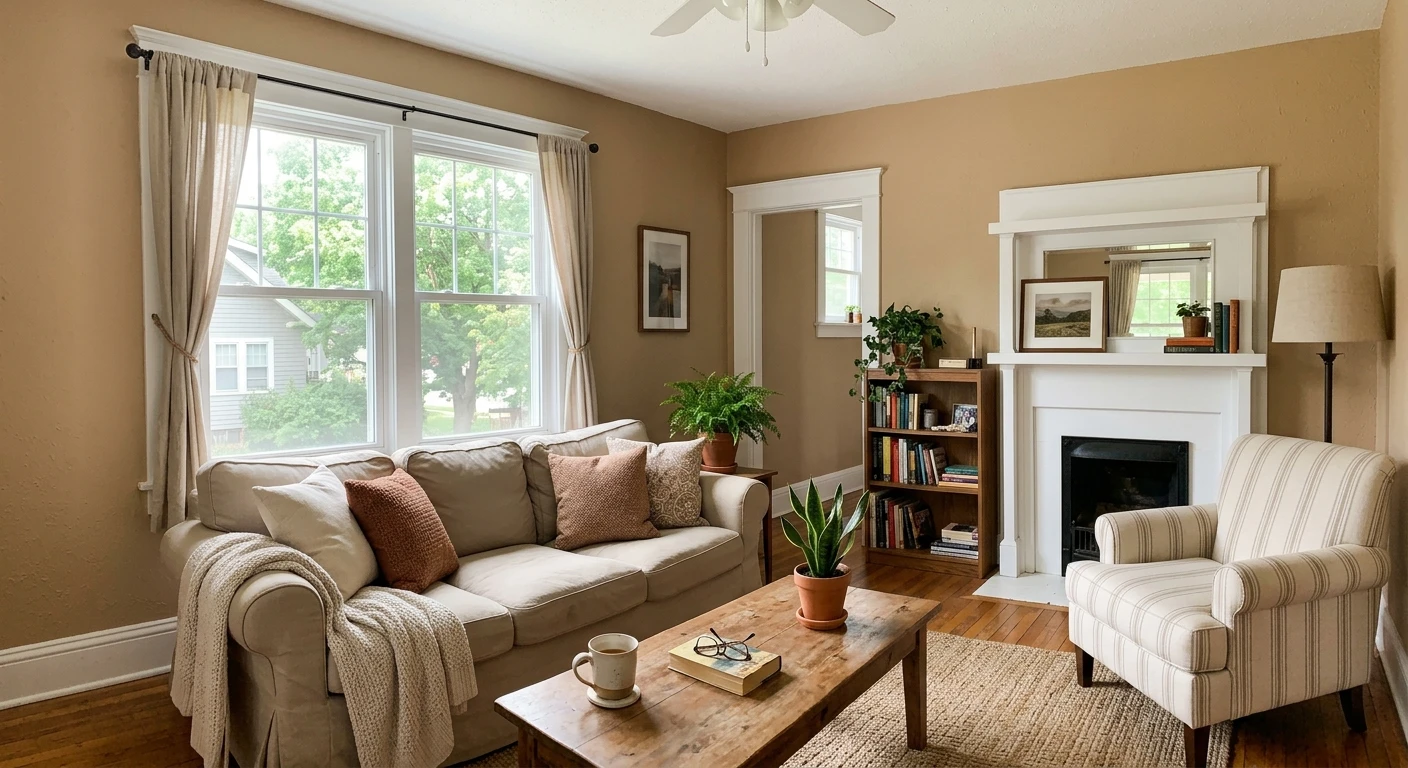
Try it on your house

The closest widely recommended Benjamin Moore match for Sherwin-Williams Kilim Beige (SW 6106, LRV 57) is Grant Beige (HC-83), a warm greige at an approximate LRV of 56.
On the Behr deck, the most commonly cited match is Baja (PPU7-08), a beachy warm beige at an approximate LRV of 55.
The deltas are small (roughly 1 to 3 LRV points, plus a light undertone shift), so treat these as very close starting points, not clones. The only way to be sure is to confirm the match on your own wall.
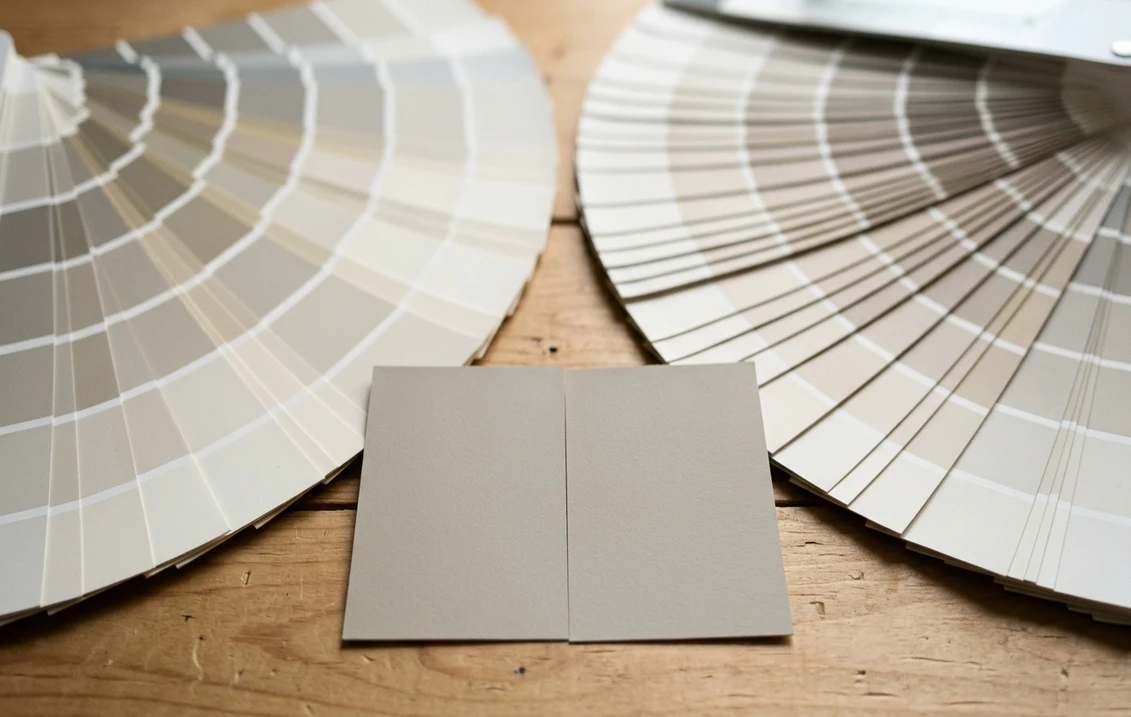
Kilim Beige is one of Sherwin-Williams' most-loved warm beiges, so plenty of people want it on a Benjamin Moore or Behr fan deck instead. Here is the honest part: no paint brand publishes official cross-brand equivalents. Matching is not a secret lookup table, it is about finding the color with the closest LRV (how light or dark it reads) and the closest undertone. If you want the full method first, we walk through how cross-brand paint matching works. Below we line up the closest matches, with numbers, so you know exactly how close each one lands.
The closest matches, side by side
| Color | Brand + code | Approx LRV | Undertone vs Kilim Beige | Verdict |
|---|---|---|---|---|
| Kilim Beige (#D7C5AE) | Sherwin-Williams SW 6106 | 57 | Reference (warm beige with a gentle gold warmth) | The color you are matching |
| Grant Beige (#CEC5B0) | Benjamin Moore HC-83 | ~56 | Almost the same depth, a hair more muted and greige (a little less of Kilim's gold) | Closest widely recommended BM match |
| Shaker Beige (#D1C2A7) | Benjamin Moore HC-45 | ~54 | A touch deeper, a bit more gold (coffee with cream) | Good BM alternative if you want more warmth |
| Baja (#D2C1A8) | Behr PPU7-08 | ~55 | Slightly deeper, a touch more golden-sepia (beachy) | Closest widely cited Behr match |
Try it on your house
No photo? Try a sample
LRV figures are approximations based on each brand's published values and can vary by batch and sheen. The hex codes above are approximate digital renderings for on-screen comparison only. A physical paint chip (and a real sample on your wall) is always the authoritative reference.
Upload one photo, preview Kilim Beige and its Benjamin Moore match side by side. Free, no signup.
Why there is no exact Kilim Beige equivalent
Every brand builds its colors on its own tint bases and proprietary colorants, then fans them out on its own sample deck. Sherwin-Williams formulated Kilim Beige to hit a specific spot: a warm beige at LRV 57 with enough gold to feel cozy but enough gray underneath to stay grounded, so it never tips fully into yellow or pink. No competitor set out to clone that exact recipe, so every cross-brand match lands close on LRV and undertone without being identical. That is not a flaw in the match, it is simply how the industry works.
The practical gap usually shows up in undertone and saturation. Kilim Beige is a little more saturated than most of its rivals, which is exactly why Grant Beige, despite sitting almost on top of it for lightness, reads a hair more muted and greige when the two are side by side. Shaker Beige pushes the other way, a touch warmer and more gold, while Behr's Baja leans toward a beachy sepia. Under bright southern light those differences shrink, and under cool north light or heavy LED they can widen. That is why an LRV delta of 1 to 3 points, which looks tiny in a table, can still feel like a real shift across a full wall at 4 p.m.
There is also the base and tint question. A color like Kilim Beige can be mixed into a light base or a deep base depending on the sheen and coverage you order, and each brand meters its colorants a little differently. Two cans that scan almost the same on a fan deck can dry down with slightly different depth once they cure on drywall. None of this makes a cross-brand swap a bad idea. It just means the smart move is to treat the codes above as your shortlist, then let a real sample settle the final call.
When the Benjamin Moore match works (and when to stay Sherwin-Williams)
Picking the right lane is less about which brand is better and more about which system your project already lives in. A few concrete calls:
- Choose the Benjamin Moore match when you are already speccing a whole-house Benjamin Moore palette and want your beige to sit in the same fan deck as your trim and accent colors. Grant Beige (HC-83) keeps everything on one system.
- Stay with Sherwin-Williams Kilim Beige when it already appears elsewhere in your home, in HOA documents, or on an existing wall, since even the closest BM match will read a little different when the two sit next to each other.
- Reach for Shaker Beige (HC-45) instead of Grant Beige when you want Kilim's gold warmth pushed a touch further, or grab Baja (PPU7-08) if you are already shopping the Behr rack at the home center.
- Before you commit either way, it helps to know how the original behaves: our guide to Kilim Beige undertones and best rooms shows where it shines and where it can turn peachy, and if you would rather judge these deltas yourself, here is how to compare two paint colors the right way.
Related matches
If Kilim Beige is one stop on a bigger neutral hunt, you may be weighing its neighbors too. We ran the same closest-match exercise for two of them: here is the Benjamin Moore match for Natural Linen, the soft warm off-white a step lighter than Kilim, and the Benjamin Moore match for Colonnade Gray, the warm greige to reach for when you want to step off beige toward something cooler and grayer.
A beige this warm rarely carries a scheme on its own: the front door, the shutters, or the island usually take a near-black, and that pick needs its own cross-brand answer. The Benjamin Moore equivalent of Iron Ore runs the same LRV-and-undertone exercise at LRV 6, and the sampling advice there is the mirror image of this page: on a soft black the distance between two brands widens in shadow and closes up in direct sun, so the test board has to sit where the color will actually live.
Frequently asked questions
What is the closest Benjamin Moore equivalent of Kilim Beige?
The closest widely recommended Benjamin Moore match is Grant Beige (HC-83), a warm greige with an approximate LRV of 56 against Kilim Beige at LRV 57. The two sit almost on top of each other for lightness, but Kilim is a little more saturated, so Grant Beige reads a hair more muted and greige side by side. If you want more of Kilim's gold warmth, Shaker Beige (HC-45) at roughly LRV 54 leans warmer. Neither is an official equivalent, so test the match on your own wall before you commit.
Is there a Behr version of Kilim Beige?
Yes, the most commonly cited Behr match is Baja (PPU7-08), a beachy warm beige with a golden-sepia undertone at an approximate LRV of 55. That is about two points deeper than Kilim Beige (LRV 57), so expect it to feel a touch warmer and cozier. Behr does not publish an official Kilim Beige equivalent, and the deck-to-deck undertone shift is real, so confirm it with a sample on your wall.
What is the LRV of Kilim Beige, and why does it matter for matching?
LRV (Light Reflectance Value) measures how much light a color bounces back, from 0 (black) to 100 (pure white). Kilim Beige sits at LRV 57, a mid-tone that gives it more body than a pale builder beige without going dark. When you match across brands, LRV is the fastest sanity check: if a candidate is more than about 4 or 5 points off, it will visibly read lighter or darker on the wall even when the undertone is similar.
Will the Benjamin Moore match look identical to Kilim Beige on my wall?
Not exactly. Every brand mixes on its own tint base and colorants, so even the closest match shifts slightly under your lighting, next to your floors, and against your trim. The matches here are close on paper (small LRV and undertone deltas), but the only way to be sure is to test the color on your own wall. Our free tool lets you preview Kilim Beige and its Benjamin Moore match on a photo of your actual room.
1 HD render plus 3 free color variations. See the SW color and its BM match on your real wall.
Trademark notice. Sherwin-Williams and Kilim Beige, Benjamin Moore, and Behr are trademarks of their respective owners. FacadeColorizer is not affiliated with, endorsed by, or sponsored by these companies. Brand and color names are used descriptively (nominative fair use). Hex and RGB values are approximate digital renderings; the only authoritative reference is a physical paint chip.
Trademarks mentioned (Sherwin-Williams, Benjamin Moore, Behr, Caparol, Brillux, Sto, Alpina, Valspar, PPG, Glidden, Dulux, Crown Trade, Sandtex, Farrow & Ball, Johnstone's, Leyland) are property of their respective owners. FacadeColorizer is independent and not affiliated with any of them. Nominative fair use under Lanham Act §1125.