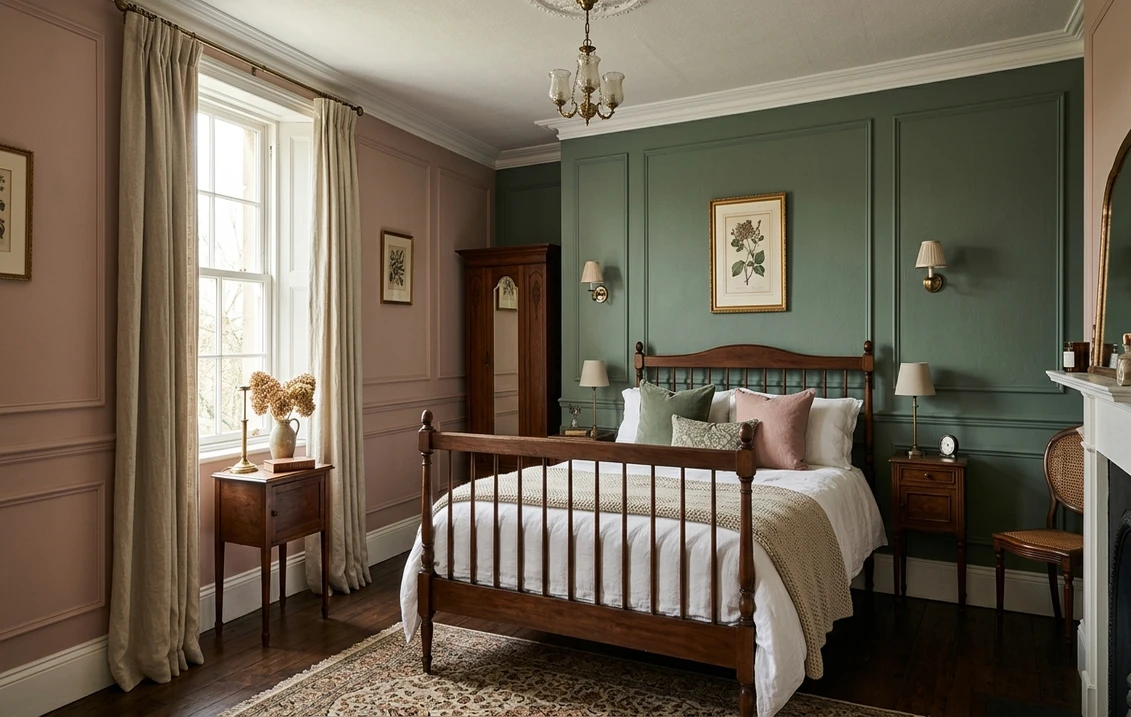
Try it on your room

Verdict in one line: choose Farrow & Ball if you want a chalky, light-shifting heritage finish for period drawing rooms and statement walls, and choose Little Greene if you need a washable, easier-to-apply emulsion with deeper opacity for high-traffic rooms and budget-aware whole-house repaints.
According to Which? and British decorator surveys, Farrow & Ball and Little Greene are the two most requested heritage paint brands in the UK. Both sit at the premium end (roughly double the price of mid-market emulsions), both target period property owners and design-led renovators, yet they behave very differently on the wall.
This 2026 guide compares Farrow & Ball Estate Emulsion against Little Greene Intelligent Matt Emulsion across price, coverage, pigment depth, finish range and real-world brush performance, with a verdict by room and style. Data drawn from each brand's technical data sheets, Which? paint reviews and Painters and Decorators Association feedback.
For full pricing, see our complete UK cost guide. You can also preview these heritage colours on your own walls with the free paint visualiser before committing to a tin.
Price per litre: Little Greene edges ahead
On the 2.5 L tin that most UK decorators buy for a standard room, Farrow & Ball Estate Emulsion is £56 (£22.40 per litre) while Little Greene Intelligent Matt Emulsion is £52 (£20.80 per litre). The £4 per tin gap looks small, but on a typical three-bedroom house repaint (around 20 litres), Little Greene saves roughly £32 before trade discount.
Both brands offer around 15 percent trade discount through accredited decorator schemes. Mid-market competitors like Dulux Heritage sit at £38 for 2.5 L (for a closer look at that brand, see our Dulux Heritage vs Farrow and Ball interior comparison), so the premium for either heritage brand is 37 to 47 percent above mainstream. For most homeowners the decision rarely comes down to £4 per tin.
Smaller tester pots are where the brands diverge most: Farrow & Ball sample pots cost £8.50 for 100 ml, Little Greene tester pots are £5.95 for 60 ml. Per millilitre, F&B is actually the cheaper sampler. Given that both brands strongly recommend testing multiple shades in situ under morning, noon and evening light, budget at least £50 for samples before committing to a full tin purchase.
Delivery adds a layer. Little Greene offers free UK mainland delivery above £75 and next-day via its own network. Farrow & Ball ships free above £50 but uses third-party couriers, which in our experience means occasional delays on larger orders. Both brands stock via independent decorator merchants, where trade prices often undercut retail.
Coverage: Little Greene's Intelligent Matt wins on paper
Farrow & Ball Estate Emulsion quotes 12 to 14 sqm per litre, while Little Greene Intelligent Matt quotes 13 to 15 sqm per litre. Over a 40 sqm bedroom with two coats, Little Greene typically needs 5.3 L versus 5.7 L for Farrow & Ball: one fewer tin on larger projects.
The coverage gap widens with deep colours. Farrow & Ball's darker shades (Hague Blue, Railings, Studio Green) notoriously need three coats over white primer, a known quirk acknowledged even by the brand's own technical line. Little Greene's deeper shades generally achieve full opacity in two coats, thanks to slightly higher titanium dioxide loading in the tinting bases.
Eco credentials: both water-based, Little Greene pushes further
Both manufacturers are water-based and carry low-VOC certification (under 30 g/L for matt emulsions). Both are child-safe once dry and meet EN 71-3 toy safety standards.
For a nursery, that certification is the floor rather than the answer. What actually decides the room is the off-gas window before the cot goes back in, and how the finish copes with skirtings wiped down every week, neither of which appears on a low-VOC label. Our guide to baby-safe nursery paint colours sets out that timeline and the twelve shades that hold up in use.
Little Greene manufactures its water-based emulsions in the UK and has moved its tins to recyclable steel in recent years, alongside published carbon-reduction commitments. Farrow & Ball manufactures in Wimborne, Dorset, and publishes its own sustainability and responsible-sourcing programme. On pure eco scoring the two are broadly comparable, with the practical differences sitting in packaging and takeback rather than in the paint itself. Always check each brand's current published environmental statement, as these programmes are updated year to year.
If sustainability sits high on your brief (and for a growing share of UK heritage renovators in 2026 it does), the detail below separates marketing language from substance. Both brands removed nearly all VOC content years ago, so the differentiators now sit in tin material, takeback schemes and manufacturing energy.
| Eco criterion (2026) | Farrow & Ball | Little Greene |
|---|---|---|
| VOC level (matt emulsion) | Under 30 g/L (minimal) | Under 30 g/L (minimal) |
| Water-based base | Yes, across emulsions | Yes, across Intelligent range |
| Manufacturing | Wimborne, Dorset | UK manufactured |
| Published eco programme | Sustainability and sourcing programme | Carbon-reduction commitments |
| Tin recyclability | Recyclable steel | Recyclable steel |
| Packaging circularity | Recyclable tin, takeback via merchants | Recyclable tin, leftover via Community RePaint |
| Toy-safety standard | EN 71-3 once dry | EN 71-3 once dry |
Try it on your house
No photo? Try a sample
One practical note for 2026: leftover heritage paint should never go down the drain or into general waste. Most UK county recycling centres now accept part-used water-based emulsion through the Community RePaint network, which redistributes usable tins to community projects. Buying the right quantity first time (using the coverage figures above) is the single biggest thing a homeowner can do to reduce paint waste, ahead of any brand-level eco claim.
Pigment is also why neither brand can be perfectly copied. A Dulux Decorator Centre or a Valspar counter will scan a Farrow & Ball or Little Greene chip and mix the nearest recipe in its own system, and a professional decorator writing for the Decorator's Forum puts the result plainly: colour matches "can get close, but never exact", because the pigments differ and the colour shifts under a different light. Our guide to Dulux colour matching covers when a cross-brand match is sensible and when it is not.
Colour depth and pigment concentration
This is where the two brands diverge most visibly. Farrow & Ball uses a proprietary blend of rich pigments with its signature chalky, light-absorbing finish: the paint looks soft, almost powdery, and shifts noticeably through the day. That is why F&B swatches are non-negotiable; a sample pot on the wall at 8 am looks different at 3 pm.
Little Greene uses higher pigment concentration in its Colours of England and National Trust ranges, giving a deeper, more saturated appearance with less daylight variation. The finish is flatter and more uniform, which many professional decorators prefer for consistency across adjoining rooms.
Upload a photo of your room - test Farrow & Ball and Little Greene shades side by side
Finish options and ranges
Outside, the comparison narrows to two eggshells: Farrow & Ball's Exterior Eggshell in two coats four hours apart, and Little Greene's Intelligent Exterior Eggshell at about 12 m² per litre, two coats 16 hours apart and a 15 % sheen according to its data sheet. Our green front door colours guide uses both on the greens each brand is known for.
Farrow & Ball offers eight interior finishes: Estate Emulsion (matt, walls), Modern Emulsion (washable matt), Dead Flat, Estate Eggshell, Modern Eggshell, Full Gloss, Dead Flat and Wood Primer. The palette holds 132 curated colours, deliberately limited.
Little Greene offers a broader finish lineup including Intelligent Matt, Intelligent Eggshell, Intelligent Satinwood, Absolute Matt, Traditional Oil Gloss and specialist masonry lines. The colour library spans over 200 shades across Colours of England, National Trust and Re:Mix repurposed ranges, giving more flexibility for complex heritage schemes.
One point that decides more projects than either finish list: both palettes carry outdoors. Little Greene has its masonry lines and Farrow & Ball has Exterior Masonry, so a colour committed to in the hall can run onto the render of the same house. The shade will not behave identically out there. A textured wall throws shadow into every dimple and reads heavier than the same colour on flat plaster, which is why our guide to pebbledash paint colour ideas tests these heritage shades on real UK roughcast rather than on a chart.
Brush and roller performance
Professional decorators consistently rate Little Greene Intelligent Matt as the easier application: better flow, fewer lap marks, more forgiving on second coats. It is formulated to be scrubbable (hence "Intelligent") and handles touch-ups without flashing.
Farrow & Ball Estate Emulsion has a characteristic thicker body that demands good technique. On large walls, lap marks are a real risk if you stop mid-wall; the paint dries fast and the join shows. Modern Emulsion (F&B's washable version) applies more like Little Greene and is increasingly recommended for high-traffic rooms.
For roller selection, both brands recommend a medium-pile microfibre roller (10-12 mm) for walls and a good quality synthetic brush for cutting in. Farrow & Ball specifically advises against foam rollers, which leave a stippled texture that jars against the signature chalky finish. Little Greene is more tolerant of roller choice, another reason DIY decorators tend to prefer it.
Spraying is another consideration. Little Greene Intelligent Matt sprays well through HVLP and airless setups at factory viscosity, requiring little thinning. Farrow & Ball Estate Emulsion typically needs 5 to 10 percent water thinning for spray application, and the brand recommends Modern Emulsion for spray jobs instead. For whole-house refurbishment where spraying saves days of labour, Little Greene is the practical choice.
Drying time and recoat
Both brands quote touch-dry in 1 hour and recoat in 4 hours at 20 degrees Celsius and 50 percent humidity. In practice, Little Greene feels slightly faster to true cure (7 days vs 14 days for full hardness on F&B Estate Emulsion), which matters if you need to rehang artwork or move furniture quickly.
Warranty and product support
Neither brand offers a years-based warranty on interior emulsion (standard in the UK market). Both provide dedicated colour consultancy: Farrow & Ball Colour Consultant visits cost £395 in-home, Little Greene offers free phone consultations and £250 in-home visits. Technical support lines are responsive and both run active trade accreditation schemes.
Batch consistency is another support dimension worth flagging. Both brands use computerised tinting, but decorators occasionally report slight shade drift between batches on very large jobs. The fix is to buy all tins for one continuous wall area at the same time from the same batch, which both brands note on their tin labels. If you are part-way through a job and run short, take an empty tin to the merchant to match the exact batch reference rather than a fresh mix.
Longevity and repaint cycle
In real-world use, both brands deliver 8 to 12 years before requiring a refresh in low-traffic rooms such as drawing rooms and bedrooms. In high-traffic zones (hallways, family kitchens, stairwells), the gap widens: Little Greene Intelligent Matt typically holds well for 7 to 10 years thanks to its washable surface, while Farrow & Ball Estate Emulsion in the same room tends to mark and show wear within 4 to 6 years, requiring local touch-ups that can flash if the original batch is no longer available.
This is the single most undervalued point in any F&B vs Little Greene conversation. A £4 per tin saving matters less than paying a decorator £1,200 to redo a hallway three years earlier than necessary. For durability-first rooms, pick the washable finish in either brand.
True cost of a room: paint plus labour over ten years
Sticker price per tin is the wrong number to anchor on. The figure that actually decides value is the ten-year cost of keeping a room looking right, which combines paint, decorator labour and how often you repaint. The worked example below uses a typical 40 sqm hallway (a high-traffic room where the brands diverge most), priced as of 2026 with a mid-range London-fringe decorator day rate of roughly £200 to £250.
| 40 sqm hallway, 2 coats | F&B Estate Emulsion | Little Greene Intelligent Matt |
|---|---|---|
| Tins needed (approx) | 3 x 2.5 L | 3 x 2.5 L |
| Paint cost per repaint | Around £168 | Around £156 |
| Typical repaint interval | 4 to 6 years | 7 to 10 years |
| Repaints in 10 years | 2 (and often interim touch-ups) | 1 |
| Indicative 10-year cost* | Around £900 to £1,100 | Around £450 to £550 |
*Indicative figures combining paint and a single decorator day per repaint, as of 2026, excluding scaffolding or making-good. The headline is counter-intuitive: in a hallway, the brand that costs £4 more per tin (Farrow & Ball) can cost roughly double over a decade because Estate Emulsion is not washable and marks faster, so it gets repainted sooner. Flip the room to a low-traffic adult bedroom and the table collapses: both brands hold 8 to 12 years, the repaint counts equalise, and the decision goes back to pure aesthetics where Farrow & Ball's chalky light-shift earns its premium honestly.
The decision rule that falls out of this is simple. Match the finish to the room's traffic, not the brand to your taste. A washable matt (Little Greene Intelligent Matt or F&B Modern Emulsion) belongs anywhere hands, splashes or shoes go near the wall. A breathable chalky matt (F&B Estate Emulsion or Little Greene Absolute Matt) belongs in calm rooms where the surface is rarely touched and the look does the work.
Full 2026 comparison table
Ten criteria side by side, based on each brand's technical data sheets, Which? 2025 emulsion testing and professional decorator surveys.
| Criterion | Farrow & Ball | Little Greene |
|---|---|---|
| Price 2.5 L | £56 | £52 |
| Coverage per litre | 12-14 sqm | 13-15 sqm |
| Coats needed (deep shades) | 2-3 coats | 2 coats |
| Water-based / VOC | Yes / under 30 g/L | Yes / under 30 g/L |
| Colour library | 132 shades | 200+ shades |
| Finish character | Chalky, light-shifting | Flat, saturated, uniform |
| Finish options | 8 finishes | 10+ finishes |
| Brush / roller feel | Thick, lap marks risk | Smooth flow, forgiving |
| Recoat time | 4 hours | 4 hours |
| Washability | Modern Emulsion only | Built in (Intelligent) |
2026 colour direction: where each brand leads
Range size matters less than range character. Both brands refreshed their direction for 2026, and the split tells you a lot about who each is for. Farrow & Ball continues to lean into warm, complex off-whites and earthy mid-tones: the kind of soft, slightly muddy neutrals (think the territory around Stiffkey, School House White and Setting Plaster) that read beautifully under low northern light and reward the brand's signature chalky depth. These are colours you choose for atmosphere, not for boldness.
Little Greene pushes harder into saturated, confident colour, particularly through its deep greens, inky blues and the archival Re:Mix and National Trust collaborations that revive historically accurate Georgian and Regency shades. Because the pigment loading is higher and the finish flatter, those deep tones land with full opacity in two coats and stay visually consistent from morning to evening. If your 2026 scheme involves a dark, enveloping room (a study, a dining room, a panelled snug), Little Greene's range is built for it.
A useful shortcut: pick Farrow & Ball when the colour should feel like it has always been there, and Little Greene when the colour should make a statement and stay exactly that colour all day. Neither is more "heritage" than the other; they simply interpret heritage with different priorities, one toward softness and light play, the other toward depth and consistency.
Verdict by room and style
Neither brand is universally "better". The right choice depends on the room, the light and the look you want. Here is a clear verdict grid drawn from interior designer briefs and professional decorator feedback.
| Room / Style | Recommended | Why |
|---|---|---|
| Period drawing room, soft neutrals | Farrow & Ball | Chalky depth suits Georgian and Victorian light |
| Kitchen, bathroom, hallway | Little Greene | Washable Intelligent Matt handles traffic and moisture |
| Deep dark colour scheme | Little Greene | Full opacity in 2 coats, even on deep shades |
| Nursery, child's bedroom | Little Greene | Scrubbable finish, deeper colour hold |
| Statement feature wall | Farrow & Ball | Signature light-shift creates drama |
| Whole-house repaint, budget-aware | Little Greene | Better coverage, fewer tins, easier touch-ups |
| Listed building, heritage palette | Either | Both supply conservation-grade heritage colours |
Room lighting and pigment behaviour
The single most overlooked variable in a Farrow & Ball versus Little Greene decision is room lighting. F&B's signature chalky finish is engineered to shift through the day, soft and warm at 8am, deeper and moodier at 7pm under 2700K bulbs. That shift is the brand's USP, but it also means a north-facing back bedroom in Sheffield with limited daylight will read F&B Pigeon (LRV 35) as cold and flat for most of the year. Little Greene's flatter, more saturated finish holds its visual identity more reliably under cool LED lighting and is the safer pick for rooms used during the day.
For evening rooms (dining rooms, snugs, drawing rooms), the F&B light-shift becomes an asset. Hague Blue under candlelight is a fundamentally different colour than the same paint at 11am. The CIBSE Lighting Guide series (referenced via CIBSE's knowledge portal) covers the Colour Rendering Index (CRI) values that affect chalky pigment depth. For UK lighting regulations, Approved Document L on gov.uk sets minimum lumens per square metre for habitable rooms, useful background when specifying bulb wattage alongside paint selection.
Traffic flow and finish durability head-to-head
This is where the durability conversation gets sharper than either brand's marketing suggests. Farrow & Ball Estate Emulsion in a high-traffic hallway typically shows wear (scuffs, marks, shadowing around light switches) within 4 to 6 years. Little Greene Intelligent Matt in the same hallway typically holds for 7 to 10 years thanks to its built-in scrub resistance, which maps to BS EN 13300 Class 2 wet-scrub testing versus F&B Estate Emulsion's Class 3 to 4. The maths is simple: a £350 hallway repaint every five years (F&B) costs more long-term than the same hallway repainted every nine (Little Greene), even before factoring in furniture moving and inconvenience.
For kitchen and bathroom applications, both brands offer washable alternatives. F&B Modern Emulsion moves to Class 1 wet-scrub and is the brand's answer to high-moisture rooms. Little Greene Intelligent Matt is washable across the entire range as standard. For mould-resistance certification under BS EN 15457, both brands declare compliance for their kitchen-and-bathroom-rated finishes. The BSI British Standards index covers the relevant references (BS EN 13300, BS EN 15457, BS 7079) used by UK decorators when specifying paint systems.
Paint finishes UK: matt, eggshell, satin and gloss
Both brands offer the four core UK finish categories plus speciality variations. The table below summarises the typical specification against BS EN 13300 wet-scrub Class. Use it to brief your decorator and compare across both brands on like-for-like terms.
| Finish | Light reflection | Wet-scrub Class (BS EN 13300) | F&B equivalent | Little Greene equivalent |
|---|---|---|---|---|
| Matt | Less than 10 percent | Class 3 to 4 | Estate Emulsion, Dead Flat | Absolute Matt |
| Washable matt | Less than 10 percent | Class 1 to 2 | Modern Emulsion | Intelligent Matt |
| Eggshell | 10 to 25 percent | Class 2 | Estate Eggshell, Modern Eggshell | Intelligent Eggshell |
| Satin | 25 to 40 percent | Class 1 to 2 | (not offered) | Intelligent Satinwood |
| Gloss | Over 60 percent | Class 1 | Full Gloss | Traditional Oil Gloss |
For consumer-facing background on finish selection, Dulux UK's paint finish guide covers the four UK finish categories with photographic examples. Both Farrow & Ball and Little Greene can be ordered directly from their websites or via independent decorator merchants; both also retail through selected outlets at Wickes (for the Little Greene exclusive partnership) and through specialist showrooms rather than B&Q or Homebase, which tend to stock the mass-market brands.
Frequently asked questions
Is Farrow & Ball worth the extra cost over Little Greene?
Only if you want the distinctive chalky, light-shifting finish that Farrow & Ball is known for. For straightforward heritage colour in high-traffic or durable locations, Little Greene Intelligent Matt delivers better coverage, easier application and a washable finish for £4 less per 2.5 L tin. The Farrow & Ball premium is really about the look of the paint in different light, not objective performance.
Which brand has better coverage on dark colours?
Little Greene, consistently. Farrow & Ball deep shades like Hague Blue, Railings and Studio Green often need three coats to reach full opacity over white primer, which the brand acknowledges in its application notes. Little Greene's higher pigment loading means deep colours typically achieve full coverage in two coats. On a dark-scheme whole-room job, that one extra coat adds roughly 4 hours of labour and one additional tin.
How much does a single room cost in each brand in 2026?
For a standard 40 sqm room in two coats, expect roughly three 2.5 L tins either way. As of 2026 that is around £168 in Farrow & Ball Estate Emulsion versus around £156 in Little Greene Intelligent Matt, before trade discount. The bigger number is labour: a decorator day at £200 to £250 dwarfs the paint, which is why the durable, washable finish (Little Greene, or F&B Modern Emulsion) tends to win on ten-year cost in any room that gets touched. Treat these as typical 2026 ranges; both brands adjust list prices periodically and merchant trade rates often undercut retail.
Can I mix Farrow & Ball and Little Greene in the same house?
Yes, and many UK schemes do exactly that. A common 2026 approach is Farrow & Ball in the calm, low-traffic rooms (main bedroom, formal sitting room) where its chalky light-shift is the whole point, and Little Greene in the working rooms (kitchen, hallway, children's spaces, bathroom) where washability and daylight stability matter more. The two brands use different colour-matching systems, so do not assume a shade in one has an exact twin in the other; always test pots of the actual product in the actual room rather than matching on screen.
Are both brands safe for nurseries and kitchens?
Yes. Both are water-based with under 30 g/L VOC, certified to EN 71-3 toy safety and considered safe for nurseries once fully dry (allow 14 days for Farrow & Ball Estate Emulsion, 7 days for Little Greene Intelligent Matt to reach full cure). For kitchens and bathrooms, choose Little Greene Intelligent Matt or Farrow & Ball Modern Emulsion rather than standard Estate Emulsion: both are scrubbable and moisture resistant.
Keep comparing
Heritage paint decisions rarely stop at a straight two-way call. If Dulux Heritage is on your shortlist, our Dulux Heritage versus Farrow & Ball piece weighs the mid-market challenger against the F&B chalky look. Want to see where the premium actually earns its keep? Farrow & Ball against Crown pits heritage depth against a trade workhorse, while Crown versus Dulux settles the mainstream question for anyone repainting on a tighter budget.
Both brands cost 50 pounds plus a tin: preview the shade on your walls first, free.
Compare Farrow & Ball and Little Greene shades on a photo of your own room - free, no signup
The right heritage paint depends on your room, light and lifestyle. Before ordering tins at £50+ each, upload a photo of your room and test Farrow & Ball and Little Greene shades side by side with our free AI interior colour visualiser. Sources: Farrow & Ball technical data sheets 2025, Little Greene Paint Company technical sheets 2025, Which? emulsion paint reviews.
Trademarks mentioned (Sherwin-Williams, Benjamin Moore, Behr, Caparol, Brillux, Sto, Alpina, Valspar, PPG, Glidden, Dulux, Crown Trade, Sandtex, Farrow & Ball, Johnstone's, Leyland) are property of their respective owners. FacadeColorizer is independent and not affiliated with any of them. Nominative fair use under Lanham Act §1125.