Try it on your room

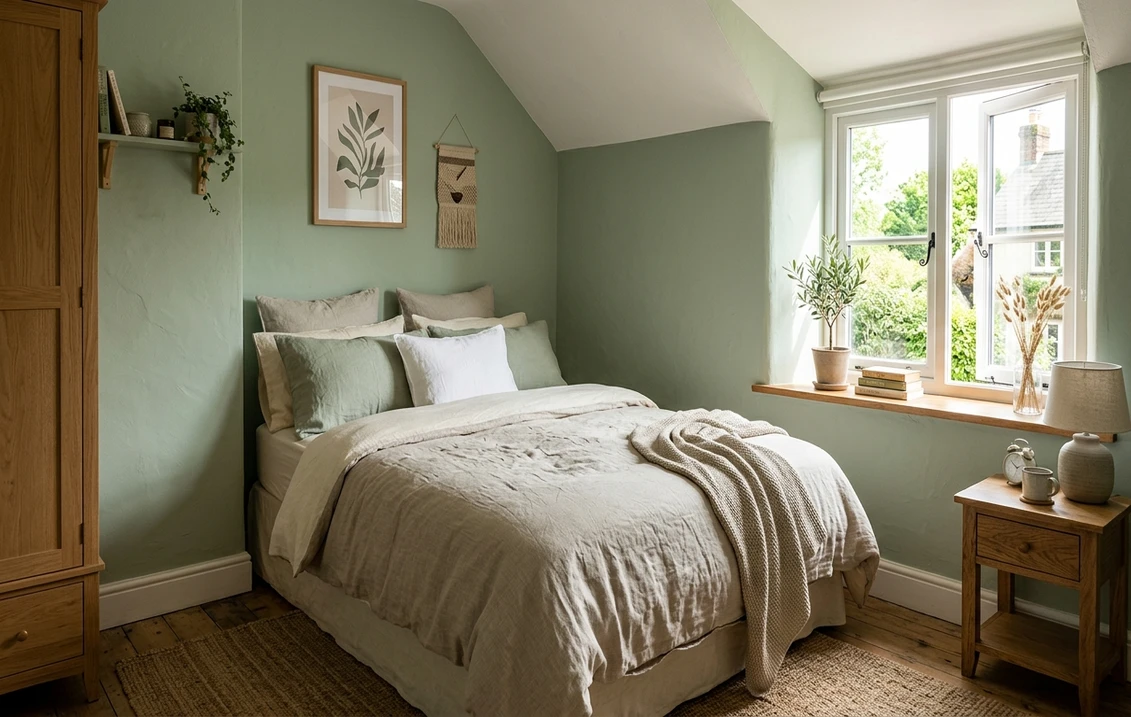
According to the English Housing Survey 2025, the average UK box bedroom measures just 7ft by 8ft (roughly 5.2 m2), below the 6.5 m2 minimum recommended for single-occupancy sleeping. Loft conversions and period flats add sloped ceilings, deep bay windows and limited natural light. In 2026, UK decorators use specific tonal strategies with Farrow & Ball, Little Greene and Dulux Heritage to make these rooms feel 20 to 30 percent larger.
This guide covers the 15 best small bedroom paint colours for UK homes in 2026, with exact codes, feature wall logic, the ceiling-same-as-walls technique, and orientation-specific advice for box rooms, loft conversions and bay-window flats.
For full pricing, see our complete UK cost guide.
The 15 best small bedroom paint colours in the UK for 2026
These 15 shades balance three qualities for small rooms: high Light Reflectance Value, undertones that do not skew cold, and quiet matt or eggshell finishes that hide wall imperfections in older UK properties.
| Colour | Brand & Code | Undertone | Best for |
|---|---|---|---|
| Pale Powder | Farrow & Ball No.204 | Whisper blue-green | North-facing box room |
| Strong White | Farrow & Ball No.2001 | Cool architectural white | South-facing loft rooms |
| Shadow White | Farrow & Ball No.282 | Warm grey-taupe white | Victorian box room, dim aspect |
| Matchstick | Farrow & Ball No.2013 | Warm cream-yellow | North-facing box bedroom |
| Slaked Lime | Little Greene 105 | Chalky warm white | Loft conversion, sloped walls |
| Rolling Fog Mid | Little Greene 144 | Muted cool grey | Bay-window flat bedroom |
| Chalk White | Dulux Heritage | Soft off-white | Any small bedroom, rentals |
| Oatmeal | Dulux Heritage | Warm pink-beige | Period flat, west-facing |
| Slipper Satin | Farrow & Ball No.2004 | Warm off-white | Box room, ceiling match |
| Cornforth White | Farrow & Ball No.228 | Cool balanced grey | Loft with Velux windows |
| Skimming Stone | Farrow & Ball No.241 | Warm greige | North-facing single bedroom |
| James White | Farrow & Ball No.2010 | Green-tinted white | Period flat with dark wood |
| Loft White | Little Greene 222 | Bright clean white | Loft conversion, bright aspect |
| French Grey Pale | Little Greene 161 | Soft pale warm grey | Guest box room |
| Timeless | Dulux Heritage | Neutral warm beige | Rentals, any aspect |
Try it on your house
No photo? Try a sample
Box room strategy: 7ft x 8ft and the rules that actually work
The classic UK box room at 7ft x 8ft (2.1m x 2.4m) is the hardest bedroom to decorate. Four walls sit within a metre of the sleeper. The trick is not the lightest possible colour, but a warm mid-tone that continues onto ceilings and woodwork without visual breaks.
Three approaches dominate 2026 UK box-room briefs:
- Enveloping warm neutral: Farrow & Ball Shadow White No.282 or Dulux Heritage Oatmeal on all four walls, ceiling, skirting and architrave in the same shade. Removing every contrast line makes the corners of the room recede visually, adding 15 to 20 percent perceived volume.
- Airy pale-cool: Farrow & Ball Pale Powder No.204 or Little Greene Rolling Fog Mid 144, again with ceiling painted the same colour. The cool undertone recedes the walls; the matched ceiling removes the "lid" effect.
- Bright chalky-white base: Little Greene Slaked Lime 105 or Loft White 222, reserved for box rooms that receive decent south or east light. Pure brilliant white is a mistake: against period plaster it reads cold and clinical.
Avoid the classic box-room errors: one dark feature wall (cuts the room in half visually), a dado rail in contrasting colour (creates a horizontal break that lowers perceived ceiling height), and strong contrasting skirting (draws the eye to the perimeter). In a 7ft x 8ft space, reducing contrast matters more than maximising brightness. For storage-heavy box rooms, paint the wardrobe wall the same colour as the wardrobe doors so the storage visually dissolves.
Upload your box room photo, test 15+ F&B and Little Greene shades in 30 seconds
Loft conversion bedrooms: sloped ceilings and Velux windows
UK loft conversions present a specific challenge: sloped ceilings that meet walls at awkward angles, dormer windows recessed into the roofline, and Velux skylights that wash the space with raking light. Painting walls one colour and sloped ceilings brilliant white is a recipe for a room that reads like a cross-section diagram rather than a bedroom.
The 2026 loft-conversion rule, endorsed by Little Greene's colour consultants and the Society of British & International Interior Design, is one colour, all surfaces. Paint walls, sloped ceilings, dormer cheeks and flat ceiling in the same shade, at the same sheen, in a single continuous envelope.
- South-facing or bright loft: Farrow & Ball Strong White No.2001 or Little Greene Loft White 222, both designed to handle strong overhead Velux light without looking stark or yellowing in evening sun.
- North-facing or dim loft: Farrow & Ball Matchstick No.2013 or Shadow White No.282, which add warmth without darkening. Avoid cool whites in north-facing lofts: they read grey under overcast UK skies.
- Loft with exposed beams: Little Greene Slaked Lime 105 on all painted surfaces, leaving beams natural or painted in a close wood-tone. Matched walls/ceilings let the beams sit as architectural features rather than compete with brilliant white.
Velux skylight reveals should always be painted the same colour as the ceiling, never white: white reveals create four bright rectangles that dominate the ceiling. For dormer windows, treat the dormer ceiling, cheeks and back wall as one tonal unit in the main room colour.
Period flat bedrooms with bay windows
Victorian and Edwardian flats across London, Brighton, Bristol and Edinburgh often feature a single bedroom with a large bay window. The bay floods the room with light during the day but creates a tricky decorating problem: the bay wall has three angled surfaces and deep sashes, and the rest of the bedroom is narrow by comparison.
The decorator's trick is to treat the bay as its own light-well: paint the bay reveals, sill and ceiling in a slightly cooler or paler tone than the main walls, which lets the bay "glow" as a natural light source rather than a dark frame against the window. Two schemes work reliably:
- Main walls: Dulux Heritage Oatmeal or Farrow & Ball Skimming Stone No.241 (warm, enveloping, flatters period cornicing). Bay reveals and ceiling: Farrow & Ball Shadow White No.282 or Slipper Satin No.2004 (a shade lighter, still warm).
- Main walls: Little Greene Rolling Fog Mid 144 (muted cool grey, sophisticated in tall rooms). Bay reveals and ceiling: Little Greene Loft White 222 (crisp, not stark, letting the bay feel luminous).
Avoid painting the bay in a bold accent colour: period bay windows already carry weight through plasterwork, shutters and deep sills. Farrow & Ball James White No.2010 is the exception, suited to rooms with dark stained floorboards and original wooden shutters.
Feature wall strategy in small UK bedrooms
In a small bedroom, the traditional feature wall often backfires: one bold wall in a 7ft x 8ft room simply chops the space into two smaller zones. The 2026 UK decorator consensus is the feature wall is dead in rooms under 9 m2, replaced by a more subtle approach:
- Tonal feature wall: paint the headboard wall in the same colour as the other three but one step deeper (e.g. Pale Powder on three walls, Pale Powder at 125 percent tint behind the headboard). The difference is visible but not disruptive.
- Integrated colour drenching: paint headboard, skirting, architrave and radiator pipes in a single saturated shade (like Farrow & Ball Matchstick No.2013) and leave the other three walls as Slipper Satin. The architectural features carry the colour weight rather than a flat wall.
- No feature wall: the most common 2026 recommendation for box rooms. Four walls in the same mid-tone, ceiling matched, and a textured headboard (rattan, upholstered, painted panelling) to provide focus.
If you must have a feature wall, it should be behind the headboard, never the window wall (backlit, colour flattens) and never the wardrobe wall. Keep it within two tonal steps of the other walls.
The ceiling-same-as-walls technique
If you learn one thing from this guide, let it be this: in small UK bedrooms, painting the ceiling the same colour as the walls makes the room feel larger, not smaller. The instinct to "lift" a small bedroom with brilliant white ceiling is the single most common mistake in British decorating, and it has been overturned by nearly every 2026 Interior Design UK feature.
Brilliant white ceilings over coloured or off-white walls create a hard horizontal contrast line at 2.4m where the cornice sits. The eye reads this line as a "lid", and the room feels boxy. Painting the ceiling in the same shade as the walls, or in the wall colour at 50 percent tint, removes the lid entirely. The eye travels upward uninterrupted, and the room feels 15 to 25 percent taller.
Practical guidance for UK small-bedroom ceilings:
- Under 2.4m ceiling height (most Victorian and modern flats): match ceiling exactly to walls. No tint difference.
- 2.4m to 2.7m (typical Edwardian and 1930s): ceiling in wall colour at 50 percent tint, for a softer version that still removes the contrast line.
- Over 2.7m (period conversions, Georgian): ceiling in a slightly deeper tone than walls to lower the perceived height and bring the space to human scale.
Farrow & Ball's Dead Flat and Little Greene's Intelligent Matt suit small-bedroom ceilings: zero sheen, no glare, no reflection of plaster imperfections. Avoid silk or satin ceiling finishes.
Best finish for small bedroom walls
UK decorators in 2026 specify matt-eggshell hybrid finishes for small bedroom walls. Farrow & Ball Modern Emulsion (7 percent sheen) and Little Greene Intelligent Matt (6 percent sheen) offer eggshell's washability with a non-reflective surface that hides hairline cracks in Victorian and Edwardian plaster. Full eggshell belongs on woodwork only; gloss is rarely right in a modern UK bedroom unless restoring a Georgian property.
Light orientation: what changes in a small room
In larger bedrooms, window orientation affects colour noticeably but not dramatically. In small bedrooms, orientation is decisive: a single small window delivers limited light, and the wrong undertone can tip a room from restful to depressing. UK interior designers apply four rules:
- North-facing small bedrooms: cool bluish UK daylight needs warming. Matchstick No.2013, Shadow White No.282, Oatmeal or Skimming Stone No.241. Avoid cool greys and stark whites which read flat and sad.
- South-facing small bedrooms: generous warm light lets you use cooler shades. Pale Powder No.204, Strong White No.2001, Rolling Fog Mid 144 or Cornforth White No.228. Warm whites can read yellow here.
- East-facing small bedrooms: bright morning, cool afternoon. Pale Powder, Slaked Lime and Loft White shift pleasantly across the day. Avoid very warm shades which can read dull after midday.
- West-facing small bedrooms: cool morning, golden evening. Oatmeal, Shadow White and Skimming Stone peak beautifully at dusk, which is when most bedrooms are actually occupied.
Always test A4 paint samples on two walls (one near the window, one opposite) at 7am, midday and 10pm before committing.
Cost to paint a small UK bedroom in 2026
Small bedrooms are the cheapest room in the house to paint: low surface area, one or two small windows, and a single radiator. Typical costs for a box room, loft or bay-window bedroom under 10 m2:
| Room type | Paint only (DIY) | Decorator labour | Total |
|---|---|---|---|
| Box room (5 to 7 m2) | £70 to £120 | £130 to £220 | £180 to £320 |
| Loft conversion (8 to 10 m2) | £100 to £160 | £200 to £320 | £280 to £450 |
| Bay-window flat bedroom (9 to 11 m2) | £110 to £170 | £220 to £340 | £300 to £480 |
Loft conversions and bay-window bedrooms cost slightly more per square metre: sloped ceilings, Velux reveals, dormer cheeks, angled bay sashes and deep sills all take longer to cut in. Budget 2.5L for walls (two coats), 2.5L for ceiling, 1L for woodwork eggshell.
Frequently asked questions on small bedroom paint colours UK
What is the best paint colour for a UK box room?
For a typical 7ft x 8ft UK box room, the 2026 UK decorator consensus is a warm mid-tone applied to all four walls, ceiling, skirting and architrave. Strong options include Farrow & Ball Shadow White No.282, Matchstick No.2013 or Dulux Heritage Oatmeal. Avoid brilliant white (reads clinical against period plaster) and avoid a single dark feature wall (chops the small space in two).
Should I paint a small bedroom ceiling white or in colour?
Paint the ceiling in the same colour as the walls, or in the wall colour at 50 percent tint. Brilliant white ceilings over coloured walls create a harsh contrast line at cornice height that reads as a "lid", making the room feel shorter. Matching the ceiling to the walls is the 2026 UK decorator rule for small bedrooms under 10 m2.
What colour works best for a loft conversion bedroom?
Treat walls, sloped ceilings, dormer cheeks and Velux reveals as one continuous envelope in a single colour. For south-facing or bright lofts, use Farrow & Ball Strong White No.2001 or Little Greene Loft White 222. For north-facing or dim lofts, use Farrow & Ball Matchstick No.2013 or Shadow White No.282. Never paint sloped ceilings white while walls are coloured: it fragments the space.
Does a feature wall make a small bedroom look bigger?
No. In rooms under 9 m2, a contrasting feature wall chops the room in two and makes both halves feel smaller. In 2026, UK decorators prefer tonal feature walls (same colour, one step deeper behind the headboard) or complete colour drenching (all four walls plus ceiling in the same shade). If you must have a feature wall, keep it behind the headboard and within two tonal steps of the other walls.
Free - No sign-up - 100+ F&B, Little Greene & Dulux Heritage shades
Small UK bedrooms reward restraint: warm mid-tones, matched ceilings, tonal feature walls rather than contrasting ones. Before committing to 2.5 litres of Matchstick or Pale Powder, visualise the shade on your own box-room, loft or bay-window photo with our free AI interior colour visualiser, then order A4 sample pots from Farrow & Ball, Little Greene or Dulux Heritage. Sources: Farrow & Ball, Little Greene, Dulux Heritage, Society of British & International Interior Design, English Housing Survey 2025.
Trademarks mentioned (Sherwin-Williams, Benjamin Moore, Behr, Caparol, Brillux, Sto, Alpina, Valspar, PPG, Glidden, Dulux, Crown Trade, Sandtex, Farrow & Ball, Johnstone's, Leyland) are property of their respective owners. FacadeColorizer is independent and not affiliated with any of them. Nominative fair use under Lanham Act §1125.