Try it on your house

The closest widely recommended Benjamin Moore match for Sherwin-Williams Moody Blue (SW 6221, LRV 27) is Blue Echo (AF-505), around LRV 24: a hair deeper, but the same muted slate blue sitting on a gray-green base. If you want Moody Blue a shade lighter and softer, Sea Star (2123-30), near LRV 33, is the pick designers reach for most.
On the Behr deck, the closest easy match is Behr Polaris Blue (PPU13-06), around LRV 23, a touch deeper and slightly more saturated than Moody Blue.
The delta between all of these is small, so the numbers only get you to the right shelf. The only way to be sure is to confirm the winner on your own wall, in your own light, before you buy a gallon.
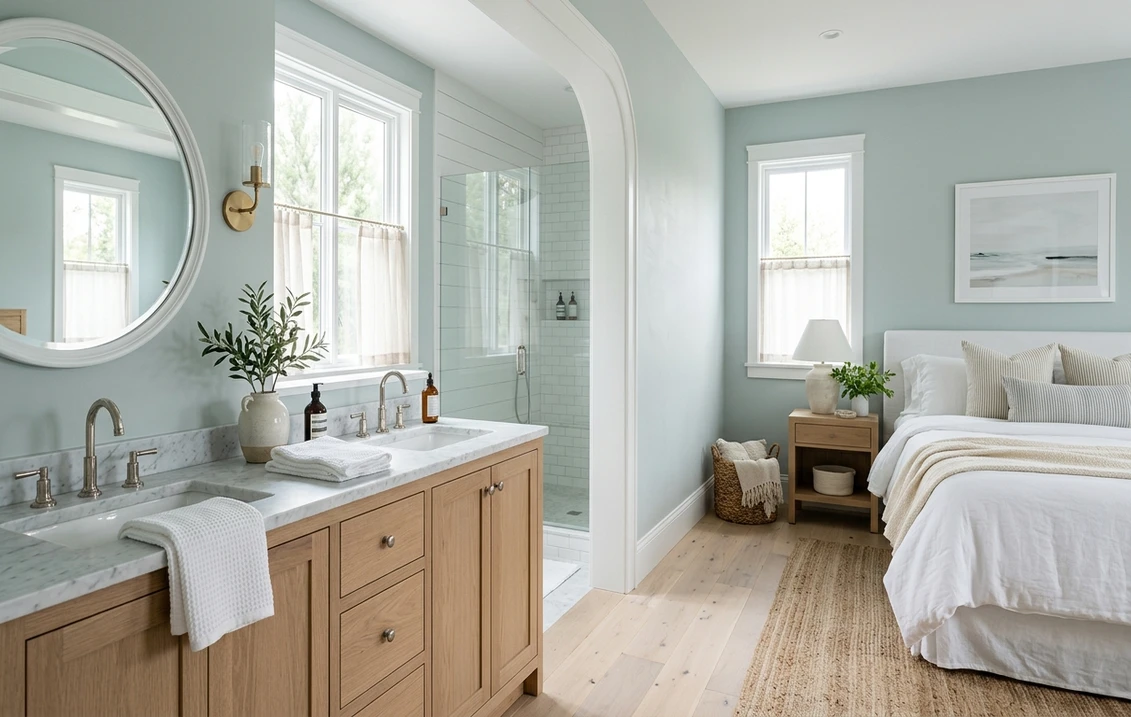
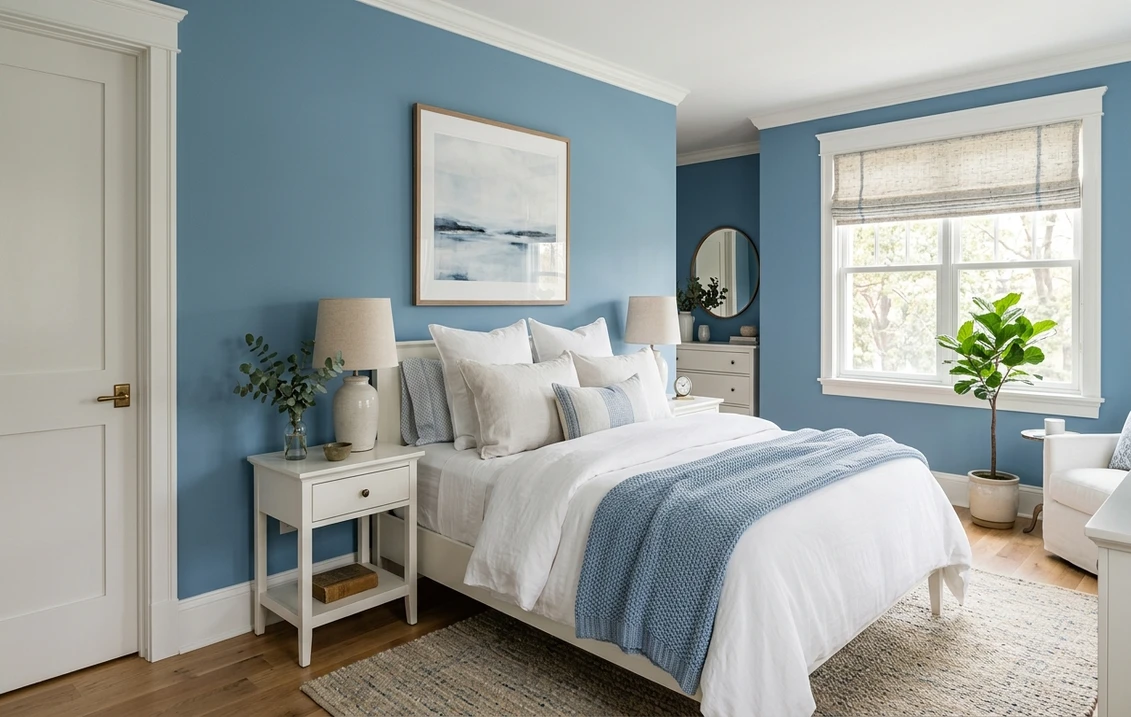
Sherwin-Williams Moody Blue is a much-loved muted slate blue, the kind of dusty, grown-up blue that reads calm on a bedroom wall, custom on cabinets, and jewel-box in a small powder room. So it is no surprise that people painting with Benjamin Moore or Behr want the same look without switching brands. The honest answer up front: no paint company publishes official cross-brand equivalents, and none of these three will ever certify a competitor's color as a match. What we can do is line up the two numbers that actually matter, LRV (how light or dark a color reads) and undertone (the gray-green cast under the blue), and find the closest fit. If you want the full method, here is how cross-brand paint matching works. For Moody Blue specifically, matching means landing within a few points of LRV 27 while holding that soft, slightly gray-green blue character.
The closest matches, side by side
| Color | Brand + code | Approx LRV | Undertone vs Moody Blue | Verdict |
|---|---|---|---|---|
| Moody Blue (approx #7A9192) | Sherwin-Williams SW 6221 | 27 | Reference: muted slate blue on a gray-green base | The color you are matching |
| Blue Echo (approx #6F898E) | Benjamin Moore AF-505 | ~24 | A hair deeper, nearly the same gray-green blue | Closest widely recommended BM match |
| Sea Star (approx #889E9E) | Benjamin Moore 2123-30 | ~33 | A shade lighter, a touch grayer and softer | Popular lighter BM alternative |
| Polaris Blue (approx #6F8A8C) | Behr PPU13-06 | ~23 | Slightly deeper and a touch more saturated | Closest easy Behr match |
Try it on your house
No photo? Try a sample
LRV figures are approximations of each brand's published data and can shift with batch and sheen. The hex values above are digital renderings meant to show relative tone on a screen, not exact color: a physical paint chip under your own lighting is the only authoritative reference.
Upload one photo, preview Moody Blue and its Benjamin Moore match side by side. Free, no signup.
Why there is no exact Moody Blue equivalent
Every brand builds its colors on its own tint bases and its own colorants, then measures them on its own equipment. Two muted blues can share almost the same LRV on paper and still read differently on a wall, because the pigments underneath are not identical. Moody Blue leans on a soft blue grayed down with a clear green-gray cast, which is why the name surprises people who expected something cleaner and brighter. Benjamin Moore and Behr each reach a similar place with a slightly different recipe, so the undertone drifts: Blue Echo lands a hair deeper, Polaris Blue a touch more saturated, and Sea Star lighter and softer. None of that is a flaw. It is simply why a cross-brand match is always a close approximation, never a certified twin.
Light makes that gap wider or narrower. A fan deck chip is drawn down under controlled store light, but your room has its own mix of daylight, warm bulbs, and color bouncing off floors and trim. Because Moody Blue carries that gray-green base, it swings more than most blues you might cross-shop: warmer and clearly blue in south light, cooler and almost teal-gray in a north room or after dark. A match that looks perfect on a chip at the paint counter can separate on the wall once your own lighting takes over, which is exactly why we treat the numbers above as a starting shelf, not a final answer.
When the Benjamin Moore match works (and when to stay Sherwin-Williams)
The right call usually comes down to the rest of your palette and how close you need the depth to land.
- Choose the Benjamin Moore match when your trim, ceiling, and coordinating grays are already Benjamin Moore, so the whole project stays inside one fan deck and one store.
- Stay with Sherwin-Williams Moody Blue when you have already sampled it and love the exact dusty read, especially on cabinets or in a powder room where the gray-green base is doing the work. See Moody Blue undertones and best rooms for where that color shines.
- Reach for Blue Echo or Polaris Blue when you want to hold Moody Blue's depth almost exactly, and reach for Sea Star when you want the same family a shade lighter and airier for a small or north-facing room.
- Whichever way you lean, put the candidates side by side the right way. Our guide to comparing paint colors walks through matching LRV and undertone instead of trusting the chip name.
Related matches
Hunting equivalents for other Sherwin-Williams blues and blue-greens? See the Benjamin Moore match for Silvermist, the soft spa blue-green, and the Benjamin Moore match for Contented, the muted gray-green sage. Both of those sit lighter than Moody Blue; going the other way, the Benjamin Moore equivalent of Urbane Bronze takes the same approach for a warm bronze-gray at LRV 8, well below Moody Blue's 27. A blue this saturated rarely covers a whole floor, so two other colors usually have to be matched alongside it. The first is the trim, since a wall at LRV 27 puts every casing line on display: Dover White on the Behr and Benjamin Moore decks handles that warm off-white at LRV 83. The second is the warm neutral in the next room: the Benjamin Moore equivalent of Accessible Beige (SW 7036, LRV 58) covers the greige most often used beside a dusty blue, and it is the swap that keeps an open plan from splitting into two schemes. Same method, same honesty: closest LRV and undertone, then a test on your own wall.
Frequently asked questions
What is the closest Benjamin Moore equivalent of Moody Blue?
The closest widely recommended match is Benjamin Moore Blue Echo (AF-505), around LRV 24. It reads a hair deeper than Moody Blue (SW 6221, LRV 27) but keeps the same muted slate blue on a gray-green base, so the two behave almost identically in a room. If you want it a shade lighter and softer, Sea Star (2123-30) near LRV 33 is the pick designers name most. There is no official equivalent, so test either one on your own wall before you commit.
Is there a Behr version of Moody Blue?
Behr Polaris Blue (PPU13-06) is the closest easy Behr match, sitting near LRV 23 with a slightly deeper, marginally more saturated read than Moody Blue. It is not an official equivalent, and Behr uses its own base and colorant system, so the gray-green undertone can shift under your lighting. Paint a sample board and check it against Moody Blue in the actual room before ordering a full gallon.
Does Benjamin Moore Blue Echo match Sherwin-Williams Moody Blue?
They are close cousins, not twins. Blue Echo (LRV around 24) sits a hair deeper than Moody Blue (LRV 27), with a nearly identical muted slate-blue and gray-green character. In most light the two are hard to tell apart, but in a dim or north-facing room Blue Echo can read a touch heavier. For a lighter take on the same color, many designers reach for Sea Star instead, then confirm the winner on the wall.
Can I get an exact Moody Blue match at Benjamin Moore or Behr?
Not officially. No paint brand publishes exact cross-brand equivalents, and each brand uses its own bases and tints, so LRV and undertone always shift a little. Some paint counters can scan a Moody Blue chip and mix a custom color-match into their own base, which gets you very close, though sheen and coverage can still differ. The only way to be sure is to test the match on your own wall in your own light.
1 HD render plus 3 free color variations. See the SW color and its BM match on your real wall.
Trademark notice. Sherwin-Williams and Moody Blue, Benjamin Moore, and Behr are trademarks of their respective owners. FacadeColorizer is not affiliated with, endorsed by, or sponsored by these companies. Brand and color names are used descriptively (nominative fair use). Hex and RGB values are approximate digital renderings; the only authoritative reference is a physical paint chip.
Trademarks mentioned (Sherwin-Williams, Benjamin Moore, Behr, Caparol, Brillux, Sto, Alpina, Valspar, PPG, Glidden, Dulux, Crown Trade, Sandtex, Farrow & Ball, Johnstone's, Leyland) are property of their respective owners. FacadeColorizer is independent and not affiliated with any of them. Nominative fair use under Lanham Act §1125.