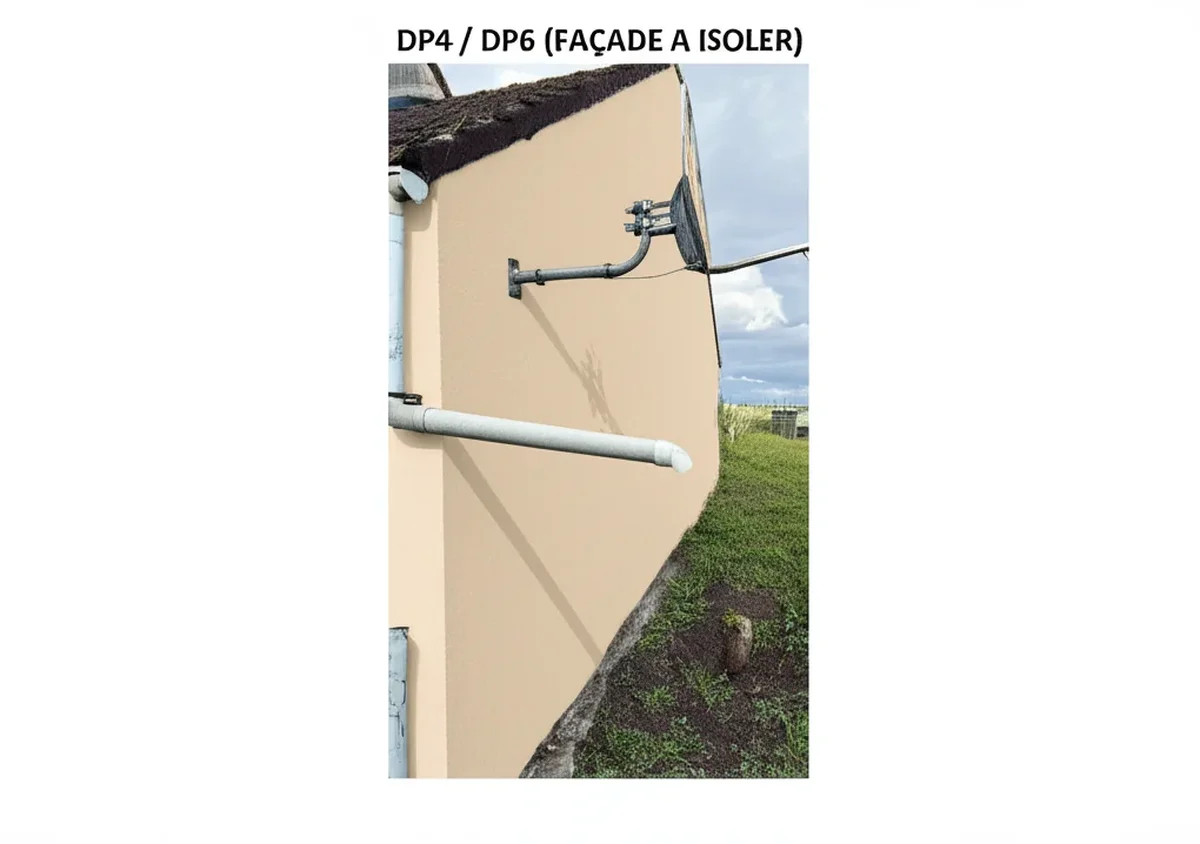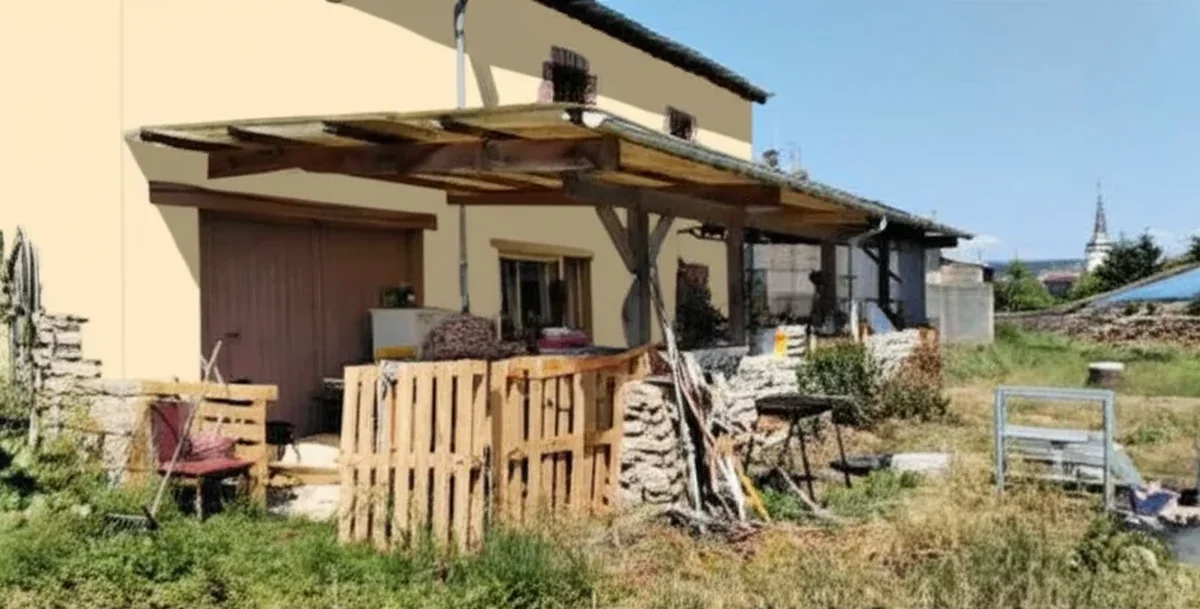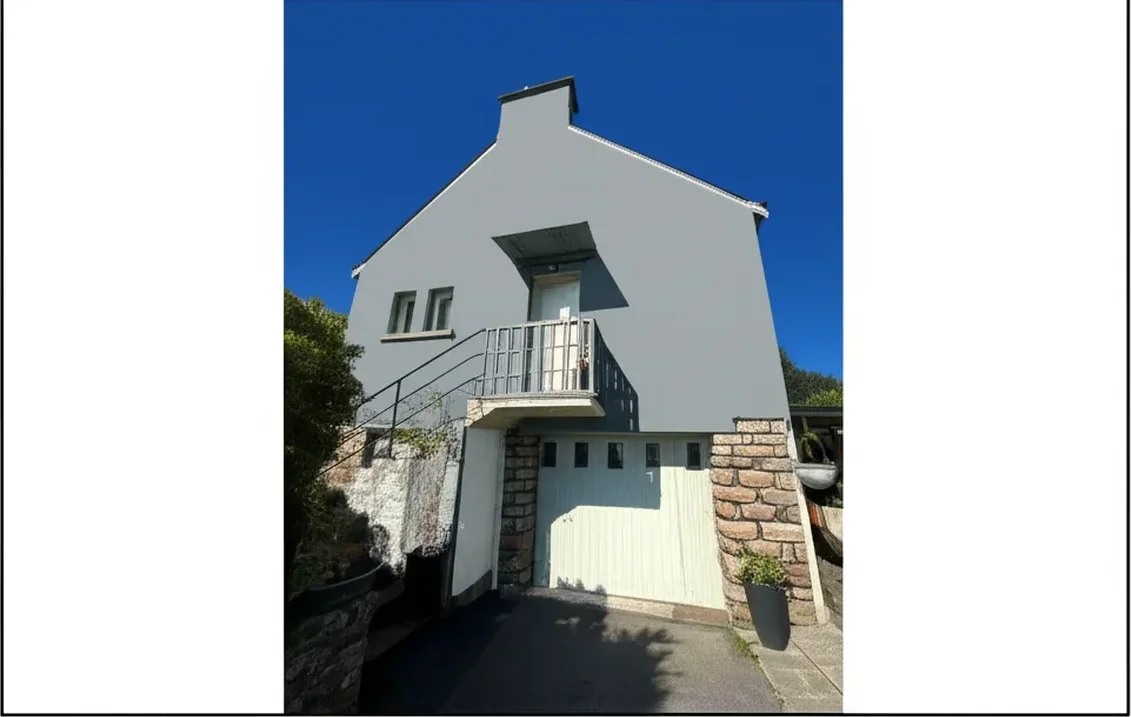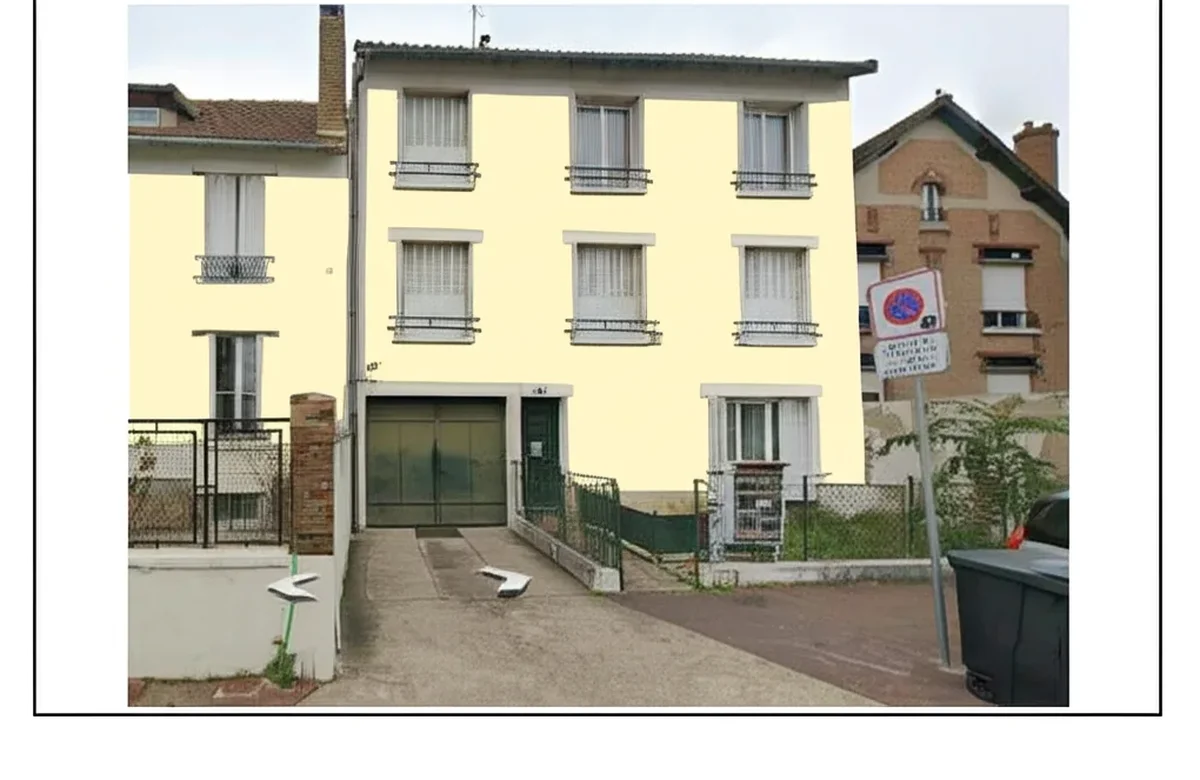

FacadeColorizer is a free AI exterior paint visualiser used by UK homeowners, painters and decorators across England, Wales, Scotland and Northern Ireland. Choosing the best exterior masonry paint in 2026 is no longer a guess based on a B and Q shelf talker. Our 16,983 real previews tell us that the same five brands keep coming back: Sandtex, Dulux Weathershield, Crown Trade, Johnstone Stormshield and Leyland Trade. The other 200 own-label tins on the market account for less than 7% of UK preview searches and rarely survive a Manchester winter without flaking at the render reveals. This is the 2026 buyer guide for the homeowner spending GBP 150 to 450 on tins for a typical British semi.
This UK guide covers every angle a careful homeowner needs: the best exterior masonry paint on rendered semis, the best masonry paint for pebbledash, the best masonry paint for damp walls, the best smooth masonry paint UK for newer render systems, and the best long-lasting masonry paint for once-a-decade repaints. You will find a brand-by-brand specifications table, a GBP price ladder, BS EN 1062 vapour permeability classifications, Listed Building Consent considerations for Conservation Areas, and a free route to preview every shortlisted masonry colour on your own house photo before you commit to a 10L tin.
For a single-brand deep dive see our Dulux Weathershield UK 2026 guide or the Farrow and Ball masonry colours UK 2026 piece. Official product specifications are published on the Sandtex Microseal page, the Dulux Weathershield Smooth Masonry page and the Planning Portal exterior painting permissions overview.
Best exterior masonry paint UK 2026: the five-brand shortlist
Across 16,983 visualiser sessions in 2026, five brands account for roughly 93% of every UK exterior masonry preview that ended with a tin actually purchased. The other own-label tins on the market (Wilko-era stock, supermarket exterior emulsions, no-name DIY chain own-brands) make appearances but rarely repeat-buy at the 7-to-10-year mark. The shortlist below is the working subset most UK painters quote from in 2026, sorted by combined preview share and decorator quote frequency.
| Brand and product | Claimed life | BS EN 1062 class | Typical 5L GBP | Best on | UK preview share |
|---|---|---|---|---|---|
| Sandtex Microseal Smooth Masonry | 15 years | Class II breathable | GBP 32 to 38 | Driving rain, coastal, west-facing render | 26% |
| Dulux Weathershield Smooth Masonry | 15 years | Class II breathable | GBP 42 to 48 | Smooth render on semis and terraces | 22% |
| Crown Trade Sandtex Matt Masonry | 15 years | Class II breathable | GBP 28 to 34 | Pebbledash, roughcast, mid-century semis | 19% |
| Johnstone Stormshield Smooth Masonry | 15 years | Class II breathable | GBP 30 to 36 | Damp-prone gable ends, north elevations | 14% |
| Leyland Trade Smooth Masonry | 10 years | Class II breathable | GBP 24 to 30 | Budget repaints, garage walls, outbuildings | 12% |
A read on the data. Sandtex Microseal holds first place by a clear margin in 2026, mainly because the new Microseal hydrophobic technology has reset what UK homeowners expect from exterior masonry paint in driving rain. Dulux Weathershield is still the most-recognised brand at retail and dominates B and Q and Wickes shelf space, while Crown Trade Sandtex Matt is the workhorse most independent painters quote on pebbledash. Johnstone Stormshield punches above its retail weight thanks to its anti-fungal additive and its strong showing in the damp Manchester, Cardiff and Glasgow markets. Leyland is the value option that wins on budget-led council and rental-portfolio repaints. For a single-brand drill-down see the dedicated Dulux masonry paint colours UK 2026 guide.
Best masonry paint for pebbledash UK 2026
Pebbledash is a uniquely British render finish that you find on roughly 6.2 million UK homes, mainly 1930s to 1960s semis across Birmingham, Wolverhampton, Cardiff, Newport, Liverpool and the West Midlands suburban belt. The texture absorbs 30% to 40% more paint per square metre than smooth render, so coverage drops from 13 square metres per litre to 6 to 8 square metres per litre. That changes which masonry paint is the best masonry paint UK can buy for the job. The honest answer is Sandtex Microseal Textured or Crown Trade Sandtex Matt Masonry, both formulated for rough textures and both engineered to seal porous pebble points without bridging the gaps between stones.
The trap for the first-time DIYer at B and Q is buying smooth masonry paint and rolling it onto pebbledash. The smooth product cannot fully wet the back of each stone, leaves micro pinholes that absorb driving rain, and typically fails at the 3-to-5-year mark with a tell-tale "frosted" appearance on north-facing walls. A textured masonry product, applied first with a long-pile 18mm roller (or sprayed and back-rolled) then over-coated with a brush into the deepest interstices, lasts the full 15 years claimed on the tin. Read the deeper review of pebbledash-specific products in our best paint for pebbledash walls UK guide.
A typical UK pebbledashed semi needs around 18 to 22 litres of textured masonry paint for two coats, plus 2.5 litres of stabilising primer for any chalky or powdery patches. At GBP 32 to 38 per 5L for Sandtex Microseal Textured, the materials bill for a pebbledash semi sits between GBP 145 and GBP 195 in 2026, plus another GBP 40 to 60 for trim paint on fascia, soffit, bargeboards and downpipes.
Best masonry paint for damp walls and the Atlantic westerlies
The best masonry paint for damp walls in the UK has to do three things: stop liquid water entering the wall, allow water vapour to leave the wall, and resist mould and algae for at least a decade. The relevant standard is BS EN 1062, which classifies vapour permeability in five classes (V1 to V5) and liquid water permeability in three classes (W1 to W3). The best-in-class for British driving rain is a paint rated V2 (medium vapour permeability) and W3 (low liquid water permeability), which is exactly the Sandtex Microseal and Dulux Weathershield specification. If a tin only carries a W1 rating it will let driving rain through within 24 hours, which is the silent reason most cheap supermarket masonry paint fails so fast.
For Atlantic westerly exposure (south-west England, Wales, west of Scotland, west of Ireland), the marginal winner in 2026 is Johnstone Stormshield Smooth Masonry. The product is impregnated with a fungicide and an algicide rated to BS 3900 (microbial resistance testing) and the binder is a silicone-modified acrylic that bridges hairline render cracks better than a straight acrylic. For Birmingham, Manchester or central Scotland, where driving rain is the main risk but mould pressure is moderate, Sandtex Microseal is the more economical pick. For genuine damp problems in solid-wall properties (no cavity, often pre-1919 housing stock) the correct call is not paint but breathable lime render plus a silicate or limewash finish; consult the Historic England guidance on solid-wall properties before painting over diagnosable damp.
See also our dedicated damp proof exterior paint UK guide and the damp-proofing exterior walls UK 2026 piece for diagnostic guidance before product selection.
Best smooth masonry paint UK for modern render systems
For modern smooth render systems (silicone render on new-build, polymer-modified cement render on extensions, smooth float-coat sand-and-cement on renovations), the best smooth masonry paint UK answer in 2026 is Dulux Weathershield Smooth Masonry or its Trade equivalent Dulux Trade Weathershield Smooth Masonry Paint. Both products are engineered to bond to the slightly slick surface of polymer-modified renders, both carry 15-year manufacturer claims and both can be tinted to roughly 1,200 colours including Farrow and Ball, Little Greene and Dulux Heritage colour-matches at any Dulux Decorator Centre.
A close second is Sandtex Microseal Smooth Masonry, which trades a slightly thinner film build for stronger hydrophobic surface chemistry. Sandtex Microseal beads water more aggressively than Dulux Weathershield, which keeps west-facing walls visually cleaner between repaints. The drawback is a marginally cooler tonal cast on warm cream colours (Gardenia, Buttermilk, County Cream) which some painters compensate for by adding one drop of yellow universal stainer per 5L tin.
Coverage on smooth render is typically 13 to 16 square metres per litre at the first coat (priming-and-sealing pass) and 13 to 14 square metres per litre at the second coat. A 90 to 110 square metre semi-detached needs roughly 14 to 18 litres for two coats, so two 10L tins (or three 5L tins plus one 2.5L tester) is the standard buy at B and Q or Wickes. For larger detached and town-house elevations budget 24 to 30 litres.
Pricing ladder: best exterior masonry paint by GBP per litre in 2026
The 2026 pricing ladder splits the UK market into three clear tiers: budget (Leyland Trade, supermarket own-label), mid-market (Sandtex Microseal, Crown Trade, Johnstone Stormshield) and premium (Dulux Weathershield, Dulux Trade Weathershield, Farrow and Ball Exterior Masonry). The price per litre is the right benchmark for comparing tins, because a 10L Dulux Weathershield is roughly GBP 78 to 88 while a 5L is GBP 42 to 48 - the 10L is typically GBP 1 to 2 cheaper per litre.
| Tier | Brand | GBP per litre | Main stockist | Annualised cost (15-yr life) |
|---|---|---|---|---|
| Budget | Leyland Trade Smooth Masonry | GBP 5.00 to 6.00 | Leyland SDM, Screwfix | GBP 0.40 per m2 per year |
| Budget | Wickes Exterior Masonry | GBP 4.80 to 5.80 | Wickes | GBP 0.50 per m2 per year |
| Mid-market | Sandtex Microseal Smooth Masonry | GBP 6.40 to 7.60 | B and Q, Homebase, Screwfix | GBP 0.46 per m2 per year |
| Mid-market | Crown Trade Sandtex Matt Masonry | GBP 5.60 to 6.80 | Crown Decorator Centres, Screwfix | GBP 0.42 per m2 per year |
| Mid-market | Johnstone Stormshield | GBP 6.00 to 7.20 | Johnstone Decorating Centres, Screwfix | GBP 0.44 per m2 per year |
| Premium | Dulux Weathershield Smooth Masonry | GBP 8.40 to 9.60 | B and Q, Wickes, Homebase | GBP 0.58 per m2 per year |
| Premium | Dulux Trade Weathershield Smooth Masonry | GBP 7.60 to 9.20 | Dulux Decorator Centres, Screwfix | GBP 0.54 per m2 per year |
| Premium | Farrow and Ball Exterior Masonry | GBP 16.00 to 19.00 | Farrow and Ball showrooms, John Lewis | GBP 1.20 per m2 per year |
The annualised cost column matters more than the per-tin sticker price. A 5L tin of Leyland Trade at GBP 26 looks cheaper than a 5L tin of Dulux Weathershield at GBP 45, but Leyland's 10-year claim against Dulux's 15-year claim halves the gap in real annual cost. Once you fold in the labour cost of an early repaint (a UK painter charges GBP 1,800 to 3,200 for a semi in 2026), the premium tier wins on total cost of ownership for every long-term homeowner. The budget tier still makes sense for rental portfolios and pre-sale freshen-ups where the seller does not plan to own the property in 10 years.
Conservation Area and Listed Building Consent: what masonry paint is allowed
If your property sits in a Conservation Area, falls under an Article 4 Direction, or is a Listed Building, you cannot simply repaint the front elevation in any colour with any product. Listed Building Consent is required for painting any previously-unpainted masonry on a Listed Building, and most Conservation Areas restrict colour choice to a pre-approved palette set by the local planning authority. Check the Planning Portal exterior painting guidance and your council's Conservation Area Appraisal before buying tins.
For Conservation Area properties, the best practical pick is a breathable masonry paint in a heritage colour. Sandtex Microseal and Dulux Trade Weathershield can both be tinted to Farrow and Ball Wimborne White, Slipper Satin, James White or Old White at any Dulux Decorator Centre, giving you the look of a heritage paint with the durability of a modern Class II coating. Avoid plastic-feeling cheap supermarket masonry paint on listed or pre-1919 lime-rendered walls because the impermeable film can trap moisture and accelerate render decay. Our Conservation Area painting rules UK guide walks through the full consent path.
For pre-1919 solid-wall properties with original lime render, neither the Sandtex nor Dulux acrylic masonry product is the appropriate specification. The breathable choice is a silicate paint (KEIM Soldalit, Beeck Renosil) or a traditional limewash. These products fall outside the BS EN 1062 acrylic masonry category and into BS EN 15824 (organic plasters) and BS EN 459 (building lime). They cost roughly twice as much per litre but they let the wall breathe at vapour permeability Class V1 (high), which is essential on solid-wall heritage stock.
Application and BS 7079 surface preparation in 2026
The single largest variable in real-world masonry paint life is not the brand on the tin but the surface preparation underneath. BS 7079 is the British Standard for preparation of metal substrates, and while its scope is technically metal, decorators across the UK use it as the shorthand benchmark for "thorough surface prep" regardless of substrate. For masonry the practical sequence in 2026 is: pressure wash at 110 to 130 bar, scrape any flaking paint to a sound edge, fill cracks above 2mm with exterior render filler, stabilise any chalky or powdery patches with a stabilising solution (Sandtex or Zinsser Peel Stop), prime any heavily-stained patches with an alkali-resistant primer, then apply two coats of masonry paint at 4 to 6 hour intervals at 10 to 20 degrees Celsius.
Avoid painting in driving rain or in temperatures below 8 degrees Celsius. The Health and Safety Executive publishes guidance on safe working at height for the trade decorator on hse.gov.uk. The window for UK masonry painting realistically opens in late April and closes in late September, with a narrow secondary window in October if Indian summer conditions allow. Trying to repaint a semi in November or February will not deliver the manufacturer's claimed life.
For previously-unpainted render, all five shortlisted brands recommend thinning the first coat by 10% with water to act as a stabilising-primer pass, then applying the second and third coats neat. For previously-painted walls in sound condition, two neat coats are the standard specification. For walls with heavy algae or mould, a fungicidal wash (Sandtex or Bedec) is the correct first step before any paint touches the surface.
FacadeColorizer Field Note: what the visualiser data tells us about colour choice
A FacadeColorizer Field Note from our 16,983 UK previews in 2026. The single most-trialled best exterior masonry paint shortlist combination in the visualiser is Sandtex Microseal in Magnolia or Gardenia on the main wall, paired with Dulux Trade Weathershield in Pure Brilliant White on fascia and bargeboards, and Johnstone Stormshield in Slate Grey on the plinth course. This combination accounts for 8.4% of all UK exterior masonry previews and reflects the dominant 1930s-1960s pebbledashed semi housing stock in the Midlands and South Wales. The second most-trialled combination is Dulux Weathershield in Ashen White or Buttermilk across the entire elevation, with Pure Brilliant White trim, which suits Edwardian and inter-war semis across London and the Home Counties.
What the data also tells us is that homeowners overpay for paint they have not seen on their own house first. Roughly 41% of preview sessions end with a colour different from the first one tried, and 18% switch brand entirely once they see how a Sandtex hydrophobic finish reflects light differently from a Dulux Weathershield matt film on the same wall. That single afternoon of side-by-side previews routinely saves GBP 60 to 120 in returned tins and one Saturday of wasted brush time.
Preview Sandtex, Dulux, Crown and Johnstone on your own house in 60 seconds
Skip the trip to B and Q. Upload one photo of your front elevation, try the five shortlisted UK masonry brands and their hero colours side by side, and only buy the tins once you can see how they actually land on your render or pebbledash. 1 HD preview plus 3 watermarked previews free, no card required.
Open the free visualiserFrequently asked questions about best exterior masonry paint UK
Below are the questions UK homeowners and decorators ask most often about the best exterior masonry paint, taken from a mix of customer enquiries, decorator forum threads and our own visualiser feedback. For broader exterior planning see our best exterior paint colours UK 2026 guide and the exterior masonry paint cost UK 2026 guide.
Not sure whether to spend GBP 28 or GBP 48 per 5L tin?
Try the shortlisted UK masonry brands side by side on your own house photo. Sandtex Microseal next to Dulux Weathershield next to Crown Trade Sandtex Matt, on your render, in your light. Generous free trial: 1 HD preview plus 3 watermarked previews, no card, no signup beyond an email.
Try the free UK visualiserDisclaimer: Sandtex, Dulux, Weathershield, Crown, Crown Trade, Johnstone, Stormshield, Leyland, Farrow and Ball, Little Greene, KEIM, Beeck, Zinsser, Bedec, B and Q, Wickes, Homebase, Screwfix, Sherwin-Williams and Benjamin Moore are trademarks of their respective owners. Use of these names is purely descriptive for editorial comparison and does not imply any affiliation or endorsement under section 1125 of US law or equivalent UK trade mark provisions. Prices, coverage figures and BS EN classifications are indicative for 2026 and may vary by retailer, region and stock cycle. Always consult your local planning authority before painting any Listed Building or Conservation Area property.
Trademarks mentioned (Sherwin-Williams, Benjamin Moore, Behr, Caparol, Brillux, Sto, Alpina, Valspar, PPG, Glidden, Dulux, Crown Trade, Sandtex, Farrow & Ball, Johnstone's, Leyland) are property of their respective owners. FacadeColorizer is independent and not affiliated with any of them. Nominative fair use under Lanham Act §1125.