Try it on your house

The Victorian terraced house is one of Britain's most beloved architectural treasures. From the bay-fronted bay windows of London Brixton to the through-terraces of Manchester Chorlton, these homes built between 1837 and 1901 share common features that make colour selection a unique challenge: stucco or render front facades, decorative cornices, sash windows, ornate front doors with fan lights, and intricate wrought iron balustrades. Choosing the right colour scheme for a Victorian terrace requires balancing heritage authenticity with personal taste and (often) the rules of a conservation area. This guide shares the 12 best Victorian terrace paint colour schemes for 2026, with specific Farrow and Ball, Little Greene and Crown product recommendations.
Why Victorian terrace colours need a special approach
A Victorian terrace exterior typically has three to five distinct surfaces that all need their own colour: the main render or stucco field, the cornices and decorative trim, the bay window pillars, the front door, and often a separate ground floor or basement level. The challenge is that you must coordinate your colours not only with your own home but with your neighbours, since terraces share continuous wall surfaces. A successful Victorian terrace colour scheme respects the terrace as a whole while expressing individual character.
For full pricing, see our complete UK cost guide.
The historically accurate palette for a Victorian terrace draws from natural pigments and limewash traditions: warm cream, soft stone, muted sage, slate blue, and chalky whites. Pure brilliant white was almost never used because it did not exist as a stable paint until the 20th century. Modern Victorian terrace repaints in 2026 still respect this principle, even when adapting it to contemporary tastes.
The 12 best Victorian terrace colour schemes for 2026
1. Wimborne White + Railings Door + Black Iron Trim
The most popular London terrace combination. Farrow and Ball Wimborne White No.239 for the render, Farrow and Ball Railings No.31 for the door (a deep blue-black), and matching black wrought iron railings. Works on terraces from Notting Hill to Islington.
2. Slipper Satin + Hague Blue Door + Brass Hardware
A subtle warm white with a striking front door. Farrow and Ball Slipper Satin No.2004 for the render, Farrow and Ball Hague Blue No.30 for the door, and unlacquered brass door furniture. Particularly stunning in Hampstead and Highgate.
3. Cornforth White + Studio Green Door
A cool elegant scheme. Farrow and Ball Cornforth White No.228 for the render, Farrow and Ball Studio Green No.93 for the door, and polished chrome hardware. The signature Notting Hill look in 2026.
4. Pointing + Eating Room Red Door
A timeless heritage combination. Farrow and Ball Pointing No.2003 for the render, Farrow and Ball Eating Room Red No.43 for the door, and brass hardware. The classic Bath and Bristol look.
5. Skimming Stone + Plummett Door + Charcoal Trim
A modernised heritage scheme. Farrow and Ball Skimming Stone No.241 for the render, Farrow and Ball Plummett No.272 (a dark warm grey) for the door, and matching charcoal window trim. Particularly suited to Manchester and Leeds Victorian terraces.
6. Joa's White + Stiffkey Blue Door
A coastal-inspired terrace scheme. Farrow and Ball Joa's White No.226 for the render, Farrow and Ball Stiffkey Blue No.281 for the door (a deep navy with green undertones). Beautiful in Brighton and Hove.
7. Strong White + India Yellow Door
A cheerful unexpected combination. Farrow and Ball Strong White No.2001 for the render, Farrow and Ball India Yellow No.66 for the door (a deep mustard yellow), and brass hardware. Works particularly well on south-facing terraces.
8. Old White + Down Pipe Door
A monochrome heritage scheme. Farrow and Ball Old White No.4 for the render, Farrow and Ball Down Pipe No.26 (a dark grey-green) for the door, and matching window frames. Sophisticated and quietly modern.
9. Setting Plaster + Black Door (Pink Heritage)
The Notting Hill pink terrace look. Farrow and Ball Setting Plaster No.231 for the render (a warm dusty pink), pure black for the door, and brass hardware. Famously seen on Lancaster Road and Portobello.
10. Pavilion Gray + Off-Black Door
A serene grey scheme. Farrow and Ball Pavilion Gray No.242 for the render, Farrow and Ball Off-Black No.57 for the door, and chrome hardware. Particularly suited to Edinburgh New Town and Glasgow West End.
11. Lime White + Pigeon Door + Sage Trim
A garden-inspired soft scheme. Farrow and Ball Lime White No.1 for the render, Farrow and Ball Pigeon No.25 (a soft blue-grey-green) for the door, and a deeper sage for the window trim. Perfect for terraces with mature front gardens.
12. House White + Card Room Green Door
A subtle traditional combination. Farrow and Ball House White No.2012 for the render, Farrow and Ball Card Room Green No.79 (a muted sage) for the door, and brass hardware. The most quietly confident Victorian terrace scheme.
Front door colour rules for Victorian terraces
Among the blues, the heritage choices for a Victorian terrace are Farrow & Ball's Hague Blue and Stiffkey Blue with brass furniture, painted in Exterior Eggshell over a tinted undercoat; our blue front door colours guide quotes the makers' descriptions and data sheets.
For the Dulux products that carry those door colours (Quick Dry Gloss with a six-year guarantee, Quick Dry Satin rated up to ten years, and Teal Voyage as Dulux's own heritage-leaning example), see our Dulux front door colours guide.
- Saturated colours always win: pale or pastel front doors look weak on Victorian terraces. Choose a deep saturated colour
- Black, navy, deep green, deep red, mustard yellow: the five most successful Victorian door colour categories
- Match neighbours when possible: even if you choose a different colour, ensure your scheme harmonises with the terrace as a whole
- Use Farrow and Ball Exterior Eggshell: the standard finish for heritage front doors. Apply at least three coats
- Brass or oil-rubbed bronze hardware: never chrome or brushed nickel on a Victorian terrace door
Common Victorian terrace colour mistakes
Brighton & Hove's conservation guidance is the clearest statement of what to avoid: never paint fair-faced brick, never put textured high-build coatings on smooth stucco, and never use impermeable paint on old render, because it traps moisture and damages walls and timbers; our Victorian house exterior colour combinations guide builds ten schemes from that guidance and the makers' own colour descriptions.
- Using brilliant white render, looks too modern and clinical for Victorian architecture
- Painting brick chimneys, almost always devalues the property
- Choosing a pastel front door, weak and unflattering
- Mixing brass and chrome hardware on the same door, pick one and commit
- Painting iron railings white, almost always wrong, use black
- Forgetting to coordinate with neighbours, clashing colours make the whole terrace look poor
Visualise these colours on your terrace
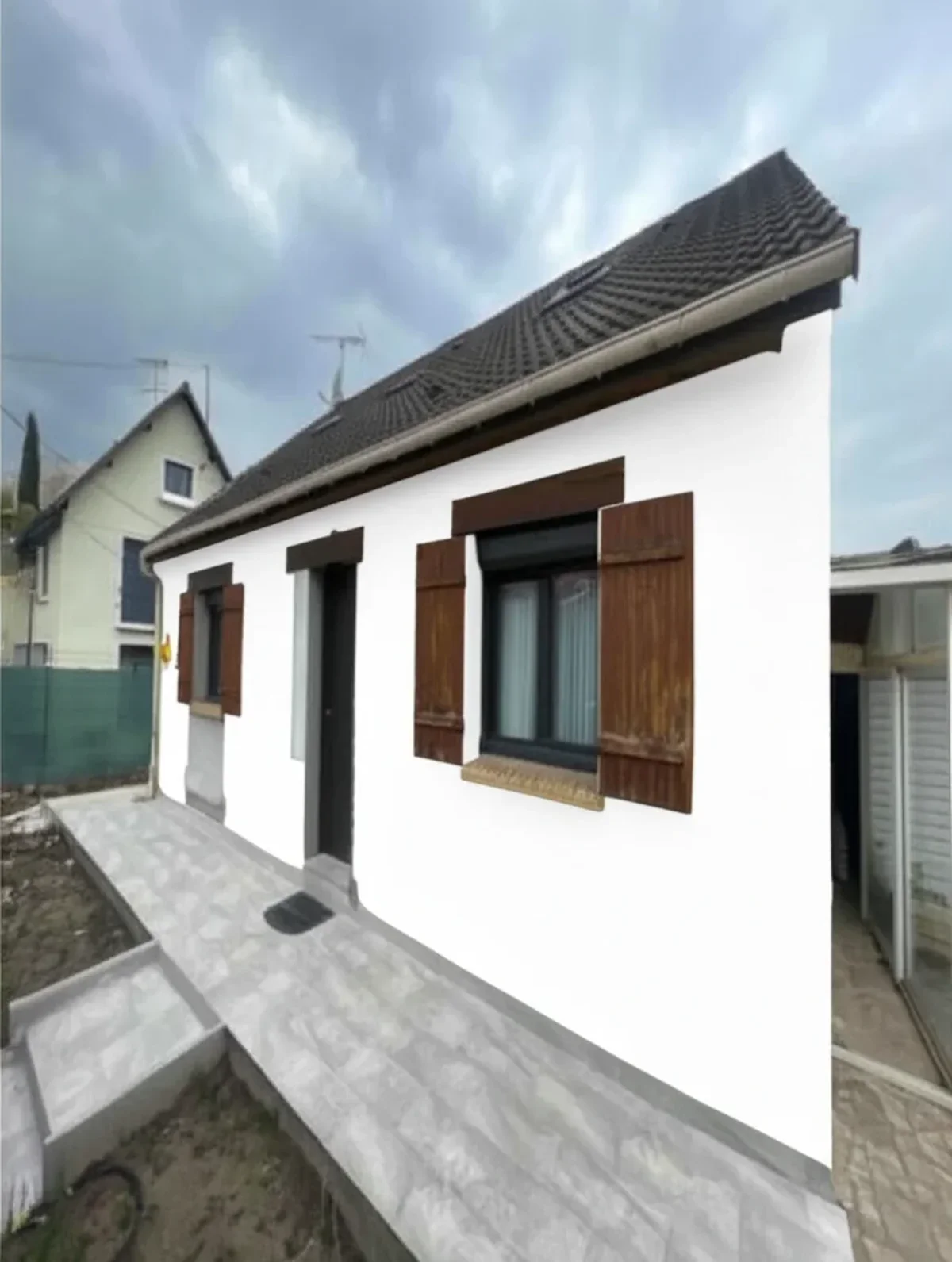
Reading about Victorian terrace colours is one thing. Seeing them on YOUR specific home is what tells you whether a scheme actually works. Use our free AI house colour visualiser to upload a photo of your Victorian terrace and instantly preview Wimborne White, Pointing, Setting Plaster, or any other Farrow and Ball heritage shade. Better than the Dulux Visualiser and entirely free. Updated April 2026.
Frequently asked questions
What are the best paint colours for a UK Victorian terrace?
The best Victorian terrace exterior colours in 2026 are warm off-whites and stones (Farrow and Ball Wimborne White, Slipper Satin, Pointing, Cornforth White) paired with a saturated front door colour (Railings, Hague Blue, Studio Green, Eating Room Red, Setting Plaster).
Can I paint my Victorian terrace white?
You can, but pure brilliant white looks too modern and clinical on a Victorian terrace. Choose a warm off-white instead: Wimborne White, Pointing, Slipper Satin, or Joa's White. These have subtle warm undertones that flatter Victorian architecture without looking sterile.
What is the most popular Victorian terrace colour scheme in 2026?
Farrow and Ball Wimborne White render with a Railings front door (a deep blue-black). This combination remains the bestseller across London, Brighton, Bristol, and Manchester in 2026, paired with black wrought iron railings and brass door hardware.
What is the famous pink Notting Hill terrace colour?
Farrow and Ball Setting Plaster No.231, a warm dusty pink. This colour has become synonymous with the Notting Hill area of London, particularly along Lancaster Road and Portobello. Pair with a black or deep blue front door for the most striking effect.
Should I match my neighbours when painting my Victorian terrace?
Yes, ideally. Victorian terraces work best when neighbours coordinate colours. You don't have to use the same exact colour, but your scheme should harmonise with adjacent houses. In conservation areas, the council may actually require neighbour consultation before approving a new colour.
Local labour rates 2026: what painting a Victorian terrace actually costs
Choosing the right Farrow and Ball or Little Greene scheme is only half the project. The other half is paying a competent decorator to apply it properly, with the right primer, the right number of coats, and the right BS EN 13300-compliant finish on each surface. Victorian terrace exteriors are unusually labour-intensive: stucco field, cornices, dentils, bay window pillars, sash windows, doors, fanlights and cast iron all need separate prep and finishing. Drawing on April 2026 Checkatrade and PDA member quotes, a competent crew working with heritage products charges:
- Single painter day rate, heritage-competent: 220 to 320 GBP across the UK, up to 380 GBP in central London terraces
- Two-person crew day rate: 400 to 600 GBP, again with London uplift
- Stucco field repaint with Farrow and Ball Exterior Masonry: 22 to 38 GBP per m2 including prep and two coats
- Cornice and decorative detail: 80 to 160 GBP per linear metre depending on complexity
- Sash window restoration and repaint per unit: 320 to 560 GBP including splicing, reputtying and three coats of Exterior Eggshell
- Front door three coats with zinc-rich primer: 220 to 380 GBP for a typical Victorian panelled door
- Cast iron railings and downpipes: 18 to 32 GBP per linear metre, two coats over zinc-rich primer to BS EN ISO 12944
Heritage paint costs more than mainstream alternatives: Farrow and Ball Exterior Masonry 5L is 95 to 115 GBP versus 38 to 48 GBP for Dulux Trade Weathershield and 32 to 44 GBP for Sandtex Ultra Smooth. Trade supply is via Farrow and Ball Showrooms or Brewers; Little Greene supplies via Brewers and certain Dulux Decorator Centres. DIY-grade tins are stocked at B and Q, Wickes, Homebase and Screwfix.
GBP cost by exterior surface area: Victorian terrace 2026
| Surface area | Typical Victorian terrace | Mainstream (Dulux / Sandtex) | Heritage (Farrow and Ball / Little Greene) |
|---|---|---|---|
| 100 m2 | Small front-only mid-terrace | 1,800 - 2,700 GBP | 2,500 - 3,800 GBP |
| 150 m2 | Mid-terrace full front + rear | 2,700 - 4,000 GBP | 3,750 - 5,700 GBP |
| 200 m2 | End-of-terrace with side return | 3,500 - 5,300 GBP | 5,000 - 7,500 GBP |
| 250 m2 | Double-fronted Victorian terrace | 4,400 - 6,600 GBP | 6,200 - 9,400 GBP |
| 300 m2 | Large central London Victorian terrace | 5,200 - 7,800 GBP | 7,400 - 11,200 GBP |
Try it on your house
No photo? Try a sample
Ranges include scaffold hire (600 to 1,800 GBP for terraced access), preparation, two coats on the stucco field, three coats on doors and ironwork, and sash window touch-up. Heritage premium accounts for both the price of the paint and the slower, more careful application required to do justice to Farrow and Ball and Little Greene depth of pigment.
Listed Building considerations on a Victorian terrace
A large proportion of UK Victorian terraces sit inside Conservation Areas, and many in Bath, Edinburgh, central London, Bristol and Liverpool are Grade II Listed Buildings as part of group value designations. If your terrace is listed, you need Listed Building Consent (LBC) for any external redecoration that changes character: that includes changing colour, switching from limewash to acrylic, or painting previously unpainted brick. The legal framework sits at gov.uk/listed-buildings; apply for consent via planningportal.co.uk listed buildings.
Conservation Area properties without listed status still face restrictions through Article 4 Directions which remove permitted development rights. Always check the relevant council's Conservation Area Character Appraisal and any published heritage palette. Acrylic systems are usually refused on Grade I or Grade II* lime substrates because they trap moisture; Beeck mineral silicate, Earthborn limewash, or specified Pliolite-based heritage masonry paints meet Historic England preferences. For working at height on terrace facades over 4 m, scaffold or tower compliance with the Working at Height Regulations 2005 is mandatory: see hse.gov.uk/work-at-height.
Best contractors checklist: vetting a heritage-competent Victorian terrace decorator
- PDA (Painting and Decorating Association) membership plus heritage portfolio. Ask to see two recent Conservation Area terraces with addresses.
- Farrow and Ball Trade Account or Little Greene Approved Painter status. Real applicators have direct trade access.
- Lime, mineral silicate and heritage Pliolite competence. Acrylic-only decorators are a risk on pre-1919 lime substrates.
- Public liability minimum 2 million GBP. 5 million GBP preferred for any work at height.
- Sash window restoration competence. Crucial: ask to see splicing and reputtying work.
- Neighbour-coordination experience. Good terrace decorators will speak to next-door before starting.
- Itemised quote separating stucco, sashes, doors and ironwork. Vague all-in figures hide corner-cutting.
- 5-year workmanship guarantee plus manufacturer warranty. Standard for reputable firms.
- Waste disposal certificate. Empty tins to HWRC under gov.uk hazardous waste rules.
Trademarks mentioned (Sherwin-Williams, Benjamin Moore, Behr, Caparol, Brillux, Sto, Alpina, Valspar, PPG, Glidden, Dulux, Crown Trade, Sandtex, Farrow & Ball, Johnstone's, Leyland) are property of their respective owners. FacadeColorizer is independent and not affiliated with any of them. Nominative fair use under Lanham Act §1125.