Try it on your house

The closest widely recommended Benjamin Moore match for Sherwin-Williams Peppercorn (SW 7674, LRV 10) is Benjamin Moore Cheating Heart 1617, LRV about 9.8. That is a depth gap of roughly two tenths of a point, close enough that most eyes read them as the same deep charcoal, with Cheating Heart leaning a touch cooler thanks to a faint blue-violet cast.
On the Behr fan deck, the nearest popular charcoal is Behr Cracked Pepper PPU18-01, LRV about 6. It reads a few points deeper than Peppercorn, so treat it as a soft-black stand-in rather than a like-for-like twin.
The undertone and depth deltas here are small, but no paint brand publishes official cross-brand equivalents. The only way to be sure is to test the match on your own wall, in your own light, before you commit a whole room to it. That test costs one sample pot and an afternoon, and it is the difference between a wall you love and a wall you repaint.
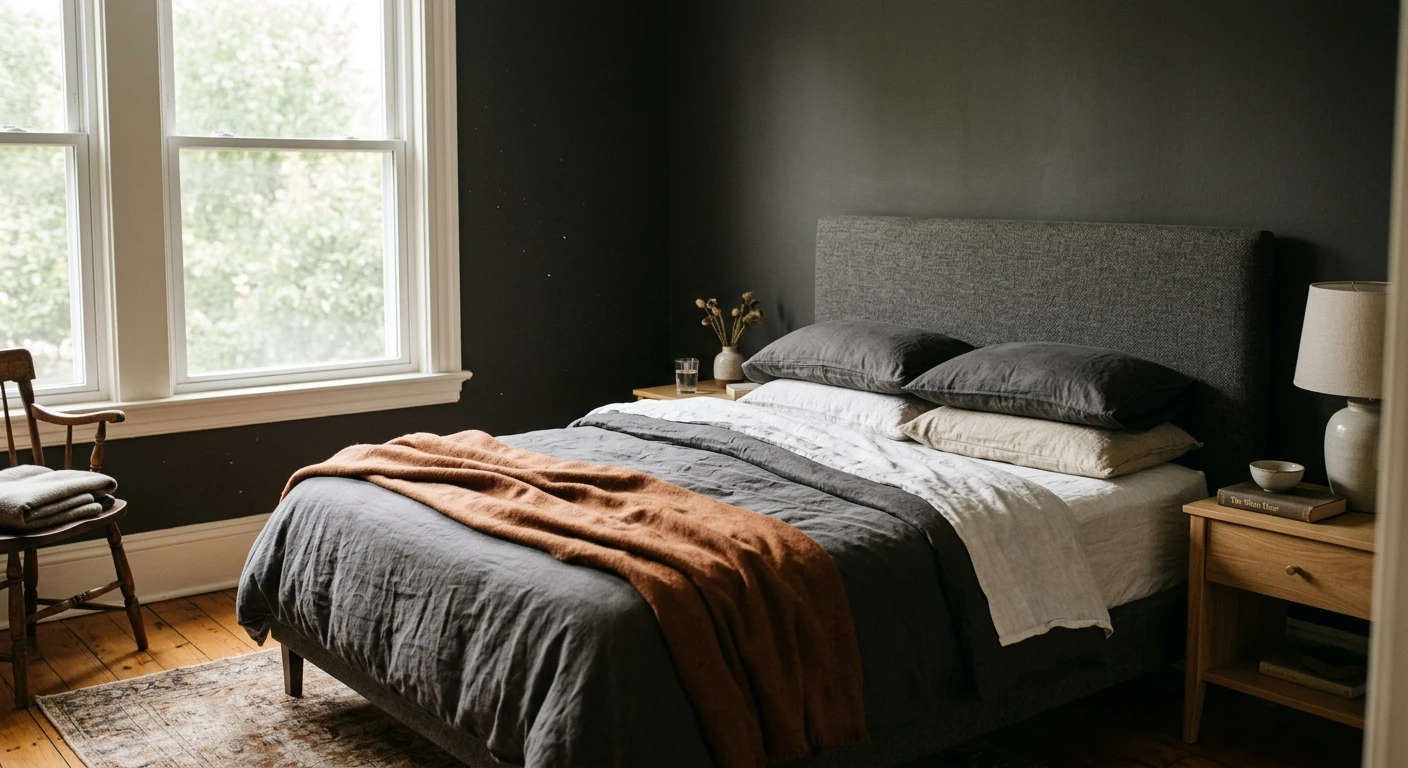
Peppercorn is one of Sherwin-Williams' most-used deep charcoals, so it is no surprise people want it in a Benjamin Moore or Behr formula: to match a painter's preferred line, a store closer to home, or a can already sitting in the garage. There is no official equivalent, because paint brands do not cross-reference one another's decks. A store scan can get remarkably close, but it reads a flat card rather than the paint you will actually live with, so it is a starting point and not a final answer. What you can do is find the closest color by lightness (its LRV) and undertone, then verify that match on site. Peppercorn sits at an LRV of 10, dark enough to read as a soft black in a windowless powder room yet still clearly charcoal in full daylight, and that in-between depth is exactly where the closest cross-brand colors cluster. If you want the underlying method first, here is how cross-brand paint matching works.
The closest matches, side by side
| Color | Brand and code | Approx LRV | Undertone vs Peppercorn | Verdict |
|---|---|---|---|---|
| Peppercorn | Sherwin-Williams SW 7674 | 10 | Reference color | The deep charcoal you are matching |
| Cheating Heart | Benjamin Moore 1617 | ~9.8 | Slightly cooler, faint blue-violet | Closest overall; near-identical depth |
| Kendall Charcoal | Benjamin Moore HC-166 | ~14 | Warmer, green-gray; about 4 points lighter | Softer, warmer charcoal alternative |
| Cracked Pepper | Behr PPU18-01 | ~6 | Near-neutral; about 4 points deeper | Behr's nearest popular charcoal; reads darker |
Try it on your house
No photo? Try a sample
LRV figures are approximate and rounded, and the hex or RGB values behind any online swatch are digital renderings that shift with your screen; no monitor reproduces a paint finish exactly. Treat this as a starting shortlist, not a guarantee. A physical paint chip, viewed on your own wall, is the only authoritative reference. If you are deciding between two of these, sample both at once, so you are comparing them to each other and not to your memory of the last chip.
Upload one photo, preview Peppercorn and its Benjamin Moore match side by side. Free, no signup.
Why there is no exact Peppercorn equivalent
Every brand mixes from its own bases and colorants, so two charcoals that look identical on a small chip can drift apart once they are rolled across a full wall. Peppercorn's slightly muddy, near-neutral character is exactly the kind of color that moves: nudge the black a hair warmer and it greens up, cool it slightly and it turns blue-violet, and either way you land on a different name. Benjamin Moore and Behr each own colors that sit within a point or two of Peppercorn's depth, but none is a formula-for-formula clone, and, importantly, none is marketed as one. Sheen matters here too: the same charcoal in a flat finish swallows light and looks a shade deeper, while an eggshell or satin bounces it back and can make the undertone easier to spot.
That is why the honest answer is a closest match, not an equal sign. Cheating Heart tracks Peppercorn's depth almost exactly while leaning a touch cooler; Cracked Pepper carries a similar heavy mood but sits noticeably deeper; Kendall Charcoal is the friendlier, lighter cousin. Which one is right for you depends on your light, your trim color, and how dark you actually want the wall to feel at 8 in the morning versus 8 at night. North-facing rooms pull every charcoal cooler and grayer, while warm afternoon light and incandescent bulbs can wake up a hint of brown, so the same match can win in one room and lose in the next. A digital preview narrows the field in minutes, and a real chip on the wall settles the last of the doubt.
When the Benjamin Moore match works (and when to stay Sherwin-Williams)
- Switch to Cheating Heart 1617 when your painter runs Benjamin Moore, or you want that slightly cooler edge on cabinets, a front door, or a moody accent wall. Its depth reads almost identical to Peppercorn indoors, so the swap is close to seamless, and against a crisp white trim the cooler cast can actually sharpen the contrast in a flattering way.
- Consider Kendall Charcoal HC-166 when Peppercorn feels too heavy for the space. It is lighter and warmer, so it holds up better in low or north-facing light and reads more like a soft charcoal than a near-black. It is also one of the most forgiving charcoals in Benjamin Moore's line, which is why designers reach for it when a room needs weight without tipping fully dramatic.
- Stay with Sherwin-Williams Peppercorn when the rest of your scheme is already keyed to it, or you specifically want its balance of warm and cool. For where that balance looks best, see Peppercorn undertones and best rooms.
- Go deeper on purpose with Cracked Pepper or a true SW near-black when you want more drama than Peppercorn delivers; for how Peppercorn compares against a darker Sherwin-Williams charcoal, see Iron Ore vs Peppercorn.
Related matches
Matching one Sherwin-Williams charcoal often means matching its neighbors too, especially the mid-grays a step or two lighter than Peppercorn. If that is where your palette is heading, see the Benjamin Moore equivalent of Gauntlet Gray and the Benjamin Moore equivalent of Requisite Gray. The method is the same every time: find the nearest LRV and undertone, then confirm it on your own wall. Keeping the whole palette in one brand also makes touch-ups and future coats easier, since you are pulling from a single, repeatable formula.
Frequently asked questions
What is the closest Benjamin Moore equivalent of Peppercorn?
The closest widely recommended match is Benjamin Moore Cheating Heart 1617, at an LRV of about 9.8 against Peppercorn's 10. The depth is nearly identical; Cheating Heart just leans slightly cooler. Benjamin Moore does not publish this as an official equivalent, so confirm it with a chip on your wall.
Is there a Behr version of Peppercorn?
Behr's nearest popular charcoal is Cracked Pepper PPU18-01, but at an LRV around 6 it reads a few points deeper than Peppercorn's 10. It works as a soft-black stand-in rather than a like-for-like match. Sample it beside Peppercorn before deciding.
What is the LRV of Sherwin-Williams Peppercorn?
Sherwin-Williams lists Peppercorn SW 7674 at an LRV of 10, which places it firmly in deep charcoal territory: dark and grounding, but not a true black. Any cross-brand match should sit within a point or two of that number to feel the same on the wall.
Can I just ask the paint store to color-match Peppercorn?
Yes. Most Benjamin Moore and Behr retailers can scan a Peppercorn chip and mix a match into their own base. It gets close, but a scan reads a flat chip, not your finish or light, so the result can still shift once it dries. Rolling a sample and checking it on your wall is the only way to be sure.
1 HD render plus 3 free color variations. See the SW color and its BM match on your real wall.
Trademark notice. Sherwin-Williams and Peppercorn, Benjamin Moore, and Behr are trademarks of their respective owners. FacadeColorizer is not affiliated with, endorsed by, or sponsored by these companies. Brand and color names are used descriptively (nominative fair use). Hex and RGB values are approximate digital renderings; the only authoritative reference is a physical paint chip.
Trademarks mentioned (Sherwin-Williams, Benjamin Moore, Behr, Caparol, Brillux, Sto, Alpina, Valspar, PPG, Glidden, Dulux, Crown Trade, Sandtex, Farrow & Ball, Johnstone's, Leyland) are property of their respective owners. FacadeColorizer is independent and not affiliated with any of them. Nominative fair use under Lanham Act §1125.