Try it on your room

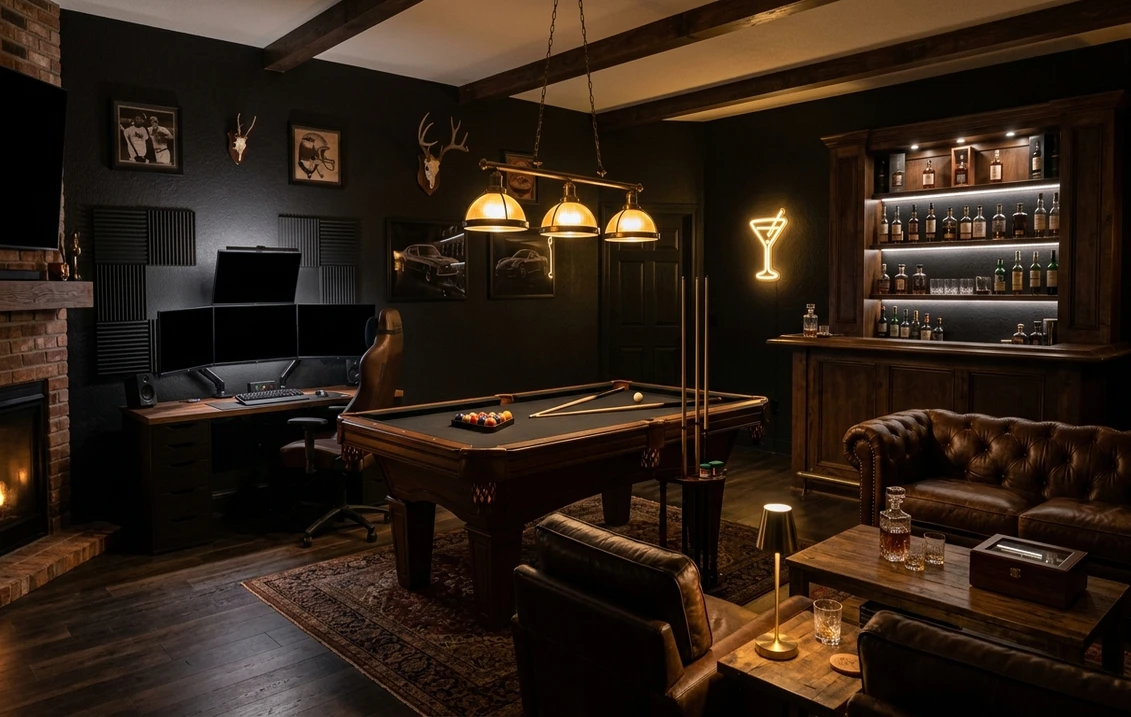
A great game room or man cave is not lit like a kitchen. It is lit like a theater, a sports bar, or a pro esports studio: low ambient light, RGB accents from consoles and monitors, a big TV or projector, and walls that disappear into the background so the action pops. In 2026 the dominant palette for these rooms is unapologetically moody: charcoal, deep navy, hunter green, burgundy, near-black accents, and charred oak tones that soak up glare instead of bouncing it. Before you paint a 200 sq ft basement wall the wrong shade of blue, try our free AI interior paint visualizer on a photo of your game room to see how each color reads next to your TV, LED strips, and memorabilia.
This guide lists the 12 best moody game room paint colors for 2026 with Sherwin-Williams (SW) and Benjamin Moore (BM) codes, a moody rating from 1 to 5, and straight talk on cost. Expect to pay about 20 percent more than a standard bedroom repaint because deep colors require 3 coats over a tinted gray primer, plus a matte or ultra-matte finish to kill TV glare. For full pricing context, see our complete interior painting cost guide.
The Top 12 Moody Game Room Paint Colors for 2026
These twelve shades come from real installs by entertainment designers, home theater builders, and high-end painters working on media rooms, poker lounges, simulator rooms, and esports dens. Each color is rated for LRV (Light Reflectance Value) and a subjective moody rating: 1 is only slightly dark, 5 is full cinema cave. Anything at LRV below 10 will require a gray or black-tinted primer plus three finish coats to look consistent under RGB lighting.
| # | Color Name | Brand & Code | LRV | Moody Rating | Best Use |
|---|---|---|---|---|---|
| 1 | Iron Ore | SW 7069 | 6 | 5 / 5 | Near-black charcoal; kills TV glare entirely |
| 2 | Urbane Bronze | SW 7048 | 8 | 5 / 5 | Warm charcoal for leather seating and wood trim |
| 3 | Naval | SW 6244 | 4 | 5 / 5 | Deep navy; classic poker and sports bar vibe |
| 4 | Hale Navy | BM HC-154 | 6 | 5 / 5 | Richest navy; plays well with blue LED RGB |
| 5 | Hunter Green | BM 2041-10 | 5 | 5 / 5 | Billiards and cigar lounge look |
| 6 | Rosemary | SW 6187 | 9 | 4 / 5 | Softer deep green; esports streaming backdrop |
| 7 | Caponata | BM AF-650 | 7 | 5 / 5 | Deep burgundy; luxe cinema and whiskey rooms |
| 8 | Tricorn Black | SW 6258 | 3 | 5 / 5 | Accent wall behind TV; true neutral black |
| 9 | Cheating Heart | BM 1617 | 6 | 5 / 5 | Blue-black accent; ideal RGB backdrop |
| 10 | Charred Oak Match | SW 9083 | 10 | 4 / 5 | Smoky brown; pairs with reclaimed wood accents |
| 11 | Wrought Iron | BM 2124-10 | 6 | 5 / 5 | Cool charcoal; neutral for multi-color RGB |
| 12 | Peppercorn | SW 7674 | 10 | 4 / 5 | Medium-dark gray; dining-and-game combo rooms |
Try it on your house
No photo? Try a sample
Upload your game room photo, test all 12 moody shades in 30 seconds
How to Coordinate Paint with RGB Lighting
The biggest mistake in a moody game room is treating wall color independently of the lighting setup. RGB LED strips, bias lights, Nanoleaf panels, and Govee backlights will wash your walls in color for most of the night. A navy wall under a red-orange Twitch scene will skew muddy purple. A hunter green wall under blue gamer lighting goes flat teal. Here is how to keep your palette stable.
Pick a paint undertone that matches your dominant LED scene. If you run cool blue and white RGB 80 percent of the time, Hale Navy (BM HC-154) and Wrought Iron (BM 2124-10) will stay true. If you run warm red, orange, and amber (retro arcade or sports bar), Caponata (BM AF-650) or Urbane Bronze (SW 7048) will hold their warmth instead of shifting. For full rainbow cycling, default to a true neutral: Iron Ore (SW 7069) or Tricorn Black (SW 6258) take every color cleanly without shifting.
Use a matte or ultra-matte finish. Eggshell and satin will reflect the LED strip itself as a bright line across the wall, killing the immersive look. Sherwin-Williams Emerald Designer Edition Matte and Benjamin Moore Aura Matte both absorb about 95 percent of incident light at grazing angles, so your RGB reads as an ambient glow rather than a visible source. This matters twice: once for LED strips, and again for TV glare during daytime gaming.
Calibrate your bias lighting to the wall. If you install a 6500K white bias LED strip behind your TV against a warm-toned wall like Urbane Bronze or Caponata, the bias light will read slightly cool and your TV image will feel disconnected from the wall. Drop the bias strip to 4000K and you will see the TV image blend smoothly into the surrounding wall color. For cool-toned walls (Hale Navy, Wrought Iron), keep the bias at 6500K. Most Philips Hue and Govee strips let you set color temperature in 100K increments, so take the time to tune this once.
Plan for a photo-friendly streaming corner. If you stream on Twitch or record YouTube content, one wall of your game room will appear on camera. Pick your streaming backdrop wall deliberately: Rosemary (SW 6187) and Hale Navy (BM HC-154) both read beautifully under a key light and RGB fill, and webcams handle their mid-LRV saturation without crushing shadows. Avoid Tricorn Black on the streaming wall because most consumer webcams cannot hold detail against a true black background and will pump up noise in the shadows.
TV Glare, Acoustics, and the Matte Finish Rule
A dark wall behind a 65 to 85 inch TV or a projector screen increases perceived contrast by 20 to 30 percent. Your eyes are not fighting a bright beige wall next to a dim scene. But glossy deep colors can backfire: a satin navy wall will reflect the TV image on the opposite side of the room, creating a ghost screen. Stick with matte on all walls in the viewing cone, and reserve eggshell for areas that take daily scuffs like the bar or the snack counter.
Dark colors also help acoustics, though indirectly. Matte deep pigments are usually formulated with more binders and fillers, which slightly damp mid-frequency echo compared to glossy whites. Pair with a thick wool rug, a fabric sofa, and a few acoustic panels disguised as framed sports posters, and you can drop reverb time by 30 to 40 percent versus the same room in a glossy light color. Your surround sound and your teammates on Discord will both thank you.
One more trick serious home theater installers use: paint the ceiling the same deep color as the walls. A white ceiling over Naval walls will bounce TV light back onto the screen and wash out dark scenes in games and films. An Iron Ore or Tricorn Black ceiling traps that reflected light and keeps contrast ratios pro-grade. The upcharge is small on a 150 sq ft ceiling, and the immersion gain is enormous during late-night gaming sessions.
Sports Memorabilia and Console LED Aesthetic
Memorabilia walls deserve their own treatment. Frame your signed jerseys, pennants, and helmet displays on the darkest accent wall in the room (usually Tricorn Black, Iron Ore, or Cheating Heart) and add a low-wattage picture light above each piece. The dark backdrop mimics a museum or a pro locker room, where colored jerseys and trophies pop. A Tricorn Black (SW 6258) wall behind a red NFL jersey will show the jersey color more vividly than any white gallery wall could.
For the console corner, the goal is to let your PS5, Xbox Series X, or gaming PC RGB be the hero. Mount your console shelf against Cheating Heart (BM 1617) or Naval (SW 6244) and run a single bias LED strip behind the monitor. The deep blue-black wall acts as a neutral canvas, letting the RGB cycle read cleanly without competing with another wall color.
Cost: Why Moody Game Rooms Cost About 20 Percent More
A standard 12 by 14 ft bedroom in a light beige runs about 500 to 800 dollars for labor and materials with a pro painter in 2026. The same room in Iron Ore or Naval will run 600 to 1000 dollars, roughly 20 percent more. Three reasons: deep colors need a gray or black-tinted primer coat plus two to three color coats to reach full opacity (five coats total is not unusual on cheap builder drywall), the premium matte paints (Emerald Designer Edition, Aura Matte) run 65 to 95 dollars per gallon versus 45 to 60 for a standard interior, and touch-ups are harder so painters price in extra care.
Budget tip: if you are painting only one accent wall in Tricorn Black or Caponata, the upcharge is small (maybe 100 to 150 dollars extra) because the primer and finish cost barely differ on a single wall. Going four walls in Naval is where the cost climbs. Visualize the balance between accent wall and full-envelope moody on your own photo before you commit.
Frequently Asked Questions
Will dark paint make my small game room feel smaller?
Counterintuitively, no. Fully committing to deep matte color on all four walls plus the ceiling blurs the wall-ceiling edge and makes the boundaries of the room disappear, giving an immersive cinema feel. Half-committing (dark walls, white ceiling) does shrink the room visually. If you only have 100 to 150 square feet, go all-in on Iron Ore or Hale Navy or keep it light; do not compromise halfway. To judge the immersive look before you paint, see a deep shade on your own game room walls.
Do I really need three coats for dark game room colors?
Yes, on most drywall. Deep colors like Naval (LRV 4), Iron Ore (LRV 6), and Tricorn Black (LRV 3) are made with concentrated pigment that barely covers on coat one and still looks blotchy on coat two. A gray-tinted primer (P2 or P3 base) followed by two color coats is the minimum; three color coats on top of primer gives the richest, most consistent look under RGB lighting. Skipping coats shows up immediately on camera if you stream.
Matte or eggshell for a basement game room?
Matte wins for 90 percent of the space. It hides drywall imperfections, absorbs LED strip reflections, and eliminates TV glare. Reserve eggshell for high-touch zones like the bar front, snack counter edges, and the back of the door. Modern matte paints like Sherwin-Williams Emerald Designer Edition Matte and Benjamin Moore Aura Matte are washable enough for a game room, so the old objection that matte cannot be cleaned no longer applies.
Free, no signup, SW and BM shades ready to test on your photo
The right moody paint color turns a finished basement or spare bedroom into a real entertainment space. Pick the undertone that matches your dominant RGB scene, commit to a matte or ultra-matte finish, and budget the extra 20 percent for a third color coat. Preview every shade on your own room photo with our free AI interior paint visualizer before you buy a single gallon. Sources: Sherwin-Williams 2026 color library, Benjamin Moore Aura technical data, home theater installer notes.
Trademarks mentioned (Sherwin-Williams, Benjamin Moore, Behr, Caparol, Brillux, Sto, Alpina, Valspar, PPG, Glidden, Dulux, Crown Trade, Sandtex, Farrow & Ball, Johnstone's, Leyland) are property of their respective owners. FacadeColorizer is independent and not affiliated with any of them. Nominative fair use under Lanham Act §1125.