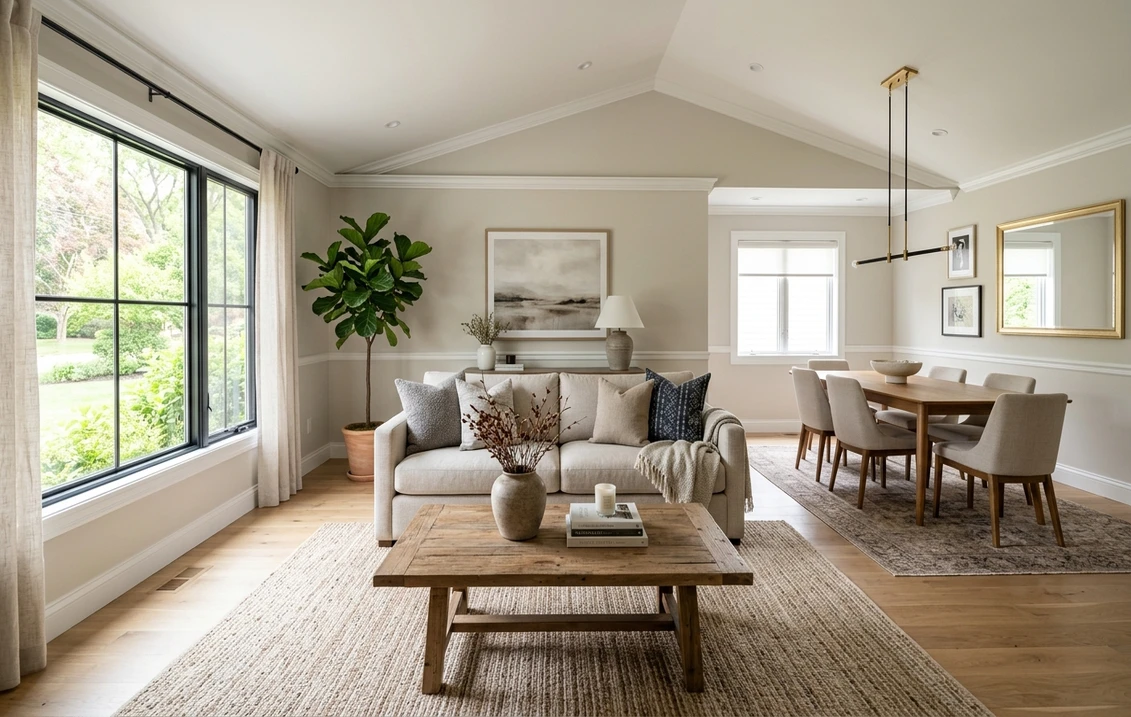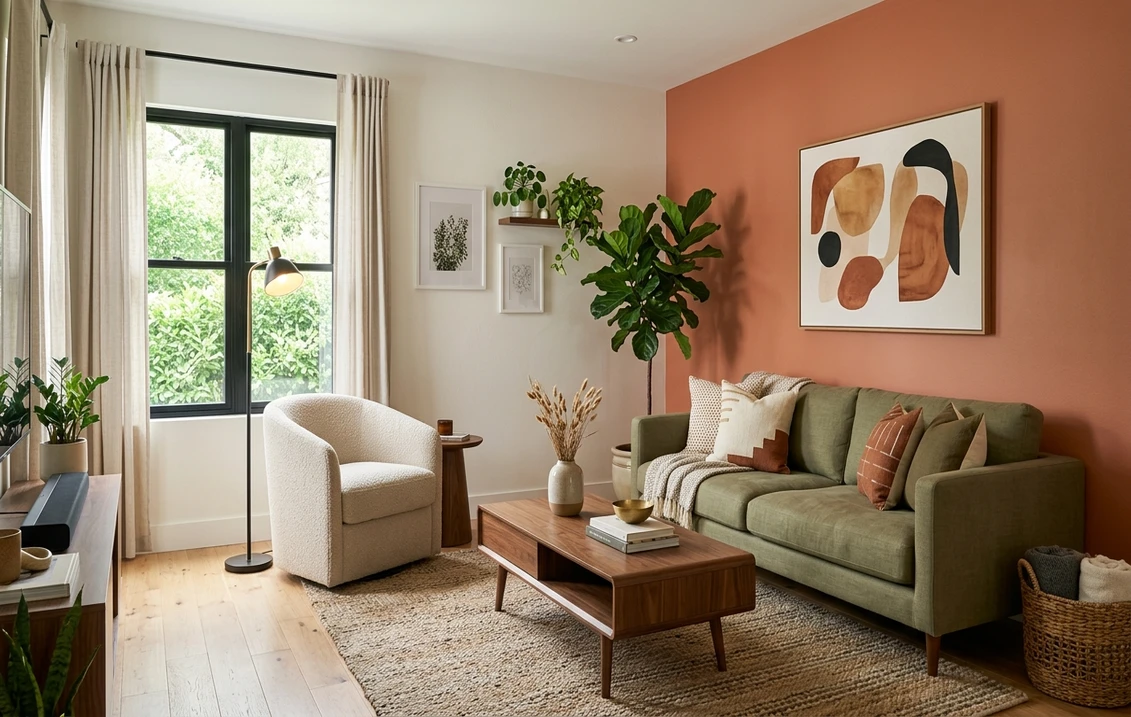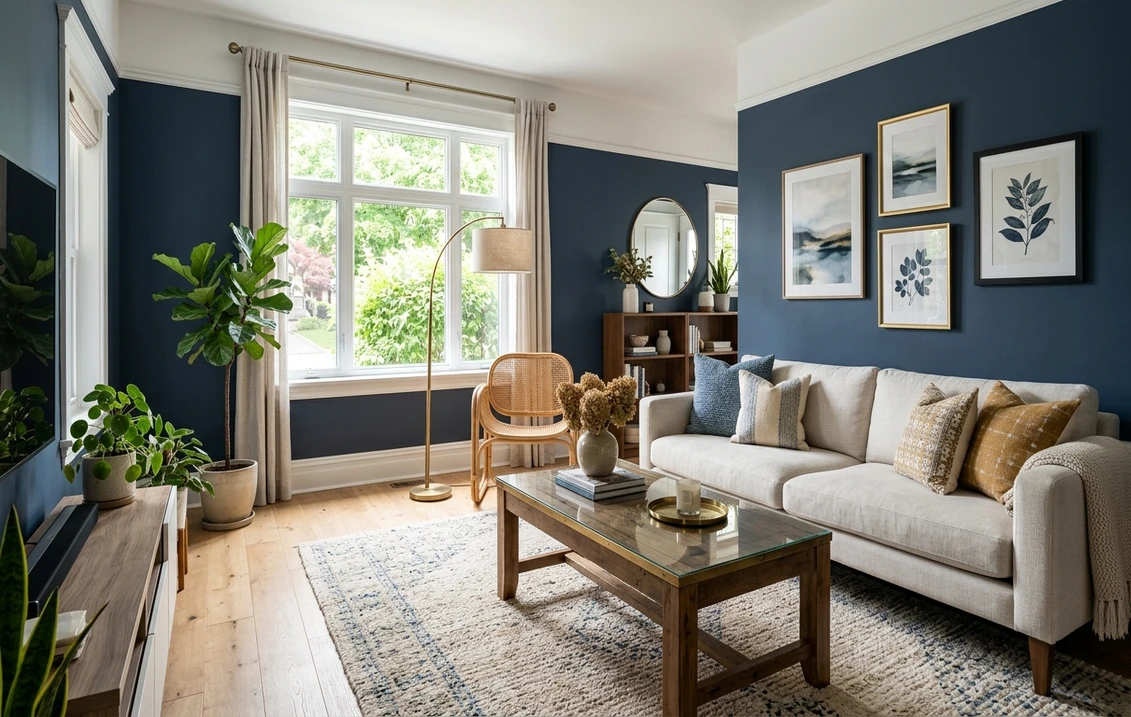
Try it on your room

Basements are the hardest room in any house to paint. You are fighting low light, tiny egress windows, cold concrete floors, a mix of framed walls and raw masonry, and a constant battle against moisture. Pick the wrong color and a finished basement feels like a cave; pick the right one and it becomes the best room in the house. In 2026, the top-performing basement palettes fall into two camps: light-reflecting neutrals (warm white, cream, soft gray) that bounce every lumen into dark corners, and moody deep tones (navy, forest green, charcoal) that embrace the low-light feel for finished media rooms. Before you commit, try our free AI interior paint visualizer on a photo of your basement to see how each shade reads under your actual lighting.
This guide walks through the 12 best basement paint colors for 2026 with Sherwin-Williams (SW) and Benjamin Moore (BM) codes, covers moisture-resistant products like Drylok masonry waterproofer and Zinsser Watertite, and shows how to coordinate wall color with concrete floor paint.
The Top 12 Basement Paint Colors for 2026
The twelve shades below have earned their spot on real-world basement walls from professional interior house painters in the Midwest, Northeast, and Pacific Northwest. Six are engineered to maximize reflected light in dim spaces; the other six are deep moody tones that work beautifully in finished media rooms and lounges where dimmer bulbs and blackout projection are the norm. Each color is paired with its LRV (Light Reflectance Value) so you can gauge how much light it will return to the room.
| # | Color Name | Brand & Code | LRV | Best Use |
|---|---|---|---|---|
| 1 | Alabaster | SW 7008 | 82 | Dark unfinished basements; bounces maximum light |
| 2 | Swiss Coffee | BM OC-45 | 83 | Warm creamy white for north-facing egress rooms |
| 3 | Accessible Beige | SW 7036 | 58 | Warm greige for finished family rooms |
| 4 | Classic Gray | BM OC-23 | 74 | Soft warm gray; versatile with LED lighting |
| 5 | Shoji White | SW 7042 | 74 | Warm off-white with subtle greige undertone |
| 6 | Revere Pewter | BM HC-172 | 55 | Warm gray for daylight walkout basements |
| 7 | Naval | SW 6244 | 4 | Deep navy for media rooms and bar areas |
| 8 | Hale Navy | BM HC-154 | 6 | Classic navy; pairs with oak built-ins |
| 9 | Forest Green (Essex) | BM HC-134 | 8 | Moody lounges; library feel |
| 10 | Pewter Green | SW 6208 | 12 | Deep muted green for accent walls |
| 11 | Iron Ore | SW 7069 | 6 | Near-black charcoal for home theaters |
| 12 | Kendall Charcoal | BM HC-166 | 11 | Softer charcoal with warm brown undertone |
Try it on your house
No photo? Try a sample
As a rule of thumb, if your basement has an LRV goal above 60, stick to the first six colors. If you are building a dedicated theater, speakeasy-style bar, or adult lounge where projection and dimmer lighting matter more than daylight, the last six will serve you better. Never paint a basement with a cool gray below LRV 50 unless you already have abundant artificial light, cool undertones below grade read gloomy and green under fluorescent tubes.
Upload a photo of your basement and test all 12 colors in under 30 seconds
Moisture-Resistant Paint: Drylok, Zinsser Watertite & Beyond
Before you open a gallon of Alabaster or Hale Navy, you need to solve the moisture problem. Basements sit below grade where hydrostatic pressure pushes water vapor (and sometimes liquid water) through concrete block and poured walls. Ordinary latex paint will bubble, peel, and grow mildew within 12 to 24 months on an untreated masonry wall. The fix is a two-layer system: a dedicated masonry waterproofer first, then your finish color on top.
| Product | Use Case | Price/Gallon | Warranty |
|---|---|---|---|
| Drylok Extreme Masonry Waterproofer | Bare concrete block, poured walls | $45–$55 | 15 years |
| Zinsser Watertite | Active seepage, mold-prone areas | $50–$60 | 5-year mold-proof |
| Drylok Original | Dry masonry; light moisture | $35–$40 | 10 years |
| Kilz Basement & Masonry | Budget waterproof primer | $30–$38 | Not rated |
| Zinsser Perma-White | Finished drywall; mold prevention | $35–$45 | 5-year mold-proof |
Drylok Extreme is the most widely specified masonry waterproofer in the US and holds back up to 15 psi of hydrostatic pressure, enough for a typical full basement wall. Apply two coats with a stiff masonry brush (rollers leave pinholes), let each coat cure 2–3 hours, then topcoat with your chosen latex. Zinsser Watertite is the pick when you see visible efflorescence or active seepage spots; its hydraulic cement additive actually plugs small cracks. Never skip primer on framed drywall either, a stain-blocking mold-resistant primer like Zinsser Bulls Eye 1-2-3 Plus stops tannin bleed from studs and protects the topcoat.
If your basement has a persistent humidity issue above 60%, paint will not solve it. Run a dehumidifier continuously and consider an interior French drain or exterior grading fix before investing in a color scheme. Paint is cosmetic protection, not a waterproofing system on its own.
Low-Light Strategies: How to Make a Dim Basement Feel Bright
Most US basements have an egress window or two no larger than 5.7 square feet (the IRC code minimum for a legal bedroom egress). That is a fraction of the glass you would find on an above-grade wall, so every gallon of paint has to work harder. Here is how professional basement finishers get the brightest possible result:
- Choose high-LRV paint (70+): Alabaster, Swiss Coffee, Classic Gray, and Shoji White all sit between LRV 74 and 83 and bounce a huge percentage of incoming light back into the room.
- Warm undertones only: Below grade, cool grays and blue-whites pick up green tints from fluorescent bulbs and feel clinical. Warm whites and creams read as natural daylight even under LED.
- Paint the ceiling white: If you have exposed joists, paint them and the underside of the subfloor the same warm white as the walls. This "sky effect" adds perceived height and reflects ceiling-mounted LEDs.
- Use eggshell or satin, not flat: A flat finish absorbs light; eggshell and satin give a subtle sheen that reflects lumens without making wall imperfections pop.
- Paint the inside of egress wells white: The exterior wall of the window well is a major source of reflected daylight. A coat of high-LRV exterior paint on that concrete nearly doubles the light coming through the glass.
- Add LED layers: Recessed 4-inch LED cans at 4000K with dimmers, plus wall sconces or picture lights, will pair beautifully with warm whites and eliminate the last of the shadow zones.
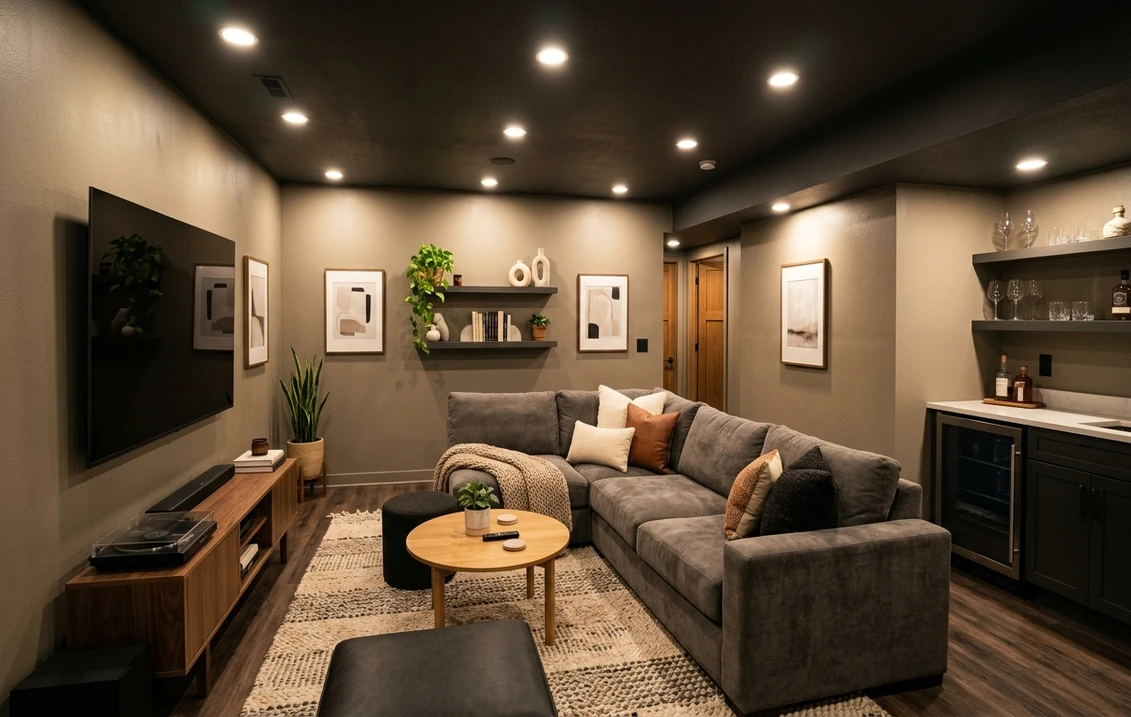
If your goal is a dedicated media room, lean into the low light. Iron Ore (SW 7069), Hale Navy (BM HC-154), or Essex Green (BM HC-134) on all four walls in flat or matte absorbs projection bounce and delivers cinema-grade contrast. Pair with blackout shades and warm 2700K puck lighting. If your media room includes a wet bar or built-ins, carrying the same near-black tone onto the millwork works the same way the charcoal and dark cabinet finishes do upstairs, grounding the space without bouncing light back at the screen.
Framed Walls vs Unfinished Masonry: Different Treatments
Most finished basements are a hybrid: drywall over framed walls in the main living areas and raw masonry in the utility, storage, or laundry zone. Each surface needs its own prep and product stack.
- Framed drywall: Prime with Zinsser Bulls Eye 1-2-3 Plus (mold-resistant), then apply two coats of a premium latex such as Sherwin-Williams Emerald or Benjamin Moore Aura in eggshell or satin. Expect $1.75–$3.50 per sq ft installed.
- Exposed concrete block: Fill mortar joints with a masonry caulk, apply two coats of Drylok Extreme with a masonry brush, then topcoat with any premium latex. Expect $2.00–$4.00 per sq ft installed due to the brush-only application.
- Poured concrete walls: Etch with a concrete etcher or degreaser, rinse, dry 24 hours, then apply Drylok or Zinsser Watertite followed by your color coat. Budget $1.50–$3.25 per sq ft.
- Exposed ceiling joists and ductwork: Spray with an airless using a flat black (for industrial looks) or flat white (for loft brightness). Budget $1.25–$2.50 per sq ft of floor area.
A common mistake is using the same white on framed walls and masonry, masonry dries several shades darker because of the porous substrate. Test-patch and cure 48 hours before committing.
Coordinating Wall Color with Concrete Floor Paint
If you are not installing LVP or carpet, the concrete slab itself becomes a major design element. Concrete floor paint (epoxy or acrylic) should be chosen in relation to your wall color, not the other way around. A few coordination rules that work in 2026:
- Light walls + medium floor: Pair Alabaster or Swiss Coffee walls with a medium gray epoxy (Sherwin-Williams ArmorSeal 1K in Dovetail or Rust-Oleum EpoxyShield Medium Gray). The floor grounds the space without shrinking it.
- Warm greige walls + charcoal floor: Accessible Beige or Revere Pewter walls with a dark charcoal epoxy feel like a premium gym or craft studio.
- Moody walls + light floor: Hale Navy or Forest Green walls paired with a natural concrete stain (Behr Premium Concrete Stain in Driftwood Gray) create theater contrast without closing the ceiling in.
- All-in monochrome: Iron Ore walls, ceiling, and floor in a matte finish is the holy grail of home theater painting, but only attempt it if you have excellent layered lighting.
Expect $1.00–$2.50 per sq ft for DIY acrylic concrete floor paint and $3.50–$7.00 per sq ft for a pro two-part epoxy. Always acid-etch or diamond-grind the slab first, epoxy will not adhere to a sealed or dusty surface.
Egress Window Considerations & Code Compliance
If your basement includes a bedroom (or you plan to add one), the egress window is non-negotiable under the International Residential Code (IRC R310): minimum 5.7 sq ft of opening, sill no higher than 44 inches above the floor, and a window well with a ladder or steps if the sill is below grade. If you are finishing a sleeping space down here, the same warm-white-plus-LED logic that works for basement bedrooms and bedroom lighting applies, since both rooms live or die by how the paint reads after dark. Paint choices interact with the egress requirement in two ways:
- Never paint the window operable hardware: Frames and sashes can be repainted, but crank mechanisms, latches, and tilt-release points must remain unpainted and fully operable. A stuck egress window can fail inspection and void insurance.
- Paint the well interior high-LRV white: A Benjamin Moore Super White or Sherwin-Williams Pure White on the corrugated steel or poured concrete well dramatically increases reflected daylight.
- Use mildew-resistant exterior paint on exposed wells: Open window wells get rained on. Apply Zinsser Perma-White or Sherwin-Williams Duration Exterior to the well interior, not interior latex, or you will be repainting every two years.
- Leave clear signage if you paint trim dark: If you paint the egress window trim in a dark color like Iron Ore, make sure emergency responders can still identify it from outside. Some municipalities require a reflective marker.
Cost Per Square Foot: DIY vs Professional Basement Painting
A typical 800 sq ft finished basement has roughly 1,200–1,400 sq ft of paintable wall surface once you account for full-height and pony walls. Here is what that translates to in 2026 dollars.
| Scope | DIY Cost | Professional Cost | Cost/Sq Ft (Pro) |
|---|---|---|---|
| Walls only, drywall, 1 color | $300–$500 | $1,800–$3,200 | $1.50–$2.75 |
| Walls + ceiling + trim | $500–$850 | $2,800–$4,800 | $2.25–$3.75 |
| Masonry waterproof + color | $450–$800 | $3,200–$5,500 | $2.75–$4.25 |
| Full finish: walls, ceiling, floor epoxy | $950–$1,600 | $5,500–$9,500 | $4.50–$8.00 |
DIY basement painting is more realistic than most interior projects because the pace is relaxed and the finish tolerance is forgiving. Expect 3–5 weekends for a two-person team. If your basement has active seepage, mold, or pre-1978 lead paint, hire a licensed and insured contractor, EPA RRP certification is required to disturb lead paint legally. Request at least three free estimates.
Basement Paint Colors FAQ
What is the best paint color for a dark basement with no windows?
The best colors for a windowless basement are high-LRV warm whites like Sherwin-Williams Alabaster (SW 7008, LRV 82) and Benjamin Moore Swiss Coffee (OC-45, LRV 83). These shades reflect the maximum amount of artificial light back into the room while their warm undertones prevent the clinical feel that cool grays produce under LED and fluorescent bulbs. Pair with 4000K recessed LEDs on dimmers for the brightest possible result. Because low light changes how a white reads, test these whites on your own basement walls before you buy a gallon.
Do I need Drylok or Zinsser Watertite on a finished basement?
Only on raw masonry walls. If your basement has framed walls with drywall installed over a proper vapor barrier and insulation, a mold-resistant primer like Zinsser Bulls Eye 1-2-3 Plus is sufficient. Use Drylok Extreme directly on exposed concrete block or poured walls in unfinished utility areas, and reach for Zinsser Watertite if you see active efflorescence or spot seepage. Neither product substitutes for solving a real water intrusion problem.
Can I use dark paint colors like navy or forest green in a basement?
Yes, and they work beautifully in finished media rooms, home theaters, bars, and lounges where lower ambient light is actually desired. Naval (SW 6244), Hale Navy (BM HC-154), Essex Green (BM HC-134), and Iron Ore (SW 7069) all have LRVs between 4 and 12 and absorb projection bounce for better screen contrast. Pair with warm 2700K lighting, blackout window treatments, and a lighter floor or ceiling to prevent the space from feeling cramped. Budget for the extra film build: under LRV 10 these shades need a tinted gray primer plus three finish coats, roughly 20 percent over a standard repaint. Our twelve moody game room paint colors rate the same shade family on how dark each one reads under RGB strips and a projector.
How much does it cost to paint a basement in 2026?
Professional basement painting costs $1.50–$2.75 per square foot for walls only on drywall, $2.25–$3.75 per sq ft for walls plus ceiling and trim, and $2.75–$4.25 per sq ft if masonry waterproofing is required. A typical 800 sq ft basement runs $1,800–$5,500 depending on scope. DIY materials for the same project cost $300–$850, saving 70–80% on labor but requiring 3–5 weekends of work.
What paint sheen should I use in a basement?
Use eggshell or satin on walls and semi-gloss on trim, doors, and baseboards. Flat finishes absorb the limited light available below grade and are harder to clean, while eggshell and satin offer subtle light reflection plus wipe-down durability, important in a space where kids play, laundry happens, and humidity fluctuates. For ceilings, a matte or flat with built-in mildew resistance (like Benjamin Moore Aura Bath & Spa or Sherwin-Williams Ceiling Paint) hides imperfections in older joists.
Preview all 12 basement colors on a photo of your own walls, free, no signup
A successful basement paint job starts with moisture control and ends with a color that works under your actual lighting. Do not guess from a 2-inch paint chip, upload a photo to our AI interior paint visualizer and see each Sherwin-Williams or Benjamin Moore shade rendered on your walls. For more room-by-room budgets, see our complete interior house painting cost guide and bedroom painting cost guide. Sources: IRC R310, EPA RRP Rule, Sherwin-Williams & Benjamin Moore 2026 color catalogs.
Frequently asked questions
What is the best paint color for a dark basement with no windows?
Do I need Drylok or Zinsser Watertite on a finished basement?
Can I use dark paint colors like navy or forest green in a basement?
How much does it cost to paint a basement in 2026?
What paint sheen should I use in a basement?
Trademarks mentioned (Sherwin-Williams, Benjamin Moore, Behr, Caparol, Brillux, Sto, Alpina, Valspar, PPG, Glidden, Dulux, Crown Trade, Sandtex, Farrow & Ball, Johnstone's, Leyland) are property of their respective owners. FacadeColorizer is independent and not affiliated with any of them. Nominative fair use under Lanham Act §1125.