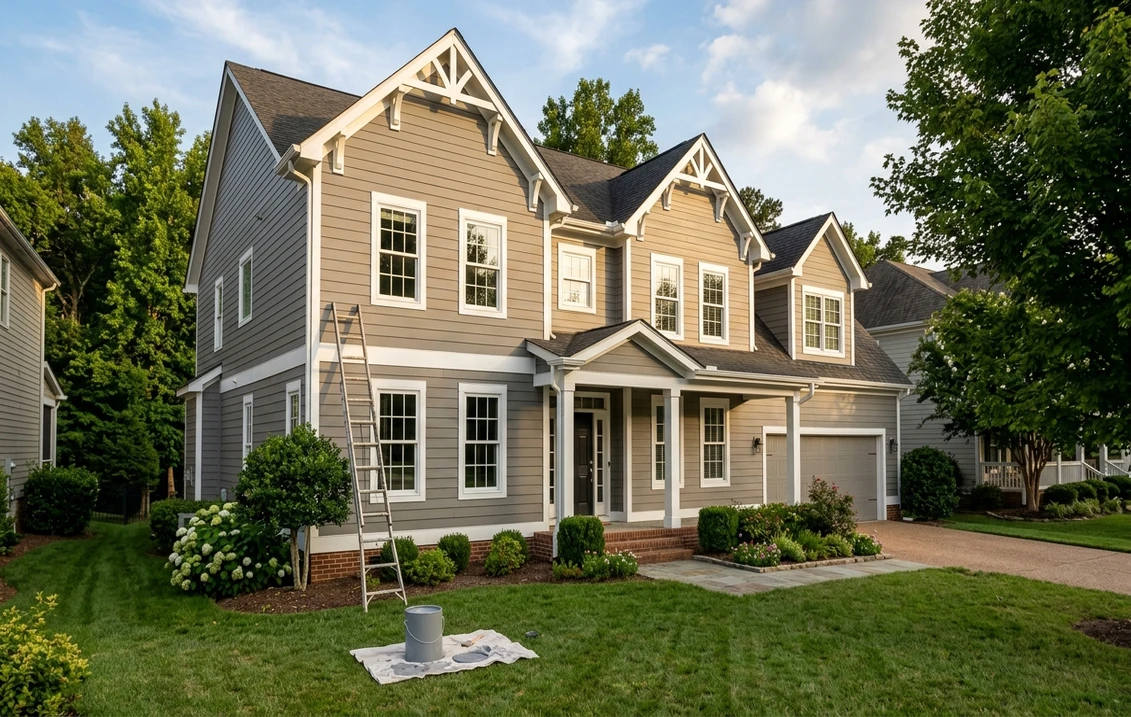
Try it on your house

Behr Ultra Exterior is the middle tier of the Behr exterior lineup sold at The Home Depot, above Premium Plus and below Marquee and Dynasty. This review sets aside the marketing adjectives and reads the two documents that actually describe the product: the technical data sheet for Ultra Exterior Satin Enamel No. 9850 and the label sheet for Ultra Exterior Flat No. 4850, both published through The Home Depot's catalog. Every number below comes from those sheets, from the Behr Ultra Exterior product page, or from the Master Painters Institute approved products list.
Where Behr Ultra sits in the lineup
Behr sells four exterior lines through The Home Depot: Premium Plus, Ultra, Marquee and Dynasty. The cleanest way to see that they are four distinct formulas, and not four labels on one can, is the MPI #11 approved products list (Latex, Exterior Semi-Gloss, MPI Gloss Level 5), which lists each line's semi-gloss under its own product code: Premium Plus 5050, Ultra 5850, Marquee 5450 and Dynasty 5650, plus the BehrPro e600 PR670. Ultra is the first tier that Behr markets as a stain-blocking paint and primer in one, and it is the tier most homeowners end up with when the Premium Plus price looks good but the house has chalky old paint, tannin-bleeding cedar or a dark-to-light color change.
If you are weighing the three mainstream tiers, our comparison of the Behr exterior lines covers the whole ladder, and the dedicated reviews of Behr Premium Plus Exterior and Behr Marquee Exterior go one step down and one step up from this one.
Behr Ultra Exterior specs, straight from the data sheet
The satin enamel data sheet (revised 8/2019) is the most complete public document on the formula. The table reads it line by line; the flat label sheet (rev. 5/21) is noted where it differs.
| Property | Ultra Exterior Satin Enamel (No. 9850 TDS) | What it means on your house |
|---|---|---|
| Resin | 100 % acrylic, paint and primer in one, NANOGUARD technology | Flexible film that moves with siding; no alkyd yellowing |
| Gloss (60 degrees) | 15 to 25 | A true satin, between flat and semi-gloss |
| Solids | 37 % by volume, 50 % by weight | Mid-range for an exterior acrylic; film build comes from two coats, not one |
| VOC | under 50 g/L; SCAQMD, CARB, LADCO, OTC and OTC Phase II compliant; GREENGUARD | Can be sold and used in every US air district |
| Coverage | 250 to 400 sq ft per gallon depending on method and porosity | Budget 250 on rough or bare surfaces, 400 only on smooth repaints |
| Film thickness | Wet 6.4 mils / dry 2.4 mils at 250 sq ft; wet 4.0 / dry 1.5 at 400 sq ft | Spreading it to 400 sq ft gives a film 40 % thinner |
| Dry time (77 F, 50 % RH) | Satin: touch 2 h, recoat 4 h, full cure 4 weeks. Flat label: dry 1 h, recoat 2 h | Two coats in a day on the satin only in warm, dry weather |
| Application window | Air, material and surface 35 to 90 F; at least 5 F above dew point; no rain expected within 2 to 3 h; not below 35 F for 48 h after painting | The 35 F floor is what Behr calls low temperature application |
| Tools | Nylon/polyester brush, 3/8 to 1 inch nap roller, airless tip .015 to .021, 60 mesh filter, 1,400 to 2,400 psi | Thin for spraying only, max 1/2 pint of water per gallon |
| Performance tests | Scrub ASTM D2486 over 2,500 cycles; mildew ASTM D3273 (4 weeks) pass; accelerated weathering ASTM D4587 500 h pass | Standard exterior acrylic test set, passed |
| MPI listing | Satin: MPI 15 and 315. Semi-gloss: MPI 11 (code 5850) | Accepted in specifications that call out MPI numbers |
| Sizes and bases | Ultra Pure White 9850, Medium Base 9854, Deep Base 9853 (flat: 4850 / 4854 / 4853); 1 gallon and 5 gallon | Tint bases must be tinted before use |
Try it on your house
No photo? Try a sample
Two things in that table deserve a second look. The first is the film thickness line: Behr gives the same can a 250 to 400 sq ft range, but the dry film at 400 sq ft is 1.5 mils against 2.4 mils at 250. A painter who stretches a gallon to 400 sq ft is not getting a bargain, he is applying a thinner coat. The second is the dry time split between sheens: the satin sheet says 2 hours to touch and 4 hours to recoat, while the flat label says 1 hour and 2 hours. Plan the day around the sheen you actually bought.
The stain-blocking primer claim, and when you still prime
"Paint and primer in one" is the phrase that sells Ultra, and the data sheet is honest about what it means: the first coat acts as the primer and the second as the finish, on properly prepared surfaces. The same sheet then lists the cases where Behr itself tells you to use a separate primer:
- Tannin-rich woods (cedar, redwood): one coat of Behr Multi-Surface Stain-Blocking Primer and Sealer No. 436, then two coats of Ultra. The flat label adds that heavy stains and tannin woods need 12 to 16 hours of drying between coats.
- Masonry with a high pH (fresh stucco, concrete, brick up to pH 13): Primer No. 436, after letting new stucco, plaster and masonry cure for 30 days.
- Concrete block: one coat of DRYPLUS Masonry Waterproofer No. 875 to fill the block before two coats of Ultra.
- Ferrous metal: Metal Primer No. 435 or Primer No. 436 after cleaning to SSPC-SP2, with a rust-inhibitive primer applied the same day the metal is cleaned.
- Vinyl, PVC and plastics: Bonding Primer No. 432 or Primer No. 436, and on vinyl the new color must be the same or lighter than the existing one.
- Drastic color changes and deep colors marked with a dagger on the color chip: a tinted primer coat of Ultra first.
So the primer claim is real for the common case, a sound previously painted surface, and it is Behr's own document that says a repaint over bare cedar or chalky stucco still starts with a can of No. 436. If your siding is one of the problem cases, the guide to Behr on masonry, stucco and brick walks through the prep in more detail.
What a gallon of Behr Ultra Exterior costs in 2026
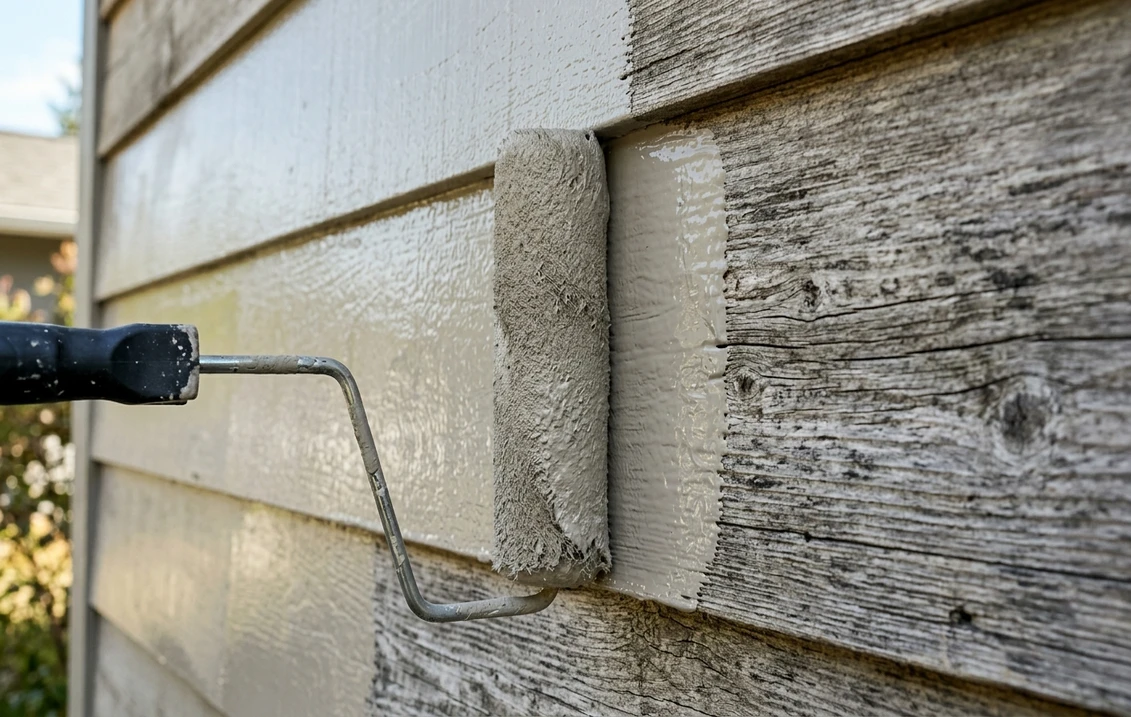
Behr Ultra is a Home Depot exclusive, so there is one retail price list. At the time of writing, the 1-gallon Medium Base Satin Enamel listing showed $41.98 and the Semi-Gloss Medium Base $42.98, with pre-tinted color listings between the low fifties and the high fifties depending on color and sheen. Prices move with promotions and by store, so treat those as a snapshot and check the listing the week you buy. For a 2,000 sq ft two-story house that needs two coats at 300 sq ft per gallon, that is roughly 13 to 14 gallons, which puts the paint alone in the mid-$500s to low $600s at base price and pushes a 5-gallon pail into the math.
Our exterior paint cost guide puts those gallons next to labor, which is the larger number on every quote.
Best uses for Behr Ultra Exterior
The data sheet's recommended substrates list is long: stucco, concrete, masonry, concrete masonry units, brick, fiber cement, wood, engineered wood, steel, galvanized steel, aluminum, other ferrous and non-ferrous metals and architectural plastics. In practice Ultra earns its price over Premium Plus in three situations.
- Repaints over sound but tired paint: the two-coat paint-and-primer system saves a separate primer day, and the 35 F application floor stretches the season into early spring and late fall.
- Fiber cement siding: Behr lists it as self-priming with two coats of Ultra, or primer No. 436 plus two coats; the 100 % acrylic film suits the dimensional stability of the board.
- Color changes from a mid-tone to a light color on smooth siding, where the tinted first coat of Ultra does the hiding and the second coat does the finish.
Where it does not earn its price: bare cedar or redwood (you are buying primer anyway, so the gap to Premium Plus narrows), and very dark colors in hot climates, where a dedicated heat-reflective line is the better tool. Our guide to the best exterior paint for hot climates explains why color matters more than tier there.
Pros and cons from the documents
| Pros | Cons |
|---|---|
| Documented 35 F application floor, with a 48-hour rule that is easy to plan around | Satin recoat is 4 hours at 77 F; cool or humid days push a second coat to the next morning |
| MPI 11, 15 and 315 listings, so it passes specification-driven HOA or commercial reviews | Full cure is 4 weeks and Behr asks you not to wash the house before then |
| Under 50 g/L VOC in all sheens, legal everywhere | Self-priming only on sound surfaces; six substrate cases still need a separate primer |
| Lifetime limited warranty to the original residential purchaser (flat label) | The warranty is void if the label prep steps were skipped, and it excludes labor |
| One retailer, one price list, easy to compare | One retailer, so no competing quotes and no contractor discount structure |
How to apply Behr Ultra for the result the data sheet promises
- Prep to the sheet. Clean off dirt, chalk, oil, mildew and loose paint. Treat mildew with a mildew stain remover, sand new wood to open the mill glaze, countersink nails, fill and sand, and caulk gaps with a 100 % acrylic, siliconized, paintable caulk.
- Check the weather, not the calendar. 35 to 90 F for air, surface and material, 5 F above the dew point, no rain for 2 to 3 hours after, no drop below 35 F for 48 hours. Avoid direct sun above 90 F, which dries the film too fast.
- Load the roller. 3/8 to 1/2 inch nap on semi-smooth siding, 3/4 to 1 inch on rough stucco or split-face block. Do not thin for brush or roller.
- Aim for 250 to 300 sq ft per gallon on the first coat. That is where the 2.4 mil dry film lives; 400 sq ft is a thin coat, not a frugal one.
- Respect the recoat window. 4 hours on satin, 2 hours on flat at 77 F and 50 % humidity, longer when it is cool or damp, and 12 to 16 hours over tannin woods.
- Leave it alone for 4 weeks. The film keeps curing; wash with a mild non-abrasive detergent only after that.
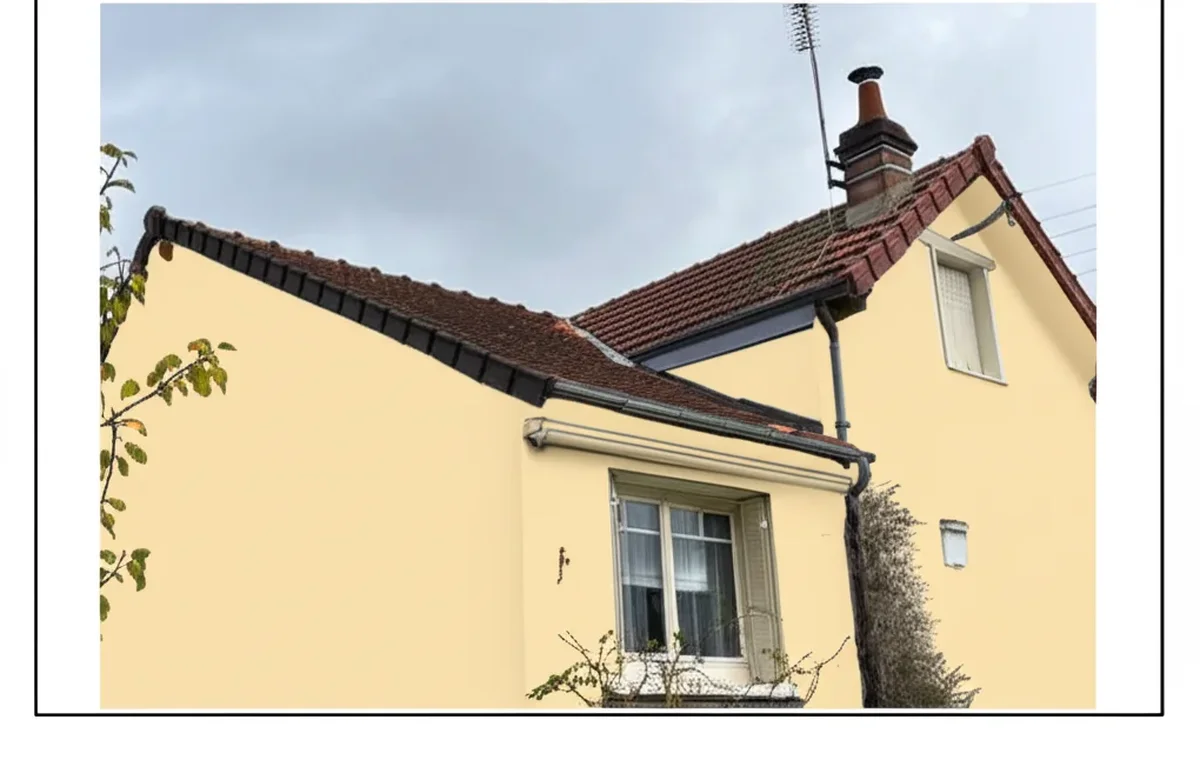
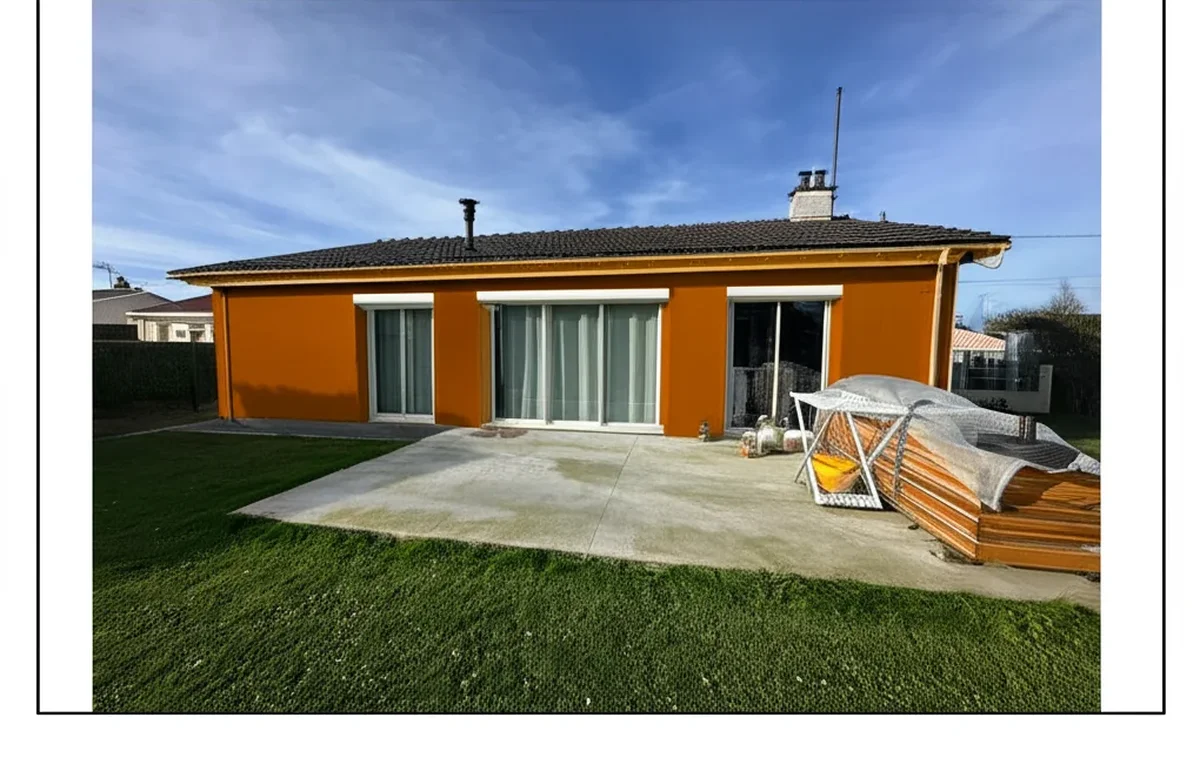
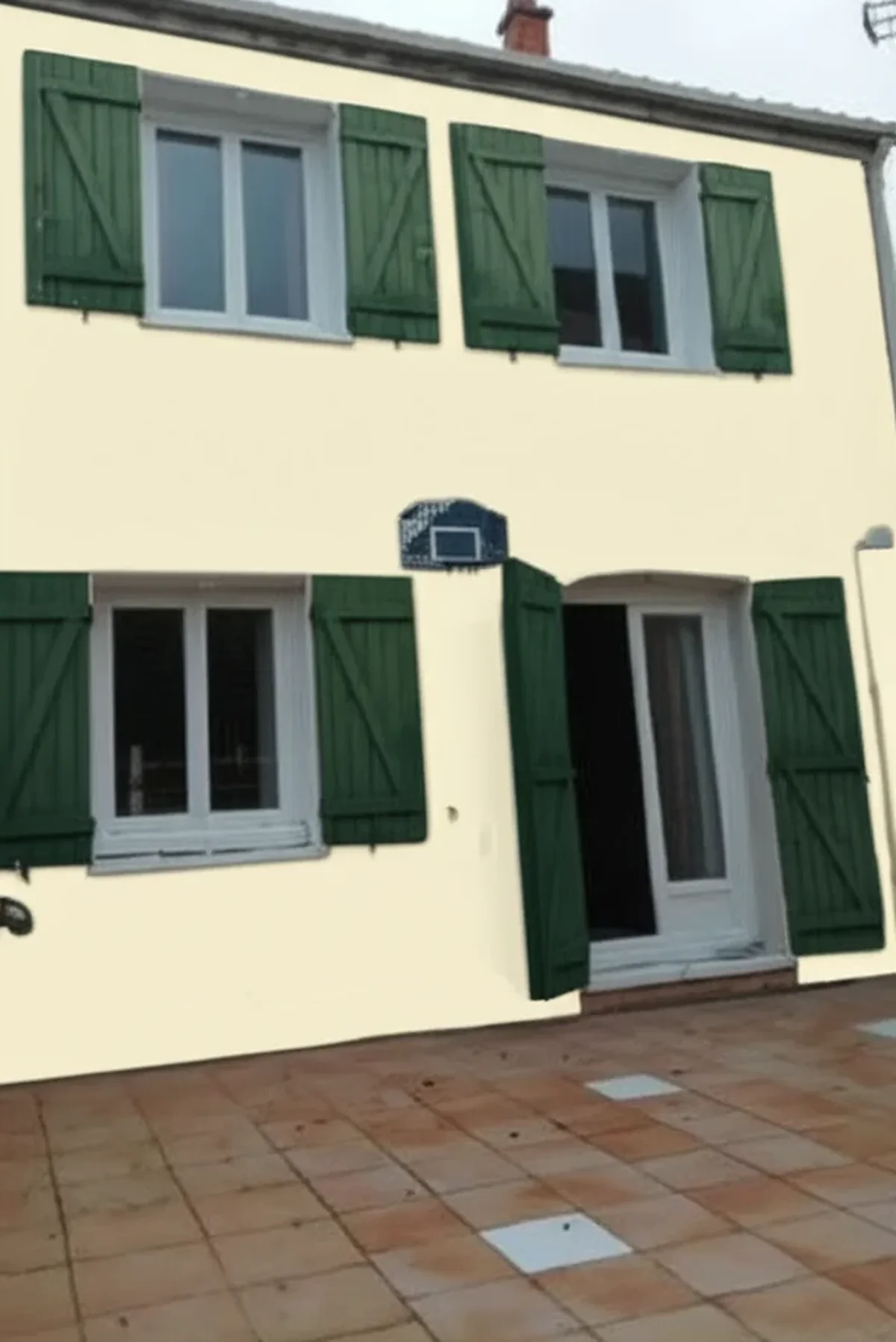
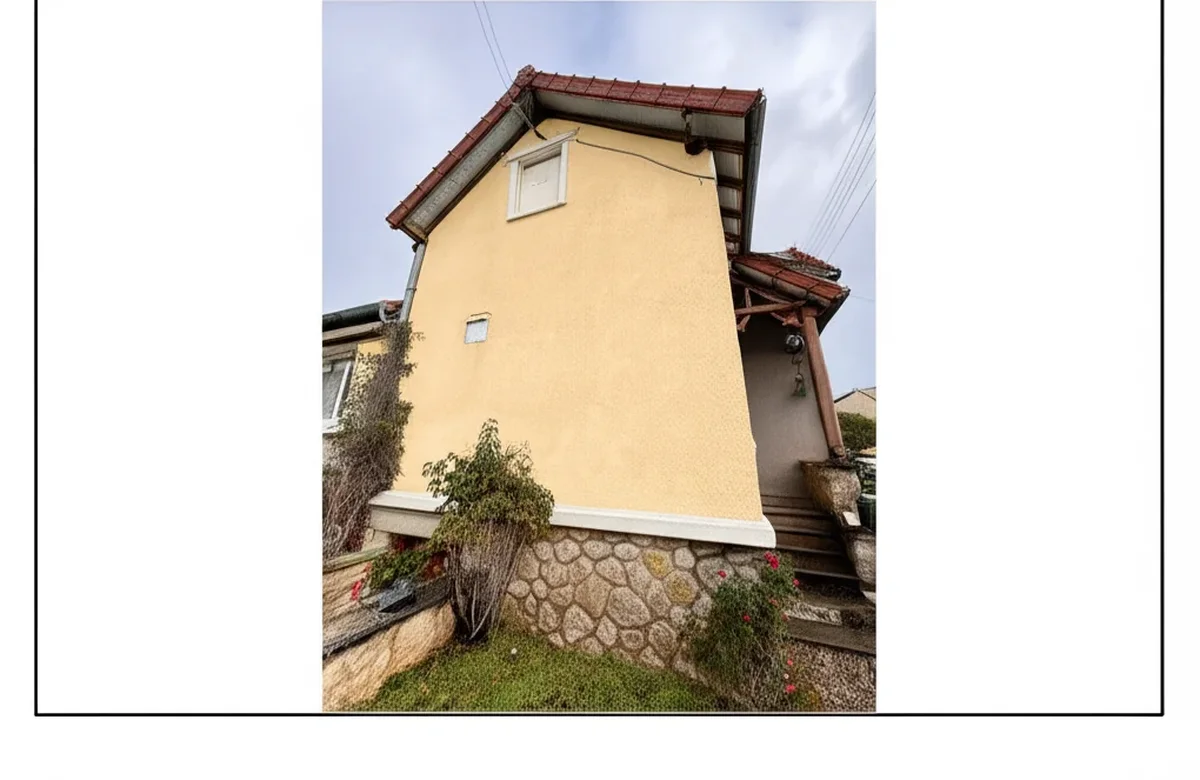
Picking the color is the part the data sheet cannot help with. The best Behr exterior colors for 2026 and the Hidden Gem, Behr's 2026 Color of the Year are the two places to start, and the Behr color visualizer puts any of them on a photo of your own house.
Behr Ultra vs Premium Plus vs Marquee: how to decide
All three lines are 100 % acrylic exterior paints sold in the same aisle, and all three appear on the MPI #11 list for semi-gloss. The decision is about your surface and your schedule, not about chemistry you can read off a label.
- Choose Premium Plus when the surface is sound, the color is staying in the same family, and the budget is the constraint.
- Choose Ultra when you want the stain-blocking first coat, the 35 F application floor and an MPI-listed product without paying for the top tier. This is the case for most repaints of painted siding and fiber cement.
- Choose Marquee when a single-coat finish over a primed surface matters to the schedule, or when the house is in a harsh-exposure location where you want the top warranty tier. Our Marquee review reads its sheet the same way.
If Behr is not a given, the Sherwin-Williams vs Benjamin Moore exterior comparison covers the two brands most often quoted against it, and the Sherwin-Williams Latitude review is the closest cross-brand match for a mid-tier acrylic with a low-temperature claim.
Verdict: the engineered middle
Behr Ultra Exterior is a well-documented mid-tier acrylic: a 2.4 mil dry film at the coverage Behr actually recommends, a 35 F application window with clear rules, under 50 g/L VOC, passed ASTM scrub, mildew and weathering tests, and MPI listings in satin and semi-gloss. The paint-and-primer claim holds on sound surfaces and is honestly limited by the same sheet that makes it. At roughly $42 per base gallon before tinting, it is the sensible default for a repaint of painted siding; the step up to Marquee is a schedule and warranty decision, and the step down to Premium Plus is a budget one.
Sources and references
- Behr Process Corporation, Technical Data Sheet, Behr Ultra Exterior Satin Enamel Paint No. 9850 (revised 8/2019, PDF): resin, gloss, solids, VOC, film thickness, coverage, dry times, application limits, primer system, ASTM results, MPI 15 and 315.
- Behr Process Corporation, Behr Ultra Exterior Flat label sheet No. 4850 (rev. 5/21, PDF): 1 hour dry, 2 hours recoat, 250 to 400 sq ft, 35 to 90 F, tannin woods 12 to 16 hours, lifetime limited warranty.
- Behr, Behr Ultra Exterior product page: lineup position, sheens, stain-blocking paint and primer positioning.
- Master Painters Institute, Approved Products List, MPI #11 Latex, Exterior Semi-Gloss (Gloss Level 5): Behr Ultra Exterior Semi-Gloss Enamel 5850 alongside Premium Plus 5050, Marquee 5450 and Dynasty 5650.
- The Home Depot, Behr Ultra 1 gal. Medium Base Satin Enamel listing: retail price snapshot used above.
Frequently asked questions
Is Behr Ultra Exterior worth the upgrade from Premium Plus?
How much does Behr Ultra Exterior cost per gallon in 2026?
How many square feet does a gallon of Behr Ultra Exterior cover?
What are the dry and recoat times for Behr Ultra Exterior?
Does Behr Ultra Exterior really replace primer?
Can I preview Behr Ultra colors on my house before buying?
Trademarks mentioned (Sherwin-Williams, Benjamin Moore, Behr, Caparol, Brillux, Sto, Alpina, Valspar, PPG, Glidden, Dulux, Crown Trade, Sandtex, Farrow & Ball, Johnstone's, Leyland) are property of their respective owners. FacadeColorizer is independent and not affiliated with any of them. Nominative fair use under Lanham Act §1125.