Try it on your room

Quick answer: For a black living room in 2026, three shades do most of the work: Tricorn Black (SW 6258, LRV 3) for a crisp true black, Iron Ore (SW 7069, LRV 6) for a soft warm near-black that is the easiest to live with, and Black (2132-10) from Benjamin Moore for a deep, velvety full-room look. Use one as a single accent wall behind the sofa, media unit, or fireplace, or commit the whole room if you have good light, then pair with white trim, brass, and warm wood.
Black is the boldest thing you can do to a living room, and in 2026 it is also one of the most requested. Used with a little restraint, black living room paint reads as expensive, calm, and modern rather than dark and heavy. The trick is choosing the right kind of black (very few of them are pure jet), putting it in the right place, and giving it enough light and contrast to breathe. This guide sits inside our wider room-by-room paint color ideas hub, and if black feels like too much commitment you can step up one notch of lightness to the charcoals and grays in the wider living room color palette. Here we stay tight on one thing: black on a living room wall.
Best black shades for a living room
Almost no interior black is a flat, printer-ink black. The good ones carry a whisper of brown, blue, or green that keeps the wall from looking like a void and lets it shift gently as the light moves. LRV (Light Reflectance Value) tells you how dark each one really is: the lower the number, the closer to absolute black. Everything below sits between LRV 3 and 10, which is the usable range for a living room.
| Color | Brand + code | Approx LRV | Why it works in a living room |
|---|---|---|---|
| Tricorn Black | Sherwin-Williams SW 6258 | 3 | The crispest true black, no strong undertone. The sharpest choice for a graphic accent wall, built-ins, or trim. |
| Black | Benjamin Moore 2132-10 | 3 | Deep, velvety, faintly warm. Reads rich and enveloping on a feature wall or fireplace surround. |
| Iron Ore | Sherwin-Williams SW 7069 | 6 | Soft warm near-black with a hint of brown. The friendliest full-room black and a bestseller for a reason. |
| Cyberspace | Sherwin-Williams SW 7076 | 6 | A blue-black charcoal that leans cool and contemporary. Great with white trim and cool daylight. |
| Peppercorn | Sherwin-Williams SW 7674 | 10 | A soft charcoal that behaves like a gentle black. The lowest-risk way in when pure black feels too heavy. |
Try it on your house
No photo? Try a sample
LRV figures are manufacturer-published and approximate on screen. Always confirm with a physical sample under your own light.
Upload one photo and preview these shades on your actual living room. Free, no signup.
How to use black in a living room
The safest way to bring black into a living room is a single accent wall, usually the one behind the sofa, the media unit, or the fireplace. That one plane gives you all the drama with none of the risk, and it frames whatever sits in front of it. If you want the full moody-room look, you can wrap all four walls, but only commit to that when the room has good natural light and you are ready to layer in lamps. Black absorbs light, so a windowless or north-facing box will feel like a cave, while a bright room with big windows turns the same black into something soft and gallery-like.
Trim is the decision that makes or breaks the look. Crisp white trim (a clean white such as High Reflective White SW 7757 or Chantilly Lace OC-65) gives you sharp, graphic contrast and keeps the room feeling architectural. Painting the trim and walls the same black instead, in a slightly different sheen, reads seamless and ultra-modern and can make a small room feel larger by erasing the edges. Pick one lane and stay in it, because a half-hearted off-white trim is what makes black walls look unfinished.
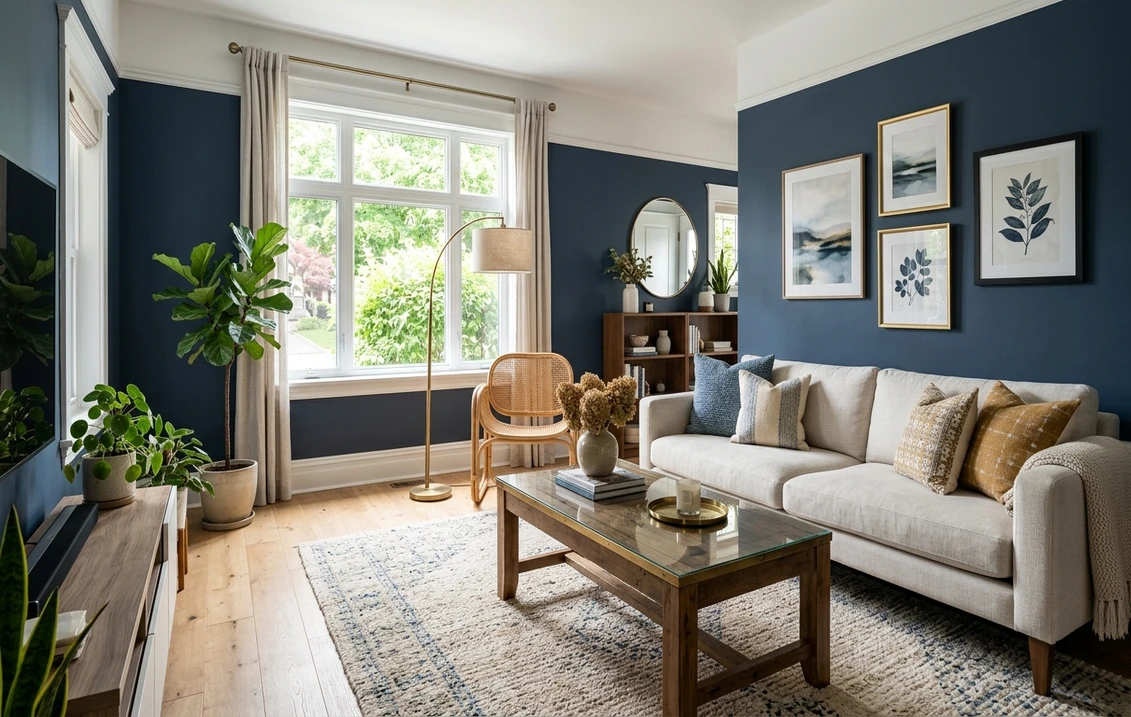
Black wants warmth beside it. Brass and aged bronze in lighting, hardware, and frames glow against a dark wall, and warm wood tones (oak, walnut, cane) stop the room from feeling cold or clinical. Layer in cream, ivory, or oatmeal textiles, a pale rug, and a few large plants, and the black turns into a backdrop that makes everything else look richer. If you prefer a cooler, more contemporary read, swap the brass for matte black or brushed nickel and lean on white and charcoal instead.
Two technical notes. First, lighting: use warm 2700K bulbs and several lamps at different heights rather than one overhead fixture, and keep the ceiling a light color to lift the room. Second, sheen: a matte or eggshell finish hides wall imperfections and gives black that deep, chalky, velvet look, while a satin picks up more light and shows every roller mark, so most people prefer matte or eggshell on a black living room wall.
What to pair with black
A black living room lives on contrast and warmth. Here is the short list that rarely misses:
- White trim and ceiling: crisp white keeps the room from feeling closed in and sharpens every edge.
- Warm metals: brass and aged bronze in lighting, hardware, and frames add glow and a sense of luxury.
- Natural wood: oak, walnut, and cane bring warmth and texture that soften the black.
- Cream and ivory textiles: a pale sofa, throw, or rug creates the light-and-dark balance that makes a room feel designed.
- Greenery: large plants read vividly against black and keep the space feeling alive.
- One accent color: a single saturated note (rust, ochre, deep green, or burgundy) in a cushion or artwork stops the scheme from going flat.
Because black shifts so much with light and neighboring colors, it is worth previewing on your own room before you buy a drop of paint. Our interior paint visualizer lets you drop any of these shades onto a photo of your living room and see the wall, trim, and furniture together. If black is pulling you toward the rest of the house, the same soft blacks look striking on cabinetry in our black kitchen paint ideas, and for a more formal, layered space see our gray dining room paint ideas.
Frequently asked questions
Is black paint a good idea for a living room?
Yes, when the room can support it. Black works beautifully in a living room with decent natural light, layered lamps, and warm accents like wood and brass. It reads calm, high-end, and modern rather than gloomy. In a dark or very small room, start with a single accent wall or a softer charcoal such as Peppercorn (SW 7674, LRV 10) rather than committing all four walls to a true black.
What is the best black paint for a living room?
The three most reliable picks are Tricorn Black (SW 6258, LRV 3) for a crisp true black, Iron Ore (SW 7069, LRV 6) for a soft warm near-black that is the easiest to live with, and Black (2132-10) from Benjamin Moore for a deep, velvety full-room look. Iron Ore is the most forgiving if you are painting more than one wall, since its warmth keeps the room from feeling cold.
Does black paint make a living room look smaller?
Not necessarily. Black blurs the edges of a room and makes corners recede, which can actually make a space feel larger and more enveloping, especially if you paint the trim to match the walls. Keep the ceiling light, layer your lighting instead of relying on one overhead fixture, and add a pale rug and lighter furniture so the room feels intentional rather than cramped.
What colors go with black living room walls?
White for trim and ceiling, warm metals like brass and aged bronze, natural wood tones, and cream or ivory textiles are the core team. Add greenery and a single accent color (rust, ochre, deep green, or burgundy) in cushions or art to keep the scheme from feeling flat. Match your whites and metals across the room so the whole look stays cohesive.
1 HD render plus 3 free color variations.
Color names and codes are trademarks of their respective owners (Sherwin-Williams, Benjamin Moore, Behr). FacadeColorizer is an independent AI visualization tool and is not affiliated with them. LRV and hex values are approximate; the authoritative reference is a physical paint sample in your own light.
Trademarks mentioned (Sherwin-Williams, Benjamin Moore, Behr, Caparol, Brillux, Sto, Alpina, Valspar, PPG, Glidden, Dulux, Crown Trade, Sandtex, Farrow & Ball, Johnstone's, Leyland) are property of their respective owners. FacadeColorizer is independent and not affiliated with any of them. Nominative fair use under Lanham Act §1125.