Try it on your room

Quick answer: For a calm, current living room, three sage greens do most of the work: SW Evergreen Fog (SW 9130, LRV 30) for a smoky feature wall, BM October Mist (1495, LRV 46) for soft, warm walls, and SW Clary Sage (SW 6178, LRV 41) for a near-neutral whole-room green. Pair any of them with warm wood, cream trim, rattan, and a little brass.
Sage green has quietly become the default living room color for people who want something warmer and more alive than gray but calmer than a true green. It is soft, it is restful, and it flatters the warm woods, cream, and brass that most of us already own. This guide stays tightly on sage green for a living room: the exact shades worth shortlisting, where to put them, and what to pair them with. It sits inside our wider room-by-room paint color ideas hub, and if you want to look past sage into deeper forests, olives, and gray-greens, start with the wider green living room palette, which covers the full green range for this room.
Best sage green shades for a living room
Five shades cover almost every sage living room job, from a barely-there whole-room wash to one dramatic plane behind the sofa. Each one below is a real, buyable color with its published LRV (Light Reflectance Value: higher means it bounces more light and reads airier). Match the depth to your room's light and to how bold you want to be.
| Color | Brand and code | Approx LRV | Why it works in a living room |
|---|---|---|---|
| October Mist | Benjamin Moore 1495 | 46 | Soft, warm sage (2022 BM Color of the Year); easy on full walls and glows under lamplight. |
| Clary Sage | SW 6178 | 41 | Gray-leaning sage that reads almost like a warm neutral; the safest whole-room pick. |
| Softened Green | SW 6177 | 53 | Airier and lighter; keeps a low-light or north-facing living room open and restful. |
| Evergreen Fog | SW 9130 | 30 | Smoky gray-green; the go-to feature-wall sage, moody without going dark. |
| Pewter Green | SW 6208 | 12 | Deep, blackened green for one accent plane when you want real drama and depth. |
Try it on your house
No photo? Try a sample
LRV figures are published manufacturer values for the named shades (Sherwin-Williams and Benjamin Moore color data, 2026). Screen color is approximate; confirm with a physical sample.
Upload one photo and preview these shades on your actual living room. Free, no signup.
How to use sage green in a living room
Start by deciding whether sage is the whole room or one wall. A light, gray-leaning sage such as Clary Sage (SW 6178) or the airier Softened Green (SW 6177) is calm enough to run on all four walls without ever feeling like a statement, so it suits open-plan living rooms and smaller spaces where you want continuity. A deeper, smokier sage like Evergreen Fog (SW 9130) usually looks best as a single feature wall, on the fireplace chimney breast or the wall behind the sofa, with the rest of the room kept in a warm off-white. Save the near-black Pewter Green (SW 6208) for a single accent plane or a set of built-in shelves; wrapping a small living room in it is too heavy.
If that feature wall is the chimney breast and a TV hangs on it, one number overrides taste. A powered-off screen only melts into a wall below roughly LRV 10, and it reads as a rectangle again above LRV 30. Evergreen Fog sits at exactly 30 and Clary Sage at 41, so no sage on this list will hide a screen: that is what Pewter Green is there for. The trade-off, along with the finish and layout rules specific to that wall, is in our guide to the accent wall with a fireplace and TV.
Trim and ceiling do a lot of quiet work. Sage flatters a soft, slightly creamy white far more than a stark, cool blue-white, which can leave the green looking gray and flat. A warm white on the trim keeps the room cozy and intentional; a warm white ceiling stops a mid sage from feeling closed-in. If you love the enveloping, custom look, color-drenching (walls, trim, and ceiling in one shade) works beautifully with a lighter sage: keep the LRV in the mid-40s or higher, like October Mist, so the room stays bright.
Light changes sage more than it changes a beige, so read your room before you commit. North-facing living rooms get cool, indirect light that can flatten a yellow-leaning sage, so lean toward the gray-greens (Evergreen Fog holds its character well in cool light). South and west rooms get warm, generous light that lets you push a touch deeper and still feel alive at every hour. Whatever you pick, check it again at night under your normal bulbs: warm 2700K lamps make sage glow, while cooler bulbs can gray it out.
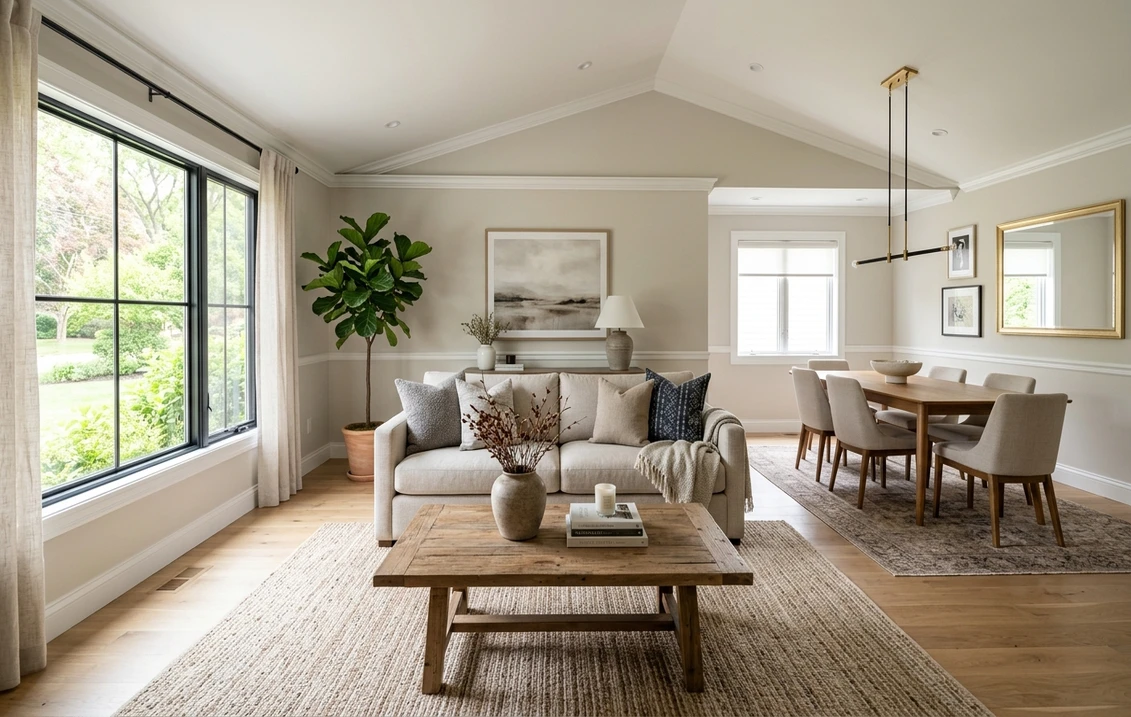
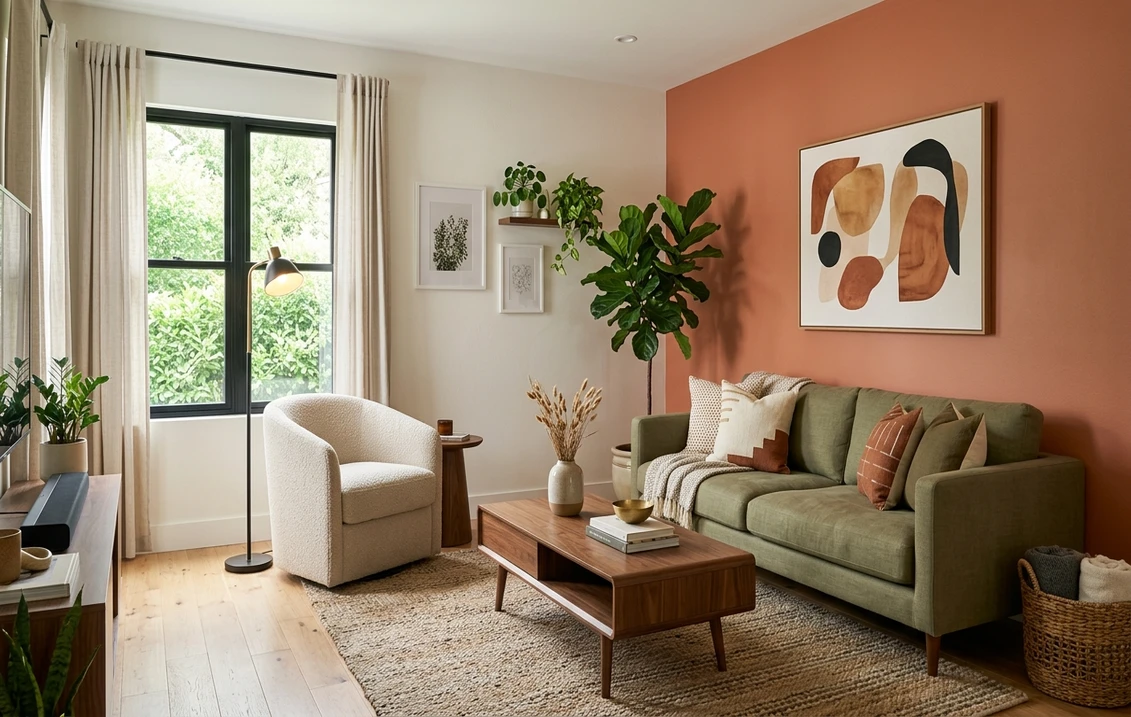
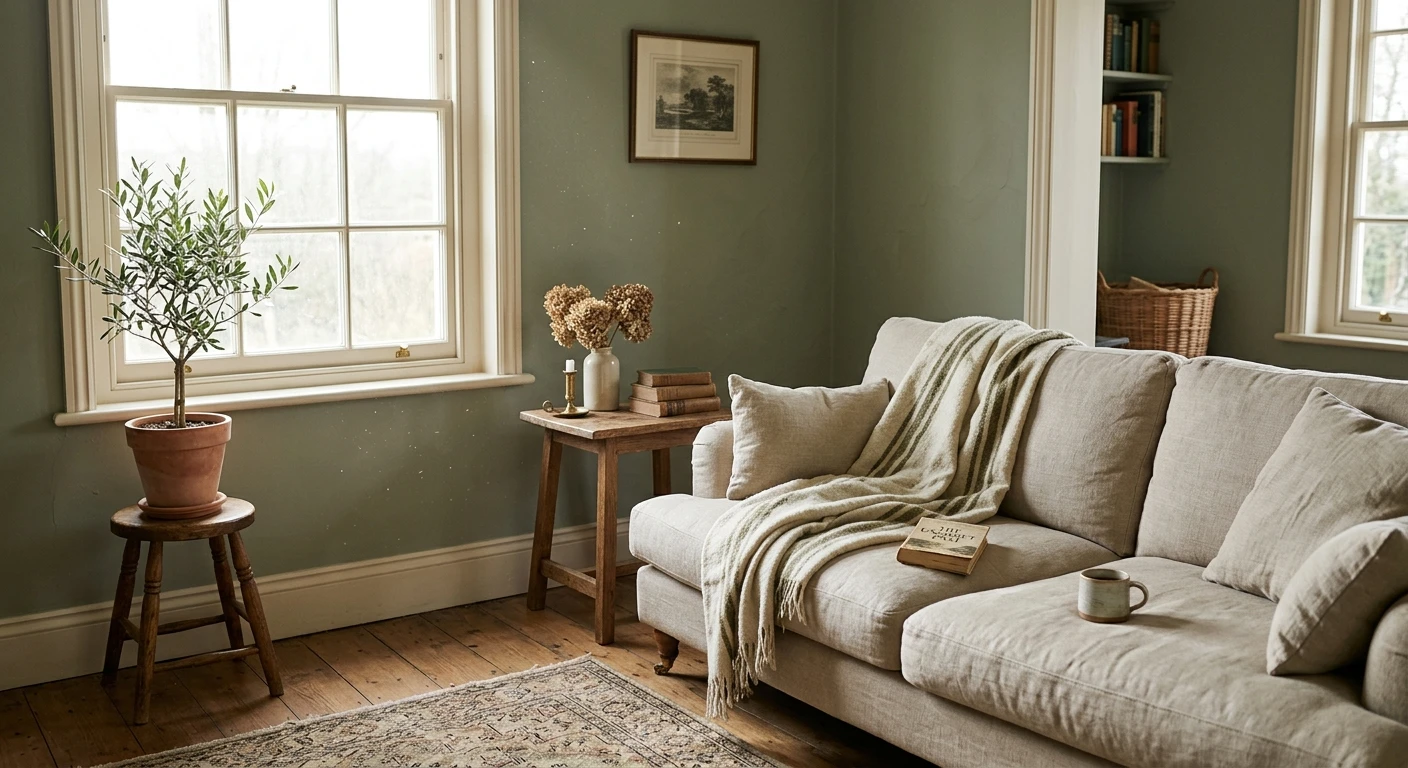
For accents, sage rewards warmth. Warm woods (white oak, walnut, and honey-toned furniture) pull the earthiness forward, cream and oatmeal textiles keep it soft, and natural textures like rattan and jute make it feel relaxed rather than precious. A few terracotta or clay accents in cushions or a rug add a warm, complementary lift, and brass or aged-bronze metal in a lamp or coffee table is the finishing note that makes the whole scheme look designed. To try any of these on your actual space before buying samples, our interior paint visualizer lets you preview a shade on a photo of your own living room.
What to pair with sage green (and what to skip)
- Warm woods: white oak and walnut are sage's natural partners; they ground the green and add warmth.
- Cream and warm white: the safest trim and upholstery choice; keeps sage cozy and current rather than cold.
- Terracotta and clay: a warm complementary accent in cushions, throws, or a rug for a lived-in, layered feel.
- Rattan and jute: natural textures that make sage read relaxed and organic.
- Brass and aged bronze: warm metals in lamps, frames, and hardware pull richness out of the green.
- Skip: a stark, cool blue-white trim next to a warm sage, which can make the green look slightly dirty. Also avoid going too dark on all four walls of a small, low-light room, where a deep green closes the space down.
Sage green is not a living-room-only trick, of course. The same soft shades that calm a living room also work in quieter rooms: see how they behave in sage green in a bedroom, or how the deeper tones read on cabinetry and walls in sage green in a kitchen. If you like a shade in one room, it is worth previewing it in the next before you buy.
Those are all room-by-room views. If you would rather start from the color itself, our guide to sage green shades and their pairings puts the whole family on one LRV ladder and adds the variable this page leaves out, which is sheen. Flat and eggshell mute sage and forgive an uneven wall; satin and semi-gloss deepen it and exaggerate whatever cast the room is throwing. That is why a shade judged on a flat chip can disappoint once it goes up in satin.
Frequently asked questions
What is the best sage green for a living room?
For a whole-room sage that reads almost like a warm neutral, SW Clary Sage (SW 6178, LRV 41) or BM October Mist (1495, LRV 46) are the safest picks, since both stay calm and rarely fight your furniture. If you want one dramatic plane instead, SW Evergreen Fog (SW 9130, LRV 30) on the fireplace or the wall behind the sofa is the most reliable high-impact sage.
Does sage green make a living room look dark or small?
A light sage with an LRV in the 40s or higher, such as October Mist (46) or Softened Green (SW 6177, LRV 53), keeps a living room feeling open and even a little calmer. Sage only darkens a room when you choose a deep, low-LRV green like Pewter Green (SW 6208, LRV 12) and wrap all four walls in it, which is exactly why deep greens work best on a single accent wall.
What colors go with sage green in a living room?
Sage loves warm, natural partners: white oak and walnut wood, cream or warm-white trim, rattan and jute textures, and brass or aged-bronze metal. For a warmer scheme, add terracotta or clay accents in cushions and a rug. Avoid a stark, cool blue-white trim next to a warm sage, which can make the green look slightly gray and flat.
Should sage green go on all four walls or just an accent wall?
Both work, and it comes down to your light and your nerve. A light, gray-leaning sage like Clary Sage (SW 6178) is calm enough for all four walls, even in a smaller room. A smoky sage like Evergreen Fog (SW 9130) is often best on one feature wall, the fireplace or the wall behind the sofa, with the rest of the room in a warm off-white so the green stays the focal point.
1 HD render plus 3 free color variations.
Color names and codes are trademarks of their respective owners (Sherwin-Williams, Benjamin Moore, Behr). FacadeColorizer is an independent AI visualization tool and is not affiliated with them. LRV and hex values are approximate; the authoritative reference is a physical paint sample in your own light.
Trademarks mentioned (Sherwin-Williams, Benjamin Moore, Behr, Caparol, Brillux, Sto, Alpina, Valspar, PPG, Glidden, Dulux, Crown Trade, Sandtex, Farrow & Ball, Johnstone's, Leyland) are property of their respective owners. FacadeColorizer is independent and not affiliated with any of them. Nominative fair use under Lanham Act §1125.