Try it on your room

Quick answer: For a navy blue kitchen, two shades do most of the work: Sherwin-Williams Naval (SW 6244, LRV about 4) and Benjamin Moore Hale Navy (HC-154, LRV about 6). Naval is the saturated jewel navy for a bold feature wall or island backdrop, while Hale Navy is the softer benchmark navy that never quite reads black. Want a lighter navy that still feels rich in a small kitchen? Reach for Van Deusen Blue (BM HC-156, LRV about 17). Pair any of them with white cabinets, butcher block, brass hardware, and marble.
Navy is the color people reach for when they want a kitchen to feel grounded and expensive without shouting. Deep, classic, and forgiving of daily wear, navy blue kitchen paint turns an ordinary wall or island into the anchor the whole room leans on. This guide is part of our room-by-room paint color ideas series, and it stays tight on one thing: navy on kitchen walls and schemes. If you want the full spread of blues from soft sky to slate, our wider blue kitchen palette covers those, while everything below is about doing navy well.
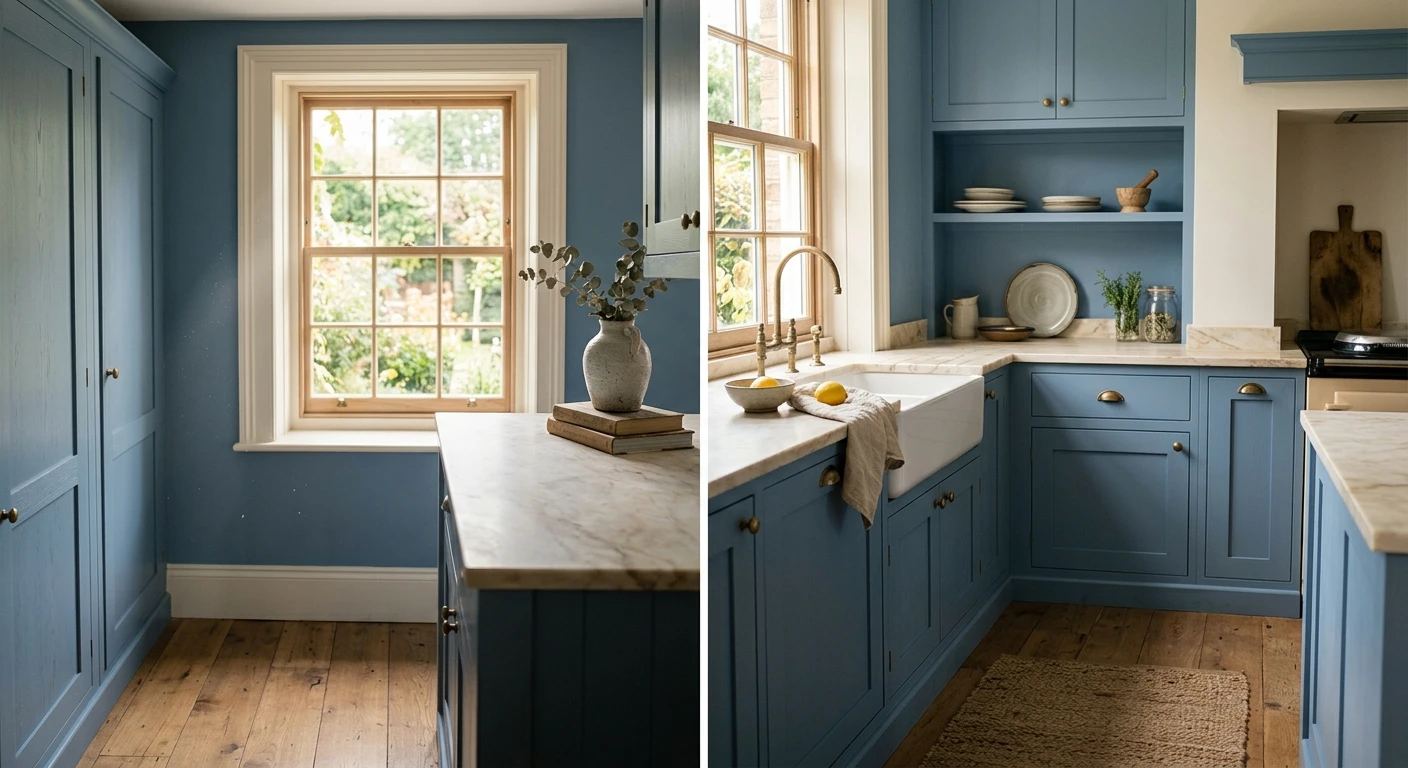
One clarification before the shades, because it changes the whole job: this is a guide to navy on the walls and the overall scheme, not a navy cabinet project. Painting cabinet fronts navy is a different task with different prep (degreasing, deglossing, a bonding primer, and a hard enamel finish that survives fingernails and grease). Navy on walls is far more forgiving and reversible, and it is the fastest way to find out whether you actually like living with a dark blue in the kitchen before you commit a weekend to spraying doors.
Best navy blue shades for a kitchen
Every shade below is a true navy, arranged from deepest to lightest so you can scan straight to the depth you want. LRV (Light Reflectance Value) tells you how much light bounces back: the lower the number, the darker and moodier the wall. All navies are light-hungry, so read the LRV as a warning about how much window light the room needs to carry it.
| Color | Brand + code | Approx LRV | Why it works in a kitchen |
|---|---|---|---|
| Naval | SW 6244 | 4 | Saturated jewel navy; the boldest pick, stunning on an island or one full feature wall in a bright kitchen |
| In the Navy | SW 9178 | 4 | Bold true navy with clean depth; a Naval alternative when you want a hair more blue and less black |
| Hale Navy | BM HC-154 | 6 | The benchmark navy; deep and enveloping but stays soft, never flattening to plain black |
| Indigo Batik | SW 7602 | 8 | Ink navy with a faint violet whisper; rich and a little unexpected against warm brass |
| Newburyport Blue | BM HC-155 | 10 | Brighter classic navy; the crispest of the group against white counters and marble |
| Van Deusen Blue | BM HC-156 | 17 | Softer mid navy leaning slate; the safest navy for a small or north-facing kitchen |
Try it on your house
No photo? Try a sample
Sources: Sherwin-Williams and Benjamin Moore published color data 2026; LRV values are approximate and vary slightly by batch and sheen.
Upload one photo and preview these shades on your actual kitchen. Free, no signup.
How to use navy blue in a kitchen
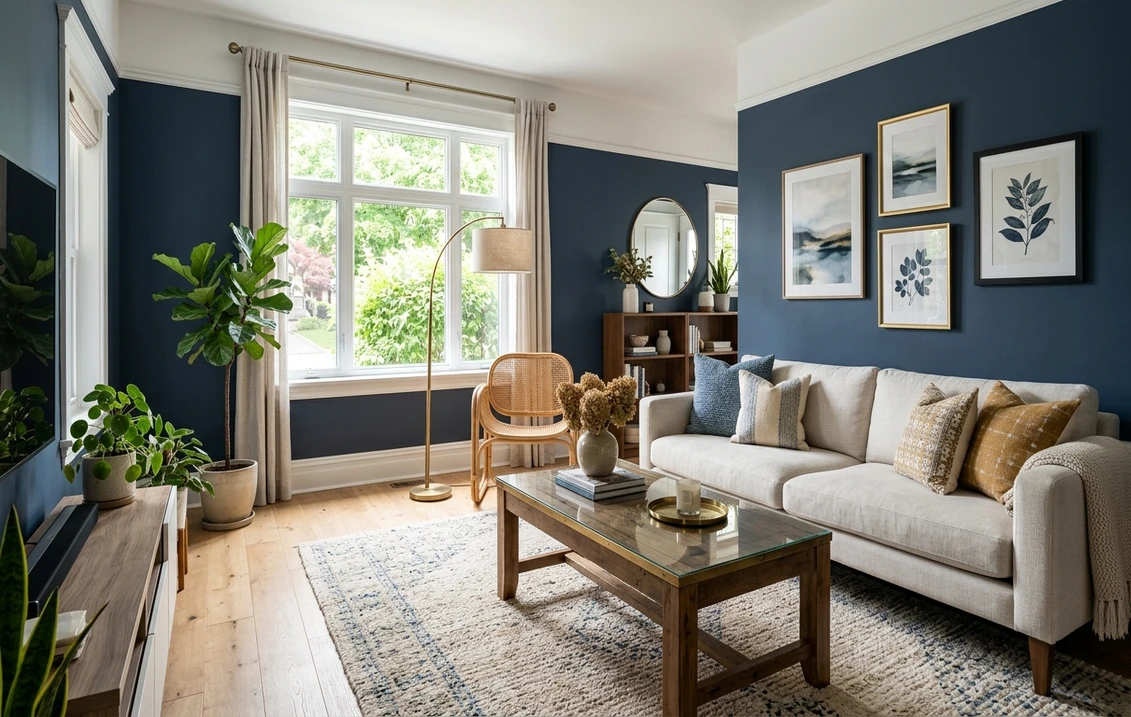
Placement is the first decision, and it matters more than the exact shade. In a bright kitchen with good windows you can carry a navy like Hale Navy or Naval across all four walls and let the cabinets pop against it. In a smaller or dimmer room, treat navy as a base rather than a blanket: one feature wall (behind open shelving or a range), the wall behind a banquette, or a navy lower zone with a lighter upper section. That lower-navy, lighter-above move gives you the richness of a deep blue without turning the room into a cave, and it reads as a deliberate design choice rather than an accident.
Trim and ceiling do the balancing. A warm white trim (think Benjamin Moore White Dove or Sherwin-Williams Alabaster) keeps a navy wall from feeling clinical, while a stark blue-white trim next to navy can actually make the wall look dull by contrast, a common mistake worth avoiding. Keep the ceiling light and warm to bounce whatever daylight you have back down onto the counters. If your window trim, casing, and crown are already a crisp white, you are most of the way to a navy kitchen that looks finished.
Then respect the light. Navy eats light, so a windowless galley painted floor to ceiling in Naval will feel heavy by mid-afternoon no matter how good the shade is. Give a deep navy real daylight or generous, warm task lighting: 2700K to 3000K bulbs pull warmth back into the blue and stop it drifting cold and gray at night. If your kitchen is genuinely dark, step up the LRV (Van Deusen Blue at about 17, or Newburyport Blue at about 10) rather than forcing the deepest navy into a room that cannot support it.
Finally, sheen and coats. Kitchens get splattered, so use eggshell or satin on navy walls: both wipe clean, and a flat navy can chalk-rub and leave a shiny scuff when you scrub grease off it. Prime with a gray-tinted primer and plan on two true coats, because saturated navies are notorious for patchy, streaky coverage on the first pass. Cut in your edges first, then roll in one direction, and let each coat dry fully before you judge the color, since navy always looks lighter and blotchier while wet.
One caveat if the navy is heading for the doors rather than the walls. Cabinet fronts sit under direct task light, get touched all day, and occupy the eye level of the room, so the shade that works across a wall can feel oppressive on twenty door faces. The blue-gray band just above true navy is the usual answer there: Van Deusen Blue HC-156 at LRV 12, SW Distance and SW Slate Tile at 15, all of which keep their color in a kitchen where a full navy would go cave-like. Our roundup of the best blue colors for kitchen cabinets lists twelve of them with their LRVs, from the deep navies through to the blue-grays and teals.
What to pair with navy blue
A navy wall is only half the room. Navy is a cool, deep color, so the job of everything around it is to add warmth and contrast back. These pairings flatter any of the shades above:
- White cabinets: crisp white or warm off-white fronts are the classic foil for a navy wall, giving you the high-contrast, timeless look that navy is loved for.
- Butcher block: a warm wood counter or island top softens all that cool blue and keeps a navy kitchen from feeling formal or cold.
- Brass and gold hardware: warm metals are the navy whisperers. Brass pulls, unlacquered bronze, or gold faucets keep a deep blue from tipping icy.
- Marble and white quartz: a white marble or quartz counter and backsplash reads clean and a little luxe against navy, and bounces light back into the room.
- Warm white trim: White Dove or Alabaster on casings and cabinets ties the scheme together without the harshness of a bright blue-white.
- Natural texture: rattan stools, a jute runner, or open oak shelving add the organic warmth that stops a navy kitchen from feeling flat.
Navy does not live only in kitchens. If you are carrying the color through the house, our navy blue living room ideas show how the same shades read in a lounge, and if you want a warmer, earthier alternative on kitchen walls, compare navy against sage green kitchen paint. Whichever way you lean, the safest next step is our interior paint visualizer, which lets you drop a navy onto a photo of your real kitchen before you buy a single sample pot.
Frequently asked questions
What is the best navy blue paint for a kitchen?
The two most reliable navies are Sherwin-Williams Naval (SW 6244, LRV about 4) for a bold, saturated look and Benjamin Moore Hale Navy (HC-154, LRV about 6) for a softer benchmark navy that never reads flat black. If your kitchen is small or dim, choose a lighter navy like Van Deusen Blue (BM HC-156, LRV about 17) so the room does not close in.
Is navy blue too dark for a small kitchen?
Not if you use it strategically. Rather than painting every wall the deepest navy, put it on one feature wall, a lower zone with lighter walls above, or the island, and keep the cabinets and trim white. A lighter navy such as Newburyport Blue (BM HC-155, LRV about 10) or Van Deusen Blue also carries a small kitchen better than Naval, especially in north light.
What colors go with a navy blue kitchen?
White or warm off-white cabinets, butcher block or white marble counters, and brass or gold hardware are the classic navy pairings. Use a warm white trim like White Dove or Alabaster instead of a stark blue-white, and add natural texture (oak shelving, rattan) to warm up the cool blue. The goal is always to balance navy with warmth.
What sheen should I use for navy blue kitchen walls?
Eggshell or satin. Both wipe clean behind a stove or coffee station, and they hide wall flaws better than gloss. Avoid flat on a navy kitchen wall: it looks elegant but will not scrub clean, and deep navies in flat can chalk-rub and leave shiny scuff marks. Plan on a tinted primer and two full coats for even navy coverage.
1 HD render plus 3 free color variations.
Color names and codes are trademarks of their respective owners (Sherwin-Williams, Benjamin Moore, Behr). FacadeColorizer is an independent AI visualization tool and is not affiliated with them. LRV and hex values are approximate; the authoritative reference is a physical paint sample in your own light.
Trademarks mentioned (Sherwin-Williams, Benjamin Moore, Behr, Caparol, Brillux, Sto, Alpina, Valspar, PPG, Glidden, Dulux, Crown Trade, Sandtex, Farrow & Ball, Johnstone's, Leyland) are property of their respective owners. FacadeColorizer is independent and not affiliated with any of them. Nominative fair use under Lanham Act §1125.