Try it on your room

Quick answer: For a navy blue bathroom, the two shades designers reach for most are Sherwin-Williams Naval (SW 6244, LRV about 4) for the deepest, inkiest drama and Benjamin Moore Hale Navy (HC-154, LRV about 6) for a grayer, more forgiving navy that works on walls or a vanity. Want a little light back in a small bath? Benjamin Moore Newburyport Blue (HC-155) reads a hair softer. Pair any of them with white subway tile, brass fixtures, and marble.
Navy is the color guests text you about. Of every deep shade you could put in a bathroom, navy blue bathroom paint is the one that reads timeless rather than trendy, because the eye already expects blue where there is water. A powder room is the single best place in the house to go bold: you are only in it for a minute, so the drama lands hard and never wears you down. This guide stays tight on navy specifically. It sits under our broader room-by-room paint color ideas pillar, and if you are still weighing lighter blues too, the wider bathroom blue palette covers soft sky, blue-gray, and teal alongside navy.
Best navy blue shades for a bathroom
All five below are true navies. What separates them is depth (measured as light reflectance value, or LRV) and undertone. The lower the LRV, the more the color drinks light, so match it to how bright your bathroom actually is. Take the code to a counter, but let the LRV and undertone guide the pick.
| Color | Brand and code | Approx LRV | Why it works in a bathroom |
|---|---|---|---|
| Naval | Sherwin-Williams SW 6244 | about 4 | The deepest, inkiest navy here. Powder-room drama against crisp white tile and brass; best where the light is generous. |
| Hale Navy | Benjamin Moore HC-154 | about 6 | The classic grayed navy. The most versatile and forgiving pick, reads near-charcoal in dim light, at home on walls or a vanity. |
| In the Navy | Sherwin-Williams SW 9178 | about 4 | A rich, saturated navy a touch warmer than Naval. Jewel-box depth for an accent wall behind the vanity. |
| Newburyport Blue | Benjamin Moore HC-155 | about 6 | A hair cleaner and bluer than Hale Navy. The most forgiving navy for a smaller or lower-light bath. |
| Cyberspace | Sherwin-Williams SW 7076 | about 6 | A blue-black that hovers near charcoal. The moodiest choice, for when you want drama more than an obvious blue. |
Try it on your house
No photo? Try a sample
Sources: manufacturer color data (Sherwin-Williams, Benjamin Moore) 2026. LRV figures are the published approximate values for each color and shift slightly on screen; confirm with a physical sample under your own light.
Upload one photo and preview these shades on your actual bathroom. Free, no signup.
How to use navy blue in a bathroom
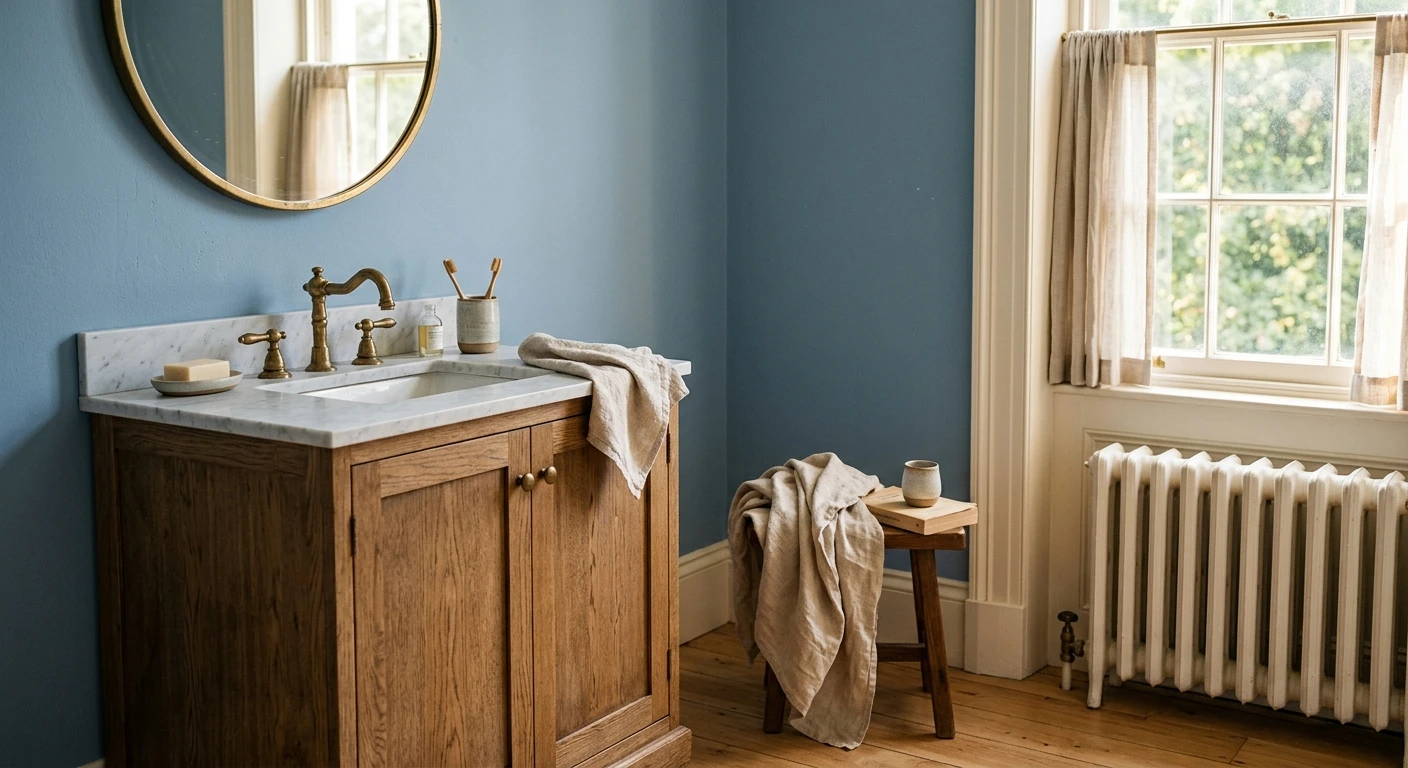
The most reliable navy move is the small powder room drenched top to bottom, walls and trim and sometimes the ceiling, then anchored by white tile. In a larger family bath, put the navy on the vanity only and keep the walls light, so you get the deep anchor without losing brightness. An accent wall behind the vanity and mirror is the middle path: real drama, half the paint, and the room stays open.
Navy lives or dies on its contrast. Crisp white does the heavy lifting here: white subway tile, white trim, and a white or marble counter with cool gray veining. That white frame is what keeps a dark room reading like a jewel box instead of a cave. Skip cream and ivory trim next to a cool navy such as Naval, because the warmth quietly fights the blue.
Give a navy bath good light and it rewards you; starve it and it goes flat. A small windowless powder room can absolutely carry Naval or Hale Navy as long as the vanity lighting is generous. Warm 2700K to 3000K bulbs keep the navy rich and stop it drifting gray. Always check your swatch at night under your real fixtures, because navy shifts more between daylight and bulbs than almost any color.
On finish, use eggshell or satin, never flat. The slight sheen shrugs off splashes and steam and helps a deep navy read rich rather than chalky. Plan on two coats: thin coverage on a dark color shows roller streaks under vanity lights more than anything lighter does.
What to pair with navy blue
Navy behaves like a near-neutral, so it plays with more than you would guess. The pairings that keep showing up in real bathrooms:
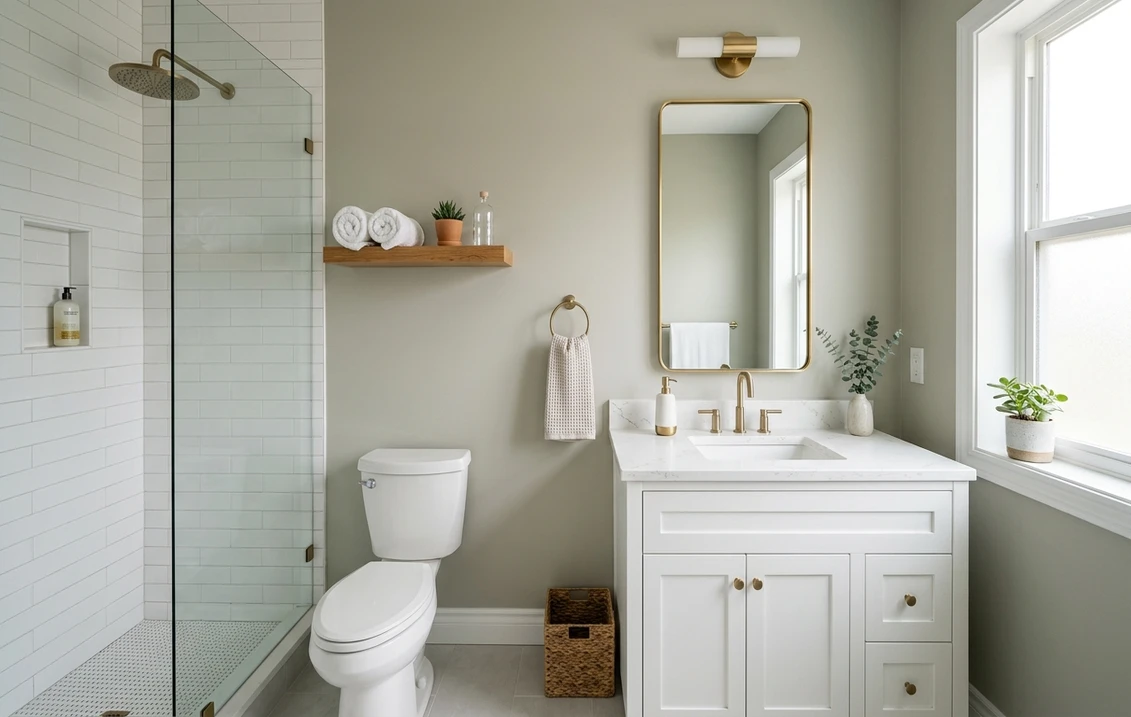
- Brass or unlacquered brass fixtures: the number-one navy partner. Warm metal against cool navy is the look in every design magazine, and it stops the blue from going clinical.
- White subway tile and marble: the crisp, timeless frame. Gray-veined marble echoes the blue while warm-white grout softens the contrast.
- Warm wood: a white oak or walnut vanity or floating shelf adds the warmth navy lacks on its own.
- Matte black: for a more modern, tailored powder room, swap brass for matte-black fixtures and a black-framed mirror.
- Soft white or pale blue walls: when the navy sits on the vanity only, light walls keep the room breathing.
Two mistakes to avoid: do not wrap a dark, low-light full bath in the deepest navy (Naval) with no white to break it up, and do not pair a cool navy with cream or beige trim. Both are how a designer navy ends up feeling heavy instead of rich.
It also helps to know where navy actually sits among the dark colors people cross-shop, because the numbers surprise most people. Hale Navy has an LRV of 6, exactly as dark as Iron Ore, a warm charcoal, and Naval at LRV 5 is only two points off Tricorn Black. Navy is effectively a colored black, which is why the lighting and finish rules above are the same ones that govern every deep shade: our moody bathroom paint colors guide lines a dozen of them up by LRV and undertone if you want to see how navy compares to charcoal, forest, and plum before you commit.
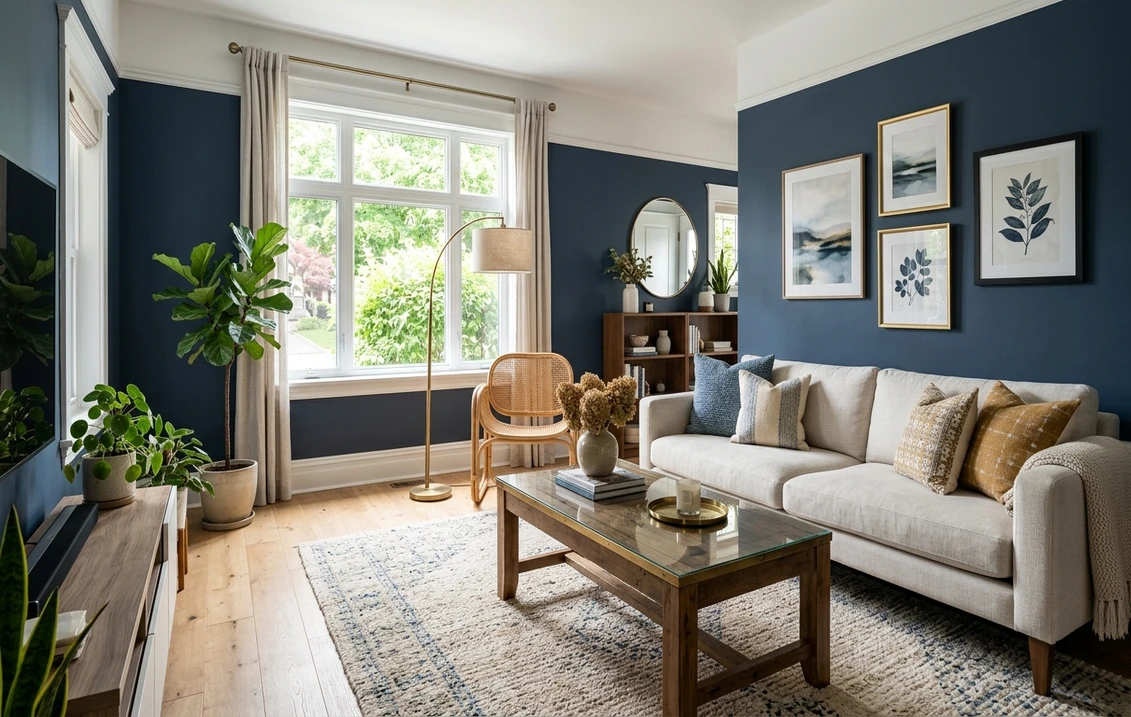
Navy is worth previewing before you commit, because a fan-deck chip lies about how a dark color fills a real room. Our interior paint visualizer puts the shade on a photo of your actual bathroom under your own light. Loving navy elsewhere in the house? See how it behaves in a bigger space in our navy blue living room paint ideas, and if you want a softer, earthier bathroom instead, our sage green bathroom paint ideas is the calmer counterpoint.
Frequently asked questions
Is navy blue a good color for a bathroom?
Yes, and the bathroom is arguably navy's best room. The eye associates blue with water, so a deep navy reads timeless rather than trendy here. A powder room is ideal because you are only in it briefly, so the drama lands without wearing on you. The one rule is light: give navy generous vanity lighting and crisp white tile, or put it on the vanity only in a darker full bath.
What is the best navy blue paint for a bathroom?
The two most-used are Sherwin-Williams Naval (SW 6244, LRV about 4) for the deepest, inkiest drama and Benjamin Moore Hale Navy (HC-154, LRV about 6) for a grayer, more forgiving navy that works on walls or a vanity. For a smaller or lower-light bath, Benjamin Moore Newburyport Blue (HC-155) reads a hair softer. Sherwin-Williams In the Navy (SW 9178) is a rich, slightly warmer alternative for an accent wall.
Can a small windowless bathroom handle navy?
Yes, as long as the light is good. A small powder room is actually the classic place to go navy, because you pass through it quickly and the color feels like a jewel box rather than a cave. Keep the tile and trim crisp white, use warm 2700K to 3000K bulbs with generous vanity lighting, and add brass or a large mirror to bounce light. If the room is both windowless and dimly lit, put the navy on the vanity only.
What colors and finishes go with a navy bathroom?
Crisp white tile and trim are the backbone, with white or gray-veined marble on the counter. Brass or unlacquered brass fixtures are the classic warm partner that keeps navy from feeling clinical, while matte black gives a more modern look. Add warm wood, such as white oak or walnut, for softness. Use an eggshell or satin sheen and plan on two coats, since dark colors show roller streaks under vanity lighting.
1 HD render plus 3 free color variations.
Color names and codes are trademarks of their respective owners (Sherwin-Williams, Benjamin Moore, Behr). FacadeColorizer is an independent AI visualization tool and is not affiliated with them. LRV and hex values are approximate; the authoritative reference is a physical paint sample in your own light.
Trademarks mentioned (Sherwin-Williams, Benjamin Moore, Behr, Caparol, Brillux, Sto, Alpina, Valspar, PPG, Glidden, Dulux, Crown Trade, Sandtex, Farrow & Ball, Johnstone's, Leyland) are property of their respective owners. FacadeColorizer is independent and not affiliated with any of them. Nominative fair use under Lanham Act §1125.