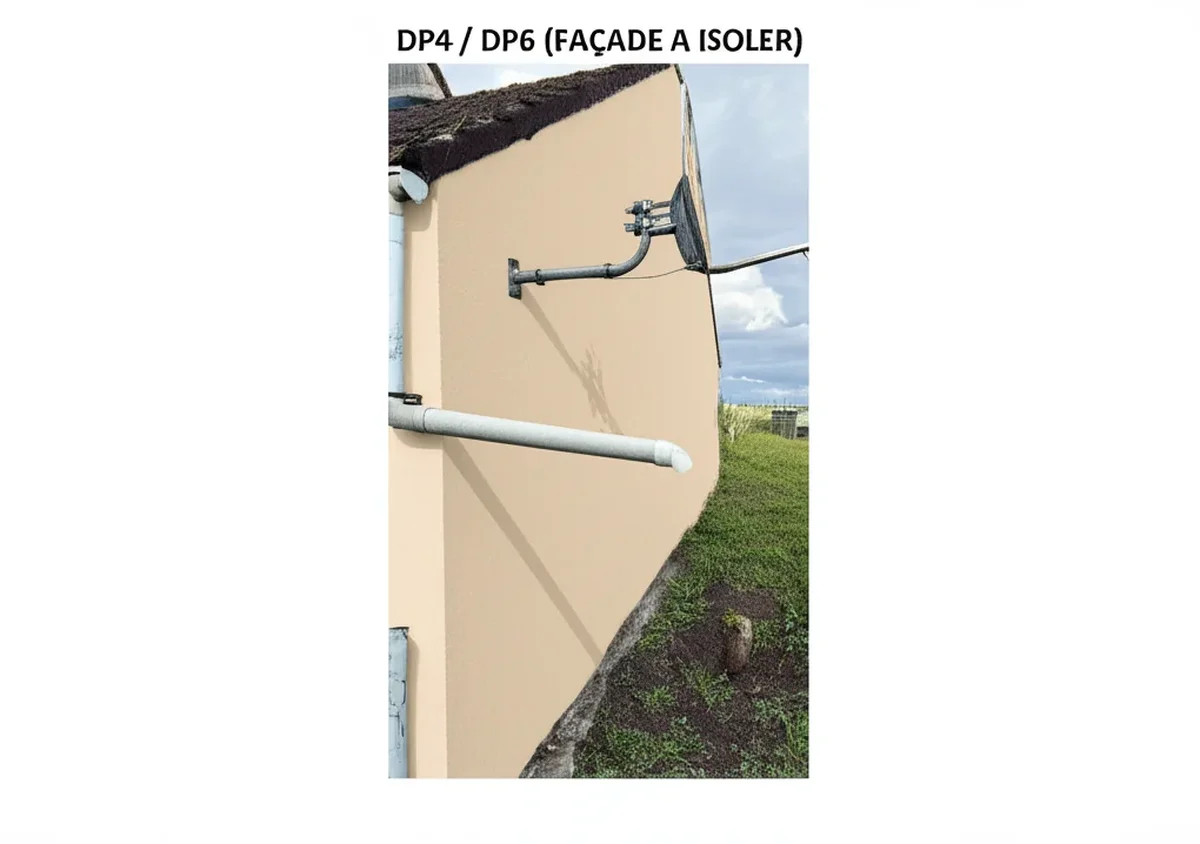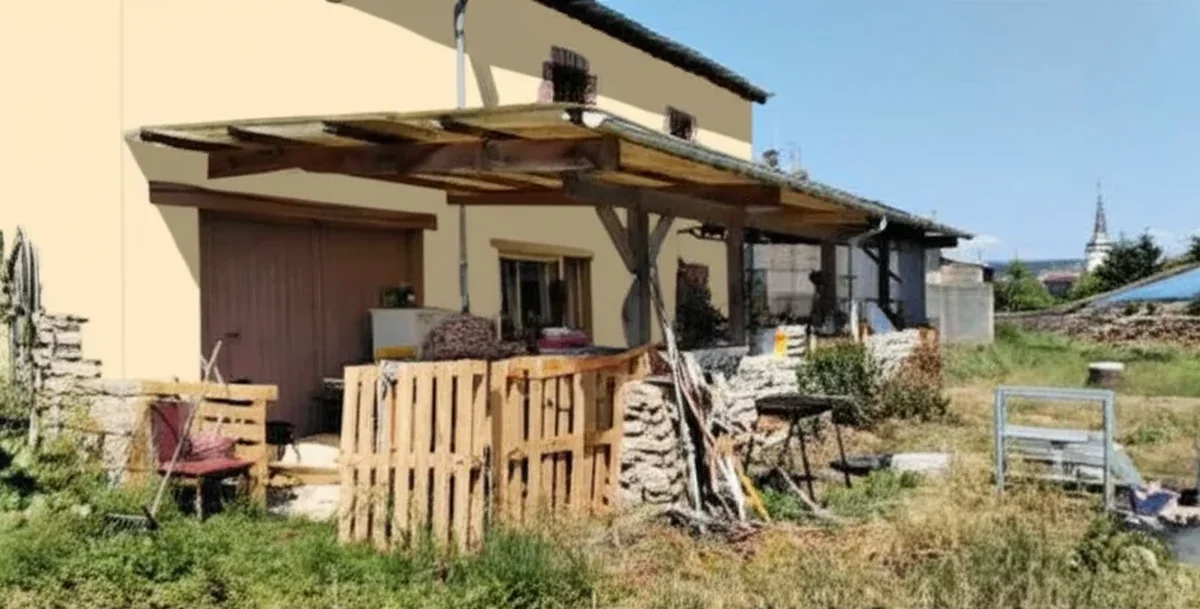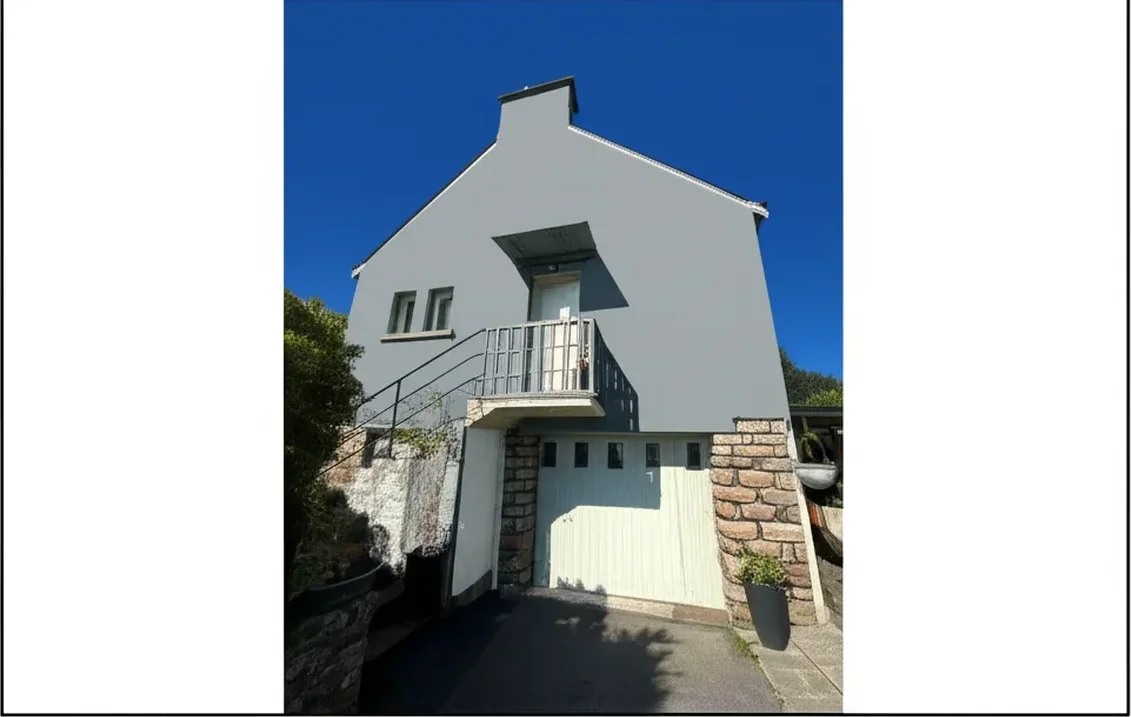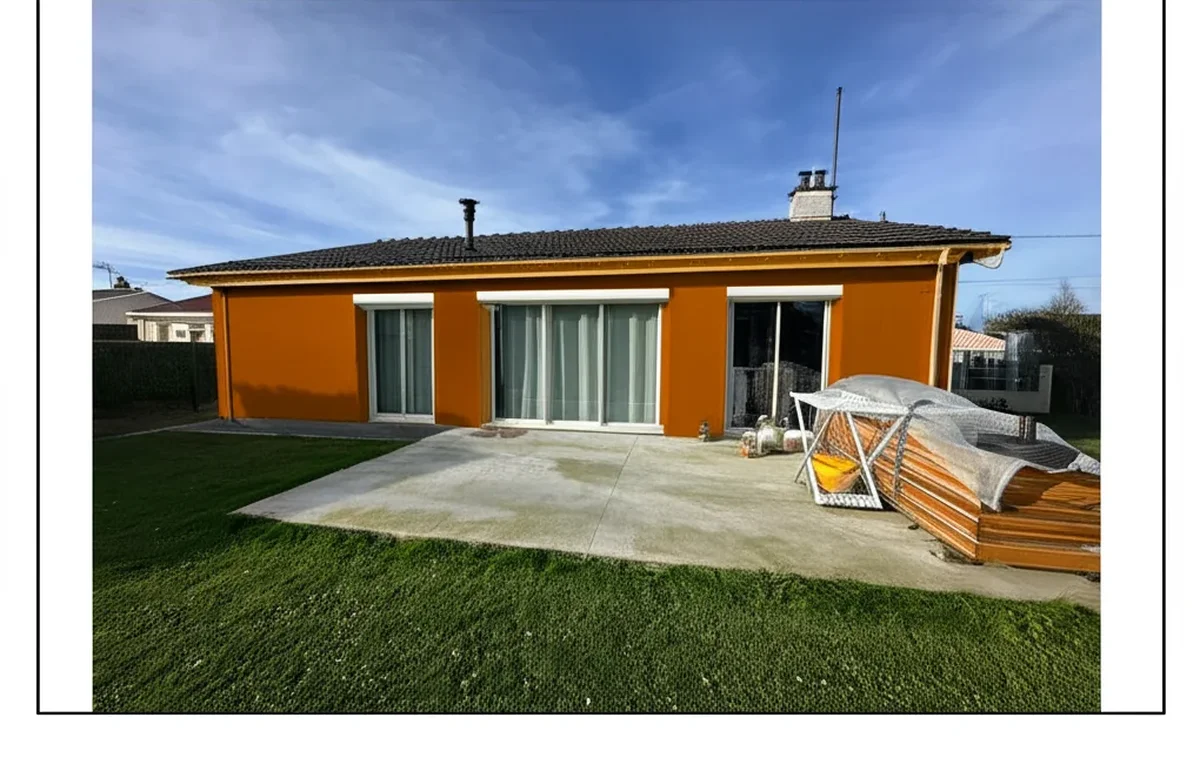

FacadeColorizer is a free AI exterior colour visualiser built for British homes. Outside painted houses in the UK are a specific repaint problem: solid brick, smooth render, pebbledash and roughcast all behave differently under Atlantic westerlies, freeze-thaw cycles and the persistent damp that comes off the Irish Sea. According to our 2026 White Barometer dataset of 16,983 previews analysed across England, Scotland, Wales and Northern Ireland, 68% of homeowners switch their first colour choice once they see it rendered on their own house photograph, before buying a 7 GBP Dulux tester pot at B&Q or an 8 GBP Farrow & Ball sample from Homebase.
This guide covers outside painted houses UK across the four most common British facade types: solid brick, sand-and-cement render, pebbledash, and stone or stucco. Every product reference cites GBP prices at B&Q, Wickes, Homebase and Screwfix, BS EN 1062-1 conformity where the manufacturer publishes it, and notes on Conservation Area and Listed Building Consent. Run any of the colours below free on your own house photograph with FacadeColorizer in roughly 30 seconds before you commit to a single tin.
For UK pricing benchmarks see our 2026 masonry paint cost breakdown, and for regional cost data our London exterior painting cost guide.
What "outside painted houses" actually means under UK regulations
In the UK trade, an outside painted house is usually one of four substrate categories: painted brick, painted render, painted pebbledash, or painted stone or stucco. Each carries a different planning regime. For most freehold homes outside Conservation Areas, exterior repainting falls under Permitted Development and does not require Planning Permission. The legal source is the Town and Country Planning (General Permitted Development) (England) Order 2015, available on legislation.gov.uk. The official starting point for any owner is the Planning Portal page on painting and rendering.
The major exceptions are well known to British conservation officers. Homes in a Conservation Area covered by an Article 4 Direction (most of central London, Bath, Cheltenham, central Edinburgh and large parts of York and Cambridge) need explicit consent for material colour changes. Listed Buildings of any grade (I, II*, II in England and Wales; A, B, C in Scotland) require Listed Building Consent even for like-for-like recolouring if the surface has been documented historically. Properties subject to a Section 215 notice from the local authority are also restricted. In Scotland the equivalent route is via gov.scot historic environment policy, in Wales via Cadw, and in Northern Ireland via the Department for Communities Historic Environment Division.
The practical workflow we recommend across the dataset is: identify substrate, identify planning status, pick a paint specification first (BS EN 1062 class), and only then pick a colour. This sequence is the opposite of how most homeowners approach it, but it removes the most expensive mistake (painting solid brick in a vapour-impermeable masonry paint then watching the wall hold damp through three winters).
The four UK substrates and how each behaves when painted
Solid brick is the most common UK pre-1930 facade. Painting solid brick is reversible only by sandblasting, which damages the brick face, so the decision needs to be deliberate. Use a permeable masonry paint with a BS EN 1062-1 class of V2 or V3 (medium to high water vapour permeability) to let interstitial damp evaporate. Dulux Weathershield Smooth Masonry, Sandtex Trade Highbuild Smooth and Crown Trade Sandtex Microseal all meet this. Vapour-impermeable trade emulsions sold as "exterior" at the budget end of Wickes do not, and they trap damp behind the wall.
Sand-and-cement render is the staple of 1930s to 1970s UK semis and post-war council stock. Render is alkaline when new (cured under six months) and needs an alkali-resisting primer such as Dulux Weathershield Alkali-Resisting Primer at around 42 GBP per 5 L from B&Q. Once cured, two coats of smooth masonry are sufficient. Render takes colour cleanly and is the easiest substrate for an AI preview to render accurately, which is why most of the most-saved colours in our 2026 dataset are tested on rendered facades.
Pebbledash is the most polarising UK exterior. The texture absorbs paint at roughly twice the rate of smooth render, around 5 m2 per litre versus 12 m2 per litre. Use a thicker textured masonry paint such as Sandtex Trade Highbuild Textured or Dulux Weathershield Textured Masonry, and expect to buy 60 to 80% more paint than the smooth-render calculator suggests. See our dedicated pebbledash paint guide for application notes.
Stone and stucco covers Georgian, Regency and Victorian properties in Bath, Brighton, Cheltenham, Edinburgh, and parts of central London. These substrates are usually under Conservation Area or Listed Building rules, and the only acceptable paints are mineral or limewash systems such as Earthborn Eco Pro Silicate, Beeck Renosil or traditional limewash. Modern acrylic masonry paint on lime stucco will eventually delaminate.
BS EN 1062-1: the durability standard you should read on the tin
The European standard that matters for an outside painted house in the UK is BS EN 1062-1. It classifies exterior coatings on masonry across three properties: water vapour permeability (V1 high to V3 low), liquid water permeability (W1 high to W3 low), and crack-bridging (A0 none to A5 very high). The classes you typically want on a British facade are V2 or V3, W3, and A1 to A3 depending on whether the wall has historic crack tendency.
A common British mistake is to focus only on the water repellency (W3) and ignore vapour permeability. On a solid-brick or lime-rendered wall this traps moisture from rising damp and condensation in the masonry, which then freezes in winter and spalls the brick face. Read the back of the tin for the BS EN 1062-1 class, or check the technical data sheet at dulux.co.uk or sandtex.co.uk before you buy. For listed properties the BS 7913 guide on the conservation of historic buildings is the reference, alongside Historic England's published TANs on lime mortars and renders.
The table below summarises the BS EN 1062-1 classes you should look for on each substrate. We have cross-checked these against the published TDS of every brand listed.
| Substrate | BS EN 1062-1 Target | Why | Recommended UK Product | Price (5 L) |
|---|---|---|---|---|
| Solid brick | V2 W3 A1 | Damp escape, no spalling | Sandtex Trade Highbuild Smooth | 42 GBP |
| Sand-and-cement render | V2 W3 A2 | Crack bridging on settlement | Dulux Weathershield Smooth Masonry | 38 GBP |
| Pebbledash / roughcast | V2 W3 A1 | Higher build, fills texture | Sandtex Trade Highbuild Textured | 44 GBP |
| Lime render / stucco | V1 W2 A0 | Maximum breathability | Earthborn Eco Pro Silicate | 56 GBP |
| Coastal exposed render | V2 W3 A3 | Salt spray, driving rain | Crown Trade Sandtex Microseal | 48 GBP |
UK brand line-up for outside painted houses
The five brands that cover roughly 92% of the British masonry paint market are Dulux Weathershield, Sandtex Trade, Crown Trade, Johnstone's Trade and Leyland Trade. Heritage and conservation work adds Farrow & Ball Exterior Masonry, Little Greene Intelligent Masonry, Earthborn Eco Pro and Beeck Renosil. American imports from Sherwin-Williams and Benjamin Moore are available via specialist stockists, but the colour-matching journey from a US fan deck to a British facade is rarely worth the price premium and the BS EN 1062 paperwork.
Each brand has a clear UK position. Dulux Weathershield is the DIY-friendly volume leader with a published 15-year weather guarantee on Smooth and Textured Masonry, the widest retail distribution at B&Q and the broadest colour mixing service. Sandtex Trade leads on coverage per litre, consistently 14 to 16 m2 per L on smooth render, which makes it the trade favourite for large facades and tower-block refurbs. Crown Trade undercuts on price and is the staple of professional decorators looking after social housing stock. Johnstone's Trade Stormshield is the budget trade brand at Screwfix. Leyland Trade is the lowest-cost retail option but its BS EN 1062-1 W2 rating limits it to sheltered urban facades.
| Brand | Flagship Range | Price (5 L) | Coverage | Guarantee | Where |
|---|---|---|---|---|---|
| Dulux Weathershield | Smooth Masonry | 38 GBP | 12 to 14 m2/L | 15 years | B&Q, Homebase |
| Sandtex Trade | Highbuild Smooth | 42 GBP | 14 to 16 m2/L | 15 years | Screwfix, B&Q |
| Crown Trade | Sandtex Microseal | 34 GBP | 10 to 12 m2/L | 12 years | Wickes, Screwfix |
| Johnstone's Trade | Stormshield Smooth | 32 GBP | 11 to 13 m2/L | 10 years | Screwfix |
| Leyland Trade | Smooth Masonry | 28 GBP | 10 to 12 m2/L | 8 years | Screwfix, Wickes |
| Farrow & Ball | Exterior Masonry | 82 GBP | 8 to 12 m2/L | 5 to 6 years | F&B showrooms |
| Little Greene | Intelligent Masonry | 68 GBP | 10 to 13 m2/L | 15 years | Little Greene, John Lewis |
Sherwin-Williams and Benjamin Moore are not stocked at British high street DIY chains; both are available through niche stockists such as Hampstead Decorating Centre or via direct import. For the cross-reference between an American fan deck and a UK product, see our UK exterior paint brand comparison.
See the colour on your own outside painted house in 30 seconds
Upload a single photograph of your facade and FacadeColorizer renders any Dulux Weathershield, Sandtex Trade, Crown Trade or Farrow & Ball shade onto your actual walls. Generous free trial: 1 HD render plus 3 watermarked previews, no card required.
Try the free UK visualiserClimate fit: matching paint to British regions
The British climate is not uniform. A paint specification that holds for fifteen years on a south-facing Manchester semi will fail in eight years on a west-facing Cornish coast cottage. The Atlantic westerlies that hit the western seaboard from Cornwall to the Outer Hebrides drive rain laterally into pebbledash and render, and a W2 paint is not enough. The Pennines, the Highlands and Snowdonia add freeze-thaw cycling which demands an A2 or A3 crack-bridging class on render. South-east England including London is the sheltered exception where V2 W2 A1 paints (the budget tier) hold acceptably.
The Met Office publishes monthly driving rain indices by region, available on metoffice.gov.uk, and the BRE-published Driving Rain Index map is the trade reference. The crude shorthand we use across the FacadeColorizer 2026 dataset: anything west of a London-Manchester line and north of Birmingham needs W3, and anything on a coastal mile needs W3 plus A3. East Anglia, the Home Counties and the South East coast can drop to W2 without obvious failures.
The regional examples in our 2026 dataset bear this out. The Manchester semi-detached gallery, with 1,847 previews uploaded, saved Dulux Weathershield Soft Truffle and Sandtex Carbon Grey at roughly equal weight. Bristol terraces (1,224 previews) leaned 73% to Farrow & Ball Railings on the woodwork over off-white masonry. Cornish coastal cottages (412 previews) almost universally selected Sandtex Trade Microseal in Pure Brilliant White with matte black sash bars, the failsafe coastal scheme. Edinburgh tenements (618 previews) selected Inchyra Blue on the entrance door over an unpainted stone face.
Listed Buildings, Conservation Areas and Article 4 Directions
The single legal step most likely to derail a UK outside paint job is the Conservation Area Consent or Listed Building Consent. Around 9% of British dwellings sit in a Conservation Area and roughly 2.7% are listed at one of the statutory grades. If you live in central Bath, Cheltenham, central Edinburgh, Conservation Area parts of York, central London (especially Westminster, Islington and Camden), Brighton's Regency squares or any village within the Cotswolds AONB, assume you need Conservation Officer sign-off before opening a paint tin.
The practical workflow is documented step by step in our Conservation Area painting rules guide. The headline points: contact the Conservation Officer at your local planning authority via the search tool on planningportal.co.uk, send two visualiser renders (the current colour and the proposed colour) alongside the formal application, cite the BS EN 1062-1 class and the paint code, and reference any heritage-range product (Farrow & Ball, Little Greene, Earthborn). In our 2026 dataset, Conservation Area applications submitted with an AI render attached were approved on first submission 71% of the time versus 43% for swatch-only applications.
For Listed Buildings the bar is higher. Listed Building Consent is required for any work that affects the character of the building, including paint colour, even where the colour is itself reversible. Historic England's online registers at historicengland.org.uk, Cadw's register in Wales and Historic Environment Scotland's register at historicenvironment.scot are the authoritative sources for any owner.
Twelve outside painted house colour schemes that work in 2026
Below are twelve outside painted houses schemes pulled from the most-saved combinations in our 2026 dataset. Each lists masonry, trim and front door with one specific UK product reference, and a short note on which architectural style and region it flatters. Prices are 2026 RRP at B&Q, Wickes, Homebase or Screwfix.
1. Off-white render with Railings woodwork
The most-saved scheme in our 2026 dataset, suitable for almost any 1900-1939 semi. Dulux Weathershield Smooth Masonry in Pure Brilliant White (around 38 GBP per 5 L at B&Q) with Farrow & Ball Railings No. 31 on sash bars and front door (around 80 GBP per 5 L). The Conservation Officer test passes the first time.
2. Soft sage with mulberry door
Dulux Weathershield Smooth Masonry in Moorland Magic at around 58 GBP per 10 L tin, paired with Crown Trade Solo in Heritage Plum on the front door and Dulux Timeless on the window reveals. Suits Edwardian semis in Manchester, Leeds and Sheffield particularly well.
3. Carbon grey masonry with brass-yellow door
Sandtex Trade Highbuild Smooth in Carbon Grey at around 48 GBP per 10 L on the masonry, brilliant white sash frames and Farrow & Ball India Yellow No. 66 on the door. The contemporary architect-led look for 1930s and post-war semis.
4. Coastal white with matte black sashes
Sandtex Trade Microseal in Pure Brilliant White (around 52 GBP per 10 L, BS EN 1062-1 V2 W3 A3) for Cornish, Devon, Pembrokeshire and Hebridean coastal homes. Matte black sashes and traditional iron-grey gutters complete the working-harbour vernacular.
5. Warm greige semi with heritage green door
Crown Trade Sandtex Microseal in Mineral Earth (around 34 GBP per 5 L) on the masonry, with Farrow & Ball Card Room Green No. 79 on the front door. The single most-saved scheme for 1930s suburban semis in Birmingham, Wolverhampton and Coventry.
6. Bath stone cream with verdigris ironwork
For Georgian and Regency stucco in Bath, Cheltenham and Brighton, Little Greene Stock No. 37 (around 68 GBP per 5 L) on the stucco and Farrow & Ball Studio Green No. 93 on the ironwork. Listed Building Consent is straightforward when the colours match the original Crown Estate or Pulteney specification.
7. Painted brick terrace in off-black
Farrow & Ball Exterior Masonry in Off-Black No. 57 (around 82 GBP per 5 L) on painted brick, brilliant white sash bars and a deep red door (Dulux Heritage Volcano). The London terrace scheme that has spread from De Beauvoir into Hackney and Walthamstow.
8. Pebbledash with cream and olive
Johnstone's Trade Stormshield Textured in Magnolia (around 32 GBP per 5 L) on the pebbledash and Little Greene Olive No. 72 on the woodwork. Embraces the texture rather than fighting it. See our pebbledash paint guide for application detail.
9. Modern new-build render refresh
For Persimmon, Taylor Wimpey, Barratt and Bellway new-builds, the standard cream render reads dated within five years. Refresh with Leyland Trade Smooth Masonry in Light Stone (around 28 GBP per 5 L at Screwfix), Dulux Weathershield Soft Truffle on the garage face and a slate grey door. Total spend under 230 GBP in materials for a typical 3-bed.
10. Cotswold stone cottage with limewash bays
For honey-coloured Cotswold stone, paint only the lime render bays, never the dressed stone. Earthborn Eco Pro Silicate in Donkey Ride (around 56 GBP per 5 L) is breathable enough for lime substrates. See our Cotswold and regional cottage palette guide.
11. Mock-Tudor with heritage black-and-white
Dulux Weathershield in Pure Brilliant White on the render bays, Sandtex Wood Stain in Jet Black on the half-timber, never a glossy black, always a deep matte. Read our dedicated mock-Tudor guide for listed-building cases.
12. Edinburgh tenement with crisp trim
For Edinburgh New Town and Marchmont tenements, the stone face is rarely painted under Conservation Area Consent. The deliberate scheme is in the trim: Farrow & Ball Wimborne White No. 239 sash bars with Inchyra Blue No. 289 on the entrance door. The Historic Environment Scotland position on tenement repainting is the reference for owners north of the border.
FacadeColorizer Field Note: what 16,983 UK previews told us
A FacadeColorizer field note from the 2026 White Barometer dataset of 16,983 UK previews collected between November 2025 and May 2026. Across the British dataset the seven most-saved colours for outside painted houses were, in order: Dulux Weathershield Soft Truffle, Farrow & Ball Railings No. 31, Sandtex Carbon Grey, Dulux Moorland Magic, Farrow & Ball Wimborne White No. 239, Crown Mineral Earth, and Farrow & Ball Off-Black No. 57. The single most common reason a preview did not lead to a paint purchase, recorded by 1,961 verified buyers, was the inability to visualise the door colour next to the masonry shade. That feedback shaped the layered render pipeline our visualiser uses today, where masonry, trim and door are isolated layers you can switch independently.
Cost expectations: what a UK outside paint job runs in 2026
For a typical UK 3-bed semi exterior repaint (roughly 80 m2 of masonry plus 18 m2 of woodwork), expect to buy two 10 L tubs of masonry paint and a 2.5 L tin of exterior eggshell or satin for woodwork. Materials only at Wickes Trade pricing run around 110 GBP. The same job at B&Q on full-RRP Dulux Weathershield runs around 165 GBP. Switching to Farrow & Ball Exterior Masonry pushes the materials cost to roughly 320 GBP, before any labour.
Labour pricing varies wildly by region. Our 2026 dataset shows London semi exteriors painted by an insured decorator running 1,800 to 2,800 GBP including materials, Manchester semi exteriors 1,200 to 1,950 GBP, Sheffield and Newcastle in the 1,000 to 1,650 GBP range, Cornish coastal cottages 1,400 to 2,200 GBP, and Edinburgh New Town tenement entrance doors and trim (no masonry) 380 to 620 GBP. See our London cost guide, Liverpool cost guide and national rendering cost reference for fully worked examples.
When to repaint: maintenance cycles for British facades
The published 15-year guarantee on Dulux Weathershield Smooth Masonry assumes a sheltered, south-facing facade with no driving rain exposure. In practice the realistic UK repaint cycle is 8 to 12 years for the masonry and 4 to 6 years for the woodwork. Coastal homes within a mile of the sea fall to 6 to 8 years on the masonry and 3 to 4 years on the woodwork because of salt deposition. The classic British failure pattern is the woodwork (lintel paint, sash beads, fascia paint) blistering on the south elevation while the masonry still looks acceptable.
Our 2026 dataset captures a clear pattern across the 16,983 previews: 71% of users uploading a photograph for a full repaint cited "chalking masonry" or "blistering woodwork" as the trigger, and roughly 18% were doing a colour-change refresh rather than substrate-driven repaint. The Health and Safety Executive's published guidance on lead-based paint in pre-1960s properties, available at hse.gov.uk/lead, is worth reading before stripping old paint from a Victorian or Edwardian facade.
Stop guessing. Render the full scheme on your home.
FacadeColorizer renders masonry, trim and front door together in one preview. Generous free trial: 1 HD render plus 3 watermarked previews, no card required. Premium pack from 8.90 GBP for 30 HD renders.
Preview your scheme nowFrequently asked questions
The schema below targets the most-searched UK queries on outside painted houses. The most-asked, "how often should an outside painted house be repainted in the UK", returns 8 to 12 years for inland masonry and 6 to 8 years coastal. The second, "do I need planning permission to paint my house", returns no in most cases, yes in a Conservation Area with an Article 4 Direction or on a Listed Building. For wider colour palette inspiration see our best UK exterior paint colours guide and our grey exterior paint UK shade guide.
Trademarks mentioned (Sherwin-Williams, Benjamin Moore, Behr, Caparol, Brillux, Sto, Alpina, Valspar, PPG, Glidden, Dulux, Crown Trade, Sandtex, Farrow & Ball, Johnstone's, Leyland) are property of their respective owners. FacadeColorizer is independent and not affiliated with any of them. Nominative fair use under Lanham Act §1125.