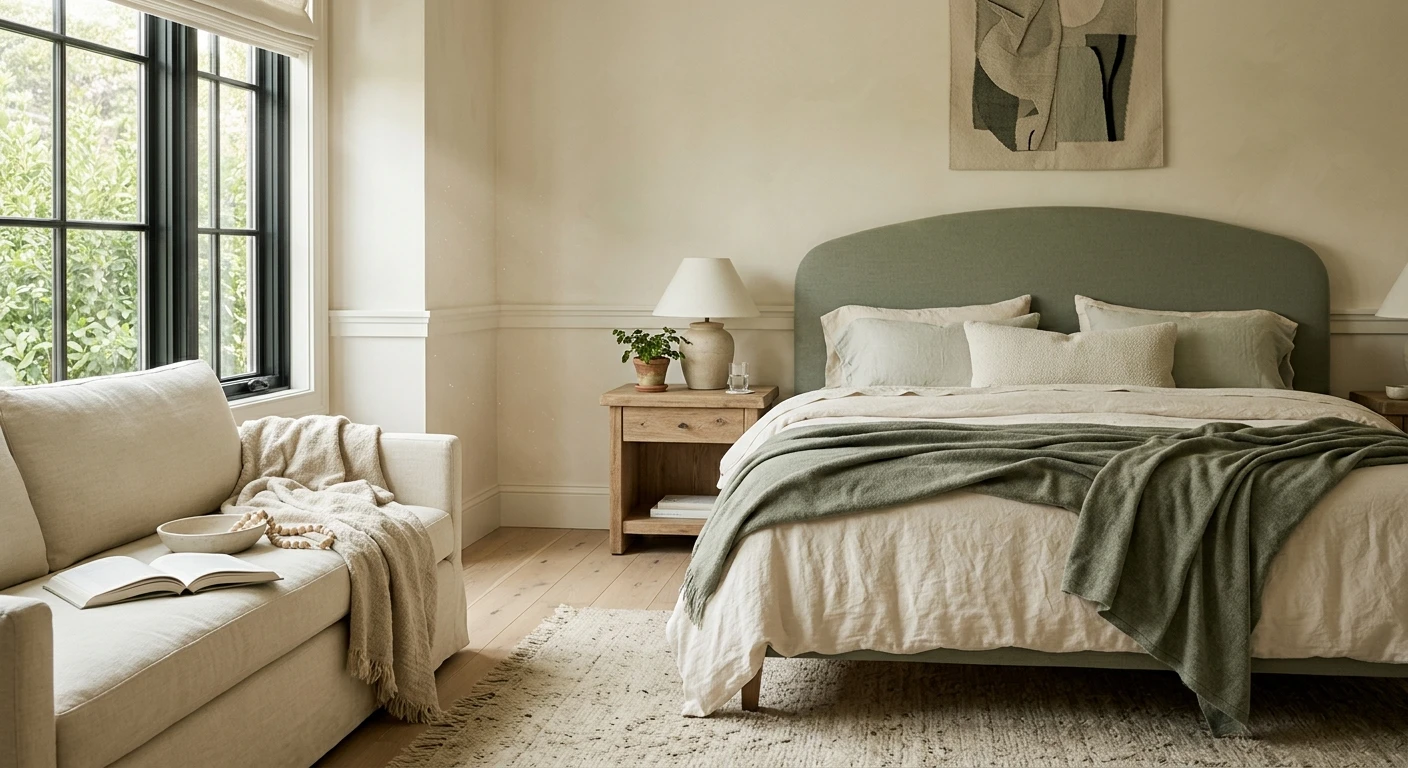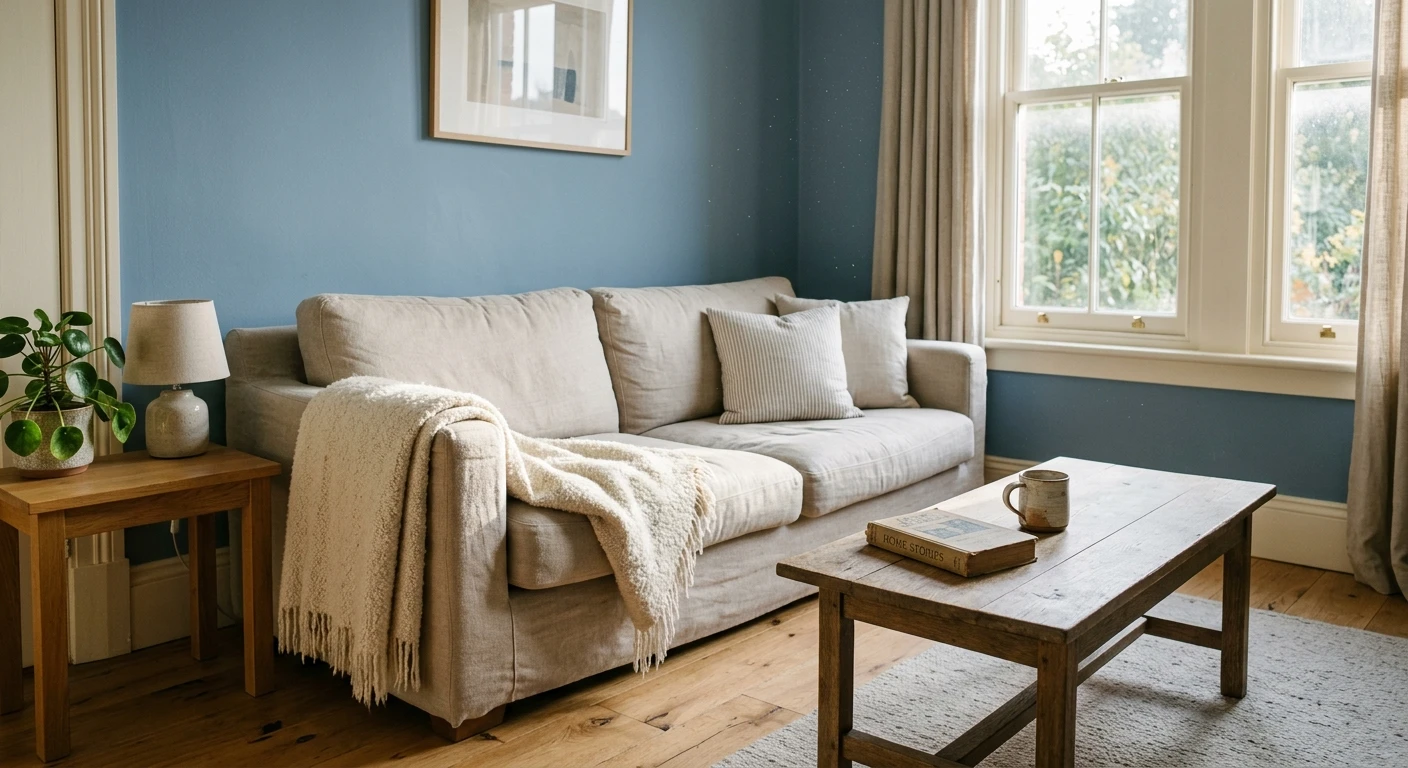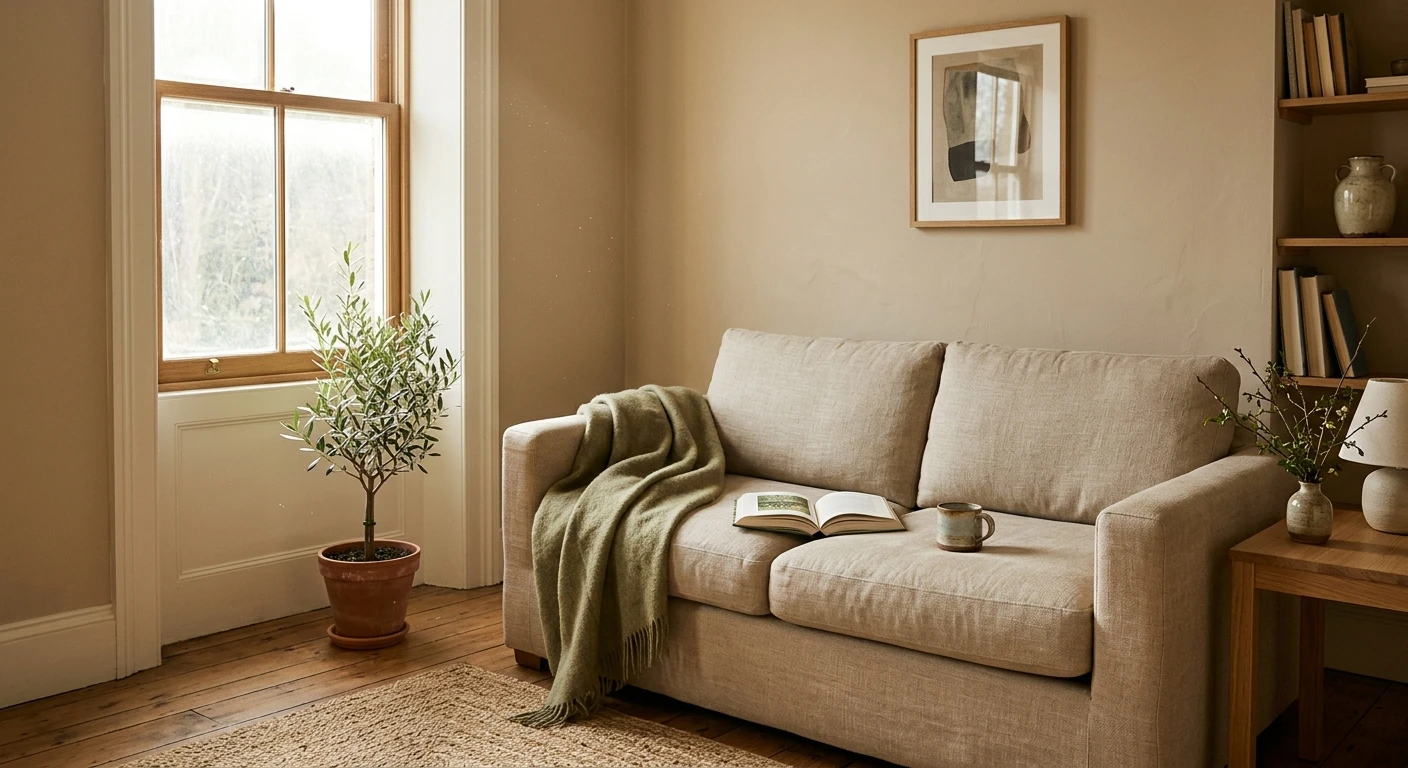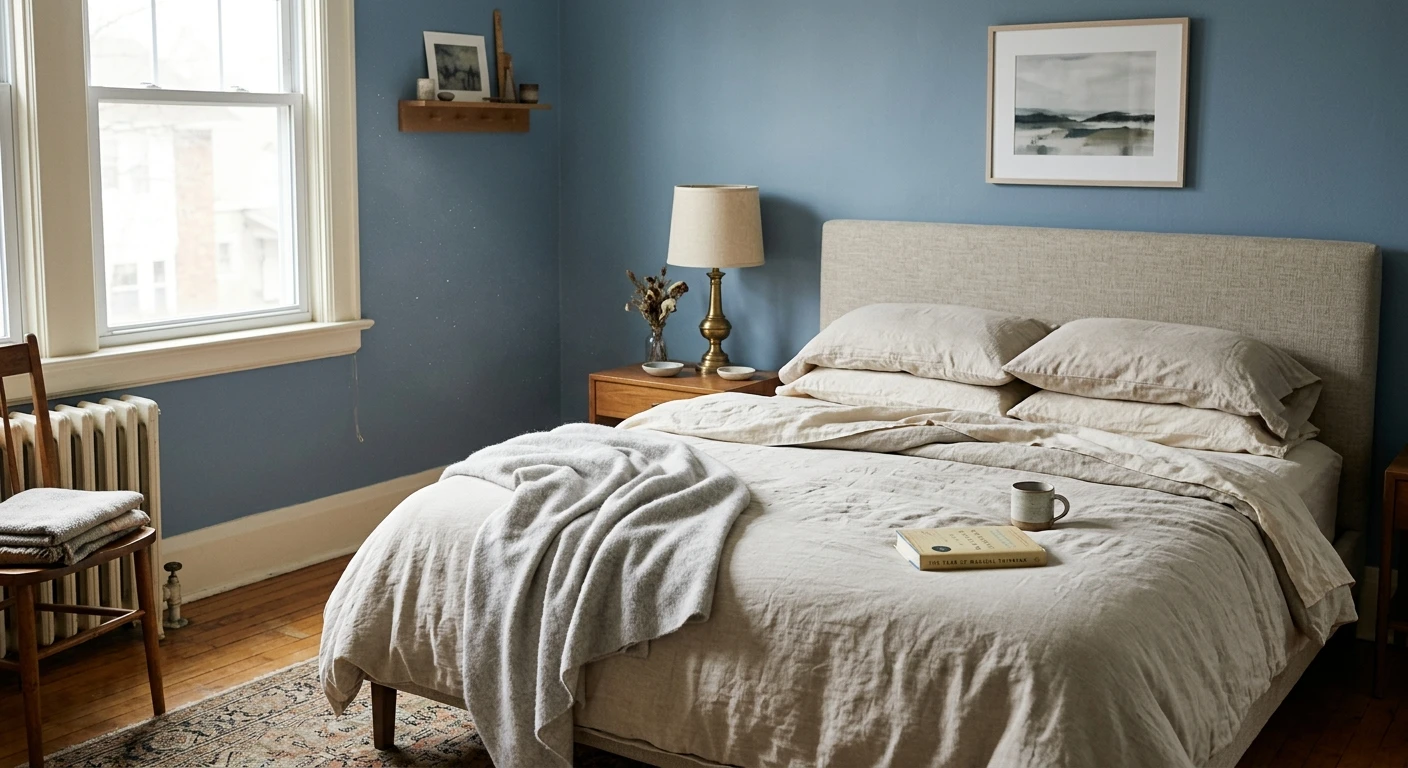
Try it on your house

Quick answer: In a low-light room, choose a warm white with a high LRV so it bounces the little light you have instead of going gray. The safest picks are Benjamin Moore White Dove (OC-17, LRV 85), Sherwin-Williams Alabaster (SW 7008, LRV 82), and Sherwin-Williams Greek Villa (SW 7551, LRV 84), with Benjamin Moore Cloud White (OC-130, LRV 85) as a creamier alternative. Skip stark, cool whites, which go lifeless without daylight. Because light is unpredictable, preview your shortlist on a photo of your own room before you buy.
White feels like the safe choice for a dark room, and it can be the best one, but only if you pick the right white. Reach for a crisp, cool white because it looks bright on the chip, and a low-light room will punish you: with almost no daylight to carry it, that same white slumps into a flat, dingy gray. The whites that actually brighten a dark space are warm whites, high enough in reflectance to bounce light but soft enough at the base that they never go cold. This is the white-specific corner of our wider paint colors by room orientation guide, and below you get real colors, real codes, and the reasoning behind each one.
Why this light is tricky
White is not one color. Every white is built on a base tint, either warm (a trace of yellow, cream, or greige) or cool (a trace of blue or gray), and that undertone is what decides how the paint reads on your wall. In a bright, sunny room, abundant daylight balances a cool undertone out, so a crisp blue-white can look clean and fresh. A dark room has no such balance. With very little light bouncing around, the undertone stops being a whisper and starts running the show. A cool white has nothing to lift it, so its blue-gray base takes over and the wall reads gray, dull, and cold. A warm white keeps a soft glow because its base is on the sunny side to begin with.
The other half of the story is how much light a color throws back, which is measured by its light reflectance value (LRV). LRV runs from 0 (pure black) to 100 (pure white), and in a low-light room you want a high number so the paint multiplies every scrap of available light around the space. The trap is treating LRV as the only thing that matters. A cool white with a very high LRV can still fall flat in a dark room, because reflectance without warmth just gives you a brighter shade of gray. The sweet spot is a white that is both high in LRV (roughly 80 and up) and warm at the base. That combination bounces light and stays inviting.
Worth naming the category while you shop: a white carrying enough warmth to survive weak light is, strictly speaking, an off-white. Every pick below sits in that group, and the tint that rescues a dark room is the same tint that makes these colors drift from one room to the next. Our guide to off-white shades and their undertones maps which base each of the popular names is built on, which is the fastest way to tell a creamy off-white from a greige-leaning one before you buy the sample pot.
The best picks
Every white below is warm at the base and high in LRV, so it lifts a low-light room without turning cold. They are ordered from the brightest, most balanced whites at the top to the creamiest, most obviously warm ones at the bottom, so you can dial in exactly how much warmth you want. LRV values are from the manufacturer color data and are a guide to how bright a color will feel, not a promise on your specific wall.
| Color | Brand + code | Approx LRV | Why it works here |
|---|---|---|---|
| White Dove | Benjamin Moore OC-17 | 85 | The workhorse warm white: bright enough to bounce real light, soft enough to never read cold. |
| Cloud White | Benjamin Moore OC-130 | 85 | Just as bright as White Dove with a touch more cream, so it feels a shade softer in weak light. |
| Greek Villa | Sherwin-Williams SW 7551 | 84 | Warm creamy white on a soft base: glows rather than glares when there is little daylight. |
| Swiss Coffee | Benjamin Moore OC-45 | 84 | Creamier still: a cozy, low-contrast white for a dark room you want to feel warm, not stark. |
| Alabaster | Sherwin-Williams SW 7008 | 82 | Soft warm white with a whisper of greige: brightens without ever feeling clinical or sterile. |
| Creamy | Sherwin-Williams SW 7012 | 81 | The warmest of the group: pick it when you want the white to read obviously soft and cozy. |
Try it on your house
No photo? Try a sample
Sources: Benjamin Moore and Sherwin-Williams published color data 2026. LRV figures are manufacturer values and vary slightly by source.
A few notes on how to choose between them. White Dove is the default for a reason: it is warm enough to feel soft yet bright enough to reflect meaningful light, which is exactly what a dark room needs, and it works with almost any trim and floor. Cloud White does the same job with a hair more cream, useful when a purer white looks slightly flat in your space. Greek Villa and Swiss Coffee step up the warmth again and are lovely under lamp light, which most low-light rooms rely on after dark. Alabaster is the popular soft warm white that adds a barely-there greige so a big wall never feels sterile, and Creamy is there for when you want the warmth to be unmistakable. Any of the six will brighten a dark room. The choice between them is simply how warm you want the wall to feel.
Upload one photo and preview the shortlist in your actual light. Free, no signup.
Colors to avoid
The whites that fail in a dark room are almost always the cool, stark ones. They look brilliant on a bright showroom wall, then go lifeless the moment the daylight drops. Steer clear of these:
- Sherwin-Williams Extra White (SW 7006): a bright white on a blue base. With little light to bounce, that cool undertone dominates and the wall drifts cold and gray.
- Benjamin Moore Chantilly Lace (OC-65): crisp and clean in strong daylight, but with almost no warmth to fall back on it can read flat and slightly cold in a low-light room.
- Sherwin-Williams High Reflective White (SW 7757): the coolest, most clinical white on the fan deck. It needs real daylight to shine and looks stark and blue without it.
- Any blue-based or true bright white: as a rule, if a white is sold on being crisp, clean, and cool, it belongs in a sunny room, not a dark one. In weak light it reflects gray, not warmth.
The pattern is simple: in a dark room, warmth beats brightness on the chip. The only way to know how a given white will actually land is to see it on the real wall, so run your shortlist through our free interior paint visualizer on a photo of the room before you buy a single sample pot. If you are open to more than white, our guide to the best paint colors for dark rooms covers the moody-dark strategy too, and if your low-light room also faces north, see the best white paint colors for north-facing rooms, where the same warm-white logic gets even more important.
Frequently asked questions
What is the best white paint for a dark room?
For a dark, low-light room, choose a warm white with a high LRV so it bounces the little light you have instead of going gray. The most reliable picks are Benjamin Moore White Dove (OC-17, LRV 85), Sherwin-Williams Alabaster (SW 7008, LRV 82), Sherwin-Williams Greek Villa (SW 7551, LRV 84), and Benjamin Moore Cloud White (OC-130, LRV 85). All four carry a soft warm base that keeps them from reading cold or dingy. Because every room's light is different, preview your shortlist on a photo of your own room before you buy.
Why does my white paint look gray in a dark room?
It is almost always the undertone. Cool whites are built on a blue or gray base, and in a bright room daylight balances that base out. In a dark room there is little light to bounce, so the cool undertone takes over and the white reads gray, dull, and flat. The fix is to switch to a warm white such as White Dove (OC-17) or Alabaster (SW 7008), whose soft warm base keeps a glow even in weak light.
Should I use a warm white or a cool white in a low-light room?
Warm white, almost every time. Cool and stark whites like Sherwin-Williams Extra White (SW 7006) or Benjamin Moore Chantilly Lace (OC-65) look crisp under strong daylight but go lifeless and slightly gray when there is little light to carry them. A warm white with a soft base holds its brightness and stays inviting in a dark room. Keep the cool whites for sunny, south-facing spaces.
What LRV should a white paint have for a dark room?
Aim high, generally LRV 80 or above, so the color reflects as much of the available light as possible. But LRV is only half the story: warmth matters just as much. A warm white at LRV 82, like Alabaster, will usually feel brighter and more alive in a dark room than a cool white at LRV 90 that goes gray without daylight. Treat LRV as a starting point and always confirm the color on your own wall.
1 HD render plus 3 free color variations.
Color names and codes are trademarks of their respective owners (Sherwin-Williams, Benjamin Moore, Behr). FacadeColorizer is an independent AI visualization tool and is not affiliated with them. LRV and hex values are approximate; the authoritative reference is a physical paint sample viewed in your own light.
Trademarks mentioned (Sherwin-Williams, Benjamin Moore, Behr, Caparol, Brillux, Sto, Alpina, Valspar, PPG, Glidden, Dulux, Crown Trade, Sandtex, Farrow & Ball, Johnstone's, Leyland) are property of their respective owners. FacadeColorizer is independent and not affiliated with any of them. Nominative fair use under Lanham Act §1125.