Try it on your room

The Short Answer: What Color to Paint a Ceiling in 2026
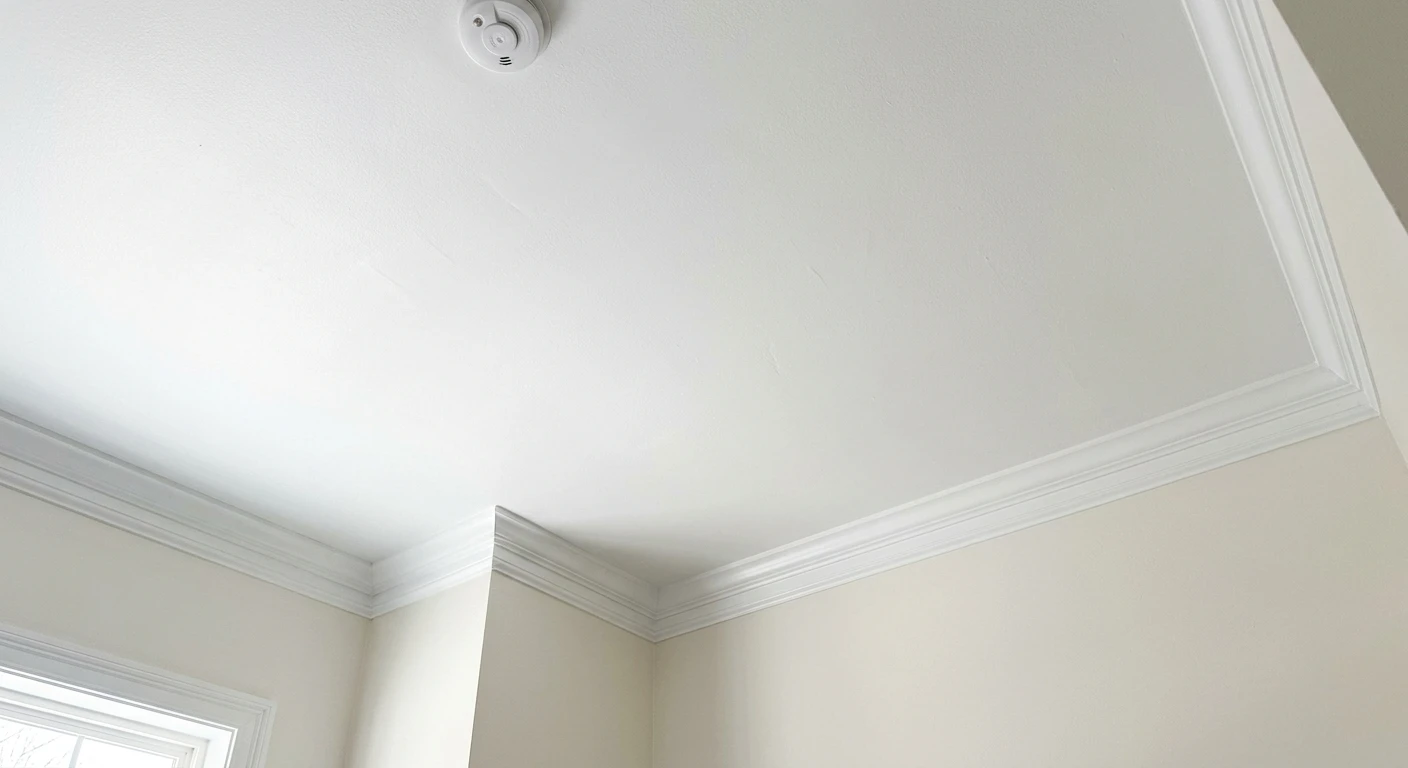
For most rooms, paint the ceiling a clean, slightly warm white in a flat (matte) finish. Flat hides drywall imperfections and joint lines that any sheen would highlight under overhead light, and a true white reflects the most light back into the room. If you want the absolute brightest result, reach for a high-LRV white such as Sherwin-Williams High Reflective White SW 7757 (LRV around 93) or Benjamin Moore Chantilly Lace OC-65 (LRV around 90). If you want a cozier, more enveloping look, the 2026 move is to paint the ceiling the same color as the walls, which we cover in detail below. Before you commit, you can see this color on your own room in seconds.
At a glance: ceiling paint spec
- Default finish: Flat / matte (hides imperfections, no glare)
- Default color: Warm white or dedicated ceiling white
- Whitest / brightest: High Reflective White SW 7757 (LRV ~93), Chantilly Lace OC-65 (LRV ~90)
- Cozy / modern: Ceiling same color as walls (often at 25-50% strength)
- Bathrooms / kitchens: Mildew-resistant ceiling paint, or a washable matte
- Coats: One coat over an existing white ceiling; two over a color change or new drywall
This is a color and finish guide, not a budget guide. For labor rates, square-foot pricing, and what painters charge to spray a ceiling, see our dedicated ceiling painting cost guide. For the whole-home picture, start at the interior house painting cost guide, which serves as the pillar for everything in this cluster.
Why Flat White Is the Default Ceiling Finish
Ceilings get raked by light from windows and fixtures at a low angle, which is the cruelest test of any drywall surface. A flat finish scatters that light instead of bouncing it, so it visually erases the seams, fastener pops, and roller-lap marks that an eggshell or satin would advertise. That is why nearly every dedicated "ceiling paint" sold at Home Depot, Lowe's, and paint stores is formulated as a flat, often with a slightly higher hide and a built-in spatter-resistant body so it does not drip on your floors and furniture.
Two practical notes. First, dedicated ceiling paints frequently include a tinted "goes-on pink, dries white" formula so you can see exactly where you have rolled. Second, ceilings in bathrooms and kitchens see steam and grease, so step up to a mildew-resistant ceiling paint or a washable matte rather than a basic builder-grade flat. Benjamin Moore, for one, lists its matte Aura Bath & Spa for bathroom ceilings as well as walls; what a mildew-resistant label does and does not cover is explained in our mold-resistant bathroom paint guide. For the finish logic on walls (eggshell, satin, semi-gloss), our interior paint finish guide breaks down where each sheen belongs.
For one example of how those ceiling-paint claims look on a data sheet, our spec-based review of Benjamin Moore Waterborne Ceiling Paint reads the numbers (a sheen of 0 to 2 at 85 degrees, 400 to 450 square feet per gallon, a 1 to 2 hour recoat) and sets them against Sherwin-Williams ProMar Ceiling.
The Whitest Ceiling Paint: High-LRV White Picks
"Whitest" really means highest LRV (Light Reflectance Value), the 0 to 100 scale of how much visible light a color bounces back. Pure absolute white sits near 100, but most paints top out in the low 90s because a tiny amount of pigment is needed for coverage. A higher LRV ceiling makes a room feel taller and brighter and helps your wall color read true. To understand how undertones shift under different light, see the LRV (Light Reflectance Value) paint guide. Dedicated ceiling paints publish their own figure: Sherwin-Williams gives the White of its Premium Ceiling Paint an LRV of 92 on the data sheet, and our Sherwin-Williams ceiling paint comparison lines it up with ProMar Ceiling and CHB.
| White | Brand & Code | Approx. LRV | Character & Best Use |
|---|---|---|---|
| High Reflective White | Sherwin-Williams SW 7757 | ~93 | The brightest standard SW white; maximum bounce for low-light rooms and basements |
| Chantilly Lace | Benjamin Moore OC-65 | ~90 | Crisp, clean white with almost no undertone |
| Extra White | Sherwin-Williams SW 7006 | ~86 | Cool, neutral bright white; pairs with cool grays and modern interiors |
| Ceiling Bright White | Sherwin-Williams SW 7007 | 82.53 | A color, not a ceiling formula, and less reflective than the whites above |
| Snowbound | Sherwin-Williams SW 7004 | ~83 | Soft warm-white with a hint of greige; ceilings in rooms with warm walls |
Try it on your room
No photo? Try a sample
A common mistake is using a stark, ultra-bright cool white ceiling above warm greige or cream walls. The contrast can make the ceiling read blue-gray and slightly cold. If your walls are warm, pick a white with a soft warm base such as Snowbound or a warm-leaning ceiling white so the two planes feel related rather than clashing.
Ceiling the Same Color as the Walls: The 2026 Rule
Painting the ceiling the same color as the walls (sometimes called "color drenching") is one of the strongest interior trends carrying into 2026. Wrapping a single color across walls and ceiling removes the visual line where the wall stops, which makes a room feel larger, calmer, and more architectural. It works especially well in bedrooms, studies, powder rooms, and any space with interesting angles or sloped ceilings.
The pro move is rarely a 1:1 match overhead. For mid-tone and darker colors, you can have the paint store mix the wall color at a lighter strength for the ceiling, which keeps the room cohesive without feeling like a closed box. For light and very light colors, matching the ceiling exactly at full strength usually looks seamless. Here is a quick decision table.
| Your Goal | Ceiling Color Strategy | Best Finish | Why |
|---|---|---|---|
| Maximum brightness | High-LRV white (SW 7757 / OC-65) | Flat | Reflects the most light; opens up low or dark rooms |
| Make ceilings feel taller | Slightly lighter than the walls | Flat | A lighter plane overhead reads as more open and airy |
| Cozy, enveloping room | Same color as walls (full or 50%) | Flat / matte | Removes the wall-to-ceiling line; intimate and modern |
| Hide a low or busy ceiling | Mid-tone match at 25-50% strength | Flat | Soft tone-on-tone hides vents, beams, and seams |
| Statement / dramatic | Deep color overhead (navy, charcoal, forest) | Flat or matte | A dark ceiling adds drama in dining rooms and dens |
One caution with color-drenched and dark ceilings: the lower the ceiling, the more a dark color can feel heavy in a small space with little natural light. This is exactly the kind of decision that is hard to picture in your head, so it pays to preview it. You can see this color on your own room with our free AI visualizer before you buy a single can.
Note from FacadeColorizer
Across our interior preview sessions, white and off-white remain the dominant ceiling choice, but color-drenched renders (ceiling matched to walls) have grown steadily in bedroom and study scenes. When users render a mid-tone wall, the lighter-ceiling and same-color-ceiling variants are the two most-compared options, which mirrors what designers recommend for 2026.
Special Cases: Textured, Sloped, and Bathroom Ceilings
Popcorn and textured ceilings drink up paint and should always be flat; a sheen would catch light on every bump. Sloped and vaulted ceilings are a natural fit for the same-color-as-walls approach, since wrapping one color over the slope avoids an awkward cut line on an angled plane. Bathroom and laundry ceilings need a mildew-resistant or moisture-tolerant formula; a flat washable ceiling paint resists the spotting that high humidity causes. For pre-1978 homes, a color change can trigger lead-safe work practices under the EPA RRP rule, and US interior latex is capped at 50 g/L VOC for flat under the EPA Architectural Coatings Rule.
How Many Coats and What Coverage to Expect
Over an existing clean white ceiling, one coat of quality flat ceiling paint usually does it. For a color change, new drywall, or a stained ceiling (water spots), prime first and plan on two coats; a stain-blocking primer keeps old water marks from bleeding through the new white. Expect roughly 250 to 400 sq ft of coverage per gallon depending on texture and how thirsty the surface is, with popcorn and fresh drywall landing at the lower end. For what this translates to in labor and materials, defer to the dedicated ceiling painting cost guide rather than guessing.
Preview Your Ceiling Color Before You Commit
A swatch on the wall never tells you how a white or a color will read overhead under your own lighting. Instead of buying samples and craning your neck, upload a photo of the room and test flat whites, warm whites, and a full color-drenched look side by side. It is the fastest way to settle the same-as-walls question and to compare a bright high-LRV white against a softer warm white in the actual space.
Not sure which ceiling white is right?
Upload a photo and preview ceiling whites and color-drenched looks on your own room, free, instant, no signup required.
See this color on your own room →Editorial methodology and updates
Last updated 2026-06-22. LRV figures cross-referenced with published Sherwin-Williams and Benjamin Moore color data; exact values vary slightly by source and lighting. Finish guidance follows ASTM sheen and washability conventions - see the ASTM standards portal. Pricing is intentionally out of scope here and lives in the ceiling painting cost guide.
Frequently asked questions
What is the best white paint color for a ceiling?
What sheen should I use for a ceiling, flat or eggshell?
Should the ceiling be the same color as the walls?
What is the whitest ceiling paint?
How many coats of paint does a ceiling need?
Trademarks mentioned (Sherwin-Williams, Benjamin Moore, Behr, Caparol, Brillux, Sto, Alpina, Valspar, PPG, Glidden, Dulux, Crown Trade, Sandtex, Farrow & Ball, Johnstone's, Leyland) are property of their respective owners. FacadeColorizer is independent and not affiliated with any of them. Nominative fair use under Lanham Act §1125.